To avoid these ads, REGISTER NOW!

Condensate drain questions

lund

Well-known member
Joined
Nov 2, 2019
Messages
806
Location
Michigan
With the hot, muggy weather in Michigan, my home central AC is working overtime. Naturally the condensate drain is plugged so I need to clean it out. Of course the installers of the owners before me installed it in a way that it cannot be disassembled or blown out without cutting the PVC pipes. I will be modifying it to better deal with this going forward.

But I have a mystery on the present setup that perhaps you more HVAC literate guys can help me with. I may not be understanding how the present system is setup. In the 1st pic below there is a fabbed trap out of 3/4 PVC lengths and elbows that (I think) drains the condensate from the evaporator coil. There was a drain plug that I removed and put a temporary brass ****** to connect a hose leading to a bucket to catch the drain overflow while I sort out my issue and modify it for clean out. I will cut the pvc pipe going into the drain line, clean out the trap, and modify the line (disconnect) where it can be opened more easily in the event of future issues and clean outs. No big deal here. But I was puzzled why no air vent above the trap. I can add one easily enough if it is needed when modifying the system. The drain line below the trap runs to the floor and follows the contour of the blower assembly base before leading into a floor drain (all look ok).

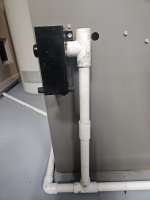
Now my main confusion. There is a black box that I show from the side, front, and back in the 2nd - fourth pics. This box is on the side and mounted *lower* in elevation than the drain in the 1st pic. It connects to a T open at the top with a pipe connecting to the same floor drain line with the PVC trap shown in the first pic. There are two hoses inside that feed into black box within the blower assembly. To the extent I can tell, they appear to go up to the level of the drain pan that the 1st pic drain with trap. There are no electrical connections to this box (not an interlock switch). There are two small lower caps on the black box on the front and back that are labeled clean out that had (clean) water in them when I removed them to check. The PVC T connects to the back side and a fitting on the front appears to be a symmetrical connection to the PVC T that is capped. The two hoses in the blower assembly have water in them.

Have any of you seen this black box or know what it is? Is this a secondary drain and vent? Or is it a primary drain and vent and the one with the PVC elbow trap is some secondary overflow (perhaps both were not working?).

Any recommendations on improving this? It is not made to come apart easy but I can cut the pipes and add some coupling unions at a few locations.

Thanks in advance for the advice. It is surprising how much condensate the AC makes on hot and humid days! So the overflow can quickly become a big problem.
 

Attachments

  • 20260703_092152.jpg
    20260703_092152.jpg
    699.8 KB · Views: 17
  • 20260703_092117.jpg
    20260703_092117.jpg
    580.3 KB · Views: 16
  • 20260703_092056.jpg
    20260703_092056.jpg
    634 KB · Views: 14
  • 20260703_092127.jpg
    20260703_092127.jpg
    608.4 KB · Views: 16
To avoid these ads, REGISTER NOW!
OP
L

lund

Well-known member
Joined
Nov 2, 2019
Messages
806
Location
Michigan
Is this unit just and air handler, or a gas furnace with a AC coil on top?

It is a gas furnace with an AC coil on top. The gas furnace is a 97% efficient model, so I think most of the water vapor condensing from the combustion goes out the large PVC pipe vent outside.

Is it possible that the 2nd drain is something linked to the gas furnace for water condensation that does not make it outside? That might also explain the lower location. I have another house I maintain with a similar high efficiency furnace and it has no auxiliary drain. But the pipe to outside on this one is pretty long (guessing 40' with elbows) and not sloped much, if any. So it might have created a need for some sort of extra drain.
 

bonneyman

Well-known member
Joined
Apr 22, 2010
Messages
8,828
Location
Desert SW
As I recall I read somewhere that a 5 ton unit can make a gallon an hour of condensate during humid times.

I'd recommend the E-Z trap set-up. Install it in place of the glued elbows. The clear U-tube lets you see if it's clogged, and they include a flexible brush to clean out that tube when needed. No disassembly necessary.

 
OP
L

lund

Well-known member
Joined
Nov 2, 2019
Messages
806
Location
Michigan
Is this it?
IMG_0073.jpeg

We don’t need AC up here, but my 95% eff shop furnace and house boiler can each make 4+ gallons/day of condensate when it’s really cold.

Yes! It looks like an exact match.

Thanks, you guys are super with the rapid and on target help.

It is also a Lennox gas furnace + AC. So I think the 2nd drain box is for the furnace. I am still puzzled why that is needed for a 97% efficient gas furnace. My guess is due to the vent pipe being so long and level that all the water may not make it out the exhaust pipe.

I should have realized it could be for that purpose! Seems less mysterious along with the height being lower now too.
 
Last edited:
OP
L

lund

Well-known member
Joined
Nov 2, 2019
Messages
806
Location
Michigan
As I recall I read somewhere that a 5 ton unit can make a gallon an hour of condensate during humid times.

I'd recommend the E-Z trap set-up. Install it in place of the glued elbows. The clear U-tube lets you see if it's clogged, and they include a flexible brush to clean out that tube when needed. No disassembly necessary.


Thanks.

That looks super and makes great sense. I think I will order one or something similar and install. I do not know if I will bother with the interlock though.
 
OP
L

lund

Well-known member
Joined
Nov 2, 2019
Messages
806
Location
Michigan
I think the black box thing is associated with the furnace condensate as its a condensing furnace.

+1 on the clear trap.

Agree. It also fits with the lower elevation and the very long vent pipe for the high efficiency furnace. So it is probably an add on needed for the install location being so far from the exterior vent.
 
To avoid these ads, REGISTER NOW!

bonneyman

Well-known member
Joined
Apr 22, 2010
Messages
8,828
Location
Desert SW
Thanks.

That looks super and makes great sense. I think I will order one or something similar and install. I do not know if I will bother with the interlock though.
Yeah, the interlock shuts off the A/C system if it senses water back up. Very important in attic or above ceiling systems - saves flooded ceilings and $$$ mold removal. But not as necessary for like garage installations.
 

firebirdparts

Well-known member
Joined
Jun 8, 2016
Messages
10,635
Location
Kingsport, TN
To your question about venting the trap, that might be needed sometimes. If the condensate drain is not sloped all the way, it could seal up an air bubble in there, but in general, there is just so little pressure required to blow the seal in both directions, it doesn't really cause a problem. I hope that makes sense. As a fundamentalist, I admit it could seal up, but they still work. The upstream side of the trap is under vacuum all the time when the a/c is running.
 

PoorUB

Well-known member
Joined
Mar 29, 2021
Messages
11,660
Location
Fargo, ND
I am still puzzled why that is needed for a 97% efficient gas furnace.
Most of the condensate in a high efficiency furnace is created in the heat exchanger and drained there, plus any furnace I have installed they want the venting to slope back to the furnace. Any condensate that gets by the drain in the furnace and heads out the venting drains back. The furnace really doesn't, and should not expel much condensate out the exhaust because an ice berg will form at the termination and possible cause problems. I have seen poorly vented furnaces with huge icebergs right below the exhaust.
 

PoorUB

Well-known member
Joined
Mar 29, 2021
Messages
11,660
Location
Fargo, ND
We don’t need AC up here, but my 95% eff shop furnace and house boiler can each make 4+ gallons/day of condensate when it’s really cold.
When I installed my own furnace I did it in January so I was in a hurry to get it running. As soon as the supply duct, gas and power was hooked up I fired it up and had it running, condensate drained into a five gallon bucket. I had to dump it twice that afternoon before I took the time to get the drain finished. I bet it would have easily produced 30 gallons of condensate a day.
 

PoorUB

Well-known member
Joined
Mar 29, 2021
Messages
11,660
Location
Fargo, ND
As I recall I read somewhere that a 5 ton unit can make a gallon an hour of condensate during humid times.
I would say that is reasonable.
I was on a construction site in it was in the 90's and very humid. We were installing the HVAC and were hooking up a 40 ton RTU We were ******* to get it running as it was miserable inside the building. As soon as we got power we fired it up. The unit had two condensate drains and we set a five gallon pail under each. It took twenty minutes to fill each pail, so close to 30 gallons and hour. As soon as we fired it up we could hear guys cheering inside!
 

bonneyman

Well-known member
Joined
Apr 22, 2010
Messages
8,828
Location
Desert SW
I almost thought about rigging up a collection system for my house unit and then using condensate to water house plants and maybe the garden. But never really got around to it.
 

larry4406

Well-known member
Joined
Jan 27, 2006
Messages
19,366
Location
Northern Virginia
As @PoorUB said, if your condensing furnace is installed properly, the flue pipes drain back towards your furnace.

So, if you remove the cover of the furnace, you will see the internal drain connections for this to the black box.

The attached picture is a Lennox Gas 90+ furnace and AC from the day job. Ignore the box (with yellow light peeking thru the ajar cover) above the A-coil drain as that is a sniffer as this is an A2L system (flammable). This is an upright "up-flow" system where the return air comes in at the bottom, then thru the heat exchanger, and continues upward thru the A-coil and then distributed to the home.

At the top (below the sniffer box), is the A-coil drain which goes into the run of a tee, a cap at the top (for maintenance cleaning), trap below, then into a branch of another tee while the upper run of the tee is vented.

You can see the gray fitting on the left side of the furnace, this is where the furnace condensate discharges are connected to the AC condensate. From there it all goes to a floor drain with an air-gap.

Our units are in the basement in a metal pan (no drain) with the float switch (red device).

This unit has 3" PVC combustion air and vent because of the distance. You may likely have 2" if your runs are shorter.
1783102356374.jpeg
 

fitter30

Well-known member
Joined
Jun 23, 2019
Messages
2,982
Location
Peace Valley,mo
Draw through coil needs a trap. Blow through doesn't. Trap offsets the suction of the blower. To shallow will never drain. To deep doesn't matter will still drain. If you want to vent the line has to be after the trap. Vent can be 3/16" - 1/4" hole on the top side of the ell(90°). The trap doesn't have to glued into the male adapter justjpush it in so ou xan take it apart. Don't hook a garden hose up to the higher fitting to flush the coil. Th e water will blow out of the condensate pan run right to the blower.
 
Last edited:
To avoid these ads, REGISTER NOW!
Top Bottom