To avoid these ads, REGISTER NOW!

Conductive epoxy

coffeebean

Active member
Joined
Jan 24, 2008
Messages
37
Location
SoCal
so i have this ultra sonic cleaner.
doesn't work right. weak wave in tank, doesn't pass the foil test at all.

manufacturer wants 900.00 for a service, wont provide schematics. cant blame them, they are in business.

service rep threw me a bone and said problem is usually the connection between tank and wires. connection is conductive epoxy.

there are a-lot of those out there. any recommendations?

thanks

dave
 
To avoid these ads, REGISTER NOW!

EOC_Jason

Well-known member
Joined
Jun 25, 2012
Messages
11,388
Location
Bentonville, AR
Last time I used some was ages ago from Radioshack (back when it stocked lots of electronics components)...

I'm sure you could find something at the big box stores or order from Amazon. Can't really say if one is better than another... Not sure how you would remove the old epoxy, I guess just scrape away. I wonder if the joints could be soldered? Why did they use epoxy?
 

gungatim

Well-known member
Joined
Jan 8, 2013
Messages
8,101
Location
west mich
seems like they would have used inductive coupling like in other powered items that are immersed in water...

subscribed as I've never heard of conductive epoxy and want to hear the fix!!
 

rlitman

Well-known member
Joined
Oct 18, 2010
Messages
24,578
Location
Long Island
seems like they would have used inductive coupling like in other powered items that are immersed in water...

The transducer in an ultrasonic is not immersed. It is glued to the underside of the tank.

One thing to keep in mind that that you want the glue line between the transducer and the tank to be as thin as possible. The metallic additives used to make epoxy conductive also thicken it, and the metallic epoxy pastes and sticks you see most would be awful in this application. You need something liquid, that can be applied in a really thin layer (with something like a credit card).
 

Davefr

Well-known member
Joined
Jan 7, 2010
Messages
11,815
Location
OR
It sounds like you need to do some more diagnosis.

It could be a bad transducer. They're an electro/mechanical device with a finite lifetime. Test them for punch thru. There should be no continuity on an ohmeter.

After that I'd focus on the power transistors driving the transducers. It's a highly tuned circuit and if any component(s) drifts they could go into an overcurrent situation and short out. (this includes running the tank dry).

I don't believe it's all that common for transducers or their connections to come loose but that would be easy to check.
 

6PTsocket

Well-known member
Joined
Mar 12, 2014
Messages
4,593
where electrical conductivity comes into this. You have an ultrasonic transducer that presumably has electrical connections (pigtails, soldered or some type of connector) and the transducer is bonded to the outside of the tank. Are you saying that there is only one lead to the transducer and the return is through thr transducer case and the tank? Possible but sounds rather improbable. If the transducer has two leads you only need a solid bond to the tank. If it is ridgid I would not think film thikness is super critical. I would try JB Weld. There are conductive epoxies. If electrical conduction is truly through through the transducer shell, check with an ohmmeter to see what you get. I don't know how conductive the epoxy actually is. If the transducer is low current it might not have to be that good. This all assumes there is only one wire to the transducer.

Sent from my SM-G900V using Tapatalk
 

6PTsocket

Well-known member
Joined
Mar 12, 2014
Messages
4,593
There is one article with illustrations where the author traced the problem to a bad transducer connection. The thing is vibrating and I could see a connection fatiguing. As another pointed out these are tuned resonant circuits. Is there a part number on the transducer? I have no idea how generic or interchangable they are.

Sent from my SM-G900V using Tapatalk
 
To avoid these ads, REGISTER NOW!

Davefr

Well-known member
Joined
Jan 7, 2010
Messages
11,815
Location
OR
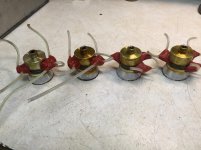
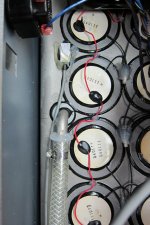
Why don't you post some images. These are the two most common transducer and connection styles:
 

Attachments

  • CP Series Transducers (1).jpg
    CP Series Transducers (1).jpg
    139.2 KB · Views: 31
  • ultrasonicmisc 004.jpg
    ultrasonicmisc 004.jpg
    146.6 KB · Views: 31

sprchrgd1

Well-known member
Joined
Oct 5, 2013
Messages
140
Location
St. Charles, MO
Not if this would work for you or not but I use this all the time for broken defrosters.
7dd6862a518a8a1e7feaa840dbeb75fc.jpg


Sent from my SM-G928T using Tapatalk
 

6PTsocket

Well-known member
Joined
Mar 12, 2014
Messages
4,593
Not if this would work for you or not but I use this all the time for broken defrosters.
7dd6862a518a8a1e7feaa840dbeb75fc.jpg


Sent from my SM-G928T using Tapatalk
I've used that to repair stripes. It is conductive paint, not cement. I don't think it was made to hold anything.

Sent from my SM-G900V using Tapatalk
 

6PTsocket

Well-known member
Joined
Mar 12, 2014
Messages
4,593
After all the published pictures it is clear that the transducers are 2 wire. Unless it is for static there is no logical reason to have electrical conduction between the transducer and the tank. From looking at the transducers on ebay it apoears that they are 28 khz or 40 khz and some are rated to handle more power than others . Further, they are selling transducers with control electronics for way under a 100 bucks. The ones I saw were 220 AC but ther might be 120 V version or just use a little step up transformer. One way or another, new transducer or the whole deal, it does not pay to go crazy trying to make the curcuit work. Just replace the guts.

Sent from my SM-G900V using Tapatalk
 

6PTsocket

Well-known member
Joined
Mar 12, 2014
Messages
4,593
McMaster-Carr sells a variety of conductive epoxies:

https://www.mcmaster.com/#conductive-epoxies/=1664vh8
And why does the transducer need to be electrically conductive to the tank? No transducer uses the tank as part of the circuit. You need a good ridgid mechanical bond to transmit the
vibratiins.Finding a product is not worth much if it does not fix the problem.

Sent from my SM-G900V using Tapatalk
 

6PTsocket

Well-known member
Joined
Mar 12, 2014
Messages
4,593
so i have this ultra sonic cleaner.
doesn't work right. weak wave in tank, doesn't pass the foil test at all.

manufacturer wants 900.00 for a service, wont provide schematics. cant blame them, they are in business.

service rep threw me a bone and said problem is usually the connection between tank and wires. connection is conductive epoxy.

there are a-lot of those out there. any recommendations?

thanks

dave
You have all these people looking for electrically conductive cement. How did you arrive at the conclusion that the transducer needs this. Transducers as other posts show,have two leads and do not use a connection to the tank as part of the circuit. You need a solidly bonded transducer to transmit vibration. You need a transducer that has sound electrical connections. You need a transducer that works. Unless you have a poor mechanical bond and the conductive cement fixes it, regardless of it's conductivity, you will not fix it.

Sent from my SM-G900V using Tapatalk
 
To avoid these ads, REGISTER NOW!
Top Bottom