To avoid these ads, REGISTER NOW!

Confused about 6x6's

Geobound

Well-known member
Joined
Aug 14, 2016
Messages
95
Location
Ontario
I wouldn't mind some opinions as the building centre people have me confused.

I am building a 14x20 shed and was going to level the ground down, put in about 4" of coarse gravel, lay about five 4x4's down, and build my floor up from there.

The building centre told me to save my money and just use two 6x6's set a foot in on either side of the 20' run, and then build my floor up using 2x10's (PT of course).

Then they said something about setting my joists at 11" on centre?

I hate having to ask, but what the heck are they talking about?

First of all would two 6x6's be enough to carry the load of the shed without having a bouncy floor?

Ya I know that 2x10's will take most of that out, but are they right?

If somebody could give me a good description that would be awesome, a sketch would be better, but I realize that takes up your time.

Thanks for whatever info you can offer.
 
To avoid these ads, REGISTER NOW!

DougWil

Well-known member
Joined
Dec 29, 2015
Messages
545
Location
NW Montana
The two 6x6s are the equalivent of a footing and fully bear on the gravel, they aren't going to be bouncy.
The 2x10 joists span over the 6x6s, 14ft -(two times *1ft overhang)- 2 times 6 inches = 11ft CLEAR SPAN. Not 11 inches.

2x10s at 24 inches on center would be fine with that span, unless you plan on really loading that shed up.
 

James-W

Well-known member
Joined
Feb 3, 2013
Messages
12,432
Location
Southeastern Wisconsin
I agree, but what is he planning on putting in the shed? If he plans on putting an awful lot of weight in the shed, then maybe go with 12 inches on center for the 2X10's, otherwise 24 inches on center is fine.
 
OP
G

Geobound

Well-known member
Joined
Aug 14, 2016
Messages
95
Location
Ontario
Okay I think I understand what you are saying.

In fact the way it was explained to me didn't make sense, but I drew this out earlier and thought that's what they meant.

The blue represents the 6x6's and the red represents the 2x10's (16" oc is what I had in mind).

I think you have pretty well confirmed it.

As for what's going in the shed.......

I am having a 6 x 14 section blocked off with a roll up door on either end, and that will be for my sled to pull in and out of.

The rest of the shed will be for ATV in the winter, lawn tractor in the winter, tires and other bits and bobs.

No cars or super heavy equipment really.

Thanks again gents, I appreciate your help.
 

Attachments

  • My floor plan.jpg
    My floor plan.jpg
    99.6 KB · Views: 147

jbwilkins

Well-known member
Joined
Mar 16, 2016
Messages
310
Location
Nashville Tn
One thing to think about....6x6 with 2x10 puts your finished floor ~16" above grade....4x4's and a 2x8 makes your finished floor ~12"......You could do the same with 2x6 you'd just need to break the span up.....

Personally I'd run the numbers on what the lumber will cost.....In my part of the country the 4x4 with 2x6 or 2x8 will be cheaper than 6x6 with 2x10's....Plus a whole lot easier to get into....
 

mmb617

Well-known member
Joined
Dec 5, 2010
Messages
4,424
Location
PA
One thing to think about....6x6 with 2x10 puts your finished floor ~16" above grade....4x4's and a 2x8 makes your finished floor ~12"......You could do the same with 2x6 you'd just need to break the span up.....

Personally I'd run the numbers on what the lumber will cost.....In my part of the country the 4x4 with 2x6 or 2x8 will be cheaper than 6x6 with 2x10's....Plus a whole lot easier to get into....

I'm in complete agreement with this.

For heavens sake, do a slab with a thickened edge, so you don't have to make ramps to get things in and out.

Probably cheaper too.

Bill

Concrete is always better for a shed floor IMO, but in some places that makes it a permanent structure which may have property tax implications. And again IMO concrete is generally more expensive and for me harder to diy.
 

Doug B

Well-known member
Joined
Dec 24, 2008
Messages
1,236
Location
Schroon Lake, NY
One thing to think about....6x6 with 2x10 puts your finished floor ~16" above grade....4x4's and a 2x8 makes your finished floor ~12"......You could do the same with 2x6 you'd just need to break the span up.....

Personally I'd run the numbers on what the lumber will cost.....In my part of the country the 4x4 with 2x6 or 2x8 will be cheaper than 6x6 with 2x10's....Plus a whole lot easier to get into....

^^^ This.
If I were building this shed, I would run 3 rows of 4x4,outer ones set in one foot and one down the center, 2x6's @ 16" o.c. and 3/4" t& g plywood.
 

jives

Well-known member
Joined
Jan 4, 2013
Messages
2,805
Location
Central NY
The 6 x 6s should be cut at an angle at the tips to act like a sled if pulled along the ground. That is the benefit of putting the shed on skids rather than having concrete.
 

gregtwojeeps

Well-known member
Joined
Jul 30, 2013
Messages
5,096
Location
Ky
Just curious. For the folks laying their shed wood runners right on the ground... do you have concerns about termites destroying the runners over the years ? (if in termite locations)
 

rlitman

Well-known member
Joined
Oct 18, 2010
Messages
24,596
Location
Long Island
Just curious. For the folks laying their shed wood runners right on the ground... do you have concerns about termites destroying the runners over the years ? (if in termite locations)


Ground contact rated pressure treated lumber should be fine.
 

James-W

Well-known member
Joined
Feb 3, 2013
Messages
12,432
Location
Southeastern Wisconsin
I do think putting the shed on concrete would be the ideal solution. I realize that having a concrete floor causes some municipalities to consider the shed as a permanent structure and there will be an added property tax charge for the shed. But how much could the additional charge be for a small shed? It can't possibly be very much and in my opinion the benefits of having a concrete floor would far outweigh the few dollars in additional tax cost. Plus, you wouldn't have to buy the 6X6's or the 2X10's so that would most likely more than pay for the concrete if you were to do it yourself.
 
OP
G

Geobound

Well-known member
Joined
Aug 14, 2016
Messages
95
Location
Ontario
Awesome information folks, thanks very much.

I hadn't considered the height difference between the 6x6's and 2x10's in relationship to the height of the ramp......good call!

I was sold on the idea of it being quicker and easier to level two 6x6's, than it was 4x4's, but in reality it's only one more piece to deal with.

As to the concrete floor, somewhere once before I had mentioned that concrete flooring is a problem for me, just due to the fact that I can't get a truck back there.

My property has a huge pond on one side that blocks the path to the back where the shed would go, and the other side is flanked with septic beds and weeping tiles, not to mention the fact that I have a steep forested hill that runs the length of the property as well.

To get from my house to the back where the shed is going would be about 250' - 300', and I don't feel like making hundreds of trips with wheelbarrows. LOL.....

Also, why do some people build their sheds with double ledger boards and rim joists, and others with singles?

On a house it makes sense, or a carpark or garage, but a shed?
 

bczygan

Well-known member
Joined
Nov 4, 2009
Messages
22,002
Location
DETROIT! Arsenal of Scrappers
The OP wants a 14x20 shed. That's more like a 1 1/2 car garage. I would make it a permanent structure and use buggies to get the concrete back there.

But if wood is to be used, then a balance needs to be attempted.

A shed this size is really not a temporary structure, and if you put it on skids, they will eventually need replacing, so consider that. And skids add height to a structure.

I would use an alternate method that will keep the height of the floor framing to a minimum, while avoiding ground contact.

Using precast concrete pier blocks, run beams the long direction of the shed, 3 rows. Bury these pier blocks so they just extend above ground enough to keep the beams and joists off the ground. Dig down enough to remove all organic material (Topsoil) and place a layer of compacted limestone with fines for the pier block to set on. Level all these blocks to each other.

Then hang joists on joist hangers, two rows of them, between these three beams.

The advantage of this method is that you have only a couple of inches or so between the ground and your floor joists, and if you size the joists properly, just their depth plus 3/4" floor sheathing to the top of your floor. Much better than the 6x6 skids plus 2x10's plus...

Now, the way to design a floor or a deck system is to first determine the loading. Standard loading for a residence is 40 pounds per square foot of live load, which is the contents, including people, plus 10 pounds per square foot for the weight of the floor structure.

Start from the top down. Use 3/4" T&G plywood )(NOT OSB!). A good joist spacing for this is 16". It will give a very solid floor for your uses.

If you have 3 rows of beams, then your 2 rows of joists will each span about 7'.
Using a calculator, 2x6 hem-fir, #2 and better with an L/240, will support that load and span 9'10". So those are your joists. Depth is nice and minimal, to keep the ramp to 9 or 10".

Next is to size the 3 beams. Since the joists are hung off the side of these with joist hangers, they end up being in the same plane as the joists, avoiding extra height. Because of that we want to keep them as close in depth to the joists, as possible.

The contributing area for the center beam is 7 square feet, times 50 pounds per square foot = 350 pounds per lineal foot, that it must be capable of supporting. The two outside beams have half this contributing area and load, but they also have walls and roof structure to support, so let's assume the same loads for them. So let's choose a wood beam and span for it, that will support this with minimal height.

Hem-fir 2x6's, like you get at the big box stores will span 4' and support 347 pounds per lineal foot. So apace your piers to accomplish this, including under the end walls. 22 piers will be required.

If you want bigger spacing, doubled beams or deeper ones will be required.

All this material floor framing material should still be treated.

Understand?

Bill
 
Last edited:

bczygan

Well-known member
Joined
Nov 4, 2009
Messages
22,002
Location
DETROIT! Arsenal of Scrappers
Awesome information folks, thanks very much.

I hadn't considered the height difference between the 6x6's and 2x10's in relationship to the height of the ramp......good call!

I was sold on the idea of it being quicker and easier to level two 6x6's, than it was 4x4's, but in reality it's only one more piece to deal with.

As to the concrete floor, somewhere once before I had mentioned that concrete flooring is a problem for me, just due to the fact that I can't get a truck back there.

My property has a huge pond on one side that blocks the path to the back where the shed would go, and the other side is flanked with septic beds and weeping tiles, not to mention the fact that I have a steep forested hill that runs the length of the property as well.

To get from my house to the back where the shed is going would be about 250' - 300', and I don't feel like making hundreds of trips with wheelbarrows. LOL.....

Also, why do some people build their sheds with double ledger boards and rim joists, and others with singles?

On a house it makes sense, or a carpark or garage, but a shed?

The walls and roof are supported at the edge of the structure where the rim joists are!

Bill
 

jbwilkins

Well-known member
Joined
Mar 16, 2016
Messages
310
Location
Nashville Tn
Just curious. For the folks laying their shed wood runners right on the ground... do you have concerns about termites destroying the runners over the years ? (if in termite locations)


When they used to be treated with CCA 4x4 and 6x6 were typically treated to .4 which is rated for ground contact. All other products were not rated for ground contact (I think they were treated to .17, or something like that). Since they've transitioned to borates, I'm not sure anymore.
 

Orionrising

Well-known member
Joined
Nov 16, 2012
Messages
960
Location
Western Maine
Typical 4x4 and 6x6 are still treated for ground contact as they are mostly used as posts but you should always check the tag

Sent from my Moto G (4) using Tapatalk
 
To avoid these ads, REGISTER NOW!

tcianci

Well-known member
Joined
Feb 7, 2009
Messages
4,242
Location
Walpole, Ma
Outside of suggesting the three 4x4's most of the suggestions on this project are way overkill. Ground contact rated PT on a bed of crushed stone will last longer than a few of us put together.
As far a joist spacing, 12" centers are just crazy, when you're not sure of what to do, think of equivalents you see from day to day. Ever seen a king or queen sized water bed go through a floor built on 16" centers, not likely.

The man is building a shed for cryin' out loud not a bomb shelter. Too often around here the go to answer for most people is to over build the living **** out of everything. Which usually translates to: "I don't have a freakin' clue as to what's really needed for this structure so I'm going for broke."

I have been in the construction/remodeling business for over 40 years. Seldom if ever do we ever see a building problem related to insufficient structural framing. These over built monuments to a lack of critical thinking eventually succumb to the same issues that plague a cheapie shed from the Depot: Poor maintenance, sticking stuff right on the ground, confusing caulking with flashing and forgetting that water runs downhill.
 

bczygan

Well-known member
Joined
Nov 4, 2009
Messages
22,002
Location
DETROIT! Arsenal of Scrappers
The joist carry the load so a double rim really doesn't do much, except give you more to nail the bottom plate to....

That is true in a building with a foundation where you have continuous support, but here where the perimeter foundation is a series of piers, this rim joist acts as a beam, supporting the joists, outside wall and roof.

Bill
 

D45

Well-known member
Joined
Mar 21, 2014
Messages
4,834
Location
NW INDIANA
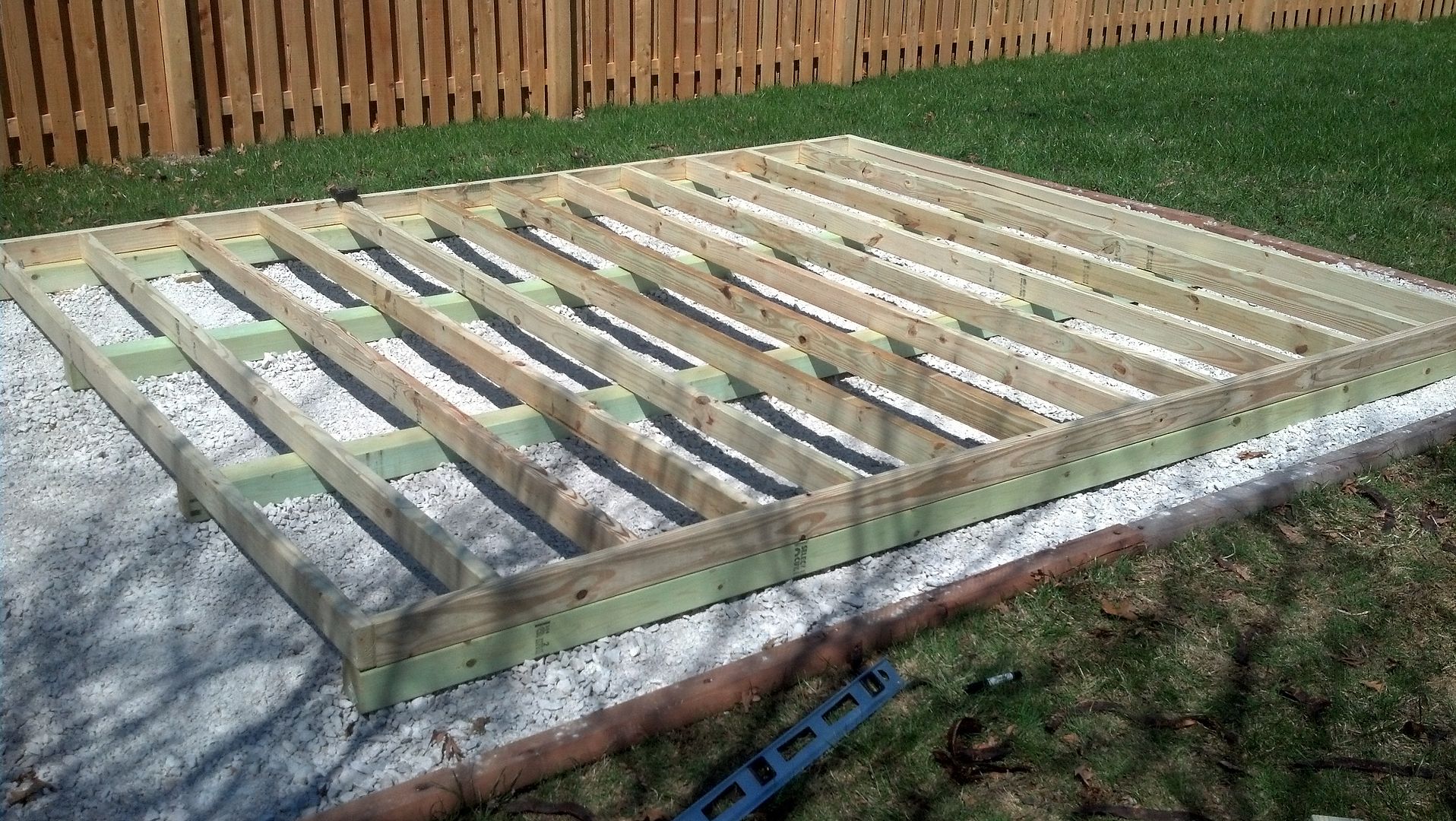
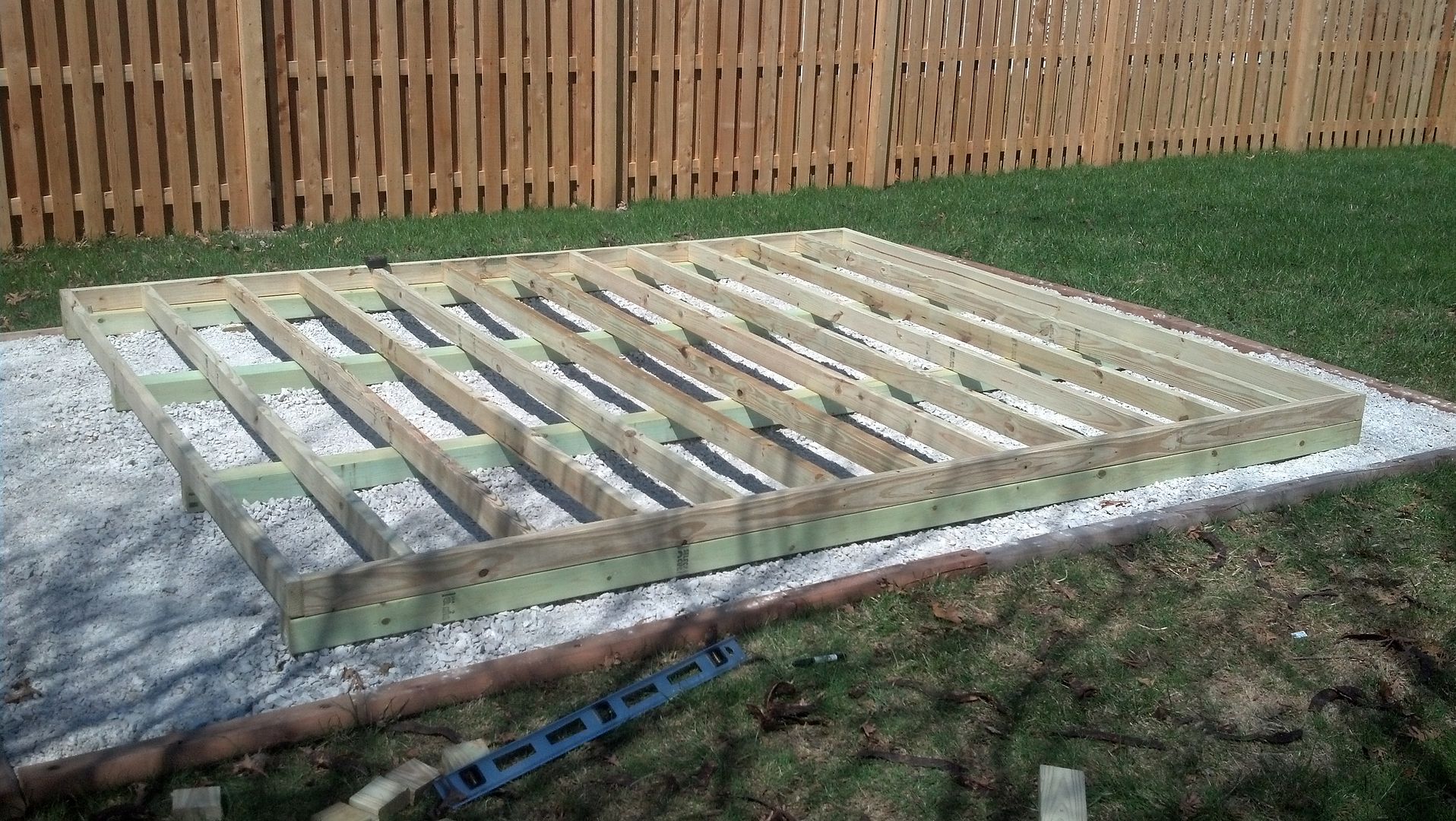
I used crushed limestone, PT 4x4s, and PT 2x4s (12" OC)


IMG_20140426_143201_947_zpsmxj9lreq.jpg


IMG_20140426_143207_556_zpsmv1gnlot.jpg
 
OP
G

Geobound

Well-known member
Joined
Aug 14, 2016
Messages
95
Location
Ontario
The OP wants a 14x20 shed. That's more like a 1 1/2 car garage. I would make it a permanent structure and use buggies to get the concrete back there.

But if wood is to be used, then a balance needs to be attempted.

A shed this size is really not a temporary structure, and if you put it on skids, they will eventually need replacing, so consider that. And skids add height to a structure.

I would use an alternate method that will keep the height of the floor framing to a minimum, while avoiding ground contact.

Using precast concrete pier blocks, run beams the long direction of the shed, 3 rows. Bury these pier blocks so they just extend above ground enough to keep the beams and joists off the ground. Dig down enough to remove all organic material (Topsoil) and place a layer of compacted limestone with fines for the pier block to set on. Level all these blocks to each other.

Then hang joists on joist hangers, two rows of them, between these three beams.

The advantage of this method is that you have only a couple of inches or so between the ground and your floor joists, and if you size the joists properly, just their depth plus 3/4" floor sheathing to the top of your floor. Much better than the 6x6 skids plus 2x10's plus...

Now, the way to design a floor or a deck system is to first determine the loading. Standard loading for a residence is 40 pounds per square foot of live load, which is the contents, including people, plus 10 pounds per square foot for the weight of the floor structure.

Start from the top down. Use 3/4" T&G plywood )(NOT OSB!). A good joist spacing for this is 16". It will give a very solid floor for your uses.

If you have 3 rows of beams, then your 2 rows of joists will each span about 7'.
Using a calculator, 2x6 hem-fir, #2 and better with an L/240, will support that load and span 9'10". So those are your joists. Depth is nice and minimal, to keep the ramp to 9 or 10".

Next is to size the 3 beams. Since the joists are hung off the side of these with joist hangers, they end up being in the same plane as the joists, avoiding extra height. Because of that we want to keep them as close in depth to the joists, as possible.

The contributing area for the center beam is 7 square feet, times 50 pounds per square foot = 350 pounds per lineal foot, that it must be capable of supporting. The two outside beams have half this contributing area and load, but they also have walls and roof structure to support, so let's assume the same loads for them. So let's choose a wood beam and span for it, that will support this with minimal height.

Hem-fir 2x6's, like you get at the big box stores will span 4' and support 347 pounds per lineal foot. So apace your piers to accomplish this, including under the end walls. 22 piers will be required.

If you want bigger spacing, doubled beams or deeper ones will be required.

All this material floor framing material should still be treated.

Understand?

Bill

That's awesome Bill, thanks for the detailed reply.

Yes I think it all makes sense, and I will have to look into that a bit more.


Outside of suggesting the three 4x4's most of the suggestions on this project are way overkill. Ground contact rated PT on a bed of crushed stone will last longer than a few of us put together.
As far a joist spacing, 12" centers are just crazy, when you're not sure of what to do, think of equivalents you see from day to day. Ever seen a king or queen sized water bed go through a floor built on 16" centers, not likely.

The man is building a shed for cryin' out loud not a bomb shelter. Too often around here the go to answer for most people is to over build the living **** out of everything. Which usually translates to: "I don't have a freakin' clue as to what's really needed for this structure so I'm going for broke."

I have been in the construction/remodeling business for over 40 years. Seldom if ever do we ever see a building problem related to insufficient structural framing. These over built monuments to a lack of critical thinking eventually succumb to the same issues that plague a cheapie shed from the Depot: Poor maintenance, sticking stuff right on the ground, confusing caulking with flashing and forgetting that water runs downhill.


That just made me laugh out loud. Great reply!

I used crushed limestone, PT 4x4s, and PT 2x4s (12" OC)


IMG_20140426_143201_947_zpsmxj9lreq.jpg


IMG_20140426_143207_556_zpsmv1gnlot.jpg

^^^ That's exactly what I had in mind.........that is until I got confused. LOL.....

The 6x6's and 2x10's make the shed sit way too high, and don't want to have a 40' ramp to get into it. LOL.....

I will likely use coarse gravel, as I find that the limestone screenings tend to hold the water around here a bit longer.

Just like ice cream, there are too many choices for this type of thing.

I have a week to sort it out, as that's when I plan to start the build.

Thanks again everybody.
 

LS6 Tommy

Well-known member
Joined
Dec 27, 2013
Messages
26,162
Location
Northern NJ
For heavens sake, do a slab with a thickened edge, so you don't have to make ramps to get things in and out.

Probably cheaper too.

Bill

IDK about where the OP lives, but around here a slab makes it "living space" and increases your taxes... I used a 2 x 8 pick up truck ramp kit. The two ramps stay in the shed except when the heavier equipment comes out. Makes mowing a lot easier. It cost me maybe $25.00. I can't build a slab (or even a concrete ramp) for that.

Tommy
 

mmb617

Well-known member
Joined
Dec 5, 2010
Messages
4,424
Location
PA
Too often around here the go to answer for most people is to over build the living **** out of everything. Which usually translates to: "I don't have a freakin' clue as to what's really needed for this structure so I'm going for broke."

I thought the go to answer around here was three fold. 1) hire professionals for just about everything. 2) permits, permits, permits. 3) code, code, code. If you were building an outhouse you would be told you need an engineering study, 16 different permits and what you want to do isn't up to the almighty code. :willy_nil :lol:
 

bczygan

Well-known member
Joined
Nov 4, 2009
Messages
22,002
Location
DETROIT! Arsenal of Scrappers
Everything depends on the intended use.

If it was a small temporary shed and I wanted to take it with me later, then skids would be great. And a wood ramp would do great.

For a real temporary floor solution you could even just excavate and level and tamp the soil and lay down some treated 3/4" T&G plywood right on the ground. I actually have a temporary shed with a floor made up of 2 layers of reclaimed treated deck boards laid at 90 degrees, right on the soil. And there are many storage buildings out there with dirt floors. Just depends on the usage.

For the OP's uses, if everything is just garden equipment storage and bulk overflow from the house, why not do a small pole barn type building with either no floor, or a floor in just a portion of the building. Then he can just drive things right in.

Many ways to skin a cat.

Bill
 
OP
G

Geobound

Well-known member
Joined
Aug 14, 2016
Messages
95
Location
Ontario
I'm in the snowbelt region of Ontario, and the shed is to be used to house my snowmobile all year long (double roll up doors though so I can drive right in and out), and the other 2/3rds will be to store one of the ATV's for the winter.

It will also hold the lawn tractor and other bits and bobs that clutter up the other 12 x 20 shed beside the garage.

My wife isn't too happy that I am ripping out her vegetable garden to put this back there, so there is the slightest of chances that the shed could be moving further back into the forest if she can't find a good spot for veggies next year.

Knowing the way our codes work around here, I wouldn't be allowed to put two garbage bins together without having to pay extra taxes, so for sure a slab floor would be the case.

In fact I'm pretty sure that just the size of mine alone is cause for permits and tax increases, but since it is at the back of the property where nobody will really see me build it, so I'm not going to worry about permits.
 

like2wheel

Well-known member
Joined
Oct 29, 2014
Messages
1,693
Location
On an as needed basis
Why does everyone stress about ramps to get up on shed floors?
I built a 12 x 16 using similar construction back in 1999, & just graded some crusher gravel up at the door & called it good.

Just moved it last year to make room for a pole barn & everything there was fine...
 

theoldwizard1

Well-known member
Joined
Feb 22, 2011
Messages
43,138
Location
SE MI
I am building a 14x20 shed and was going to level the ground down, put in about 4" of coarse gravel,

When you say "level the ground" I assume you mean remove any sod/vegetation correct ? Good, but I would go about 6" down. Also make that gravel base at least 16x22. That is over 6 yds of gravel. Rent a compactor. Do not use "river rick"/pea gravel as round edges don't lock together well.

"Crusher run", sometimes "3/4 down" is a mixture of what comes out of a stones crusher that is 3/4" or less. It compacts very well, almost as hard as concrete.
 
OP
G

Geobound

Well-known member
Joined
Aug 14, 2016
Messages
95
Location
Ontario
When you say "level the ground" I assume you mean remove any sod/vegetation correct ? Good, but I would go about 6" down. Also make that gravel base at least 16x22. That is over 6 yds of gravel. Rent a compactor. Do not use "river rick"/pea gravel as round edges don't lock together well.

"Crusher run", sometimes "3/4 down" is a mixture of what comes out of a stones crusher that is 3/4" or less. It compacts very well, almost as hard as concrete.

Yes I did mean dig it down to the 4" mark and then add in the coarse gravel.

I could just as easily go 6" as go 4", it only means a few extra bucks really.

Thanks for the reminder on going a but wider than the shed, I was going to do 1' but 2' is just as easy.

I will have to box it in though, as the ground slopes away and the gravel would just slip away over time.

My neighbour came by today and suggested that all I had to do was put the gravel under the ties (be it 6x6's or 4x4's), and then leave a 4" hole underneath the rest of the shed.

His comments were that it would give you proper airflow, and keep any moisture away from the shed floor.

All I could think about was where I could put a diving board for the pool that I just created, for the animals that would swim under there. LOL.....

I like my neighbour, but it's clear that he knows even less than I do about building sheds. :lol:

If I'm honest with myself, the only thing that keeps up at night is the spacing of the 6x6's or 4x4's.

I've gone back and forth so many times now on how to do it, and what everybody says is the "best way", it's just killing me. LOL......

I have a whole note pad dedicated to sketches of the base only.......okay slight exaggeration, but I'm sure you get the point.
 

bczygan

Well-known member
Joined
Nov 4, 2009
Messages
22,002
Location
DETROIT! Arsenal of Scrappers
The more I think about it, the more a pole barn construction with no floor except where absolutely necessary, seems to be the most appropriate solution.

Why do snowmobiles or 4 wheelers need to be up on a wood floor?

I can see a general work area might could use a floor, maybe even a storage area, although things stored on shelving don't need a floor under them.

I would build it as a pole barn without a finished floor, just dirt.

Then in one area throw down a bunch of treated 4x4's, 16" on center and nail some 3/4" plywood to them for a floor deck. 4 1/4" step up onto the floor. No excavation needed except stripping off the grass and leveling the dirt.

Pole barn posts 4' on center. Clad with metal or T1-11 or whatever.

Roll roofing for the roof.

You're not heating or insulating this are you?

Just shelter from wind, rain and storm.

Bill
 
Last edited:

jives

Well-known member
Joined
Jan 4, 2013
Messages
2,805
Location
Central NY
Here is my 22 x 22 small pole barn. The main part is 22 x 14, with the lean-to at 22 x 8. The floor is dirt/gravel. Gets pretty damp in there because I never really finished the floor. If you go the pole barn route without a 'real' floor, do yourself a favor and get plenty of good gravel and compact it well. The loose gravel will tend to freeze to your sled and snow blower in the winter.

The splash boards don't really allow drive-in access unless a ramp is built. The lean-to side was left open without a splash board to drive in my garden tractors.


CTyankee

Well-known member
Joined
Jan 13, 2013
Messages
3,792
Location
CT
IMO unless money is a huge factor, it would be crazy to build a shed that will be holding power equipment/toys without a floor.
 
OP
G

Geobound

Well-known member
Joined
Aug 14, 2016
Messages
95
Location
Ontario
The pole barn was something that I was thinking of, but in the end decided to go with more of a "garage" style......although Jives looks good. LOL....

I will definitely have a floor in there, as I don't want the skies of my sled to stick to the ground.

I'm pretty sure I have it nailed down to what I'm doing, now I just waiting on a quote for the material.

I'm hoping that they will give me some sort of diagram showing what they have allowed for, but if not then I'm sure I can work my way through it.

Thanks all for the ideas and suggestions.
 
To avoid these ads, REGISTER NOW!
Top Bottom