To avoid these ads, REGISTER NOW!

Considering 3 Phase...

tavernaut

Active member
Joined
Jun 27, 2014
Messages
34
I have an old 7,000sf industrial building that's getting re-wired and re-plumbed and so forth. The building was badly flooded in an accident, so everything below six feet is 'mandatory replace'. This includes the outside disconnect and meter pan, and 2 of the 3 inside subpanels.

The previous service was 600amp 3 phase- this is going to be my personal playground and I don't envision ever needing that much power. But I keep wondering if I should re-establish the 3 phase or just save a few bucks and bring in 120/240.

I don't have any 3 phase equipment but it's always around at the right price so it might be worth the initial expense, just to be prepared. I'd hate to be kicking myself 10 years down the road, for only having single phase because I wanted to save $2,000 back in 2014. I'm even willing to admit that part of the appeal is that 3 phase is 'big boy' electricity, like 'real' shops use.

Probably lots of you guys have thought about bringing 3 phase service into your garage, if it's available in the area. How many actually did it? Was it worth it? I'd really like to hear some personal experiences along the single-phase/3-phase divide.
 
To avoid these ads, REGISTER NOW!

ddawg16

Well-known member
Joined
Jul 11, 2008
Messages
21,005
Location
S. California
600 V? You're in Canada?

If you don't need 3-ph....it's easy to use single phase...

But if you ever need 3 ph and it's not there? Not so easy.

So, yea....put it in.
 

Norcal

Well-known member
Joined
Mar 16, 2008
Messages
13,752
600 V? You're in Canada?

If you don't need 3-ph....it's easy to use single phase...

But if you ever need 3 ph and it's not there? Not so easy.

So, yea....put it in.


He said 600A not 600V.:)
 

wyliesdiesels

Well-known member
Joined
Aug 14, 2012
Messages
19,994
Location
Modesto, CA
I have an old 7,000sf industrial building that's getting re-wired and re-plumbed and so forth. The building was badly flooded in an accident, so everything below six feet is 'mandatory replace'. This includes the outside disconnect and meter pan, and 2 of the 3 inside subpanels.

The previous service was 600amp 3 phase- this is going to be my personal playground and I don't envision ever needing that much power. But I keep wondering if I should re-establish the 3 phase or just save a few bucks and bring in 120/240.

I don't have any 3 phase equipment but it's always around at the right price so it might be worth the initial expense, just to be prepared. I'd hate to be kicking myself 10 years down the road, for only having single phase because I wanted to save $2,000 back in 2014. I'm even willing to admit that part of the appeal is that 3 phase is 'big boy' electricity, like 'real' shops use.

Probably lots of you guys have thought about bringing 3 phase service into your garage, if it's available in the area. How many actually did it? Was it worth it? I'd really like to hear some personal experiences along the single-phase/3-phase divide.

What kind of 3-phase?? Theres many flavors....3-wire, 4-wire, delta, wye, etc. i wont go into different voltages without knowing your location... And where are u located?

If its an older service and one that the PoCo doesnt give for new services anymore, they may switch it out since u have to do a new service panel....utilities love to get rid of the oldsystems that they no longer give for new services.....Be careful with 3-phase....if u dont know all the aspects of the particular system(such as the stinger leg on a 4-wire delta), u can mess things up real fast...I would keep it 3-phase though- increases the resale value...

600 V? You're in Canada?

If you don't need 3-ph....it's easy to use single phase...

But if you ever need 3 ph and it's not there? Not so easy.

So, yea....put it in.

600v? He didnt say that he said 600a....
 
Last edited:

volleyball

Well-known member
Joined
Aug 29, 2011
Messages
4,127
Location
NY, not NYC
I'd find a power co. employee who can give you the facts. What is going to be your monthly costs? Why pay now for a future? big boy toy if its not in the plans.
You can always convert to 3 phase when the time comes you have enough stuff.
Now if you were planning on or had industrial 3 phase stuff, you wouldn't be asking the question.
 

Mustang51js

Well-known member
Joined
Jan 24, 2014
Messages
1,734
Location
Haskell nj
I can at least say it will cost more than 2k to replace that stuff. One thing to consider is if you ever get rid of the building it may be easier if 3 phase is in there for the next buyer.
 

Stuff

Well-known member
Joined
Aug 31, 2013
Messages
572
One drawback is that it is 208 volts phase-to-phase so residential appliances like clothes dryers don't heat as well.
 

sberry

Banned
Joined
Jun 18, 2005
Messages
35,747
Location
Brethren, Michigan
It has been a limiting factor for me as I am rural but,,,,,,,,,,,,,,, I would have to take a good look at what I wanted to do. Business is a different matter, personally wouldn't get it unless I had to and all the stuff you collect that is single is very fluid if that matters. If the plan was to head out and stuff the place full of old machine tools then it makes sense, other wise its money parked at idle waiting for 10 years to come or some potential sale that may or may not happen?
We got some old buildings here, hasn't help sell one of them.

My neighbor who is a master came down the the day with a 3 ph service panel and gave it to me. I got no use for it.
 
Last edited:

Norcal

Well-known member
Joined
Mar 16, 2008
Messages
13,752
One drawback is that it is 208 volts phase-to-phase so residential appliances like clothes dryers don't heat as well.

The OP has not stated but could be either 208Y/120V or 120/240V, 480Y/277V will get real expensive quickly.
 

theoldwizard1

Well-known member
Joined
Feb 22, 2011
Messages
43,106
Location
SE MI
What kind of 3-phase?? Theres many flavors....3-wire, 4-wire, delta, wye, etc. ...

I would keep it 3-phase though- increases the resale value...

I agree 100% !

I don't know which is more common, delta or wye, but I have found dealing with wye to be simple for a non-professional. Each phase is 120v, phase to phase is 208v. Panel boards are designed so that plugging your breakers in a row (somewhat) balances the load.
 

nehog

Well-known member
Joined
Jan 2, 2010
Messages
7,935
Location
Jaffrey, NH
As a few others say: check the costs. Around here 3-phase can be more expensive than single phase. (significantly more expensive, if you don't need it on a constant basis.)
 
OP
T

tavernaut

Active member
Joined
Jun 27, 2014
Messages
34
It's 240 Delta service in the area. I've asked the utility company a dozen different ways and at my level of use, it doesn't seem like 3 phase electricity costs any more than 120/240. I keep trying to find the 'catch' but there doesn't seem to be one.

The $2k figure is roughly the difference between 3 phase and 120-240 re-wiring.
 

Rookie2

Well-known member
Joined
Feb 27, 2013
Messages
1,925
Location
Western Pa.
There is always a catch ! No power company is going to hang three power transformers on a pole or a huge pad mount transformer for the cost of single phase electricity ! plus there is a 'Demand' meter involved. also if you add any transformers inside the building ,they are 'consumers' of power 24/7 as long as they are powered up.
 

Gizmosity

Well-known member
Joined
Jun 17, 2014
Messages
376
Location
SW Wisconsin
I immediately looked at 3phase availability when I bought my place. It's "cost prohibitive" as it's about a mile away.

With the low cost of VFD's to run 3 phase equipment on single phase power AND the complete control of RPM through them, the odd 3phase piece of equipment I may find can be hooked up and used.

But for $2k? No question I'd have it available. To put it in perspective, I have a treadmill and a kayak that cost more than that.....I don't use either if them.
 

big.jim

Well-known member
Joined
May 11, 2011
Messages
1,011
Location
derbyshire uk
go for it in the uk we run 240/415, three phase equipment is cheaper and more readily available second hand and is also more reliable because of not needing capacitors etc for starting
 

KenC

Well-known member
Joined
Dec 20, 2009
Messages
2,577
There is always a catch ! No power company is going to hang three power transformers on a pole or a huge pad mount transformer for the cost of single phase electricity ! plus there is a 'Demand' meter involved. also if you add any transformers inside the building ,they are 'consumers' of power 24/7 as long as they are powered up.

Not always. My power is local municipality provided. I was able to change my service from 120/240 single phase to 240 4 wire 'high leg' delta at no cost from the utility. They even provided the new meter and base, hung an additional transformer and pulled one new service wire, about 300 feet. No charge! rate is the same also, just usage at the same as single.

All I was out was the breaker box/breakers and wire to the weatherhead.

Of course this was in an older building, zoned agricultural (holdover from when it was just outside the city limits), and the old single phase main breaker failed, so it was a 'repair'.

The even gave me a permit and inspected it even though by the letter of the code owners are not allowed to work on that type of thing.
 
To avoid these ads, REGISTER NOW!

My Old Tools

Well-known member
Joined
Jun 4, 2014
Messages
5,427
Location
Hamrick Lake, TX
I don't have access to POCO 3 phase, but I have a bunch of 3 phase equipment. It's easy to RPC generate 3 phase if you need it, and the POCO never knows. I set a small 3 phase breaker box and run a few circuits to 3 phase machines. Since I work alone, I don't feel compelled to run a dedicated circuit for every machine. I would save the $2000 unless you need it now. You can RPC much cheaper than that. If it's available at your location, it won't change the selling dynamics down the road.
 

Steve from Socal

Well-known member
Joined
Jan 27, 2009
Messages
3,491
Location
Hutchinson Ks.
IF you incur no penalty like demand charges then of course wire the place with three phase. The only issue you may have is; if the service is high leg delta, the high leg is not usable for 120V circuits. So on a 30 space panel, 10 slots are out of play for 120 lighting and receptacles.

Steve
 

KenC

Well-known member
Joined
Dec 20, 2009
Messages
2,577
IF you incur no penalty like demand charges then of course wire the place with three phase. The only issue you may have is; if the service is high leg delta, the high leg is not usable for 120V circuits. So on a 30 space panel, 10 slots are out of play for 120 lighting and receptacles.

Steve

And be sure to mark those spaces on the panel! DAMHIKT!!
 

MTW

Well-known member
Joined
Aug 6, 2013
Messages
294
Location
SE Michigan
For a building that size I would consider it foolish not to keep what it had 3Φ 600A. $2K more is a small price to pay now while being forced to rework it. To do it later will require twice the work and cost.

Consider for an upgrade later, the building will be in use and downtime will need to be scheduled, things will need to be relocated to make the space available. You will need to remove and junk the electrical equipment you already bought. Later you will need to get granted permission to upgrade, right now you already have permission, for no extra cost or time.

The ongoing operating cost shouldn't be that much greater, than a 1Φ service. Especially if the serving utility doesn't have to do anything other than heat it back up with the existing transformers. If they change them out or remove one to (reduce) change capacity or switch to single phase, then you will get billed later for changing the transformers and connections back again. This cost will be significant, now and down the road. This service work and equipment cost is what dives up the rates, it gets factored into your energy price, to recoup their cost. No free rides here.

To give an example I have a 1000 Sq/ft home and a 7000 Sq/ft one man shop. The shop is an older industrial building zoned for industrial use. At my home the price is 16¢ per KWH, at the shop it's 18¢ per KWH. These costs are for the total delivered and taxed rate. In other words, the bottom line on my invoice divided by the KWH used. My electric invoices are usually higher for the house than the shop. Home has a 200A 1Φ service, shop has a 200A 3Φ service. I'm a miser at the shop, and the wife spares no indulgence at home. So beyond the cost of replacing the gear, there shouldn't be much ongoing cost of the KWH, as long as you don't consume large amounts of KWH's and start to get into demand charges.

Remember that kilowatt hours (KWH) are the same whether you have three wires or two, delivering those KWH's. That's what you normally get billed for on an existing setup. But if you make them change something, then the costs will really start to add up. Every provider has differences in the way that they allocate their costs, some want money upfront, others will factor it into your ongoing bill, neither is good. Keeping what you have is the wise and economical option.

To find out what the real cost will be for keeping the existing setup, is to talk to one of your neighbors with a similar 3Φ service. Ask them if you could see the numbers from one of their bills for comparison. You may be able to obtain the previous use records of your own building from the utility. Then make the comparison with your home invoice.

My fixer upper building was similar to yours. At one time it had a 400A 3Φ service. Previous owner change it to 2) 200A 3Φ services to rent space with a separate meter. City inspector made me change it to one service, to meet NEC (Code) rules, one service per management. It got reduced to one 200A 3Φ service, by eliminating the added service. Now the building has a neutered service, capacity now cut in half. It's fine for a one man shop for most anything I want to run. But would be inadequate if a fully staffed operation were to occupy the building. Now I would be forced to redo it all over again, if I needed the capacity for a tenant or business need. Best and cheapest may be to keep what you had....

Your mileage may vary, check with other building owners or tenant's.

MTW Ω
 

BillK

Well-known member
Joined
Aug 24, 2006
Messages
9,310
Location
Beautiful Southern Maryland
tn,
If there is ever a possibility that you may want to rent or sell the building in the future, the 3 phase would be a big plus depending on the buyer/renter. If the price difference is not that much I would keep it. Its already to the building so you are only talking about the panel being different.
 

jayrush13

Well-known member
Joined
Dec 30, 2006
Messages
340
Location
Lebanon Oregon
Three phase power comes the same, the delta,wye is how you wire your induction motors on the machine.

I can't believe people even ask questions here with answers like this. If people don't know what there talking about they shouldn't try to answer questions. Wye and delta refers to how the transformers are tapped on the pole and it determines what kind of 3 phase power you have 120/208 is a wye tapped and gives you 3 usable legs of 120v 120/240 3 phase is delta tapped and gives you 2 120v legs to ground and one "high leg" to ground which is useless except for 240 single phase and 3 phase loads.
 

wyliesdiesels

Well-known member
Joined
Aug 14, 2012
Messages
19,994
Location
Modesto, CA
One drawback is that it is 208 volts phase-to-phase so residential appliances like clothes dryers don't heat as well.

That is ONE flavor of 3-phase. There is several other types as i have already said...uggg. :rolleyes:

Power in my neck of the woods is sold two ways. Residential and commercial, the second costing way more. Three phase is readily available to your buildings location then you can add it later. I live outside the city and our utilities are under ground so for me the cost for adding three phase was 14k back in 1998.
I build a self starting rotary phase converter for $800 and it still works and runs the three phase equipment. (about eight machines).

Three phase power comes the same, the delta,wye is how you wire your induction motors on the machine.

NOT TRUE. There is wye electrical service in addition to delta. As i already said above....ugggg :rolleyes:

I agree 100% !

I don't know which is more common, delta or wye, but I have found dealing with wye to be simple for a non-professional. Each phase is 120v, phase to phase is 208v. Panel boards are designed so that plugging your breakers in a row (somewhat) balances the load.

Delta used to be way more common, but many utilities have stopped offering new delta service. You will mostly see it on old biildings and old 3-wire pumping stations!

It's 240 Delta service in the area. I've asked the utility company a dozen different ways and at my level of use, it doesn't seem like 3 phase electricity costs any more than 120/240. I keep trying to find the 'catch' but there doesn't seem to be one.

The $2k figure is roughly the difference between 3 phase and 120-240 re-wiring.

Most PoCos have a demand charge as well as peak and off-peak rates in addition to the usual rate for KwH usage, for 3-phase and commercial(single phase) accounts. I would ask for a copy of their tariffs or rate sheets and calculate out the costs yourself!

I can't believe people even ask questions here with answers like this. If people don't know what there talking about they shouldn't try to answer questions. Wye and delta refers to how the transformers are tapped on the pole and it determines what kind of 3 phase power you have 120/208 is a wye tapped and gives you 3 usable legs of 120v 120/240 3 phase is delta tapped and gives you 2 120v legs to ground and one "high leg" to ground which is useless except for 240 single phase and 3 phase loads.

Your telling me man. :thumbup: Comments like that irks me all the time. Some people have no clue but theyll answer anyway! Whats even worse is when someone takes that ilk advice and frys or screws something up! I hear stories of people frying stuff because they hooked up 120v outlets to the stinger on a delta service. Idiots....:lol_hitti :shocking:
 
OP
T

tavernaut

Active member
Joined
Jun 27, 2014
Messages
34
I can't believe people even ask questions here with answers like this. If people don't know what there talking about they shouldn't try to answer questions.

Unfortunately, it's like this on most forums. I've learned to ask very specific questions ("people with personal experience") and give only very specific answers, but there's still always static from folks who start typing before they even finish reading the post.

Thanks, helpful folks, for the helpful answers. You know who you are.

The local PoCo is probably going to block my number, I've called so many times. I keep asking them if there's a fee for connection to the transformers, if there's a rental fee for a special meter, if the electricity itself costs more, and they keep telling me that in my context, the only extra expense I'll have is the actual wiring in my building. It seems like there HAS to be a catch... you know, when something seems too good to be true...

They keep mentioning 'CT Metering' because it's different from residential metering but still they say it's nothing for me to worry about.
 

Norcal

Well-known member
Joined
Mar 16, 2008
Messages
13,752
Unfortunately, it's like this on most forums. I've learned to ask very specific questions ("people with personal experience") and give only very specific answers, but there's still always static from folks who start typing before they even finish reading the post.

Thanks, helpful folks, for the helpful answers. You know who you are.

The local PoCo is probably going to block my number, I've called so many times. I keep asking them if there's a fee for connection to the transformers, if there's a rental fee for a special meter, if the electricity itself costs more, and they keep telling me that in my context, the only extra expense I'll have is the actual wiring in my building. It seems like there HAS to be a catch... you know, when something seems too good to be true...

They keep mentioning 'CT Metering' because it's different from residential metering but still they say it's nothing for me to worry about.

Except for a few exceptions, meters for services over 200A require current transformers.
 

MTW

Well-known member
Joined
Aug 6, 2013
Messages
294
Location
SE Michigan
That's what I was trying to tell you, there should not be any additional cost if you are just replacing your gear and asking them to heat it back up. What they want is an inspection tag to energize it.

MTW
 

wyliesdiesels

Well-known member
Joined
Aug 14, 2012
Messages
19,994
Location
Modesto, CA
Unfortunately, it's like this on most forums. I've learned to ask very specific questions ("people with personal experience") and give only very specific answers, but there's still always static from folks who start typing before they even finish reading the post.

Thanks, helpful folks, for the helpful answers. You know who you are.

The local PoCo is probably going to block my number, I've called so many times. I keep asking them if there's a fee for connection to the transformers, if there's a rental fee for a special meter, if the electricity itself costs more, and they keep telling me that in my context, the only extra expense I'll have is the actual wiring in my building. It seems like there HAS to be a catch... you know, when something seems too good to be true...

They keep mentioning 'CT Metering' because it's different from residential metering but still they say it's nothing for me to worry about.

This is why i said u should ask for their rates and tariffs. If they have a website, it may be available on there. And as i said above, most PoCos have demand charges as well as peak and off peak rates. Forget about asking them the cost, instead ask them for their rates and tariffs!

CT metering uses current transformers which uses iron cores that wrap around each phase conductor. This is so the electrical current doesnt have to feed through meter. The meter has a special pan that accepts the wire from the CTs. If theyre gonna be doing CT metering u should ask them if u need to install a CT cabinet or meter pan that has room for CTs.

Except for a few exceptions, meters for services over 200A require current transformers.

Thats for commercial right. Cause Ive installed 400a services for houses that didnt use CTs. I have seen 3-phase 300a and 400a services on occasion tht didnt use CT metering!!
 

MTW

Well-known member
Joined
Aug 6, 2013
Messages
294
Location
SE Michigan
CT metering is current transformer metering. You already have this installed. It's a large box with some metering transformers inside. These power the meter indirectly as compared to thru the meter as is done for 300 amps and less. Your meter will directly connect to these measurement xformers. You own the boxes they own the xformers and meter. Think of it as the cash register. This is the item that takes extra space on an install,either inside or outside the building. It's difficult to add this later without redoing the entire existing service. Like I said earlier it's best to keep the one (CT Cabinet) that you have.

MTW
 

Norcal

Well-known member
Joined
Mar 16, 2008
Messages
13,752
This is why i said u should ask for their rates and tariffs. If they have a website, it may be available on there. And as i said above, most PoCos have demand charges as well as peak and off peak rates. Forget about asking them the cost, instead ask them for their rates and tariffs!

CT metering uses current transformers which uses iron cores that wrap around each phase conductor. This is so the electrical current doesnt have to feed through meter. The meter has a special pan that accepts the wire from the CTs. If theyre gonna be doing CT metering u should ask them if u need to install a CT cabinet or meter pan that has room for CTs.


Thats for commercial right. Cause Ive installed 400a services for houses that didnt use CTs. I have seen 3-phase 300a and 400a services on occasion tht didnt use CT metering!!

Please note the 1st part of my comment: "Except for a few exceptions, meters for services over 200A require current transformers.:lol:
 
OP
T

tavernaut

Active member
Joined
Jun 27, 2014
Messages
34
It looks like 'CT Metering' might be the deciding factor. The service drop, the outside disconnect, meter pans, the giant wiring feeding the subpanels inside- that stuff is long gone and that's what I need to buy. The CT transformers and special meter etc just sound like MORE MONEY to me.

I'll call PoCo again and ask what's the biggest service I can get with direct metering- it might be plenty for me.

Can you have single phase AND 3-phase service in the same building? If that's a possibility, then I could have single phase in the front office part and three phase in the big workshop, two smaller meters instead of one bigger one.

It's late- am I talking all crazy? I'm just excited because next week I get temporary power, and I won't have to power up the place with a generator!
 

MTW

Well-known member
Joined
Aug 6, 2013
Messages
294
Location
SE Michigan
Your delta 3 phase will have a neutral tapped off of the center of one phase winding, giving both single and 3 phase in the same service. No need for 2 services as this is not normally allowed.

With a delta wild leg(208V) service it's best to install 2 panels one single phase and one three phase. That way you can avoid wasting pole spaces in a three phase panel where the wild phase (208V) is located. And ameratures are less likely to makes connecting to the wild leg for single phase loads.

MTW
 

Norcal

Well-known member
Joined
Mar 16, 2008
Messages
13,752
The customer is responsible for the CT cabinet, the PoCo supplies & installs the CT's & the meter.
 
OP
T

tavernaut

Active member
Joined
Jun 27, 2014
Messages
34
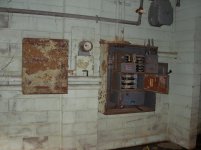
That extra box on the left must be the CT cabinet. It was like that when I got here, so up until I learned what CT means, this 'extra' cabinet was a mystery. Thanks, guys.
 

Attachments

  • P7112020.jpg
    P7112020.jpg
    142.1 KB · Views: 70
OP
T

tavernaut

Active member
Joined
Jun 27, 2014
Messages
34
The gas meter above the panel looks like an unusual location?

Yeah, it's a little goofy. This is the wall right inside the main rollup door. I guess they didn't want to leave the meters outside. That gas service is 2" pipe but I'm not bringing gas service back to the building until later, maybe never.
 
To avoid these ads, REGISTER NOW!
Top Bottom