To avoid these ads, REGISTER NOW!

Contact cement that's not permanent

m32825

Well-known member
Joined
Jul 26, 2015
Messages
1,009
Location
Central FL
I want to attach a piece of Formica to my bench. The current top is 1/8" steel sheet and the dimensions are 4' x 7'.

Looks like contact cement will do the job, but I want to be able to replace the Formica down the road. Something kind of like contact cement, only not as permanent. Does such a thing exist?

As an alternate plan, if I used the regular stuff, would it turn loose if I applied heat to the Formica?

Thanks!

-- Carl
 
To avoid these ads, REGISTER NOW!
OP
M

m32825

Well-known member
Joined
Jul 26, 2015
Messages
1,009
Location
Central FL
Maybe pressure sensitive glue used on carpet squares?

Okay, this got me pointed in a promising direction. There is a flooring product called Henry 650R Releasable Bond Pressure Sensitive Adhesive. It's used for applications like rental apartments where you need to pull up flooring and put down new stuff.

I got some at HD. You apply it to the floor, wait for it to form a skin, then put your flooring over it. I'm going to test rolling it on the steel and see how it holds but also test rolling it on the Formica and evaluate that. Since the Formica has a coarse back, seems like I might get more grab if I paint that side. If you want a permanent grab you paint it and place the flooring while the product is still wet. Let you know how it goes!

-- Carl
 

Two Door

Well-known member
Joined
Jan 7, 2011
Messages
814
Location
Houston, TX - USA
I just recently peeled contact-cement-glued formica off a particle board countertop and sheetrock walls. It wasn't that difficult. I imagine it would be even easier off of steel. If that doesn't sound reasonable you might try wood glue.
 

Git

Well-known member
Joined
May 18, 2008
Messages
6,894
Location
S Cal
Keep in mind - they use contact cement for a reason. When it dries you can place sticks or other objects that help you properly place the Formica without screwing it up. Get it in place, slowly remove the sticks and roll it out. Can't really think of anything else that is going to let you do that. You might just end up with a mess on your hands and the Formica not where you really want it
 
OP
M

m32825

Well-known member
Joined
Jul 26, 2015
Messages
1,009
Location
Central FL
I just recently peeled contact-cement-glued formica off a particle board countertop and sheetrock walls. It wasn't that difficult. I imagine it would be even easier off of steel. If that doesn't sound reasonable you might try wood glue.

That's what I'm looking for. Formica is tough, but I see it as sacrificial and want to be able to change it. Maybe I'll get tired of matte white and replace it was the that groovy boomerang pattern they used in diners in the 50s!
 
OP
M

m32825

Well-known member
Joined
Jul 26, 2015
Messages
1,009
Location
Central FL
Keep in mind - they use contact cement for a reason. When it dries you can place sticks or other objects that help you properly place the Formica without screwing it up. Get it in place, slowly remove the sticks and roll it out. Can't really think of anything else that is going to let you do that. You might just end up with a mess on your hands and the Formica not where you really want it

Good point, and exactly my reservation about using contact cement: one try. I've worked with me, and I can tell you I'm not that good!

Most of the Formica stuff I've seen is designed so you can place it, then run a router around the outside to trim it up. I wasn't that smart when I built my bench, the top sits down just a bit below a lip all the way around. I've got the Formica cut to fit, but I want to be able to position it a bit before I stick it.

My test prices are done. The Henry stuff starts out white and turns clear as it dries. For removable applications there is an unlimited working window. Once it is clear it is still super tacky, but nothing comes off on your fingers. Both samples stuck down well and could be pried back up and stuck down again. Applying the adhesive to the back of the Formica worked best, and left little residue behind on the steel.

Time to scale it up!

-- Carl
 
OP
M

m32825

Well-known member
Joined
Jul 26, 2015
Messages
1,009
Location
Central FL
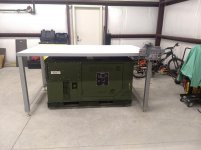
All done! I left a couple inches unpainted all the way around for handling, really only needed a couple spots on each end. Here are pictures of right after painting, where the adhesive is white, after it sets, where the adhesive is clear, and final product. I really like how it came out. Now, to see if the adhesive stands the test of time!

-- Carl
 

Attachments

  • rps20200606_202639.jpg
    rps20200606_202639.jpg
    103.4 KB · Views: 49
  • rps20200606_202710.jpg
    rps20200606_202710.jpg
    106.8 KB · Views: 46
  • rps20200606_202733.jpg
    rps20200606_202733.jpg
    83.9 KB · Views: 51
To avoid these ads, REGISTER NOW!
OP
M

m32825

Well-known member
Joined
Jul 26, 2015
Messages
1,009
Location
Central FL
Nicely done!

Great looking bench, whats underneath?

Thanks! That big hunk of green is a MEP-803a diesel generator that used to belong to the Marines. It's the reason I built the bench. I could move the generator around the garage with my pallet jack, but wherever I put it, it always seemed to be in the way. So I decided I would build a bench that I could park the generator under. I put a solid sheet top on it so debris and liquids from the bench can't rain down on it.

-- Carl
 
OP
M

m32825

Well-known member
Joined
Jul 26, 2015
Messages
1,009
Location
Central FL
Sharing a few things I learned...

If you want to use this adhesive for permanent applications one of the sides you're sticking together needs to be porous, because the volatile part of the adhesive needs somewhere to go as it sets up. This wasn't an issue for my application but it might be for someone else.

I left a bit of space between the Formica and the surrounding frame but I didn't get it centered the first time (told you I wasn't that good). So I tested the "removable" claim and got it centered. While I had it off I went ahead and painted adhesive all the way to the edges. When you handle it, the adhesive is tacky, but nothing comes off on your hands, so I didn't really need a margin for handling.

When I put it down this time I ran a tile roller over for a good bond. Suggest putting down butcher paper to protect the surface from the roller. Also suggest having a teenager on hand to lift that thing onto the top. You don't need to worry about getting it back down, it does that just fine by itself if you're not careful enough near the edges... :rolleyes:

-- Carl
 
OP
M

m32825

Well-known member
Joined
Jul 26, 2015
Messages
1,009
Location
Central FL
Oh, and the coolest feature of this bench is that it has a heavy duty mount for an old Craftsman vise I got from my grandfather!

-- Carl
 

Attachments

  • rps20200607_170552.jpg
    rps20200607_170552.jpg
    107.8 KB · Views: 42

Git

Well-known member
Joined
May 18, 2008
Messages
6,894
Location
S Cal
That turned out great!

I will have to make a note of that "Henry 650R Releasable Bond Pressure Sensitive Adhesive" for future use
 

rlitman

Well-known member
Joined
Oct 18, 2010
Messages
24,620
Location
Long Island
I just recently peeled contact-cement-glued formica off a particle board countertop and sheetrock walls. It wasn't that difficult. I imagine it would be even easier off of steel. If that doesn't sound reasonable you might try wood glue.

Wood glue is rather permanent. Wood glue also cures like **** behind non-porous surfaces like formica.

Contact cement is anything but permanent. In fact, contact cement is the glue of choice for attaching corks to musical instruments (I've done this on clarinets for my son), because it can be removed relatively easily, without any damage to an expensive wooden instrument, yet still holds quite well in use.
 

Firstram

Well-known member
Joined
May 16, 2017
Messages
1,391
That looks good!
Formica can be removed by dissolving the contact cement with Lacquer Thinner. Fill a squeeze bottle, start at one edge lifting with a putty knife while squirting LT under the sheet. Keep lifting and squirting thinner until you reach the other side.
 

JR 42

Well-known member
Joined
Nov 2, 2013
Messages
966
Location
Sunny Seattle
Even really good contact cement releases with heat, so no major issues removing your p-lam in the future if you'd used it. Sounds like your adhesive was a bit easier to work with, though.

The latest generation of pressure- sensitive multi- purpose flooring adhesives seem to be able to bond just about anything to wood and concrete.
 
OP
M

m32825

Well-known member
Joined
Jul 26, 2015
Messages
1,009
Location
Central FL
I appreciate all the good info. So far, so good. If I have issues I will report back on this thread.
 
To avoid these ads, REGISTER NOW!
Top Bottom