Monkey Radio
Well-known member
I am getting read to do a slab soon (26x32). And was wondering if saw cutting is necessary to prevent cracks ? Or can the concrete person trawl them in and be effective?


I am getting read to do a slab soon (26x32). And was wondering if saw cutting is necessary to prevent cracks ? Or can the concrete person trawl them in and be effective?
I don't think anyone really answered his question. It doesn't matter which way you go, but the troweled crack will look a hell of a lot better. I personally would not do any control joint as they are hellaciously ugly and collect dirt. My garage does not have them nor does the garage of any of the older homes I see around here. If you are going to epoxy it I sure wouldn't do it as any fine line cracking you get is going to patch with the paint; otherwise you are going to be trying to fill some sawcut.
I don't think anyone really answered his question. It doesn't matter which way you go, but the troweled crack will look a hell of a lot better. I personally would not do any control joint as they are hellaciously ugly and collect dirt. My garage does not have them nor does the garage of any of the older homes I see around here. If you are going to epoxy it I sure wouldn't do it as any fine line cracking you get is going to patch with the paint; otherwise you are going to be trying to fill some sawcut.
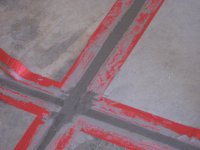
You obviously didn't understand my answer. Zip Strips leave a flat surface without any ravine running through the shop.
lg
no neat sig line
lg
no neat sig line
Its important to install "pathways" for concrete to crack during the hydration. Concrete tends to shrink when drying and it will find it's own path if one isn't offered. Concrete cracks from the bottom up so either install them during the finishing or cut them in real early. Waiting too long and you are only scoring decorative lines as the concrete has already cracked on the bottom. gene

I think I answered his question quite well....
" If you plan on epoxy I would soffcut it...much easier to patch than a troweled in one...either way I would defenitely do it .
Cut it into thirds and one down the middle"
You did see the size of the slab?
The "older homes in your area" . are they that big?
How does a troweled joint look better after it's filled with dirt?
Just sayin
Both accomplish the same goalYou kind of answered but did not address the basic question of whether the troweled joint was just as effective. It is.
On the size, you are right his is a little bigger. Ours are about 500 square feet.
On the troweled joint, the reason they are not done more often is difficulty and $$$$. The joint looks a lot better with its compacted smooth radiused corners than a somewhat jagged saw kerf, even when filled with dirt.
My pour was at done 11 am today, they power troweled couple hours later (was in the shade) and they're coming back to cut at 8 PM with what he called a 'green saw'. Apparently it's got a super thin blade. He was worried about using his regular saw since it was so hot out.
*And the guy doing the finish work told me about some classes he took recently...at EliteCrete.
I am planning to cut my joints with a skill saw and a diamond blade while I hold the hose next to it. I have seen it done before. Any comments on this technique?
I am planning to cut my joints with a skill saw and a diamond blade while I hold the hose next to it. I have seen it done before. Any comments on this technique?
My pour was at done 11 am today, they power troweled couple hours later (was in the shade) and they're coming back to cut at 8 PM with what he called a 'green saw'. Apparently it's got a super thin blade. He was worried about using his regular saw since it was so hot out.
*And the guy doing the finish work told me about some classes he took recently...at EliteCrete.
This is a workable though less than ideal method. In addition to being slow and dusty, the primary disadvantage is that you will probably have to wait 24 hours or more before you can cut with a circular saw. The blade spins upward, which causes 'raveling' at the edges of the cut. An early entry saw has a plate that presses on the surface and a very narrow blade that spins downward. This allows cutting to start immediately after finishing before shrinkage cracks can develop. If cracks develop before you cut, you've wasted your time - you've got cracks and cuts.
Interesting. I think I will see If I can rent a early entry saw. When you say the early entry saw can be used immediately after finishing. Do you mean that if the slab is poured in the morning I can cut the joints with this saw in the afternoon? Is this saw made specifically for this job? What other names does this saw go by?
If it's a mono pour flat slab/foundation it is cut to the the outside edge where the form board was. If it was a stem wall type foundation the guard on the soff-cut is lifted up and cut to the stem wall
Thanks.
My foundation is a stem wall type. One more question. My slab is going to be 4" thick. How deep should I cut with a early entry saw?
One more. How does the guide work? Do I lay a board down and follow it with the guide?
What happens with the areas near the walls that the saw can not reach?
My slab poor went smooth today. I used a soft cut x150 to cut the joints. It cut easily. The concrete chipped out quite a bit from the blade. I wish I would have gotten a smoother cut.
I think I may have cut a little early, but I felt I needed to get it covered up. Maybe I should have covered it and then uncovered a few hrs later to cut. The saw was a rental. I don't not any thing about these saws so cant really comment on the shape of the blade or shoe. It didn't look like much of a show to me.
I want to fix the chip out at the edges. I believe I will acid stain then clear coat it. I would like to discuss how to fix it.