
To avoid these ads, REGISTER NOW!

Converting Quincy Compressor gas to 230v

Avispex

Active member
Joined
Jul 21, 2012
Messages
38
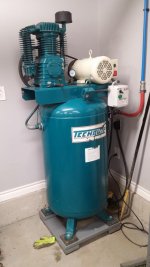
I have a new to me older Quincy 325 compressor. I got a good price on it and I bought this one because it has already been set up for dual control. The parts to convert my current compressor to dual control (pressure switch or continuous) would be more than this whole compressor. I think I will be able to sell the 5 hp gas engine and get almost all of my money back.

I have a brand new, 1725 rpm, 5 hp Baldor single phase motor ready to go. My question for the forum is, what would you use for a starter? I don't want to put a ton of money into this, and I know that sometimes people have a good source for these parts, so I wanted to ask if there is some great option for a functional starter that will work for a 5 hp compressor motor. I suppose that it will need to be able to function with a typical pressure switch, but aside from that, I don't think I have any unique or bizarre requirements. I looked on automation direct, but I am not sure I was looking at the right parts. So much of my stuff is so old that I am used to working with older starters and I actually haven't bought a new one in a long, long time.

Thanks for any suggestions.

Andy
 
To avoid these ads, REGISTER NOW!
OP
A

Avispex

Active member
Joined
Jul 21, 2012
Messages
38
Thanks for that link. I will see if there is something that looks good there. I found some in the $70 range on Ebay, but this one from Mattblast's incredible Quincy resto thread also looks very good right now. ( https://www.amazon.com/dp/B004PHB5U8/?tag=atomicindus08-20)

Before I get too far into my new Quincy issues, if anybody inadvertently stumbles on this thread prior to reading mattblast's thread, I strongly encourage you to red that one. It is just 2 years old, he does much more work on his than I am planning to do on mine, and his thread hass the links to owners manuals, parts lists, the teardown and rebuild manual from Quincy, as well as a link to Rotarycomptech's incredible youtube series of videos on Quincy compressors. Here is the direct link to mattblast's quincy restoration thread- https://www.garagejournal.com/forum/showthread.php?t=309858&page=3

Yesterday I picked up the gas powered Quincy. This was from an auction from a local municipality's service fleet repair shop. The compressor recently came off of one of their service trucks. I saw the new one and it looked like a bit of a downgrade, but it might pump more air than this old Quincy did. The only information was that it ran and built air and was in fair condition. The mechanic who had replaced it with something newer said that it couldn't keep up with his 1" air wrench as well as he would like, but I checked a bit on those and I don't know that they use more than about 10 cfm, so if this quincy really could not support that, then in might be in substantially worse shape than "fair".

I bid on this for the simple reason that the price was low and it was already set up for continuous run, meaning it had an extra unloader tower already and the pilot valve and other fittings. Even if I wanted to take just those parts off and use them on my other Quincy, this would probably be cheaper than trying to buy all of that stuff new. But, this may have been poor thinking on my part because this stuff is so old that it is probably not really repairable and might not still be working properly, which means that using it on my new Quincy would probably be asking for trouble. I have no idea if these old pilot valves have any parts that can be repaired in them or how long they are supposed to last, but this one is definitely older than I thought it would be.

I don't have any information about this Quincy head. I am 95% certain that it is a 325, but the tag has been ripped off, so I can't be certain of the ROC number. I am pretty sure it is older than the mechanic I got it from.

It was mounted on what I assume is a 30 gallon tanks and was paired with a Kohler Magnum 8 gas engine. The pulley on the Kohler was 4 1/2" and the flywheel on teh Quincy is 16", so if they ran it at 3600 rpm, that would be about 1,000 rpm at the pump, a little over spec, but I still think it should have been enough to run an air wrench. Maybe my thinking is screwed up.

In terms of the current pump, there is oil leaking from the gas engine, oil leaking from the pump inspection plate and oil drain areas, and sadly, what seems like oil leaking from the bottom of the high pressure unloader valve cover.

The brightest spot of the day was I was able to obtain 4 of the original Quincy valve repair tools that have apparently never been used, so whatever work I need to do will probably be a bit easier with the proper tools.

Here are some pictures.

view


view


view


view


view


More pics in a bit.

Thanks,

Andy
 
Last edited:

Lelandwelds

Well-known member
Joined
Sep 6, 2017
Messages
2,443
Location
Central Texas
I have seen the info online so I know it is out there. I can think of three approaches.

Use a conversion chart to show 5 hp electric is equivalent to 8 hp gasoline.

Find that exact models rpm range limit specs. Find the power needed to get in the window. Aim for the lower rpm. (Might get another 50 years out of it.)

Just stick whatever the factory bolted on that pump and cross fingers.
 
To avoid these ads, REGISTER NOW!

mattblast

Well-known member
Joined
Jan 30, 2013
Messages
784
Location
Bridgewater, NJ
Looks like a fun project. These are solid units and both new and used parts are easily obtainable at reasonable prices.

To convert to electric you need to put a pressure switch on the tank and add a mag starter. You can probably also use the pilot valve to unload in order to have continuous motor run (avoids frequent starts and stops that isn’t good for compressor or motor). I never ended up using the pilot valve on mine and just relied on pressure switch. There are a few designs of the pilot valve. Mine is LVD but there is also an LS model.

If you don’t need continuous motor run then you can also uninstall the pilot

The pilot control valve is needed for a gas motor since the motor will always run but you don’t want to always build up pressure. It unloads at the high pressure which is set via some adjustment nuts on the valve.
 

larry_g

Well-known member
Joined
Apr 28, 2007
Messages
16,874
Location
oregon
Member Steevo went through this a few years back. He did start a few different threads on the subject so if you do an advanced search on 'compressor' and member 'steevo' and default threads started by you will find all of them. He did an IR compressor but a lot of the information will apply. I got involved in this thread, https://www.garagejournal.com/forum/showthread.php?t=139111&highlight=compressor

You may have to search out the performance curves for the Quincy. On a conversion like this you have two variables to adjust for a given pump/motor combo, They are max pressure and pump speed. You have to adjust these as needed to keep the motor operating withing its current range.

Good Luck

lg
no neat sig line
 
OP
A

Avispex

Active member
Joined
Jul 21, 2012
Messages
38
Thanks for the feedback so far. I have a nice 3 hp electric motor that I would like to try with a low rpm set up for this machine. maybe shooting for that 400-500 rpm zone. It's three phase, so that will make getting a starter a bit cheaper. in the mean time, I wanted to at least fire this thing up to see how it works if at all, but I have a couple of questions and concerns that I wanted to run by the group.

1. The oil is low in the gas engine, and black. So, at the least I would probably need to add oil, but maybe replacing it entirely wouldn't be a bad idea. After the test run, I have no further use for this gas engine, so I don't want to put a ton of money into it just to test the compressor prior to any additional rebuilding work.

2. The oil in the pump is at the right level, but is also black, so it might be worth draining that out and putting clean oil in. If there is tons of **** in the crank case, then new oil might not help anything at this point, so maybe it doesn't matter if I am only wanting to test it for a few minutes. Is there a good type of oil I could use for this that would be easy to get locally? I don't want to order 25 gallons of the special Quincy oil just for my test run.

3. I don't have any way to start the gas engine. It is electric start, not pull cord, like the old time lawn mowers. I think I need to hook it to a 12 volt battery. I obviously don't want to buy a 12 volt car battery just for this. Can I use a battery charger or jumper cables from my car to the engine? Are there any really clever tricks that make this super easy that somebody would likely not think of on their first time ever using one of these?

4. I guess I also need to put some gas in the engine. I hadn't bothered to check it, but this is a pretty easy step.

5. The tank has more hoses, drain plugs, valves, and fittings than any compressor I have ever seen before. I think some may have been knocked about when they were taking it off the truck, so I would probably need to inspect all of those before attempting any kind of test run. This seems like a goose chase of different hose hole and fitting sizes and plugs, etc.

6. Once I start opening up this pump, it will probably be down for a long, long time. Since there seems to be oil leaking out of the high pressure unloader, I think it probably at least needs new rings, which involves a significant amount of disassembly. I could probably handle that and cleaning the valves. Above that would be changing the bearings and seals for the crank shaft, cleaning that oil pump system that is pumped through the shaft, and possibly honing the cylinders. Those involve even more special equipment, so that seems a bit daunting if I have to do that much. But who knows, maybe it is in perfect shape even with the leaks? My concern is that without knowing the ROC version for this pump, I am going to have a hard time ordering the right parts. Does anyone know of an easy QR-325 ROC identification chart?

7. I have no idea if the current gauges work. The glass covers are broken completely off on both of them, but maybe the needles still move and display accurately. If not, my test run won't show me much.

Thanks,

Andy
 

mattblast

Well-known member
Joined
Jan 30, 2013
Messages
784
Location
Bridgewater, NJ
Hopefully this answers your questions. There are many ways to approach this project and the info below is simply how I would do it. You can successfully accomplish the same results using your own methods.

1. Anytime I get a "new" motor I drain the oil completely and take a look at the spark plugs and carburetor. If it hasn't been used in a while and if gas was left inside, the carb will be gummed and up need to be cleaned, repaired or replaced (depending on your time and budget). Replace with new oil. Make sure spark plugs look good and replace if needed (check for OEM specified plugs and don't just replace with same that is in there now as they may no be spec.)

2. Drain compressor oil. Clean out the gunk if you find any, then replace with fresh oil. You can get compressor oil at Home Depot for less than $3 for 16oz Home Depot Compressor Oil

3. I would just hook it up with jumper cables to your car battery and it should turn over.

4. If any old gas is in there for more than a few months, drain it out fully before putting fresh gas in. Don't use old gas.

5. Once you get familiar with the connections, the hoses will make sense.

6. I normally only need to rebuild valves, replace gaskets and orings and change oil. I've replaced rings and honed cylinders but only if they were really bad. You can download several revisions of the manual on the quincy site and check the diagrams to see what yours match. One way to tell is the way the intercooler is connected to the head - they changed this design significantly at one point.

7. Gauges should be replaced, but you can tell a lot without them. In fact if it were me I would remove belt to motor and turn pump by hand a few dozen rotations. Then open valve in tank and air should come out. Then you know it pumps.

Good luck
 
OP
A

Avispex

Active member
Joined
Jul 21, 2012
Messages
38
This is a pretty basic question, but are all of the fittings for compressors designed for NPT threads?

Thanks,

Andy
 
To avoid these ads, REGISTER NOW!
Top Bottom