To avoid these ads, REGISTER NOW!

coolant flow question

kvom

Well-known member
Joined
Feb 1, 2008
Messages
820
Location
*******, GA
The engine in my offroad buggy doesn't have a thermostat, so the coolant circulates through the radiator continuously when the engine is running. Several friends claim this is not efficient as the coolant will pass through the radiator "too fast."

It seems to me that heat transfer would be the same. I always have assumed that the purpose of the thermostat was to warm the engine faster when first starting up.
 
To avoid these ads, REGISTER NOW!

Ironcrow

Well-known member
Joined
Sep 30, 2005
Messages
1,169
Location
Arizona
No such thing as that "too fast" story. Without the thermostat, it will warm up slower and if the ambient is very cold the engine may not come up to operating temperature (effecting wear and economy). Some engines prefer the slightly elevated boiling temperature in the cylinder head caused by the increased coolant pressure of the water pump working against the restriction of the thermostat (even when it is open). That said, leaving the thermostat out has no real up side either, the engine will not be harder to overheat, so you should have one in there.
 

ddawg16

Well-known member
Joined
Jul 11, 2008
Messages
21,005
Location
S. California
Neither your friends know much about cooling....not trying to rag on you so don't take it as an insult....I used to think the same as well...at least about t-stats.

First off, the purpose of the t-stat is to heat up the engine to the ideal operating temp as quickly as possible and keep it there. Contrary to many stupid myths....removing a good t-stat or putting in a cooling one does not solve a cooling problem. Additionally, removing a t-stat or using a cooler one will not only make your MPG worse, the engine will not run as well. Engines are designed to run at a certain temp....go above or below that....they don't run as well.

As for the water going 'too fast'....sorry....but that is a total myth. Just like water wetter is....heat transfer is a function of surface area and velocity....I won't get into Renolds numbers....but look at this way....if you put boiling water in a glass...it will start to cool...right? Let it just sit there and it will take x amount of time to cool down to a certain temp....but start stiring it around a bit...it will cool a little faster....the reason....the water molecules at the edge of the glass give up their energy....they depend on the molecules next to them to give up their energy...so on, so on. The rate at which they do this depend on the temp diff. Think of it as a domino effect. Circulate the water and you don't have to deal with the domino effect as much.....faster heat transfer......clear as mud?

So....The heat transfer is not the as the water goes faster....is is a faster heat transfer....just maybe not as effiecient. I reality, I really doubt there is a big change in water flow velocity with the t-stat out....the radiator is your real choke point....

I would suggest putting in your t-stat....and if you have a cooling issue...find the cause.
 

bgott

Well-known member
Joined
Oct 31, 2005
Messages
3,512
Location
Houston, TX.
Well, I'm sure there is a debate on whether or not the coolant needs to stay in the radiator for a while, or not. I do know that restrictor plates are sold to replace the thermostat. They are basically thermostat sized inserts that have a hole in the middle of them. For more on this, Google " thermostat restrictor plate". It brings up about 18,700 results.
 

buildmyown

Well-known member
Joined
Mar 3, 2010
Messages
783
Location
Franklin Ma
Neither your friends know much about cooling....not trying to rag on you so don't take it as an insult....I used to think the same as well...at least about t-stats.

First off, the purpose of the t-stat is to heat up the engine to the ideal operating temp as quickly as possible and keep it there. Contrary to many stupid myths....removing a good t-stat or putting in a cooling one does not solve a cooling problem. Additionally, removing a t-stat or using a cooler one will not only make your MPG worse, the engine will not run as well. Engines are designed to run at a certain temp....go above or below that....they don't run as well.

As for the water going 'too fast'....sorry....but that is a total myth. Just like water wetter is....heat transfer is a function of surface area and velocity....I won't get into Renolds numbers....but look at this way....if you put boiling water in a glass...it will start to cool...right? Let it just sit there and it will take x amount of time to cool down to a certain temp....but start stiring it around a bit...it will cool a little faster....the reason....the water molecules at the edge of the glass give up their energy....they depend on the molecules next to them to give up their energy...so on, so on. The rate at which they do this depend on the temp diff. Think of it as a domino effect. Circulate the water and you don't have to deal with the domino effect as much.....faster heat transfer......clear as mud?

So....The heat transfer is not the as the water goes faster....is is a faster heat transfer....just maybe not as effiecient. I reality, I really doubt there is a big change in water flow velocity with the t-stat out....the radiator is your real choke point....

I would suggest putting in your t-stat....and if you have a cooling issue...find the cause.


Sorry but I have to argue about the part I outlined in red with a real world example. My car always ran hot with the new motor first thing I did was yank the t-stat out didnt make a difference why because the one I had in there was to cool at 160 so it was always open same effect as not having one at all. Put a 190 in there and now it runs nice and cool the only time i have to kick the electric fan on is ifi get stuck at a long red light on a hot day. I can watch it on the temp gauge the gauge gets to 200 the t-stat opens allowing the cool water from the radiator to enter the motor and i can watch the gauge drop back down to 190. Without a t-stat or the 160 I was only getting a 25 degree difference from the in and out hose on the radiator im now getting a 35-50 degree difference depending on outside air temp. So yes by slowing the water down and letting it sit in the radiator you are going to see better cooling results.

As for water wetter seen it with my own eyes. Friend runs an ashphalt drag sled rules say water only to antifreeze but water wetter or a similar product is ok. They put water wetter in and saw a 15 degree difference in temp.
 

justanengineer

Well-known member
Joined
Apr 5, 2011
Messages
7,722
Location
Motor City
Do yourself a favor and install a thermostat unless you enjoy rebuilding engines. As already stated, your cooling ability isnt diminished with a thermostat installed, but the rate at which the engine warms up is rapidly diminished and is definitely not a good thing.
 

Tim-Bob

Well-known member
Joined
Nov 13, 2010
Messages
72
Depending on the design of the engine/t-stat, it can cause an overheat. However, in most cases it won't, but will actually cause lower operating temperatures. The overheat due to faster flow is a myth.

Your engine is designed to operate around an ideal temperature. If it isn't at or near that temperature, efficiency is reduced, ie, less power, higher fuel consumption, faster wear, etc. In other words, if it was designed for a t-stat, use one.

Water wetter does work in some instances, but not others. It is one of those high performance products that filtered down to us everyday people who can't really benefit from it in our everyday drivers. Interestingly enough, it is popular for use in water cooled computer setups. I've never used it in my computer, but test results show it can make a difference. High performance vehicles with "just enough" cooling would likely benefit too.
 

ddawg16

Well-known member
Joined
Jul 11, 2008
Messages
21,005
Location
S. California
Well, I'm sure there is a debate on whether or not the coolant needs to stay in the radiator for a while, or not. I do know that restrictor plates are sold to replace the thermostat. They are basically thermostat sized inserts that have a hole in the middle of them. For more on this, Google " thermostat restrictor plate". It brings up about 18,700 results.

Yea....did a quick search....it becomes pretty obvious that most of the links are actually trying to see you something.....

The reason for the restrictor plate is to produce enough restriction on the flow so that some of the water goes through the heater core.....on in the case of some vehicles....intake manifold so as to keep the intake at a designated level. Without some restriction...water takes the path of least resistance. Notice how the heater core hose connects 'before' the t-stat?
 

buildmyown

Well-known member
Joined
Mar 3, 2010
Messages
783
Location
Franklin Ma
For the ones saying faster flow is a myth it is not. By using a stat and slowing the water down you are allowing the radiator to do its job and exchange heat to the atmosphere.
 

nehog

Well-known member
Joined
Jan 2, 2010
Messages
7,935
Location
Jaffrey, NH
Absolutely true, it can happen. We proved it over and over building race cars, which would over heat if no thermostat was installed, for the simple reason that the coolant was flowing so fast it would not pick up (and loose in the radiator) the heat built up in the engine.

There is documentation about this on the web if you do a careful search.
 

Chris Adams

Well-known member
Joined
Oct 21, 2007
Messages
2,117
Like most 'how high is up' questions, it all depends.

In my years of autoparts, mechanic, and service writer (that was less than a year) I've seen examples of removing thermostats 'fixing' over heating, because the vehicles problem was right on the tip, that is, a couple percent improvement, car is drivable, couple percent the other way, car overheats.

If the overheating is from a bad thermostat, quite common, then it fixes the problem, duh.

Mostly, it didn't help as the problem in the old days was usually a leaking (weeping) water pump. Nowadays the problem is usually a gasket failure or tank seal problem.

Thermostats still go bad.
Both ways.
Most common is stuck open rather than stuck closed. I've seen both in the last year on friends cars, and over the decades, well, I could have filled a large barrel with both types of defective.


I've seen many hot rods and some stock vehicles overheat because the water was circulating too fast.
Not theory.

Fixed them with 'washers' which were just thermostats with the guts pulled out.
Then they ran too cool for efficiency, but functional.

Radiator material, air flow perimeters and cooling system design has changed dramatically over the years.

What worked fine or did not work on one setup, works on others.

So people who have experience with only cars from say a twenty year period tend to extend 'what works' to all years. Just isn't true.

Older (Pre 70) cars ran fine with no thermostat, except they didn't warm up enough to be emissions efficient.

If you ran them for years with out a thermostat, they tended to wear internal engine parts in odd ways.

Many cars from the mid70's through the early 80's ran HOT without the thermostat.
Design of the system had changed.

Used to get customers that came in shocked when they pulled a thermostat and the car overheated. Wasn't the way grandad said it would be...

By the mid to late 80's the cars would function without the thermostat, but it would now encounter problems from the electronic controls requirements.

My favorite was an 81 Corvette that was diagnosed as needing a new transmission. Nope, the thermostat was opening a couple degrees too early, thus the torque converter wasn't locking. Lots of fun.


On a buggy, a custom built vehicle is just that, custom built.
You can not be sure of how it will behave until you actually TEST it.

I've seen in the real world lots of major results from what should have been simple changes.
 

MrMark

Well-known member
Joined
Jan 25, 2010
Messages
4,626
Location
Southern Cal.
Lot of BS in this thread. Watter wetter works, I have seen it myself. And, obviously the flow rate affects the heat transfer. Last post seems to have straightened out a lot. This is what is great about the internet. If you get a large enough sample size of responses you will eventually get a good answer.
 

nissan_crawler

Well-known member
Joined
Jan 12, 2008
Messages
9,638
Location
Wichita, KS
Neither your friends know much about cooling....not trying to rag on you so don't take it as an insult....I used to think the same as well...at least about t-stats.

First off, the purpose of the t-stat is to heat up the engine to the ideal operating temp as quickly as possible and keep it there. Contrary to many stupid myths....removing a good t-stat or putting in a cooling one does not solve a cooling problem. Additionally, removing a t-stat or using a cooler one will not only make your MPG worse, the engine will not run as well. Engines are designed to run at a certain temp....go above or below that....they don't run as well.

As for the water going 'too fast'....sorry....but that is a total myth. Just like water wetter is....heat transfer is a function of surface area and velocity....I won't get into Renolds numbers....but look at this way....if you put boiling water in a glass...it will start to cool...right? Let it just sit there and it will take x amount of time to cool down to a certain temp....but start stiring it around a bit...it will cool a little faster....the reason....the water molecules at the edge of the glass give up their energy....they depend on the molecules next to them to give up their energy...so on, so on. The rate at which they do this depend on the temp diff. Think of it as a domino effect. Circulate the water and you don't have to deal with the domino effect as much.....faster heat transfer......clear as mud?

So....The heat transfer is not the as the water goes faster....is is a faster heat transfer....just maybe not as effiecient. I reality, I really doubt there is a big change in water flow velocity with the t-stat out....the radiator is your real choke point....

I would suggest putting in your t-stat....and if you have a cooling issue...find the cause.

I'll have to argue that. Worked on a Jeep Cherokee with a new used engine that wouldn't cool. Owner swore the thermostat was ok. I could find nothing else wrong, finally tore it apart when they weren't around...no thermostat. Installed thermostat...no over heating. They ate crow. They also decided that no thermostat = no problem.

As for "water wetter", I haven't used that, but I did use "40 below" in the '57. It would overheat at idle with the fan on without it, even in winter. After I put the 40 below in, it would idle with the fan on in summer, without overheating.

Again, it definitely worked.
 

bgott

Well-known member
Joined
Oct 31, 2005
Messages
3,512
Location
Houston, TX.
The reason for the restrictor plate is to produce enough restriction on the flow so that some of the water goes through the heater core

On a dirt track car? The water has to spend some time in the radiator, period. It takes time to radiate heat, it doesn't just go away.

Some posts have mentioned 160 degree thermostats. Those aren't car parts, they're boat parts. You want to run a raw water cooled boat engine at a cooler temperature. That cuts down on the thermal shock of sucking cold lake water into a hot engine.
 

Torque1st

MEMBER EMERITUS
Joined
Sep 14, 2008
Messages
5,668
Location
KC Metro, Kansas
One of the biggest cooling problems I have seen in vehicles is removal of the baffles and shields that direct airflow through the radiator especially when the vehicle is in motion. Many people do not realize the purpose of all of those flaps, shrouds, etc, and remove the 'worthless' parts for access when performing maintenance or repairs.

Major cooling problems are often found on custom or modified vehicles without all the OEM technology. OEM's spend major $$ getting the cooling systems to work right. 'Upgrades' and 'performance' or 'dress-up' parts that eliminate fan shrouds etc are also a major problem. They look cool on trailer queens but perform poorly.
 

mech.reclined

Well-known member
Joined
Mar 3, 2010
Messages
158
Location
Twin Falls,Idaho
SSSSHHHHHHH!!!!!! Liqued Downey= Water Water.
WW just breaks down the surface tension in water to allow BETTER heat transfer.Most race tracks and drag strips I've been to won't allow anti-freeze in case of a mishap.Takes too much time to clean up.
Couple shots of fabric softener-ready to go.
 

ddawg16

Well-known member
Joined
Jul 11, 2008
Messages
21,005
Location
S. California
Boy....a lot of expert opinions without any technical info to back it up....though I do excuse Nissan's comment about the Cherokee....I can't say he is wrong....though I am inclined to think that there was something else going on and putting in the t-stat was not the fix.

Anyway....I'm going to give you a lot of technical info that will basically expalin why water wetter is a hoax...and flowing water too fast is not an issue.

First...some background info...

Heat Capacity - Basically, the amount of heat a specific volume can hold, typically expressed in KJ/(kgK), or j/g/c....or in simple terms...how many jouls of energy per gram per 1 deg C change. The following web site has a good list of the common materials along with thermal conductivity (how well something conducts heat).

Basics of Heat Transfer

For reference...
Water 4.18 KJ/KgK
Antifreeze 2.38 KJ/KgK

Compare water to air....water holds about 4x as much heat as the same 'weight' of air.

Now compare thermal conductivity...water = 0.67 vs 0.25 for antifreeze...wow...looks like anitfreeze reduces performance.....

One of the funny things about materials and thermodynamics is that things change with temperature....check out this table...

Specific Heat of Water/Antifreeze

Below 200 deg F, the antifreeze hurts the heat capacity of water....but above 200 deg, it actually increases it. At 240 deg (the uppper limit on most cooling systems), the water/antifreeze mix actually has twice the heat capacity as compared to plain water.

Almost all of the web sites that talked about water wetter seemed to have the same basic pattern....car had cooling problem...tried a few things...put in the water wetter after flushing it out real good...works great....except results were all over the place from 1-2 deg difference to 20-30 deg. Doesn't sound very scientific to me.

I found this to be more informative...

What is in Water Wetter

It would appear that it's eating up some of the cooling systems.

I don't buy the "surface tension" idea....about the only thing it is going to effect is overall flow resistance. Additionally....when it comes to thermal conductivity of liquids....water is pretty much up there on top. It might improve the thermal compacity....but I have not seen anything that changes the conductivity...

Additionally...almost all the examples of good reviews involved systems where one or more other changes were made in conjuction with the water wetter AND using only water and the ww with no antifreeze. This reminds me of a similar case involving suspension systems on jeeps....guys have worn out bushings...put in poly and swear by it....when in reality...putting in new rubber would have given the same if not better results.

Now...lets talk about water velocity....

Higher cooling water velocity increase the heat transfer rate and therefore removes more heat. It basically reduces the film resistance close to the heat transfer surfaces and also increase heat capacity of the water. No magic involved....

If there is a case where cooling 'appears' to go down because of faster cooling....I would be inclined to look at the cooling pump. Cooling pumps are desinged to flow a certain amount with a known range of back pressure. In one of my jobs I have to set up large cooling pumps...I'm talking the 50hp +.....we have a globe valve on the output and we will start closing it until the full load amps drops to the design of the motor....leave it wide open and the motor will over current....and in some cases cavitate.

I would be willing to bet that without the t-stat...the water pump is cavitating. Once cavitation starts, flow drops fast.
 

NUTTSGT

Super Moderator
Staff member
Joined
Sep 14, 2009
Messages
51,041
Location
Northern Central Ohio
Like most 'how high is up' questions, it all depends.

In my years of autoparts, mechanic, and service writer (that was less than a year) I've seen examples of removing thermostats 'fixing' over heating, because the vehicles problem was right on the tip, that is, a couple percent improvement, car is drivable, couple percent the other way, car overheats.

If the overheating is from a bad thermostat, quite common, then it fixes the problem, duh.

Mostly, it didn't help as the problem in the old days was usually a leaking (weeping) water pump. Nowadays the problem is usually a gasket failure or tank seal problem.

Thermostats still go bad.
Both ways.
Most common is stuck open rather than stuck closed. I've seen both in the last year on friends cars, and over the decades, well, I could have filled a large barrel with both types of defective.


I've seen many hot rods and some stock vehicles overheat because the water was circulating too fast.
Not theory.

Fixed them with 'washers' which were just thermostats with the guts pulled out.
Then they ran too cool for efficiency, but functional.

Radiator material, air flow perimeters and cooling system design has changed dramatically over the years.

What worked fine or did not work on one setup, works on others.

So people who have experience with only cars from say a twenty year period tend to extend 'what works' to all years. Just isn't true.

Older (Pre 70) cars ran fine with no thermostat, except they didn't warm up enough to be emissions efficient.

If you ran them for years with out a thermostat, they tended to wear internal engine parts in odd ways.

Many cars from the mid70's through the early 80's ran HOT without the thermostat.
Design of the system had changed.

Used to get customers that came in shocked when they pulled a thermostat and the car overheated. Wasn't the way grandad said it would be...

By the mid to late 80's the cars would function without the thermostat, but it would now encounter problems from the electronic controls requirements.

My favorite was an 81 Corvette that was diagnosed as needing a new transmission. Nope, the thermostat was opening a couple degrees too early, thus the torque converter wasn't locking. Lots of fun.


On a buggy, a custom built vehicle is just that, custom built.
You can not be sure of how it will behave until you actually TEST it.

I've seen in the real world lots of major results from what should have been simple changes.

Out of all the posts in this thread, I'd agree with this one the most.
 
To avoid these ads, REGISTER NOW!

Charles (in GA)

Well-known member
Joined
Jan 11, 2006
Messages
12,489
Location
50 mi south of Atlanta
Absolutely true, it can happen. We proved it over and over building race cars, which would over heat if no thermostat was installed, for the simple reason that the coolant was flowing so fast it would not pick up (and loose in the radiator) the heat built up in the engine.

There is documentation about this on the web if you do a careful search.

I've seen that on a couple of stock automobiles in years past. Certainly some do overheat, I'm sure some do not, lots of factors involved. The engine really needs a thermostat for several reasons.

Charles
 

Falcon67

Well-known member
Joined
Jun 11, 2009
Messages
18,371
Location
Merkel, TX
Water Wetter - as noted - reduces surface tension and may reduce temps some, depending. I use it in the race cars for the pump lube because antifreeze is not allowed on the track. But we run it anyway because in the spring and fall it might be below freezing at the track overnight.

IMHO - the hotter thermostat does not work because it "slows down the water". It works because when you raise the operating temp the heat exchanger work better. It is especially true with aluminum radiators. Been there, done all this, know the drill.

Easy cool a 500HP race engine enough to drive on cruise night, ran with a 195F t-stat. With a 160 - no workee.
LT1fanA.jpg
 

darkk

Well-known member
Joined
Dec 24, 2009
Messages
3,361
Location
Willimantic, Ct.
Boy....a lot of expert opinions without any technical info to back it up....
Anyway....I'm going to give you a lot of technical info that will basically expalin why water wetter is a hoax...and flowing water too fast is not an issue
yeah....what he said!:beer:
 

Bruce4310TX

Well-known member
Joined
Nov 4, 2009
Messages
507
Location
Forth-Worth, TX
Lot of BS in this thread. Watter wetter works, I have seen it myself. And, obviously the flow rate affects the heat transfer. Last post seems to have straightened out a lot. This is what is great about the internet. If you get a large enough sample size of responses you will eventually get a good answer.

Gotta agree Water Wetter works used it when i raced dirt bikes and used it in all my street bikes really makes a difference here in Texas....:thumbup:
 

Bruce4310TX

Well-known member
Joined
Nov 4, 2009
Messages
507
Location
Forth-Worth, TX
Boy....a lot of expert opinions without any technical info to back it up....though I do excuse Nissan's comment about the Cherokee....I can't say he is wrong....though I am inclined to think that there was something else going on and putting in the t-stat was not the fix.

Anyway....I'm going to give you a lot of technical info that will basically expalin why water wetter is a hoax...and flowing water too fast is not an issue.

First...some background info...

Heat Capacity - Basically, the amount of heat a specific volume can hold, typically expressed in KJ/(kgK), or j/g/c....or in simple terms...how many jouls of energy per gram per 1 deg C change. The following web site has a good list of the common materials along with thermal conductivity (how well something conducts heat).

Basics of Heat Transfer

For reference...
Water 4.18 KJ/KgK
Antifreeze 2.38 KJ/KgK

Compare water to air....water holds about 4x as much heat as the same 'weight' of air.

Now compare thermal conductivity...water = 0.67 vs 0.25 for antifreeze...wow...looks like anitfreeze reduces performance.....

One of the funny things about materials and thermodynamics is that things change with temperature....check out this table...

Specific Heat of Water/Antifreeze

Below 200 deg F, the antifreeze hurts the heat capacity of water....but above 200 deg, it actually increases it. At 240 deg (the uppper limit on most cooling systems), the water/antifreeze mix actually has twice the heat capacity as compared to plain water.

Almost all of the web sites that talked about water wetter seemed to have the same basic pattern....car had cooling problem...tried a few things...put in the water wetter after flushing it out real good...works great....except results were all over the place from 1-2 deg difference to 20-30 deg. Doesn't sound very scientific to me.

I found this to be more informative...

What is in Water Wetter

It would appear that it's eating up some of the cooling systems.

I don't buy the "surface tension" idea....about the only thing it is going to effect is overall flow resistance. Additionally....when it comes to thermal conductivity of liquids....water is pretty much up there on top. It might improve the thermal compacity....but I have not seen anything that changes the conductivity...

Additionally...almost all the examples of good reviews involved systems where one or more other changes were made in conjuction with the water wetter AND using only water and the ww with no antifreeze. This reminds me of a similar case involving suspension systems on jeeps....guys have worn out bushings...put in poly and swear by it....when in reality...putting in new rubber would have given the same if not better results.

Now...lets talk about water velocity....

Higher cooling water velocity increase the heat transfer rate and therefore removes more heat. It basically reduces the film resistance close to the heat transfer surfaces and also increase heat capacity of the water. No magic involved....

If there is a case where cooling 'appears' to go down because of faster cooling....I would be inclined to look at the cooling pump. Cooling pumps are desinged to flow a certain amount with a known range of back pressure. In one of my jobs I have to set up large cooling pumps...I'm talking the 50hp +.....we have a globe valve on the output and we will start closing it until the full load amps drops to the design of the motor....leave it wide open and the motor will over current....and in some cases cavitate.

I would be willing to bet that without the t-stat...the water pump is cavitating. Once cavitation starts, flow drops fast.

So i guess if you post it your so called tech info your right and everyone else is wrong, well do you know that anti-freeze attacks aluminum heads, blocks and intakes not just WW do you know non distilled water causes corrosion in engines by having a reaction with the anti-freeze ? oh and also eats the rubber on the seals and gaskets. If you ever raced any motor sport where heat in a engine was a issue WW could make the difference between overheating or not. Thats the real world not some internet tech page.
And slowing down the water to a certain point does pick up more heat and transfers it to whatever method of transfer your using oil, air, fuel. All the info is available to those who take the time to look for it.
 

ddawg16

Well-known member
Joined
Jul 11, 2008
Messages
21,005
Location
S. California
So i guess if you post it your so called tech info your right and everyone else is wrong, well do you know that anti-freeze attacks aluminum heads, blocks and intakes not just WW do you know non distilled water causes corrosion in engines by having a reaction with the anti-freeze ? oh and also eats the rubber on the seals and gaskets. If you ever raced any motor sport where heat in a engine was a issue WW could make the difference between overheating or not. Thats the real world not some internet tech page.
And slowing down the water to a certain point does pick up more heat and transfers it to whatever method of transfer your using oil, air, fuel. All the info is available to those who take the time to look for it.

So....where is your 'tech' to support any of your claims.....

Oh...and BTW....I believe your getting some of your 'facts' wrong...the issue you raise about antifreeze reacting with AL heads is actually related to GM's use of DEXCOOL in it's engines. There was a class action lawsuit claiming that DEXCOOL caused problems with the AL....in reality...it would appear that because eveyone thought the cooling system never needed maintenance, they let the level get too low....engines got too hot and damaged them.

The simple fact is, water ALONE is the best way to cool an engine. So when everyone flushes out their cooling system of the water/glycol mix and puts in water along with WW...of course it seems to run cooler...

About the only benifit WW might have would be the anti-corrosion and lubercating features.....

You know....a lot of people tried Acetone in their gas. Claimed it improved their gas mileage.....nope...sorry....all it really did is make them improve their driving habits.

I know your tired of reading links...but here is another one....

http://www.eng-tips.com/viewthread.cfm?qid=60630&page=95

Go to the 7th post.....

One of the issues I have with people saying how much it helped is that...1, most temp gauges are not that accurate....2 - your thermostat is going to be regulating the temp , 3 - there are so many variables...outside temp, load, terrain..etc.

If the product was so good....why is it not being used by the auto manuf? It means they could put in smaller radiators and save money....but do they? NO...Why? Because it does not work.

As for water velocity.....sorry....we are talking purse physics here....yes, slowing down the flow does pick up more heat...but, is it moving more heat? NO. An engine generates X amount of BTU's in heat....moving the water just means the relative temp goes up...hopefully not to the boiling point....it is still about BTU...move the water faster and you can remove more heat....anyone that says the water flow was too fast and could not cool as well has something else going on.

Consider this....your sweating....to help cool off you get in front of a fan. If we follow your theory....you will cool faster with the fan on slow....yea, right....if your really hot you turn that fan to max.....same principle for cars.
 

nissan_crawler

Well-known member
Joined
Jan 12, 2008
Messages
9,638
Location
Wichita, KS
I'm not going to get into the science of how it works or why, because honestly, I don't care.

I will say this. On the cherokee, it went from overheating, me doing lots of work, it still overheating (because they were being jerky about me touching the t-stat), to me finally saying screw it, finding there was no t-stat, (which I was suspicious of due to the hose temps), installing it, and it working fine.

I don't know if it went to fast, cavitated, whatever. Don't care. I do know going from no t-stat to having a t-stat fixed it.

As for the '57, the only thing changed was adding 40 below to the coolant. It went from overheating during the winter, to me pulling out about 3 quarts of fluid, putting in 2 quarts of 40 below, then adding antifreeze to the right gravity, and topping with a bit of water. It never overheated all summer long then.

Again, don't know the science, don't care. It had the same specific gravity of antifreeze (per the refractometer), but it cooled much better. Something changed.
 

Bruce4310TX

Well-known member
Joined
Nov 4, 2009
Messages
507
Location
Forth-Worth, TX
So....where is your 'tech' to support any of your claims.....

Oh...and BTW....I believe your getting some of your 'facts' wrong...the issue you raise about antifreeze reacting with AL heads is actually related to GM's use of DEXCOOL in it's engines. There was a class action lawsuit claiming that DEXCOOL caused problems with the AL....in reality...it would appear that because eveyone thought the cooling system never needed maintenance, they let the level get too low....engines got too hot and damaged them.


Its not just Dexcool all antifreeze is affected its the new formulations of rubber, silicone whatever they want to call it seals and gaskets thats been used since the early 90's thats why it keeps changing. none of them work very good.
Tech is not just what you read in a forum its about real world trial and error i guess if you cant read it on the internet it doesnt work.


The simple fact is, water ALONE is the best way to cool an engine. So when everyone flushes out their cooling system of the water/glycol mix and puts in water along with WW...of course it seems to run cooler...


Yep first think you said that was right..


About the only benifit WW might have would be the anti-corrosion and lubercating features.....

You know....a lot of people tried Acetone in their gas. Claimed it improved their gas mileage.....nope...sorry....all it really did is make them improve their driving habits.

I know your tired of reading links...but here is another one....

http://www.eng-tips.com/viewthread.cfm?qid=60630&page=95

Go to the 7th post.....

One of the issues I have with people saying how much it helped is that...1, most temp gauges are not that accurate....2 - your thermostat is going to be regulating the temp , 3 - there are so many variables...outside temp, load, terrain..etc.

If the product was so good....why is it not being used by the auto manuf? It means they could put in smaller radiators and save money....but do they? NO...Why? Because it does not work.


oh if the auto manufactures dont use it it doesnt work oh and they put seat belts in cause they wanted to save our lives no its cause the govt made them oh my god its a revelation please go bury your head back in the sand


As for water velocity.....sorry....we are talking purse physics here....yes, slowing down the flow does pick up more heat...but, is it moving more heat? NO. An engine generates X amount of BTU's in heat....moving the water just means the relative temp goes up...hopefully not to the boiling point....it is still about BTU...move the water faster and you can remove more heat....anyone that says the water flow was too fast and could not cool as well has something else going on.

Consider this....your sweating....to help cool off you get in front of a fan. If we follow your theory....you will cool faster with the fan on slow....yea, right....if your really hot you turn that fan to max.....same principle for cars.


ITS not the speed its the flow for the enviroment your trying to regulate.
 

omr

Banned
Joined
Jun 1, 2011
Messages
723
air flow has alot to do with the thermostat argument, my bike with no thermostat running down the road will cool just fine if not too cool because there is alot of air flow going across the radiator but that same bike sitting in traffic will over heat with out a thermostat but will not over heat in traffic with a thermostat ..real world experience ..

the thermostat absolutely restricts flow to allow the heat from the engine to transfer to the coolant and then from the coolant to the radiator and then from the radiator to the air , if there isnt enough air flow and the coolant is flowing too fast the coolant does not has sufficient time to transfer enough heat ..

as a side note i live in south florida and while working at covey radiator years ago as their only tech i have installed countless thermostats in cars that ran fine all winter but as soon as the summer came they came to me with an over heating problem , coincidence ? no lol
 
OP
K

kvom

Well-known member
Joined
Feb 1, 2008
Messages
820
Location
*******, GA
Thanks for all the opinions/discussion.

In the case of my Jeep, it has a big Northstar V8 engine that was originally transverse mounted in a Cadillac, but is front-to-rear now. That puts the water pump and tstat housing against the firewall where it is practically impossible to access without pulling the engine. So it's unlikely I'll try to install a thermostat any time soon.

It's not a street legal vehicle and gets trailered to the trails, where it almost never goes over 20mph. It also spends a lot of time either idling or shut down when wheeling in a group, and MPG is clearly not a concern.

In addition, it has two radiators. The front fan runs any time the main switch is on whether the engine is running or not, and the rear fan is controlled manually for any time the temp gauge gets a bit higher than desired. I had an overheat problem last year, but then discovered that the front fan was turning the wrong way. With this corrected, I don't expect to have an issues going forward. We've got a ride scheduled in 2 weeks where the weather is likely to be 90F+, so we'll see what happens.
 

ddawg16

Well-known member
Joined
Jul 11, 2008
Messages
21,005
Location
S. California
I think I know the reason everyone thinks that NO T-Stat causes over heating....

Look at where the temp sender is.....usually in the intake or some other place that is related to the feed for the heater core....why? Because water is always circulating through the heater core hoses so as to provide heat inside the cab as soon as possible.

Remove the t-stat and now you don't have any restriction to help force water through that line.....water takes the path of least resistance....

So what I think is happening is that the water flow through the ckt that the temp sender is on is not getting as much water flow and as a result shows a higher temp.

I would be willing to bet that if you were to measure the actual water temp going into the radiator from the t-stat housing....it would be fine....

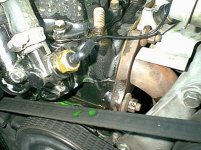
Here is a pic of the t-stat housing on my old Cherokee...see how the sender and heater hose is off to the side? Without restriction, no as much water...any any is going to be pushed through the heater hose.
 

Attachments

  • Image10.jpg
    Image10.jpg
    62.1 KB · Views: 6

VWandDodge

Well-known member
Joined
May 20, 2011
Messages
951
I'm late to the party, but yes, water can run too fast and not cool, thus causing issues with running hot. Ask any radiator shop technician.
 

tdkkart

Well-known member
Joined
Jun 17, 2006
Messages
6,887
Location
Eastern Iowa
Thanks for all the opinions/discussion.

In the case of my Jeep, it has a big Northstar V8 engine that was originally transverse mounted in a Cadillac, but is front-to-rear now. That puts the water pump and tstat housing against the firewall where it is practically impossible to access without pulling the engine. So it's unlikely I'll try to install a thermostat any time soon.

It's not a street legal vehicle and gets trailered to the trails, where it almost never goes over 20mph. It also spends a lot of time either idling or shut down when wheeling in a group, and MPG is clearly not a concern.

In addition, it has two radiators. The front fan runs any time the main switch is on whether the engine is running or not, and the rear fan is controlled manually for any time the temp gauge gets a bit higher than desired. I had an overheat problem last year, but then discovered that the front fan was turning the wrong way. With this corrected, I don't expect to have an issues going forward. We've got a ride scheduled in 2 weeks where the weather is likely to be 90F+, so we'll see what happens.


Anybody that doesn't believe that coolant flow rate doesn't affect cooling needs to come play with my radiant floor heating system. By throttleing the water flow through the floor and the heater I can see very clearly how water flow rate affects how much heat it picks up in the heater(engine), and how much it gives up in the floor(radiator).

With a bit of thought, you could easily make up an inline thermostat housing to put in the radiator hose, or for that matter go buy a big ball valve and plumb it into the radiator hose so you can control the flow.

My question is, given the requirements of this application, why go to all the trouble of using a Northstar Caddy engine?? As much as I dislike "cookie cutter" solutions, and GM products, this is a clear application for a 350 Chevy.
When it breaks down on the trail just about anyone will have your part, if not, you can probably find it under that tree over yonder.....
Hell, for that matter, considering the gear ratios this thing probably has under it, a 30HP Kohler air cooled twin would probably haul the jeep just fine. Imagine all the parts you could eliminate then.
 

Johnny chaos

Well-known member
Joined
Mar 6, 2010
Messages
598
Location
upstate NY
The thermostat helps to control the flow to the radiator allowing it to do its job efficiently. If the coolant flows to quickly through the core of the radiator it wont release it's heat to atmosphere as well as it should.

My understanding of water wetter is it helps to break the waters surface tension using surfactants to help reduce the pockets of air that form in the head and other restrictive areas of the cooling system. Racers have used a couple drops of "soft soap" for years for the very same reason. It doesn't lower coolant temps directly it just helps the cooling system do what it was designed to do more efficiently.
 

Johnny chaos

Well-known member
Joined
Mar 6, 2010
Messages
598
Location
upstate NY
Speedway sells some inline t-stat housings I believe? I have at least seen a few cooling system add-ons they sell you could get creative with.
 

bwindy

New member
Joined
Jan 14, 2009
Messages
1
Here is an actual engineering explanation of how heat rejection works. The faster you flow fluid through a radiator the better it works. There is another reason that a car would overheat without a thermostat such as pump cavitation but increasing fluid flow is certainly not it. There are many engineers which spend all day designing engines to get faster water flow without cavitation to increase cooling. The local radiator expert may know how to make your car cool better but may not really know why what he does works....


Heat Load to the Cooling System

The heat load to the cooling system is related to the flow through the radiator and the temperature drop through the radiator by the following expression:

Q = M * cp *dT

Where Q is the heat load BTU/min., M is the mass flow rate of the coolant in BTU per pound per degree F, dT is the temperature drop through the radiator in degrees F, and * indicates multiplication. Since a gallon of coolant weighs about 8.3 pounds, we can replace M in the expression by 8.3 times the coolant flow in gallons per minute, or GPM. The resulting expression is as follows:

Q = 8.3 * GPM * cp * dT

Since the specific heat of the coolant is essentially constant and the coolant flow rate


is constant at rated engine speed, the expression tells us something that surprises most people. That is, for a given heat load and coolant flow rate, the coolant temperature drop through the radiator will be constant, and nothing anyone can do to the design of the radiator can change that. Adding rows or fins or face area or whatever will not change the temperature drop through the radiator. As a general rule, cooling systems are designed to operate with a coolant temperature of about 190 degrees F at the radiator inlet and have about a 10 degree F temperature drop through the radiator at rated power and rated coolant flow. This will result in a bottom tank temperature of 180 degrees F. Note that the coolant temperature drop

through the radiator must be specified in degrees F or degrees C, not percent. Taking a percentage of the radiator inlet temperature will yield different results depending on whether the inlet temperature is given in degrees F or degrees C.

Effects of Radiator Design on the Cooling System

A cooling system whose heat load and coolant flow rate results in a 10 degree F coolant temperature drop through the radiator will have that same coolant temperature drop whether the radiator has a very small face area and flat fins or a very large face area and louvered fins. The difference is that the large louvered fin radiator will be more effective than the small radiator at transferring heat to the cooling air, meaning that it can do it with a much lower difference in temperature between the core and cooling air. The small radiator may require such a high difference in temperature between the core and the cooling air and the core that the coolant may reach boiling temperature before the core is able to transfer all of the heat load to the cooling air. While both radiators would have the same coolant temperature drop through the radiator, we would say that the larger radiator had better heat transfer performance if its top tank temperature (Inlet coolant temperature) stabilized at, say, 180 degrees F while the smaller radiator stabilized at 220 degrees F.

Improving an Overheated Cooling System

Armed with this understanding of how a cooling system works what recommendations should we make for a cooling system that is overheating? Suppose we have an engine and cooling system that, in stock condition, produced a rated 200 hp and ran at rated ambient temperature with a top tank temperature of 190 degrees F and a 10 degree F temperature drop through the radiator. Now suppose the engine were modified to produce 240 hp, a 20 percent increase. We would find that at 240 hp the core temperature drop had increased by 20 percent to 12 degrees F and the top tank temperature had increased, let’s say to the point where it was just overheating. Now suppose we take this system and reduce the power to the point where the radiator inlet, or top tank temperature is steady at 190 degrees F. (Guess what? It’ll be producing 200 hp! Funny, how that works). So we check coolant temperature drop and find it is back to 10 degrees F, as we would expect, meaning the average core temperature is 185 degrees F. Now we want to make improvements to the system in order to lower the top tank temperature to the point where we can then go back to 240 hp without the engine overheating.

Coolant Flow Rate

Looking at the previous expression, we can see that slowing the coolant down is the wrong way to go. If the heat load is constant, lowering the flow will increase the temperature drop through the radiator, making the bottom tank, or radiator outlet, temperature less than before. If the bottom tank temperature goes down, the top tank temperature must go up to maintain approximately the same average core temperature so that the heat load may be transferred to the cooling air. At the reduced power setting it would rise above 190 degrees F and at 240 hp the engine would be overheating worse than before. In fact, because the lower flow rate results in lower coolant velocity and less “scrubbing action” in the tubes, the average coolant temperature must rise slightly in order to transfer the heat load from the coolant to the cooling air, making matters even worse.

What would happen if we increase the coolant flow? Will it go through the radiator so fast that there won’t be time for cooling to take place? Not at all, from the expression, we can see that if the heat load is constant, increasing the coolant flow rate will reduce the coolant temperature drop through the radiator, resulting in a higher bottom tank temperature. If the bottom tank temperature is increased, the top tank temperature must go down to maintain approximately the same average core temperature. This is what we were hoping to achieve. With the top tank temperature now less that 190 degrees F at the reduced power point, we can expect that the system will be better able to run at 240 hp without overheating, In fact, because the increased coolant flow rate results in a higher coolant flow velocity and better “scrubbing action” in the tubes, the average coolant temperature decreases slightly while transferring the same heat load to the cooling air, further lowering the top tank temperature, resulting in better cooling performance.

From this we see that increasing the coolant flow rate will result in better heat transfer performance. There are some cautions to be observed in increasing coolant flow rate, however. Going too far may result in aeration and foaming of the coolant, possible damage to the radiator by overpressure, cavitation of the pump, due to excessive pressure drop through the radiator, and erosion of the radiator tubes. The ideal coolant flow rate is one that will provide optimum coolant flow velocity through the radiator tubes in the range of 6 to 8 feet per second. Flow velocities above 10 feet per second should be avoided.
 

omr

Banned
Joined
Jun 1, 2011
Messages
723
all the engineers in the world can say what ever they want the fact of the matter is if there is enough air flow most vehicles wont over heat with out a thermostat but when sitting in traffic alot of those same vehicles will over heat ..

and bwindy did i understand you correctly ? did you say a larger radiator doesnt cool better ?
 

tdkkart

Well-known member
Joined
Jun 17, 2006
Messages
6,887
Location
Eastern Iowa
and bwindy did i understand you correctly ? did you say a larger radiator doesnt cool better ?


Yep, that's what he said,
"Adding rows or fins or face area or whatever will not change the temperature drop through the radiator".

Which means there's alot of FreightLiner drivers that actually have Pinto radiators behind those giant grills..........next time I build a custom vehicle I'm gonna use a heater core as a radiator.
 

omr

Banned
Joined
Jun 1, 2011
Messages
723
Yep, that's what he said,
"Adding rows or fins or face area or whatever will not change the temperature drop through the radiator".

Which means there's alot of FreightLiner drivers that actually have Pinto radiators behind those giant grills..........next time I build a custom vehicle I'm gonna use a heater core as a radiator.
i laughed out loud :lol:
 
To avoid these ads, REGISTER NOW!
Top Bottom