To avoid these ads, REGISTER NOW!

Cordless batteries.. possible brainfart...

ZRX61

Well-known member
Joined
Aug 15, 2006
Messages
28,716
Location
Solar Blight Valley, SoCal
I get that a 4AH battery should last twice as long as a 2AH... but does the 4 have more balls than the 2? or is it just down to the A of the motor in the tool (as I suspect.. & should ******** know)
 
To avoid these ads, REGISTER NOW!

Bubba Fett

Well-known member
Joined
Jun 11, 2018
Messages
1,517
Location
Eastern NC
Nope. Just more run time. A half a tank of gas vs a full tank. You go further, but not necessarily faster.

Edit: speaking in general terms.
 
Last edited:

dnschmidt

Well-known member
Joined
Oct 3, 2014
Messages
7,293
Location
Phoenix, AZ
Depends on the tool. You need the big batteries for things like grinders, buffers, table saws and the alike. For small impacts, normal sized drills, drywall screwguns and normal stuff the compact batteries are fine. I've found that anything the spins thousands of RPM's like routers, blowers and saws need the bigger batteries.
 

mr.lemons

Well-known member
Joined
Oct 24, 2017
Messages
2,191
Location
UK
There are a few youtube vids that test this, and find that larger ah batteries provide more power. As always, youtube may not be the best place for reliable info, but the test results are consistent enough to confirm there is some difference. Something to do with there being more cells in larger ah batteries, so each cell does not have to work as hard? (clearly I don't understand the science).
 

bwringer

Well-known member
Joined
Jan 1, 2013
Messages
10,324
Location
Indianapolis
Depends on the tool.

For yer basic drill or 1/4" impact, then it's mostly "more gas in the tank". But you trade off some bulk and weight.

For really high-demand stuff, for example some 1/2" impacts, then some tools can take advantage of being able to draw more amps from more cells. There are a lot of variables in design and such.
 

boom10ful

Well-known member
Joined
May 15, 2020
Messages
128
Location
United States
There are a few youtube vids that test this, and find that larger ah batteries provide more power. As always, youtube may not be the best place for reliable info, but the test results are consistent enough to confirm there is some difference. Something to do with there being more cells in larger ah batteries, so each cell does not have to work as hard? (clearly I don't understand the science).
Voltage sag on each cell is lower as more cells are added therefore giving you a slight "increase" in power.
 

Neggy

Well-known member
Joined
May 30, 2021
Messages
754
in theory it should last twice as long with no difference in performance when comparing apples to apples.

In reality people have opined that the Milwaukee batteries in larger sizes work better than the smaller ones in high draw applications due to their opinion that the battery is not one larger cell but two or more smaller batteries in parallel
 

ToolRoom

Well-known member
Joined
Feb 19, 2014
Messages
83
Location
UK
Larger capacity batteries will obviously give you longer run-time.

However as said above, there is a bit more to it - when drawing current from the battery, as it discharges the voltage will change which, depending on how the tool is designed, may have a direct impact on the power.

Larger capacity batteries may not be as susceptible as a smaller one. Different sizes of batteries may use different cell technologies too, such as 18650 or 21700 which have different characteristics.

In short, it is mostly just run-time, but a bigger one might provide less of a performance drop than a smaller battery in use.
In some cases the smaller battery might actually provide better performance, I seem to remember that is the case with some of the Makita packs.
 

GeoBruin

Well-known member
Joined
May 5, 2018
Messages
3,750
Voltage sag, as mentioned above by Boom, is really the key. As you draw current from a battery, the voltage under load drops, so the power in watts (which is volts x amps) drops as well.

If you have more batteries in parallel, the amount of voltage sag is less for a given current draw, so your effective wattage is higher.

As mentioned, this effect is more pronounced with higher current applications.
 

Mallen

Well-known member
Joined
Aug 11, 2021
Messages
649
in theory it should last twice as long with no difference in performance when comparing apples to apples.

In reality people have opined that the Milwaukee batteries in larger sizes work better than the smaller ones in high draw applications due to their opinion that the battery is not one larger cell but two or more smaller batteries in parallel
Larger cells have a higher current capacity. If the tool knows that it might pull more but I don't know if they are doing this. While there is a little less sag it probably not much as lithium ion batteries have pretty stable voltage output. Maximum current output is not determined by the voltage sagging. Its determined by how much you can draw without destroying the battery. A brushless tool SHOULD be able to detect a larger battery and determine how much current it wants. But I don't know whether it's done like that or they just assume that you can draw so much and don't go over that.
 

Ign

Well-known member
Joined
Jul 7, 2006
Messages
12,769
Location
Butte Peak ND
We've debated this here before but the short answer in real life is yes, more amp hours equals better performance, primarily on high draw tools.

If you don't think so, go crank your car with an M12 battery. What, it won't do it? That doesn't make sense, your car is a 12V system, right??

Ironically Torque Test Channel discussed how impacts don't necessarily benefit from larger batts because the force needed to overcome the hammer/anvil mechanism is relatively constant. That's a generalization and poor summation of how it was actually described by them. Go find the video before arguing with my poor accounting.
 

P0234

Well-known member
Joined
Aug 6, 2012
Messages
3,241
Location
NoVA
Two batteries made of the same cells (and C rating), the larger capacity one will always have the ability to flow more current out. Just like with car batteries, the bigger one always has the higher CCA rating. Now if your tool only uses half the max current output of the smaller battery, you are unlikely to notice any difference in real life.

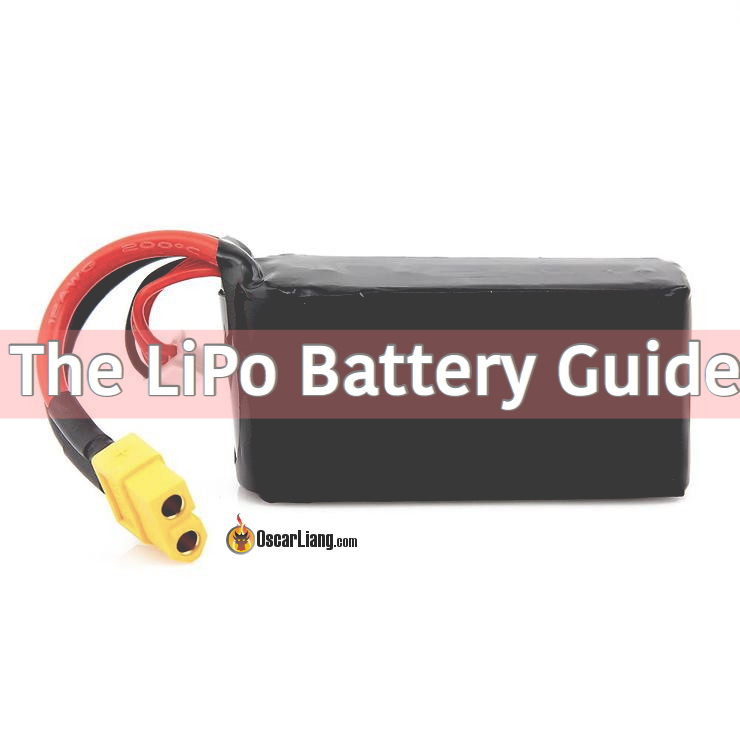
This article does a decent job of explaining it in a hobby context:


The most important part is the actual equation: Max Current Draw = Capacity x C-Rating

The tool companies unfortunately don't post C ratings.
 

Mallen

Well-known member
Joined
Aug 11, 2021
Messages
649
That may not be the case. A lower rated battery may not have the ABILITY to provide as much current as the larger one because it has greater internal resistance. But it may be the case that it is able to provide the same current as it's larger sibling, but damage itself in doing so. A typical lithium ion battery can provide much greater currents than it's rated for. But doing so will damage the battery. If I connect a 2 ohm resistor across the fully charged 2ah cell, I'm going to get

For example, let's say we have a 4ah cell and a 2ah cell. Let's say the 4ah cell is rated at 4amps. (Because it's simple) and the 2ah cell is rated at 2amps. Let's assume that the cells both put out 3.7volts. (in reality things are about more complex, but let's pretend) lithium ion batteries have a quite low internal resistance which means they dont sag much. So your going to draw about 1.85amps. When you put that resistor across the larger battery you'd expect about 3.7 amps. The voltage on a lithium ion battery sags something like .1 or .2v between 0.5C and 5C. The difference between say, 5c and 2 5c is going to be something like 0.05V. So somewhere around 1%.

Obviously, the manufacturer must limit the tools current draw when using smaller batteries. Either they have to build the tool to draw only the current that can safely be supplied by the smaller battery or they must let the tool determine how much to draw based on the battery installed. (Not that hard with a brushless motor). But unless the too is specifically designed to draw more from the larger battery, it won't make an appreciable difference.

I wouldn't want to try it but an 18v tool battery might just be able to supply 50-80amps and start your car. I wouldn't try it on modern car, but if I were stuck in the desert with a dead battery in my old 1972 truck, I'd give it a shot. It might just work. That starter has a resistance of around 150milliohms. 18v should push around 120 amps. A lithium ion battery has an I thermal resistance of 1-400milliohms. Figure it's not brand new, but not used up. Figure 200milliohms. So you will get around 72amps, the battery will may get hot and will probably be damaged. And if your lucky it won't die before the car cranks over and starts.
 
Last edited:

Bacon!

Well-known member
Joined
Jul 16, 2016
Messages
402
Many good points were made, but also realize that the faster you drain a battery, the lower its realized capacity is. For example if you have a 5 series, 18650, 18V pack and drain it at 10A, it will have less than half the realized capacity of a 5 series x 2 parallel, 18650 pack because cell capacity drops as current increases.

This is offset by maintaining a lower voltage droop at same load, so especially with brushed tools, you get more power output and higher current as a result but with more power output you tend to get the work done faster. On the other hand if you have a brushless tool that doesn't suffer performance drop with voltage drop, it necessarily has to draw more current to do so, again leading to less than half the realized capacity from a half capacity pack.

Then there is the other factor, that you have to recharge the smaller pack twice as often so you end up with less than half the lifetime-work before it needs to be retired, even less if the smaller pack falls below your minimally acceptable runtime for the jobs you do, while a double capacity pack stayed within an acceptable runtime range. Hopefully I worded that in a comprehensible way.

I can understand wanting a smaller battery pack for certain uses like long hours of overhead work or in very cramped spaces but so far I have never regretted only buying 4Ah or larger batteries. Tools that come as a kit with 3Ah or lower, I just pick up as bare tools instead, with one exception being a leaf blower where a 5Ah battery for it, cost more than the entire blower with a 2.5Ah (60V) battery & charger included.
 
To avoid these ads, REGISTER NOW!

Mallen

Well-known member
Joined
Aug 11, 2021
Messages
649
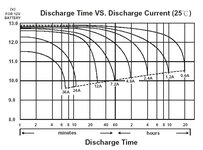
Although you see this with lithium ion cells, for other battery chemistries it's even more pronounced, for example lead acid batteries are rated at a 20 hour discharge as seen in the first diagram below. Its truly a abysmal. The diagram shows a 12ah battery. You'd think you'd get 12amps for an hour, but you only get 30 minutes. You'd expect 36amps for 20 minutes but you only get 7 minutes at that rate, barely more than a third. As you can see in the second diagram, lithium ion cells are far more forgiving of discharge rate. The same effect happens, but is much less pronounced unless you really stress the cells. Over an order of magnitude between 2C (24A) and 0.2C (2.4A) the lead acid goes from
About 5Ah to 9.6AH losing almost half it's capacity. The lithium ion in the other hand shows very little change in available capacity.
yCbSw.jpg

download (1).png
 

Mallen

Well-known member
Joined
Aug 11, 2021
Messages
649
I have to say, the big 8/4ah multicolor 18/36 volt batteries my drill uses are just too heavy sometimes. Im considering trying one of the lighter weight batteries. I've even considered if I could find some 14680 cells. Amount can get parts for an aftermarket battery pack minus the cells. That would make a 1/2ah battery. It wouldn't last long but could be nice for some jobs where the weight is just outrageous. I could just use some plastic bushings to mount the cells in the pack. But I dont think I can find cells that can supply the current I need. In fact, I don't know what current is needed at all.

Edit: I couldn't help myself. I just opened up one of my multicolor batteries. It has Samsung cells in it. I cant read the whole part number, but I see "INR21700-". The batteries are purple in color with a capacity of 4000mAh. A Google search comes up with purple Samsung 4000mAh batteries , on INR21700-40T. They are rated for 30amps. That makes sense. Im curious what the 2.5aH cells are rated at in the smaller battery. I'm guessing they are using 18650 cells in that pack.
 
Last edited:

Mallen

Well-known member
Joined
Aug 11, 2021
Messages
649
I couldn't help myself. I just opened up one of my multicolor batteries. It has Samsung cells in it. I cant read the whole part number, but I see "INR21700-". The batteries are purple in color with a capacity of 4000mAh. A Google search comes up with purple Samsung 4000mAh batteries , on INR21700-40T. They are rated for 35amps without a temp cutoff at 80 degrees C. With a temperature cutoff they are rated at 45 amps. It doesn't give a peak current rating. They are good for 90% of their rated capacity at 40Amps. Im curious what the 2.5aH cells are rated at in the smaller battery. I'm guessing they are using 18650 cells in that pack.


So yea, the mutivolt battery pack, which contains two banks of those, when connected as an 18V pack could easily start my truck. It can supply 80 amps for something like 5 minutes.


haveissues

Well-known member
Joined
Feb 9, 2011
Messages
379
Location
Hudson Valley NY
I'm guessing a 4ah battery will be built with similar cells as a 2ah battery but twice as many of them in parallel so it can provide twice the power at any given time. A 2ah battery can provide 2 amps for an hour and a 4ah battery can provide 4 amps for an hour. Or 2 amps for 2 hours. If the tool is capable of using more power it will be more powerful with the larger battery.
 

Bubba Fett

Well-known member
Joined
Jun 11, 2018
Messages
1,517
Location
Eastern NC
I've always thought of volts vs amps like this:

Imagine a two-lane highway with a 55mph speed limit. Now imagine a four lane highway with a 55mph speed limit. Assuming the cars are all obeying the speed limit, each car won't get from A to B faster, but more cars can get there at a time.

The speed limit is the Voltage, and the number of lanes is the Current.

Does this translate to more performance? Not in terms of voltage, but in amps you get more run time. There may be a bit more "oomph" at first, but most of the time the electronics limit that in order to keep the batteries from overheating and extend the lifetime of the pack.
 

Mallen

Well-known member
Joined
Aug 11, 2021
Messages
649
I'm guessing a 4ah battery will be built with similar cells as a 2ah battery but twice as many of them in parallel so it can provide twice the power at any given time. A 2ah battery can provide 2 amps for an hour and a 4ah battery can provide 4 amps for an hour. Or 2 amps for 2 hours. If the tool is capable of using more power it will be more powerful with the larger battery.
Often smaller batteries are built with 18650 cells and larger batteries are built with 21700 cells.fir example, the 2.5/5ah Metabo hpt cells I suspect are but with Samsung INR18650-25R cells. I just pulled a 4/8ah cell apart and it had Samsung INR21700-40T cells in it. The 18650 cells weigh about 45g compared to a 21700 at 70g. That's roughly the same as the weight ratio. Each battery pack contains 2 5 cell 18v battery banks. The terminals on the battery pack are arranged such that an older 18v tool connects to both banks unparallel while a newer 36v tool connects to them in series. DeWalt uses a different way. They have an internal switch in the pack that determines how the sub packs are connected.
 

Mallen

Well-known member
Joined
Aug 11, 2021
Messages
649
I've always thought of volts vs amps like this:

Imagine a two-lane highway with a 55mph speed limit. Now imagine a four lane highway with a 55mph speed limit. Assuming the cars are all obeying the speed limit, each car won't get from A to B faster, but more cars can get there at a time.

The speed limit is the Voltage, and the number of lanes is the Current.

Does this translate to more performance? Not in terms of voltage, but in amps you get more run time. There may be a bit more "oomph" at first, but most of the time the electronics limit that in order to keep the batteries from overheating and extend the lifetime of the pack.
If the tool is aware of which pack is connected, and capable of using more current, then there's no reason they can't design them to do it. But that's a design choice by the manufacturer to derate the motor when connecting to the smaller pack. Many seem to simply limit it to what the smaller pack can produce. But I'm sure some take the battery size into account. I can't imagine the companies trying to squeeze every last bit of performance out of their products would leave that on the table.
 

Badgerstate

Well-known member
Joined
Nov 15, 2020
Messages
484
Location
Columbus, OH
I get that a 4AH battery should last twice as long as a 2AH... but does the 4 have more balls than the 2? or is it just down to the A of the motor in the tool (as I suspect.. & should ******** know)

You do often get a little more power with a 4ah vs a 2ah. Its because pretty obvious especially with high demand tools like impact wrenches.
When you are talking about electricity, volts and amps go hand in hand. When you have more amp hours and more of a supply of power, you can put more power to the tool.
 

Firebrick43

Well-known member
Joined
May 12, 2015
Messages
14,221
Location
West central Indiana
I will throw in some first hand experience. I have the 7 1/4 fuel circular M18 saw. I never would imagine a battery powered saw could hold its own against a corded saw. It does, so much so that my skill 77 got sold.

It will cut three sheets of 5/8 osb stacked with no issues. I bought it with the 9.0ah battery. One day I was cutting stair stringers and some 2x4's for framing. Stair stringers(at least how I do them is plunge cutting and a real load. So after doing the stringers I had to cut a few 2x4 to length and the battery stopped due to being discharged. I switched to a new 5.0ah battery and finished the cuts. The 5.0ah battery fully recharged was noticeably down on power compared to the last cut on a 9.0ah battery.

On the other hand I use my fuel m18 drill (2701 if I remember correctly) to mix thin set commonly (another application I would have never thought a battery tool would be able to do). I don't notice any appreciable difference other than run time when using a 5.0 or 9.0. The 9.0 isnt an issue running a big paddle in a 5 gallon bucket but is if your trying to actually drill holes as it unbalances the tool and sometimes interferes by hitting the wall before you drill thru the material as it hangs out the front more
 

Showkey

"MEMBER EMERITUS"
Joined
Aug 9, 2014
Messages
8,638
Location
Wausau WI
Torque channel has multiple reviews and dyno testing on the battery size and the ability to deliver power:


OP
Z

ZRX61

Well-known member
Joined
Aug 15, 2006
Messages
28,716
Location
Solar Blight Valley, SoCal
Looks like Dewalt has turned into a total shitshow. Fresh battery in the impact, it wouldn't even drive ONE ******* 1 5/8 drywall screw flush into a piece of soft pine. Drove three screws in, changed the battery, drove the 4th & then used a regular screwdriver to drive the damn screws 2-3 more turns by hand to get them flush.

Explains why I had trouble drilling ONE goddamn 1/4in hole into some stucco with the drill a few weeks ago.
 
Last edited:

Mallen

Well-known member
Joined
Aug 11, 2021
Messages
649
Looki g at the discharge curves if lithium ion batteries, your not going to lose torque on the smaller batteries unless the tool was specifically designed to throttle maximum torque so as not to overload the small ones. Put another way, if you are designing a tool, you can't depend upon the internal resistance of the battery to limit current. It will readily produce enough current to destroy the battery. As such, if a tool produced more torque on a larger battery, its not actually a function of the battery but a function of the tool itself.
 

Mallen

Well-known member
Joined
Aug 11, 2021
Messages
649
You do often get a little more power with a 4ah vs a 2ah. Its because pretty obvious especially with high demand tools like impact wrenches.
When you are talking about electricity, volts and amps go hand in hand. When you have more amp hours and more of a supply of power, you can put more power to the tool.
That's not actually how it works. A lithium ion cell has a very low internal resistance. It's the responsibility of the load not to draw enough current to destroy the battery. It seems like some cordless tools do, while others seem to simply assume the smallest battery battery and limit themselves to that.
 
To avoid these ads, REGISTER NOW!
Top Bottom