twertsy
Well-known member
The December 18, 1919 Edition of Iron Age, announces the formation of the Cornwell Tools Co. in Cuyahoga Falls, Ohio. We have found this same announcement as early as September, 1919 in other publications. Officers noted in the announcement are:
B. L. Coleman - President
Eugene Cornwell - Vice President
H. L. Wandsneider - Secretary, Treasurer and General Manager
The article also mentions that Messrs. Cornwell and Coleman have been operating a plant in Pittsburgh using the Cornwell process for forging, treating and tempering tools.
The Ohio State Record - Annual Report of the Secretary of State notes the official state corporation filing date for the Cornwell company of 11/14/1919.
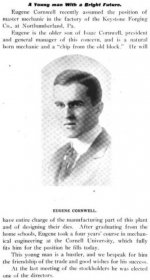
Eugene's father, Isaac, had taken over The Keystone Forging Co. in Northumberland, PA in 1909. Upon graduation from Cornell University in 1915, Eugene was brought in to run all operations and die making at Keystone, and was also voted to the Board of Directors. Keystone Forging was primarily know for producing forged carriage parts, automobile parts and small drop forgings such as clips and retainers. During the late teens, Eugene iteratively refined and improved both their alloys and the steel treating process at Keystone.
Now, here's where it gets a little fuzzy, and I'm going to insert my own version of what I think happened. It does not even come close to the story Cornwell tells.
Due to newly discovered information, I'm inclined to offer a new theory on the early Cornwell story. There was no "small blacksmith shop in Cuyahoga Falls." I am asserting that B. L. Coleman, a noted area banker, and the Kemmerline family at some point in early 1919 decided to investigate starting a tool company. The Kemmerline family was well known in Ohio, having grown into a thriving dairy farming operation. Meanwhile, Eugene Cornwell had been perfecting a new process for treating and hardening steel just a couple hundred miles away in Northumberland, PA while running operations at his father's Keystone Forging Co.. I assert that Mr. Kemmerline was somehow sold on the quality of the technique (could be through farm and buggy forgings he had purchased?) and decided to name his company after the "Cornwell Process" for treating steel. As far as Mr. H. L. Wandsneider, the only place the name appears is within the announcement of the company founding. During this timeframe (late teens) and according to my research, it appears that the only place in the U.S. where any Wandsneider family member resided was Waukesha, WI. I believe that Eugene Cornwell was simply offered an officer position in the company due to his steel treating contribution. Less than a year after founding, in the 1920 U. S. census, Eugene, his wife and children are living next door to his father, Isaac Cornwell on Water St. in Northumberland, PA. In 1925, B. L. Coleman and Eugene Cornwell founded the "Titan-Rite" company. The January 1925 edition of The Iron Trade Review announces the formation of a new company by the name of The Titan-Rite Co. in Elmira, NY to manufacture machinist tools. According to the 1930 census, Eugene and family are renting on Wark Ave. in Detroit, MI and he is working as a Mechanical Engineer for an Auto Factory. By 1935, the family has moved to Fredericksburg, VA and own a home at 906 Sylvania Ave. His draft registration card from 1941 shows him working for Sylvania Industrial Corp. in Fredericksburg, VA and living at the same Sylvania Avenue address. Eugene passed away in 1972 and is buried in Fredericksburg, VA. As a side note his son, also Eugene, was a WWII and Korean War Veteran and is buried in Arlington National Cemetary.
I have found many references showing that by 1920 / 1921, Frank Kemmerline was in complete control of the company. Frank even recognized his own shortcomings in the tool making industry and attended night school in order to learn about forging and the steel forming processes. This further supports my "conjecture" below, they didn't yet know what they were doing.
Conclusions / Conjecture: I do not believe Eugene had anything more to do with Cornwell Quality Tools than simply the name and steel treating process. However, while I have yet to find proof, I do find it plausible, and perhaps even likely, that Eugene returned to Northumberland and leveraged the die making and forging capabilities of Keystone Forging Co. to get his namesake company off the ground by producing their first tools.
For the complete notes from my research, and links to everything I've found, see this link: http://toolarchives.com/node/2387
B. L. Coleman - President
Eugene Cornwell - Vice President
H. L. Wandsneider - Secretary, Treasurer and General Manager
The article also mentions that Messrs. Cornwell and Coleman have been operating a plant in Pittsburgh using the Cornwell process for forging, treating and tempering tools.
The Ohio State Record - Annual Report of the Secretary of State notes the official state corporation filing date for the Cornwell company of 11/14/1919.
Eugene's father, Isaac, had taken over The Keystone Forging Co. in Northumberland, PA in 1909. Upon graduation from Cornell University in 1915, Eugene was brought in to run all operations and die making at Keystone, and was also voted to the Board of Directors. Keystone Forging was primarily know for producing forged carriage parts, automobile parts and small drop forgings such as clips and retainers. During the late teens, Eugene iteratively refined and improved both their alloys and the steel treating process at Keystone.
Now, here's where it gets a little fuzzy, and I'm going to insert my own version of what I think happened. It does not even come close to the story Cornwell tells.
Due to newly discovered information, I'm inclined to offer a new theory on the early Cornwell story. There was no "small blacksmith shop in Cuyahoga Falls." I am asserting that B. L. Coleman, a noted area banker, and the Kemmerline family at some point in early 1919 decided to investigate starting a tool company. The Kemmerline family was well known in Ohio, having grown into a thriving dairy farming operation. Meanwhile, Eugene Cornwell had been perfecting a new process for treating and hardening steel just a couple hundred miles away in Northumberland, PA while running operations at his father's Keystone Forging Co.. I assert that Mr. Kemmerline was somehow sold on the quality of the technique (could be through farm and buggy forgings he had purchased?) and decided to name his company after the "Cornwell Process" for treating steel. As far as Mr. H. L. Wandsneider, the only place the name appears is within the announcement of the company founding. During this timeframe (late teens) and according to my research, it appears that the only place in the U.S. where any Wandsneider family member resided was Waukesha, WI. I believe that Eugene Cornwell was simply offered an officer position in the company due to his steel treating contribution. Less than a year after founding, in the 1920 U. S. census, Eugene, his wife and children are living next door to his father, Isaac Cornwell on Water St. in Northumberland, PA. In 1925, B. L. Coleman and Eugene Cornwell founded the "Titan-Rite" company. The January 1925 edition of The Iron Trade Review announces the formation of a new company by the name of The Titan-Rite Co. in Elmira, NY to manufacture machinist tools. According to the 1930 census, Eugene and family are renting on Wark Ave. in Detroit, MI and he is working as a Mechanical Engineer for an Auto Factory. By 1935, the family has moved to Fredericksburg, VA and own a home at 906 Sylvania Ave. His draft registration card from 1941 shows him working for Sylvania Industrial Corp. in Fredericksburg, VA and living at the same Sylvania Avenue address. Eugene passed away in 1972 and is buried in Fredericksburg, VA. As a side note his son, also Eugene, was a WWII and Korean War Veteran and is buried in Arlington National Cemetary.
I have found many references showing that by 1920 / 1921, Frank Kemmerline was in complete control of the company. Frank even recognized his own shortcomings in the tool making industry and attended night school in order to learn about forging and the steel forming processes. This further supports my "conjecture" below, they didn't yet know what they were doing.
Conclusions / Conjecture: I do not believe Eugene had anything more to do with Cornwell Quality Tools than simply the name and steel treating process. However, while I have yet to find proof, I do find it plausible, and perhaps even likely, that Eugene returned to Northumberland and leveraged the die making and forging capabilities of Keystone Forging Co. to get his namesake company off the ground by producing their first tools.
For the complete notes from my research, and links to everything I've found, see this link: http://toolarchives.com/node/2387