To avoid these ads, REGISTER NOW!

Correct material for new trailer

ez-duzit

Well-known member
Joined
Jun 24, 2013
Messages
5,094
Location
Marina del Rey
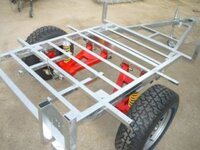
C channel is comical for this application. Angle iron is more than enough
Angle iron is about the least efficient shape, and therefore the worst possible choice for the frame. I-beam or channel is way more efficient, as it is the extreme fibers (the upper and lower flanges) of a beam which carry the loads
 
To avoid these ads, REGISTER NOW!

mike93lx

ALLIANCE MEMBER
Joined
Dec 9, 2013
Messages
37,456
Location
Richmond, VA
Angle iron is about the least efficient shape, and therefore the worst possible choice for the frame. I-beam or channel is way more efficient, as it is the extreme fibers (the upper and lower flanges) of a beam which carry the loads
It's a trailer with an 800 lb load. I beam? Let's see the sizing you would recommend for that
 

Hohn

Well-known member
Joined
Aug 25, 2016
Messages
2,638
Location
Diesel Central, Indiana
Not that torsional rigidity isn't a factor in a trailer, but with three points of support (hitch and 2 tires) the only torsional load on the trailer is from the weight of contents and the trailer itself and momentum of those things when traversing obstacles.
Torsional fatigue is an issue to address because many suspension movements will impact only one of the trailer tires. Even with a solid axle, you'll end up with a twisting moment if for no other reason than the axle is so much lighter than the load and has a much lower MOI.
Nominally? Correct, no twisting. But we tend to roll trailers on roads that tend to be imperfect, so it's not completely negligible.
 

Hohn

Well-known member
Joined
Aug 25, 2016
Messages
2,638
Location
Diesel Central, Indiana
Angle iron is about the least efficient shape, and therefore the worst possible choice for the frame. I-beam or channel is way more efficient, as it is the extreme fibers (the upper and lower flanges) of a beam which carry the loads
exactly right. Angle is useful because it's many times better than just a flat bar which has useful stiffness in only one plane. Angle gives you a bit of stiffness in two planes. But it's still far behind an I beam or Channel. Put the metal where it's actually carrying stress.

What a lot of people don't seem to grasp is that being strong enough is the easy part-- it's being stiff enough that matters. At least with metals, it's all but impossible for a part to be stiff enough and NOT be strong enough.

So if you design for stiffness, you get the strength for free.
Why does stiffness matter? In a word, fatigue. Structures that aren't stiff enough will fail in fatigue even if the basic tensile strength is sufficient for a cycle or two.
ESPECIALLY with a trailer that will be bounced around under load, you absolutely must design for sufficient stiffness. Things like spring mounts, tongue connections, axle housings, etc tend not to withstand repeated flexing to or beyond their yield stresses. (I believe there is some evidence in the literature of fatigue induction at stresses slightly below nominal yield strength due to localized yielding in the grain boundaries).
 
Last edited:

Hohn

Well-known member
Joined
Aug 25, 2016
Messages
2,638
Location
Diesel Central, Indiana
If the trailer is too light, the suspension will destroy the frame. I would also consider the tounge to frame interface carefully as well.
Yes, the ratio of sprung to unsprung mass matters. With a somewhat heavy axle flopping around back there, it can manhandle an underweight trailer into structural failure.
 

ez-duzit

Well-known member
Joined
Jun 24, 2013
Messages
5,094
Location
Marina del Rey
It's a trailer with an 800 lb load. I beam? Let's see the sizing you would recommend for that
From OP's original post: "The camper shell will put about 800 pounds on the perimeter of the trailer" you have assumed (wrongly) that the static load of the shell was the only load being applied.
 

mike93lx

ALLIANCE MEMBER
Joined
Dec 9, 2013
Messages
37,456
Location
Richmond, VA
From OP's original post: "The camper shell will put about 800 pounds on the perimeter of the trailer" you have assumed (wrongly) that the static load of the shell was the only load being applied.
I did not assume that. I still ask, what is the I beam sizing that you recommend?
 

sjvicker

Well-known member
Joined
Aug 9, 2014
Messages
602
Location
SW Washington
OP, what you're seeing here is a bunch of different opinions from internet engineers. If you have the skills to build one using the basic guidelines here then you have the ability to repair and fix one if there's issues. Give it a quick weld/deformation inspection while you're using it and you're probably good to go.

You'll be out enjoying your camp trailer while the internet engineers are still tapping away at their keyboards telling you how you should do it.
 

Hohn

Well-known member
Joined
Aug 25, 2016
Messages
2,638
Location
Diesel Central, Indiana
OP, what you're seeing here is a bunch of different opinions from internet engineers. If you have the skills to build one using the basic guidelines here then you have the ability to repair and fix one if there's issues. Give it a quick weld/deformation inspection while you're using it and you're probably good to go.

You'll be out enjoying your camp trailer while the internet engineers are still tapping away at their keyboards telling you how you should do it.
well, there are internet engineers. Then there are engineers on the internet.

With experience, you can spot the difference.
 

billconner

Well-known member
Joined
Jul 20, 2021
Messages
6,950
Location
Thousand Islands NYS
Keep your cross beams at 16" O.C. Wider will cause the decking to flex too much (unless you are using 5/4 PT decking mounted at a 45° angle).
Most I've seen and read of use a SIP like floor - 1/4" ply on both sides of foam. It will easily span 2' or more.

The ones used and which I have specified for portable concert stages are 4x8 supported only at the corners, and only 3/16" ply skins on 2" honeycomb. And engineered for 150 psf, considerably more than even two big active adults in a trailer. It's all about the adhesive.

You have to think airplane, not house, for a travel trailer like this. And seeing many builds on tnttt.com, most are 2x2x1/8 tube. The foamies - trailer cabins built of foam, cloth, and glue - would absolutely drive GJers nuts, but the owner/builders love them for many years.
 

theoldwizard1

Well-known member
Joined
Feb 22, 2011
Messages
43,123
Location
SE MI
Most I've seen and read of use a SIP like floor - 1/4" ply on both sides of foam. It will easily span 2' or more.

The ones used and which I have specified for portable concert stages are 4x8 supported only at the corners, and only 3/16" ply skins on 2" honeycomb. And engineered for 150 psf, considerably more than even two big active adults in a trailer. It's all about the adhesive.
About 20 years ago, some RV manufacturers tried using honeycomb plastic (fiberglass skin?). It was very light and worked well for a short time. After about 2 or 3 years there would be a noticeable sag in the floor where people walk. Some very large people actually put a put through. Never heard of this type of composite subfloor.
 

Hohn

Well-known member
Joined
Aug 25, 2016
Messages
2,638
Location
Diesel Central, Indiana
About 20 years ago, some RV manufacturers tried using honeycomb plastic (fiberglass skin?). It was very light and worked well for a short time. After about 2 or 3 years there would be a noticeable sag in the floor where people walk. Some very large people actually put a put through. Never heard of this type of composite subfloor.
Nothing wrong with honeycomb geometry-- it's brilliant and effective.
However, many plastics (like PVC) do age and lose strength over time. Many grades of PA66 or PA6 are also prone to hydrolysis and will weaken over time.
Probably didn't let their engineers get that far into it before the bean counters pulled the trigger on the plastic floors.

Real fiberglass (Epoxy resin, not polyester resin) is very strong and stable over time and there's a reason that it's STILL the standard for the marine industry.
 

Firebrick43

Well-known member
Joined
May 12, 2015
Messages
14,014
Location
West central Indiana
Pretty much THE WORST possible suspension for offroading!!! Torsion axles are simple, light and cheap but have no where near enough travel and articulation to work on rough ground.

Three options:

Timbren Silent Ride (here is a video): https://timbren.com/en-ca/products/...ide-trailer-suspension?variant=44708156408090
Great travel, good roll stiffness but side-to-side articulation means putting huge torsional load on the axle tubes.

One light torsion axle forward and one aft on a pair of walking beams. Similar travel to Timbren, but similar "problem" of putting differential articulation loads from one side across to the other by placing the torsion axle housings in torsional loading. Again: great travel, good roll stiffness but side-to-side articulation issues.

What I would greatly prefer to see: one pivoting tube fixed member holding a pair of independent walking beams with 4 fully independent torsion axles at each end. This gives far less roll stiffness than those above, but for offroading you will want the differential articulation travel to work for you.

If you use typical trailer farmyard junk axles (be they spring or torsion) you will tear the trailer apart from rough offroading loads - unless you build the trailer as heavy as a bank vault. And, YES, you are far better off with 2 very light axles than trying to get enough travel from one (again, walking beams being the key element)
Your suggesting 4 wheels for a 800lbs static load plus trailer frame and personal ****, maybe 2000lbs total max?

Little overkill isnt it? And the timbrens have marginally (as in 3/16" ; 2.3" vs 2.4375") more suspension travel than an equivalent capacity dexter torflex.
About 20 years ago, some RV manufacturers tried using honeycomb plastic (fiberglass skin?). It was very light and worked well for a short time. After about 2 or 3 years there would be a noticeable sag in the floor where people walk. Some very large people actually put a put through. Never heard of this type of composite subfloor.
coosa board with e glass/epoxy skins is the floor to have.
 

billconner

Well-known member
Joined
Jul 20, 2021
Messages
6,950
Location
Thousand Islands NYS
The home builts I see are usually XPS or EPS between plywood. Insulation and structure. I learned of them as stressed skin panels. It's the "I-beam" idea already mentioned.
 

cannuck

Well-known member
Joined
Nov 30, 2021
Messages
4,606
Location
Rural SK
Your suggesting 4 wheels for a 800lbs static load plus trailer frame and personal ****, maybe 2000lbs total max?

Little overkill isnt it? And the timbrens have marginally (as in 3/16" ; 2.3" vs 2.4375") more suspension travel than an equivalent capacity dexter torflex.
I think you missed the whole point. Use Timbren (or anyone else's) smallest, lightest independent (i.e. just spindle, no axle) on each end of a walking beam. THAT is 10x or more travel than anything else and gives ability for very different displacement side to side.

Little torsion axles can get this small: https://www.amazon.ca/dp/B07G95JZRB/?tag=atomicindus04-20
 
To avoid these ads, REGISTER NOW!

Firebrick43

Well-known member
Joined
May 12, 2015
Messages
14,014
Location
West central Indiana
But the timbren unit you showed is not a walking beam. Its just two single units back to back.
I would expect a homebuilt camping trailer with cabin for an 11' x 5' to be nearer 1000 pounds, and easily accomplished.
For the trailer yes, but I am including water, gear, food, ice, ect, things that make nearly every commercial camper/rv overweight.

I think you missed the whole point. Use Timbren (or anyone else's) smallest, lightest independent (i.e. just spindle, no axle) on each end of a walking beam. THAT is 10x or more travel than anything else and gives ability for very different displacement side to side.

Little torsion axles can get this small: https://www.amazon.ca/dp/B07G95JZRB/?tag=atomicindus04-20

I understand what your saying, I just think its way over complicated and unneeded.

The aussies adopted and have used the same type of independent suspension on off road "caravans" for several decades now.

extreme-024-300x225.jpg

xtf-gallery-2__65427.1631591312.png

Either Air or coil springs.
 

cannuck

Well-known member
Joined
Nov 30, 2021
Messages
4,606
Location
Rural SK
But the timbren unit you showed is not a walking beam. Its just two single units back to back.
Not sure which one you are referring to, but the video I thought I lined is their live axle with one leading and one trailing torsion set on a walking beam. actually very simple, but I think that is their 3500 lb. one.
Either Air or coil springs.
That is almost identical to suspensions I started building about 25 years ago. I think I have only done 2 coil (automotive coilovers for very light and delicate loads) the rest in air. Small air suspensions are easily made with the air bags from semi cabs. Absolutely the best way to make fully independant, but if you want a LOT of travel the air bags are larger and go between the pivot axis and the spindle axis. Note: they are using a complete automotive spindle (stub axle), disc brake and probably matching hub and bearing unit and caliper. I have been doing that for almost 40 years.
 

Firebrick43

Well-known member
Joined
May 12, 2015
Messages
14,014
Location
West central Indiana
Not sure which one you are referring to, but the video I thought I lined is their live axle with one leading and one trailing torsion set on a walking beam. actually very simple, but I think that is their 3500 lb. one.
Sorry, that part was supposed to be deleted. My bad, Yes it the model you showed was a walking beam with rubber suspension outboard on the beam.
 

jonesg

Well-known member
Joined
Mar 15, 2010
Messages
1,698
Location
northern Maine/
But the timbren unit you showed is not a walking beam. Its just two single units back to back.

For the trailer yes, but I am including water, gear, food, ice, ect, things that make nearly every commercial camper/rv overweight.


I understand what your saying, I just think its way over complicated and unneeded.

The aussies adopted and have used the same type of independent suspension on off road "caravans" for several decades now.

extreme-024-300x225.jpg

xtf-gallery-2__65427.1631591312.png

Either Air or coil springs.
he just wants to build a little trailer and its turning into the undercarriage for a jumbo jet.
 

Firebrick43

Well-known member
Joined
May 12, 2015
Messages
14,014
Location
West central Indiana
he just wants to build a little trailer and its turning into the undercarriage for a jumbo jet.
If the jumbo jets you fly on have landing gears that are that low tech I wouldn’t fly on them! That is about as archaic of an independent suspension as it gets.

I am not sure what you think standard on road trailer suspension will act like in the Off road conditions the OP stated he was going to take it on.
 

jonesg

Well-known member
Joined
Mar 15, 2010
Messages
1,698
Location
northern Maine/
If the jumbo jets you fly on have landing gears that are that low tech I wouldn’t fly on them! That is about as archaic of an independent suspension as it gets.

I am not sure what you think standard on road trailer suspension will act like in the Off road conditions the OP stated he was going to take it on.
these over engineered discussions turn so pedantic because the stakes are so....small.
 

jonesg

Well-known member
Joined
Mar 15, 2010
Messages
1,698
Location
northern Maine/
Save yourself the headache and just go buy a simple trailer. Design your stuff to fit the trailer, not the other way around.
voice of reason,
I looked at building my own trailer, couldn't buy parts anywhere near as cheap as a used 4x8 utility trailer ($250).
I've had it loaded down with thousands of pounds of concrete fill.
Registered as homemade, heavy angle iron.
 

cannuck

Well-known member
Joined
Nov 30, 2021
Messages
4,606
Location
Rural SK
Save yourself the headache and just go buy a simple trailer. Design your stuff to fit the trailer, not the other way around.
The vast majority of what is offered in the trailer world are horrible pieces of **** due to the race to the bottom in price. Once you go off road, the suspension you NEED has to have a huge amount of travel or the act of driving WILL destroy the trailer and its contents in a fairly short time.
 

Firebrick43

Well-known member
Joined
May 12, 2015
Messages
14,014
Location
West central Indiana
4'x8'x34" sheet is over $200 !!
Did you compare it to marine plywood? a piece of "cheap" hydrotek 3/4" thick is around 230 dollars, okume is 250 dollars from the local Johnsons workbench. Hell even crappy ACX is 55 dollars.

And none are as light at coosa board or self destruct like the cheap PVC/Propylene ($75) honeycomb that you were talking about in RVs.

Real nomex honey comb is 650 dollars for 3/4" sheet. Even the nomex doesn't do well with large stressed areas
 
Last edited:

theoldwizard1

Well-known member
Joined
Feb 22, 2011
Messages
43,123
Location
SE MI
Did you compare it to marine plywood? a piece of "cheap" hydrotek 3/4" thick is around 230 dollars, okume is 250 dollars from the local Johnsons workbench. Hell even crappy ACX is 55 dollars.
Most builders use ACX. The real problem is, if the roof or windows leak (very common) water sits on the floor and it rots. Replacing the floor correctly requires removing all of the cabinetry inside. Using Coosa on a 24' travel trailer would add about $1000. Using commercial grade TPO roof instead to the residential grade EPDM would probably add another $500.

If you plan on keeping it for a long, LONG time, both are worth the cost.
 

billconner

Well-known member
Joined
Jul 20, 2021
Messages
6,950
Location
Thousand Islands NYS
If a home built, hard to beat 1/4" ply on foam and fibreglass the whole thing. Strong and water tight. Or for walls and ceiling/roof, skip the ply and just fiberglass the foam.
 
To avoid these ads, REGISTER NOW!
Top Bottom