To avoid these ads, REGISTER NOW!

Corrugated metal ceiling questions

jonny02r6

Member
Joined
Sep 9, 2013
Messages
9
Location
Southwest Virginia
I am planning to install corrugated steel on my garage ceiling which is 14ft high. Right now the ceiling is just open rafters to a ridge vent and I lose all of my heat during the winter. garage is 32x32. I do have 6 8ft florescent lights and a large ceiling fan, already installed to the rafters. My plan is to somehow put 3/4" foam sheathing on the bottoms of the rafters, and then attach the corrugated sheets to cover it all up.. Anyone have any tips? I am kind of unsure about how to go around the lights. They are hanging vertically in line with the rafters. Any help would be great. Thanks!
 
To avoid these ads, REGISTER NOW!

Pat Brady

Banned
Joined
Jun 24, 2013
Messages
519
Location
Centerville
Can't you just punch/drill a hole in the metal ceiling and hang the lights on hooks? Or are they the kind that mount flush to the ceiling?
 

zcar751

Well-known member
Joined
Apr 15, 2013
Messages
831
Location
Knoxville, TN
I would suggest a different material for ceiling cover. Metal is going to reflect 300% of the sound or so it will seem.:D If you have ever been to a Texas Road House you will notice how noisy it is during diner. It's mainly from the corrugated steel they use everywhere.

If you don't want to use dry wall look at 3/16 plywood underlayment. It will also be easier to work with.
 

K9ZOEY

Member
Joined
May 29, 2013
Messages
5
Location
Peoria, IL
I have metal on my ceiling in my garage with 6 - 8' light fixtures. I cut a hole in the metal with a hole saw, put the metal up and reconnected the wiring to the lights. my garage is 25' x 32' and have no noise problems what so ever....my garage is much brighter with the metal ceiling. Trust me you will be very happy with it. Good luck
 

John in OH

Well-known member
Joined
Jun 2, 2007
Messages
2,444
Location
SE Ohio & Eastern Virginia
I installed white steel on the ceiling of my new shop and totally love it!! But rather than using foam above the steel, I placed regular kraft-faced fiberglass insulation batts between the ceiling joists. Easy to install the fiberglass and it has a much higher R value ... I used R-30.

The steel sheets are attached directly to the ceiling joists. They are rather awkward to handle so it will take at least 2 people, preferably three or more, to do the installation. But once the sheets are up, you're done ... no joint taping, no sanding, no priming, no painting and the light reflection is terrific!

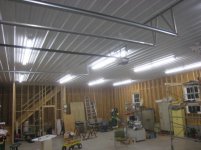
IMG_7732 - Copy 775.jpg IMG_7736 - Copy 775.jpg IMG_7741 - Copy 775.jpg

Of course, since it was a new build, I had not yet mounted any lights or fans; however, the garage door rails and openers were already installed. Simple matter to loosen and temporarily support the openers while installing the steel then reattach the supports through the steel. As mentioned above, a small hole saw was used to drill a 1" hole through the steel where the wiring passed to the lights. A 2" long threaded pipe ****** with insulating bushings was used through the steel at each light and fan to protect the wires from the sharp edges of the steel.

We did find that if there are any ceiling boxes already installed that project below the bottom of the joists you should probably pull them loose before installing the steel. Trying to cut a 3-4" round hole in a steel sheet and getting it to align properly with an existing box is nearly impossible!

There is more detail, pics, and discussion in my build thread starting at Post #84:

http://www.garagejournal.com/forum/showthread.php?t=98038&page=5

As noted in the thread, I've even added some rectangular duplex outlet boxes at selected points on the ceiling by cutting through the steel. A little care and time is required to cut a non-round hole, but easy enough to do. I generally work in my shop alone and have not found noise to be an issue, but I suspect that if there were numerous folks working on different projects it could get noisy.
 
OP
J

jonny02r6

Member
Joined
Sep 9, 2013
Messages
9
Location
Southwest Virginia
so did you take the lights down or just leave them up and cut out around them and a hole for the wires? Im trying to keep from taking them all down if possible...
 

rieferman

Well-known member
Joined
May 18, 2009
Messages
2,586
Location
Collegeville PA (30 min west of Philly)
Definitely take the lights down. For the 15 minutes worth of effort, it will be well worth it.

When I was selling these buildings for a living, we put metal ceiling and walls on MANY structures and had 100% happy customers. Never had complaints about noise (if it's that noisy of a task you should have hearing protection on anyways) and had rave reviews about how well lit the spaces were. Easy to keep clean too. Finding studs later is easy. Getting behind the wall to run more electric is easy. Magnets will stick to it. etc. etc. etc.
 
OP
J

jonny02r6

Member
Joined
Sep 9, 2013
Messages
9
Location
Southwest Virginia
ok, What would be the easiest way to reattach the lights to the ceiling. With the continuous rolling corrugated metal Im thinking it will be difficult to get them to mount flush?
 
OP
J

jonny02r6

Member
Joined
Sep 9, 2013
Messages
9
Location
Southwest Virginia
Also, since I am planning to use foam sheathing for a little bit of insulation (I dont need a whole lot). Is it best to just nail it to the bottom of the trusses? or Is there some way to cut the 4x8 sheets and kind of wedge them in between the 2x4 trusses that are on 24" centers? All in all I wouldnt be dreading this or that worried about it but the 14ft ceiling is going to make this 100 times more difficult than normal. I guess my best bet is to borrow some scaffolding from someone.
 

rieferman

Well-known member
Joined
May 18, 2009
Messages
2,586
Location
Collegeville PA (30 min west of Philly)
For mounting, the ribs are typically 3/4" so small blocks of 1" lumber (which has a real thickness of 3/4") work very nicely to space your lights to ride flush on the ribs.

Unless you have foam insulation for free somehow, batts are probably less expensive per square foot, and you'll get more R value. But, if you must use foam, I'd affix to the bottom cord of the trusses and use longer screws when attaching the steel. Less work this way. edit: but longer screws are more costly, so again, I'd recommend batts as noted in above post.

Because the material is long and goes up quickly, you'll be moving a lot. So, 3 ladders, 3 guys, and you'll zip right along. 2 ladders and 2 guys can do it easily as well, but as a newbie to this task, you'll just be a little clumsy at first.

Tip: When picking up a long piece of steel, roll it into a U shape along the long side (NOT against the ribs, WITH the ribs). This makes it rigid and easy to pickup and move. If you try to lift it flat like a pancake it's a real pain. Take a piece of paper and do the same thing and you'll see how much more rigid the paper is when rolled vs. flat.
 

383 240z

Well-known member
Joined
Dec 4, 2006
Messages
4,295
Location
Findley Twp. Allegheny Co.
My lights will be mounted in line with the trusses, so they will be 90* to the ridges in the metal. I plan on using lathe (3/4"x 1 1/2") screwed to the trusses , run between the ridges, then screw the lights to that. The lights are 2'x4' 4 bulb fluorescence lamps. I then plan on running 1/2" EMT between them for the wiring. Keith

I'm also lifting them with the HF drywall lift. Makes it a one man job. This is how I did my Dad's shop
 
Last edited:

John in OH

Well-known member
Joined
Jun 2, 2007
Messages
2,444
Location
SE Ohio & Eastern Virginia
You will need to take your lights down and put them back up later if installing metal for a ceiling.

+1 It may seem like a pain to take everything down, but it will make the installation of the insulation (foam or fiberglass) and steel much easier and quicker in the long run.

I'm sure you can do all the work off of ladders, but I bought a used two-lift section of rolling scaffold off Craig's List and it made ALL of the ceiling work much easier ... rough electrical work, insulation, steel installation, installation of lights and fans, etc. was far easier off of scaffold than ladders. You can see the scaffold that I bought in the first picture in Post #5 above.

Made the steel installation really easy as we could lay the sheet on top of the scaffold at our waist level then make the short lift to get it up to the ceiling. Our sheets were each 14'-6" long x 3' wide so they were pretty awkward to handle. I can't imagine how hard it would have been for us amateurs to do this steel install off of ladders!!
 

JMURiz

Well-known member
Joined
Dec 6, 2005
Messages
1,483
Location
NoVA
I have galv corrugated metal on my ceiling, I just cut out plug receptical holes with tin snips and hung fixtures on hook eyes. But my ceiling was a vaulted/angled roof.

Scaffolding was a must for me, luckily we had a neighbor willing to lend some to us.
 
Last edited:

911mike

Well-known member
Joined
May 22, 2010
Messages
494
Location
michigan
Don't use foam under the steel because when you tighten the screws the foam compresses and you will get dimples at every screw. The proper screws will torque down fairly tight. Another issue is finding the rafter once the foam is up. Metal is not like drywall where if you miss you just run another screw next to it. Looks like hell if you do.

I strongly suggest mounting to the rafter and then insulate from above with blown or batts.

As for mounting the lights we run them perpendicular to the ribs and screw them to the rafter. You don't need spacers if you screw through the center of a rib. Use rubber or plastic grommets at any hole that wire passes through.
 
OP
J

jonny02r6

Member
Joined
Sep 9, 2013
Messages
9
Location
Southwest Virginia
Thanks for all of the replies guys. I believe you have talked me out of the foam panels in between the steel and trusses. And someone asked what was on the roof? Shingles, with ridge vent and soffit vents. Ill post some pics soon, But I have a mess right now. Ive been putting up some panels to cover my insulated walls, and preparing to drylok the 5 runs of block around the bottom of my garage, so everything is a huge mess right now. Thanks again for all of the replies!
 

jasong70

Active member
Joined
Jan 17, 2008
Messages
26
Thanks for this. I'm going to re-do my attached garage this way and when my new detached is going up, I'm putting this in too. Anyone ever do silver?

I installed white steel on the ceiling of my new shop and totally love it!! But rather than using foam above the steel, I placed regular kraft-faced fiberglass insulation batts between the ceiling joists. Easy to install the fiberglass and it has a much higher R value ... I used R-30.

The steel sheets are attached directly to the ceiling joists. They are rather awkward to handle so it will take at least 2 people, preferably three or more, to do the installation. But once the sheets are up, you're done ... no joint taping, no sanding, no priming, no painting and the light reflection is terrific!

IMG_7732 - Copy 775.jpg IMG_7736 - Copy 775.jpg IMG_7741 - Copy 775.jpg

Of course, since it was a new build, I had not yet mounted any lights or fans; however, the garage door rails and openers were already installed. Simple matter to loosen and temporarily support the openers while installing the steel then reattach the supports through the steel. As mentioned above, a small hole saw was used to drill a 1" hole through the steel where the wiring passed to the lights. A 2" long threaded pipe ****** with insulating bushings was used through the steel at each light and fan to protect the wires from the sharp edges of the steel.

We did find that if there are any ceiling boxes already installed that project below the bottom of the joists you should probably pull them loose before installing the steel. Trying to cut a 3-4" round hole in a steel sheet and getting it to align properly with an existing box is nearly impossible!

There is more detail, pics, and discussion in my build thread starting at Post #84:

http://www.garagejournal.com/forum/showthread.php?t=98038&page=5

As noted in the thread, I've even added some rectangular duplex outlet boxes at selected points on the ceiling by cutting through the steel. A little care and time is required to cut a non-round hole, but easy enough to do. I generally work in my shop alone and have not found noise to be an issue, but I suspect that if there were numerous folks working on different projects it could get noisy.
 

Rookie2

Well-known member
Joined
Feb 27, 2013
Messages
1,925
Location
Western Pa.
If you have shingles then you can pretty much treat it as you would a house . Batts or foam ,your looking for R value though. I would take the lights down and reinstall them. if you go with foam don't over tighten the screws thats all but findind the truss to screw the panels to (after you install the foam)will be a PITA.
 
To avoid these ads, REGISTER NOW!

Mr onetwo

Well-known member
Joined
Apr 6, 2011
Messages
2,006
Location
Coastal Maine
Like others have said....I used white ribbed steel.There are no noise issues and the brightness is great.I have scissor trusses and R30 fiberglass insulation.We strapped 2ft OC and screwed the metal to the strapping with painted stitch screws.I used 6500K T8 fixtures and it is very nice to work in.I would not use corrugated galvanized....too dark IMHO.:thumbup:
 

Attachments

  • 100_2754.jpg
    100_2754.jpg
    131.4 KB · Views: 666
  • 100_2755.jpg
    100_2755.jpg
    135.6 KB · Views: 591

BirdRacer

Well-known member
Joined
Dec 2, 2008
Messages
236
Like others have said....I used white ribbed steel.There are no noise issues and the brightness is great.I have scissor trusses and R30 fiberglass insulation.We strapped 2ft OC and screwed the metal to the strapping with painted stitch screws.I used 6500K T8 fixtures and it is very nice to work in.I would not use corrugated galvanized....too dark IMHO.:thumbup:

I don't want to hijack, but do you have a thread, or any more details and pics of your bridge crane setup?
 

rieferman

Well-known member
Joined
May 18, 2009
Messages
2,586
Location
Collegeville PA (30 min west of Philly)
Mr. OneTwo calls out a good point about using strapping. The steel can span up to 4' spacing but hitting the edge of a truss reliably isn't nearly as easy as hitting the wide side of strapping more frequently.

Also, tip: With your stack of material carefully lined up, measure where your strapping will be (and thus, where your screws will be) and use a nail set to telegraph your screw locations through the stack of material (sometimes, it won't go through all of them, but you can repeat this procedure as you pull sheets off the pile). This will ensure that your screw lines are right on the money, and the small indent will also give the screws a place to start so that they don't wander.
 

Wallyman

Well-known member
Joined
Oct 18, 2011
Messages
107
Location
West Michigan
Mr. OneTwo calls out a good point about using strapping. The steel can span up to 4' spacing but hitting the edge of a truss reliably isn't nearly as easy as hitting the wide side of strapping more frequently.

Also, tip: With your stack of material carefully lined up, measure where your strapping will be (and thus, where your screws will be) and use a nail set to telegraph your screw locations through the stack of material (sometimes, it won't go through all of them, but you can repeat this procedure as you pull sheets off the pile). This will ensure that your screw lines are right on the money, and the small indent will also give the screws a place to start so that they don't wander.

Help me out here.. "strapping".. not familiar with the term, what is that?

I'm currently struggling on the start of installing pro-rib metal on my ceiling, and can use all the help I can get! I've got 2' OC trusses with foam board insulation (also partially installed - working in a shop full of **** is a real pain). Should I be doing anything other than just screwing the metal to the joist? I did 8' panels to make my life easier (shop is 28'w x 48' long).
 

gnxtc2

Well-known member
Joined
Sep 3, 2010
Messages
304
Location
New york
My joists are 24" OC. I ordered my panels 10'6" so I have some over lap in case a joist was on center exactly. My shop is 60'L x 35' W. Ceiling insulation is R30.

You want to start from the back and work forward so you don't see the joints from the front (like vinyl siding). I put up the metal panels perpendicular to the joist. If you have to install the panels parellel to the joists, you have to add strapping. See the pics of the walls.

The panels were screwed into the joists. I ordered the screws with panels so the screw heads match.

DSC_0027.jpg

DSC_0028.jpg

DSC_0033_zps371e42d6.jpg
(GF got in the pic) :dunno:

After the ceiling was put up, I did the walls. Since the panels were installed parellel with the studs, I added metal strapping. Where the wall meets the ceiling, there is J channel. At the bottom, there is rat guard (Z channel). Wall insulation is R19. Bottom is 1/2" plywood with 2 coats of oil base Kilz and one coat of Sherwin Williams oil base enamel.

DSC_0087.jpg

DSC_0106.jpg

DSC_0198_zpsedf56b38.jpg

Ceiling height is 12', wish it was 14' but it'll do. The lights are 8' T8s, with 850 bulbs.

Billy T.
[email protected]
 
Last edited:

sweetcretin

Well-known member
Joined
Oct 3, 2013
Messages
45
Location
Fargo, ND
Rather than manhandling the sheets into place, I suggest a Panellift. The chain driven ones are better and should hit 12' ceilings without an extension. Makes the job really nice with just two guys.
 

Wallyman

Well-known member
Joined
Oct 18, 2011
Messages
107
Location
West Michigan
perpendicular to the joist. If you have to install the panels parellel to the joists, you have to add strapping. See the pics of the walls.
Billy T.
[email protected]

Billy,

That's what I needed, thanks! I too and working perpendicular to joist, so no strapping needed there. I started from the back (never thought about the overlap visibility, good idea!) mainly because it was the more tricky of areas to deal with so I figured cut my teeth there where it won't show as much if it isn't great. :)

Wallyman
 

Highbeam

Well-known member
Joined
Feb 15, 2011
Messages
2,292
Location
Mt Rainier foothills, WA
Billy,

That's what I needed, thanks! I too and working perpendicular to joist, so no strapping needed there. I started from the back (never thought about the overlap visibility, good idea!) mainly because it was the more tricky of areas to deal with so I figured cut my teeth there where it won't show as much if it isn't great. :)

Wallyman

Always start any repetitive task in the back, your skill level will improve as you gain experience.
 

Wallyman

Well-known member
Joined
Oct 18, 2011
Messages
107
Location
West Michigan
Ok, guys, I am struggling.

Starting at the back, in a corner. I am using 8' panels. The first one I had to cut at 54" long for an obstruction (cut as in cut off, it's a 2x4 that holds up a perimeter shelf). So Icut the panel at 54, cut in a notch for the 2x4, and put it into place. Fit is fine, nothing seems off. I put the remainder of that 8' up after the obstruction, and it is crooked, the far end (8' from end wall) is wider than the rest of the panel(s).

I cut it off using tin snips, and it looked like I stretched the ribs in doing so. I measured an uncut panel at 37 7/8" edge to edge, and I squeezed and fiddled with the cut one to get it back to the same. I put it up, and it is still not right.

I probably need some photos but too ****** discouraged right now to take any. I used plastic J channel along the side, and the panels are all inserting the same depth. measuring out from the face of that wall, I am getting:

37 7/8" at the end wall
37 7/8" at the 54" mark (end of cut panel)
38 1/4" at the end of the second half of that panel

It's crooked (wider so it doesn't line up) and looks like ****.

What am I doing wrong? Is my cutting with tin snips going to be the issue? I have a **** ton more obstructions like that and I don't want to aggrevate myself for the entire job.. should I be using something else?? :dunno:

Really discouraged, any advice appreciated.
 

smokem2020

Well-known member
Joined
Jul 21, 2011
Messages
92
Location
Rossville In
snap a chalk line to keep your steel running in a straight line. you will be glad you did. I didn't and wish I had.
 

John in OH

Well-known member
Joined
Jun 2, 2007
Messages
2,444
Location
SE Ohio & Eastern Virginia
Ok, guys, I am struggling.

Starting at the back, in a corner. I am using 8' panels. The first one I had to cut at 54" long for an obstruction (cut as in cut off, it's a 2x4 that holds up a perimeter shelf). So Icut the panel at 54, cut in a notch for the 2x4, and put it into place. Fit is fine, nothing seems off. I put the remainder of that 8' up after the obstruction, and it is crooked, the far end (8' from end wall) is wider than the rest of the panel(s).

I cut it off using tin snips, and it looked like I stretched the ribs in doing so. I measured an uncut panel at 37 7/8" edge to edge, and I squeezed and fiddled with the cut one to get it back to the same. I put it up, and it is still not right.

I probably need some photos but too ****** discouraged right now to take any. I used plastic J channel along the side, and the panels are all inserting the same depth. measuring out from the face of that wall, I am getting:

37 7/8" at the end wall
37 7/8" at the 54" mark (end of cut panel)
38 1/4" at the end of the second half of that panel

It's crooked (wider so it doesn't line up) and looks like ****.

What am I doing wrong? Is my cutting with tin snips going to be the issue? I have a **** ton more obstructions like that and I don't want to aggrevate myself for the entire job.. should I be using something else?? :dunno:

Really discouraged, any advice appreciated.

Hmmm, yeah, cutting the ribbed steel is not an easy task .... cross-wise or length-wise.

So, for clarification, regarding the cut 42" panel described above ... one end width is 38-1/4" ... so what is the width of the other end?

Charles (in GA) offers a good suggestion regarding the fine-tooth circular saw. I've also heard that you can cut steel sheets by using a plywood blade by installing it backwards, but I've never seen it done ... it does sound sort of goofy so proceed with caution!! Suffice it to say you should use ALL the personal protective equipment that Charles recommends as those flying steel cuttings are wicked and the saw literally shrieks!!!

I've seen a local contractor use an electric "nibbler" (sort of like sissors but with three blades) to cut steel sheets. There is also a nibbler adapter that can be clamped to an electric drill that is supposed to work pretty well. If I recall, this nibbler drill adapter is made by Malco and costs about $70. Or, maybe you can try a different style of tin snip or maybe work on refining your tin-snipping technique.
 

vision8

Well-known member
Joined
Jan 19, 2012
Messages
124
Location
Southern Ontario Canada
Use a skill saw, reverse a plywood blade ( so it turns in the opposite direction that it made to turn ) ; wear ear and use eye protection. Did all of my soffit and vent cutting using this method.
 

SI86

Well-known member
Joined
Aug 30, 2013
Messages
71
Location
Pennsylvania
Hmmm, yeah, cutting the ribbed steel is not an easy task .... cross-wise or length-wise.

So, for clarification, regarding the cut 42" panel described above ... one end width is 38-1/4" ... so what is the width of the other end?

Charles (in GA) offers a good suggestion regarding the fine-tooth circular saw. I've also heard that you can cut steel sheets by using a plywood blade by installing it backwards, but I've never seen it done ... it does sound sort of goofy so proceed with caution!! Suffice it to say you should use ALL the personal protective equipment that Charles recommends as those flying steel cuttings are wicked and the saw literally shrieks!!!

I've seen a local contractor use an electric "nibbler" (sort of like sissors but with three blades) to cut steel sheets. There is also a nibbler adapter that can be clamped to an electric drill that is supposed to work pretty well. If I recall, this nibbler drill adapter is made by Malco and costs about $70. Or, maybe you can try a different style of tin snip or maybe work on refining your tin-snipping technique.

I have Cut steel garage doors like you said by turning the blade backwards... It does actually work believe it or not.
 

sweetcretin

Well-known member
Joined
Oct 3, 2013
Messages
45
Location
Fargo, ND
If you have a metal cutting saw, use it. Otherwise, blade backwards is the way to go if you only have a circ saw.

You don't have to use a plywood blade, any blade will work, but the fewer teeth, the rougher the cut (none will really be visible on a 12' ceiling, but you can clean the edge with a grinder or file if you desire). The thinner the kerf the easier it is to push the saw.

Wear hearing, face/eye protection, and gloves. It is very loud and throws little slivers of metal everywhere. Also, don't use a blade you care about because it's going to be ruined. We use our trashed plywood and framing blades.

Make sure you support the metal as well as you can during the cut. As you've found expanding the ribs makes for an annoying install.

To fix the "stretched" panel, you can lay it upside down in an undamaged sheet to determine where the ribs are flattened. Use some 1x2 in the ribs and a little creative bending (push the valleys towards each other while pushing down on the 1x2) to deepen the ribs until the panel is the proper width again. You should also take the time to snap chalk lines on the joists to mark the edge of the panels so you know that they are the proper width before nailing.

If needed, you can bow the middle of the panel down a little to make the edge line up and then force the panel flat against the joist using a 2x4 as you screw off the middle. This should result in narrowing of the ribs not waves in the panel.
 

Wallyman

Well-known member
Joined
Oct 18, 2011
Messages
107
Location
West Michigan
Ok, fresh look today yielded a decent approach. With the corner 47" installed, and the next 54" removed, I installed the second panel out from the side wall. This gave me a hard edge to work the extra-wide panel off, and I was able to get it about 97% right. I screwed it down at the long panel and just worked teh bowing up agaisnt the truss and screwed as I went. When I continue that first (side wall) run, I hope to force the last 3% and get it right.

I dug out an old plywood plade and isntalled that on the circular saw, so I am ready for some noisy cutting. Of course my neighbor is having a wedding in his backyard tomorrow so I won't be able to do any then.. :sad: I reseigned myself today to just pick up the shop wherever I can since my helper (the 16 y.o. stepson) is at the GF's house (gotta teach that boy some priorities!)

Thanks guys for the tips, I hope to put them to use in the next few days and will report back progress (and photos).. I must say puttign this up has been the most frustrating thing so far.
 

Justanoldguy

Well-known member
Joined
Jun 1, 2008
Messages
3,673
Location
Atiamuri. Central North Island. New Zealand
I would suggest a different material for ceiling cover. Metal is going to reflect 300% of the sound or so it will seem.:D If you have ever been to a Texas Road House you will notice how noisy it is during diner. It's mainly from the corrugated steel they use everywhere.

If you don't want to use dry wall look at 3/16 plywood underlayment. It will also be easier to work with.

I will just add that the noise factor mentioned here is just a myth for the most part.
I've installed many ceilings like this over the years and no-one has come back with noise complaints. :D
 

Wallyman

Well-known member
Joined
Oct 18, 2011
Messages
107
Location
West Michigan
Dakota - The Pro-Rib panels I bought at Menards.. in stock as 8', 10' in white and special order other colors and any size in 1" increments (I did that for the 10'4" roof pieces I needed for a wood shed I built a year and a half ago, worked fine and was 2 weeks lead time or so).

Finally got around to installing some of it, lessons learned:

Rolling scaffold a MUST. Rent at Menards for $8 for day 1, $4 each day after. Started on ladders and that was stupid, scaffold is king. Also, I grabbed a couple of CoolWhip plastic tubs, drilled a couple holes and tywrapped to the upper bars so screw buckets are within reach, one on each end. Never knock them over and always one-handable to grab more while you are holding a panel over your head.

Reverse fine tooth blade = good, but noisy as heck, throws shavings everywhere and leaves ragged edges (no different than a cutoff wheel). Just hit it with a file and it is cleaned up. We ended up using the cutoff wheel on the 4.5" instead, not as straight of cuts but mine are all covered and it was more manageable to use.

Put all your ceiling **** in LATER. :mad: I had done all mine ahead of time (thinking I would never do a metal panel ceiling) and it's hellish to cut around everything. I have 12-10" round ceiling speakers :)eyecrazy: yes, overkill but I got a smoking deal on a school gym take-out 70V system!), 4-8" round heat vents, 1-12" HVAC supply, 1-8" black pipe chimney, 1 air shutoff for the hose reel, 3-1/2" conduits, 2-2" pipes (traffic light and TV mount), 15 outlets, 4 ceiling fans, garage door bracing, GDO... it *****.

If you foolishly did ceiling mounted stuff first like me, the tools to deal with it all:

  • 4.5" angle grinder with a pile of cutoff blades from HF works great for:
    -outlets/straight cuts
    -Trimming off ribs for faceplates
    -'adjusting' cuts when you are a little long
    -angle iron holes for the GDO and GD supports
  • Malco HC1 hole cutter works perfect for round holes up to 12" diameter.
  • Unibit for conduits up to 3/4", you have to pull and reinstall the conduits but super clean.
  • Holesaw kit for round holes bigger than 3/4" (2" for the TV mount & traffic light). Also have to remove and reinstall.

Worst ones were teh chimney and 12" supply, had to cut the hoels and then cut the panel to fit around them, so I have like 3-4 overlaps within 8'.. panel end, then chimney cut, then supply cut, then panel end again.

To trim out the exposed rib ends for things like outlet covers and speaker grilles, I bought a pack of "Tuftex 5-Pack 1-in x 36-in Square Cross Link Polyethylene Exposed Fastener Closure Strips" from Lowes. It isn't the shape of the panels but you want individual humps not full strips. This one gives the most humps for the buck :wtf:. I cut the individual humps out and tuck them into the exposed ends, really cleans it up and gives a more finished look.

In stock 8' panels are convenient to buy, but a ***** to put up since I have 2' OC trusses and you need overlap so after panel #1, you have saggy ends without hitting a truss. I bought a bag of 500 white head steel 1/8" pop rivets (cheap on ebay), and am riveting any saggy joints on the ribs and mid-point between the ribs. A little time consuming but cleans up a lot and nearly invisible from the ground on my 10' ceiling.

Cord and plug for the ceiling lights works fine, and "Ty-rap mounting head ties" such as teh T&B L-7-50MH-9-C screwed in with 1/4" selftapping sheet metal screws work good for clean cord routing and keeps them out of the ceiling fan blades. :shocking:

For small things that need to be trimmed out like the air supply cord reel connection (mine is a recessed box) we had to cut the end trim stuff and rivet it to the panel instead of screwing it to the ceiling since you can't tuck the edges in due to the overlap nature of the stuff. Worked out well but you have to be spot on with measurements to make it work.

Utilizing free brother-in-law labor (all 4 of them in fact), we managed to knock out about half of the ceiling in maybe 8-10 hours working, doing the worst stuff first with the most cuts in it. I need to get xome photos of the progress, but it is lookign decent. Could be a tad straighter, holes could be a smidge tighter.. but free labor is free labor and who looks at the ceiling after it's installed?

Lots of work, but I think it looks so much better. Hope to post some pictures as it gets done.
 
To avoid these ads, REGISTER NOW!
Top Bottom