To avoid these ads, REGISTER NOW!

Cotter pin

To avoid these ads, REGISTER NOW!

NewShockerGuy

Well-known member
Joined
Oct 12, 2010
Messages
2,481
Location
Northern Virginia / DC
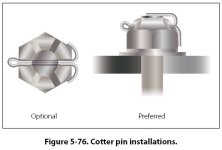
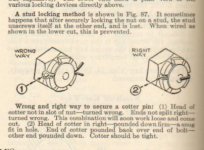
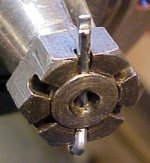
I was doing them by what was pictured. Bending the legs outward.

Then searching brought this thread up with some pictures. More pictures online and I see the following:

Who knows now. Stock on my STi the ones pictured below are how it was done at the factory. (not my pics just showing examples)

-Nigel
 

Attachments

  • cotter pin.jpg
    cotter pin.jpg
    23.6 KB · Views: 125
  • PinIn.jpg
    PinIn.jpg
    17 KB · Views: 89
  • PinBent.jpg
    PinBent.jpg
    13.3 KB · Views: 87

LS6 Tommy

Well-known member
Joined
Dec 27, 2013
Messages
26,162
Location
Northern NJ
I have a solution for you! Behold, the R-clip!

R_CLIPS.jpg

Try getting a Jeezus clip like that under a wheel bearing dust cover...:lol:

Tommy
 

LS6 Tommy

Well-known member
Joined
Dec 27, 2013
Messages
26,162
Location
Northern NJ
What do they do in aviation?

http://navyaviation.tpub.com/14014/css/Cotter-Pins-119.htm

Turns out either way is OK, but one end over the bolt and the other bent back against the nut is preferred.

That's the way I do it for castellated nuts. Maybe it's because when I was little, Dad worked for Curtis Wright and sometimes I used to go to work with him on Saturdays. For securing something like a pin where you can't go over the end of the fastener, I just bend the ends back, trim and contour to the fastener as best as I can.

Tommy
 
Last edited:

ZipSnafu

Well-known member
Joined
Mar 8, 2011
Messages
410
Location
Virginia
To me it just depends on the application. Most of the time I tap them in snug, bend one end and snip the other. This way it is easier to remove.
 

JR7

Well-known member
Joined
Jan 2, 2018
Messages
51
Location
NE Ohio
For aircraft I use the top-down method.

For my car I do both depending on access.
 

driftpin

Well-known member
Joined
Dec 22, 2016
Messages
11,304
Location
Miami-Dade/Broward Co. Florida
In the Naval Aviation online text, in the illustration the link takes you to, they label the long end of the cotter pin 'pong.' I hadn't heard of that term before, and thought I had learned something today, until I realized it was a typo, and they meant, "prong."

I usually use the "bend the prongs around the perimeter of the nut" method. On my motorcycle castellated nuts for axles, I usually replace the factory cotter pin with an R clip. Reusable, and inexpensive, and if you have to do something on the side of the road, you don't have to worry about metal fatigue, and breaking the cotter pin upon re-use.
 
To avoid these ads, REGISTER NOW!

dbabicky

Well-known member
Joined
Dec 30, 2012
Messages
874
Location
NE Wisconsin
About 25 years ago I was killing time in the library of the CW Post Campus of Long Island University and I ran across an SAE paper that covered this very topic. According to that paper the correct method is the one Tony posted with the long leg bent over the bolt/stud and the short end bent over the nut, cut to where it touches the washer. That sticks in my mind because of where I was when I read it, the fact that I was bored enough to be reading an SAE paper and because that's not how I had been doing it prior to then.

This was the way I was taught how to do it in Jet Engine Tech School in the Air Force. I do not know if the Air Force has changed their mind or not, but, it's how it was to be done on all Air Craft maint. as of 2004 when I retired.
 

why worry

Well-known member
Joined
Oct 3, 2014
Messages
301
I prefer to bend them over. Since I have had to remove things that others have welded, I can honestly say that it is a first class pain in the @#$% and can get rather spendy to boot!
Dave
 

Schurkey

Well-known member
Joined
Oct 27, 2011
Messages
2,378
Location
The Seasonally Frozen Wastelands
I bend the end over the top and trim the lower piece short.

I use a diagonal cutter to pull them out.
^^^ That's me, although there have been a few times I've used a specially-bent "awl" to pull the pins out. Mine's like this, but lots older--black hard handle
https://store.snapon.com/Soft-Grip-Hose-Picks-Soft-Grip-Cotter-Pin-Puller-P823985.aspx
SGCP1BO.jpg

I guess I've been installing 'em "wrong" for three decades. Shucks.

How many of you turn the ball joint or tie-rod end stud so that getting at the cotter pin for installation (and therefore removal) is easier?
 

493mike

Well-known member
Joined
Jul 24, 2015
Messages
148
Location
mid Michigan
One other suggestion if I may: Antiseize the little buggers so they might not rust in place!
( I live in MI-salt capital of the world )
Mike
 

Vegaman_Dan

Well-known member
Joined
Jun 1, 2012
Messages
2,453
Location
Pacific, WA
Metal cotter pins? Sheesh, are you guys all made of money?

Plastic zip ties and JB Weld. Works great and my customers never come back to complain.

Hmm, come to think of it, they don't come back at all. Nah, probably completely unrelated.

.......

But seriously, this is where having one of those assortment packs of cotter pins from Harbor Freight, TSC, or Amazon comes in very handy. I like having those assortment packs for snap rings, E clips, roll pins, O rings, etc. Nothing like being in a repair in your garage or driveway and discover you need a 10 cent clip that just broke and it will take an hour to get to the store and back. That extra trip gets expensive, because you can't just go to the store for ONLY a single clip. I mean, check that shelf over there- more grease you might need. And some more blue towels. Maybe some grease zircs. You know, your grease gun could use a new whip hose. OOOOOH, they have new welding gloves.

Somehow those 10 cent clips cost me $200 in extra purchases.
 

apollo11

Banned
Joined
Aug 19, 2017
Messages
1,226
Location
State Of Reality
^^^ That's me, although there have been a few times I've used a specially-bent "awl" to pull the pins out. Mine's like this, but lots older--black hard handle
https://store.snapon.com/Soft-Grip-Hose-Picks-Soft-Grip-Cotter-Pin-Puller-P823985.aspx
SGCP1BO.jpg
I guess I've been installing 'em "wrong" for three decades. Shucks.
How many of you turn the ball joint or tie-rod end stud so that getting at the cotter pin for installation (and therefore removal) is easier?
I use angle dikes since I never re-use pins unless it's an emergency of some sort. Easier and quicker

Isn't that common sense?
 
To avoid these ads, REGISTER NOW!
Top Bottom