To avoid these ads, REGISTER NOW!

Covered porch receps

AntonLargiader

Well-known member
Joined
Nov 20, 2016
Messages
1,372
Location
Charlottesville, VA
We are finally getting a screened-in porch built where an older version of the porch used to be. I'm going to do the electrical which is pretty simple: receps, fans and lights with either two or three switches.

I want two receps on the porch; they'll be about 4' from the edge and maybe 12' from an edge. My understanding is that they don't need in-use covers but I'm going to install the receps before the construction (for accessible power for the contractor) and during some of that time there will be no roof so I'll add in-use covers if the contractor wants them. They probably won't be working in the rain until there's a roof on it.

It's a solid brick wall, with the stairway to the unfinished basement on the inside. I'm thinking metal bell boxes on the outside, waterproof covers, conduit through the brick and then NM-b to the panel which is about ten feet away. On the stairwell side I'd fasten a 2x4 to the brick and fasten the NM-b to that for support. Or just use EMT for all of the exposed stairwell part.

Thinking about the GFCI protection, I prefer protection at the breaker (because it protects everything if water gets in) but if the workers get nuisance trips it would be easier to reset them at the recep. The panel is pretty easy to get to, though. GFCI at panel vs recep, thoughts?

Other stuff sound about right?
 
To avoid these ads, REGISTER NOW!

Falcon67

Well-known member
Joined
Jun 11, 2009
Messages
18,371
Location
Merkel, TX
My shop is full of GFCI outlets and the race trailer uses GFCI outlets on the exterior and in the bath. No nuisance trips. Air compressors, battery chargers, fridge in the shop, drill press, etc, etc. Last GFCIs I had trouble with were after a bad lightening storm that also blew out all the landscape lighting. No direct hit, hit a pole some distance away. After replacing those GFCI outlets I also installed surge units in both panels.
 

kd3pc

Well-known member
Joined
Aug 10, 2013
Messages
3,630
Location
Northern Neck
code in VA may require every wall or every so many feet for receptacles and TR ones at that in addition to the GFCI.
 
OP
A

AntonLargiader

Well-known member
Joined
Nov 20, 2016
Messages
1,372
Location
Charlottesville, VA
I have no issue with TR and of course these will be WR. AFAIK we are essentially on an older NEC and that specifies one recep for a porch. I intend to install two, on about 15' of wall.

For indoor use I'd go with GFCI receps, but for outdoor/damp location I feel like I'd rather protect the entire circuit rather than just the device. I'll may wire the whole thing on one 20A GFCI circuit. Lights are all likely to be LED and there will be two fans. Not a lot of load.

I'll work up a diagram and post it at some point. I should probably get moving on this within a week or two.
 

Janda21

Member
Joined
Apr 23, 2019
Messages
5
Location
Bali
code in VA may require every wall or every so many feet for receptacles and TR ones at that in addition to the GFCI.

+1
b.png
 
OP
A

AntonLargiader

Well-known member
Joined
Nov 20, 2016
Messages
1,372
Location
Charlottesville, VA
I want to install the boxes. Reading a bit, it seems that I should use galvanized steel "masonry boxes" like Garvin and Raco make. Thinking back to some roofing stuff, aluminum and mortar don't get along really well so aluminum Bell boxes (my initial thought) probably wouldn't be that great.

I have been planning to mortar the boxes into place. Are the Raco/Garvin boxes the ones I want? Would anything else be good?
 

cybrdyke

Well-known member
Joined
Sep 9, 2014
Messages
3,442
Location
USA
I want to install the boxes. Reading a bit, it seems that I should use galvanized steel "masonry boxes" like Garvin and Raco make. Thinking back to some roofing stuff, aluminum and mortar don't get along really well so aluminum Bell boxes (my initial thought) probably wouldn't be that great.

I have been planning to mortar the boxes into place. Are the Raco/Garvin boxes the ones I want? Would anything else be good?

You use masonry boxes if you are going to put the boxes INTO the wall when you are stacking the bricks. You use the WP boxes when you are going to put the boxes ONTO the wall after the bricks are stacked.
CD
 
To avoid these ads, REGISTER NOW!
OP
A

AntonLargiader

Well-known member
Joined
Nov 20, 2016
Messages
1,372
Location
Charlottesville, VA
Cyberdyke: I wasn't clear in my previous posts. I am recessing these boxes into the wall. Cutting out a brick (or most of one) and setting these boxes flush. They will be fed from the back.

Charlie: the links are to the specific boxes I am referring to.
 

Slowgsr

Well-known member
Joined
Nov 14, 2014
Messages
610
Location
Southern ontario
Cyberdyke: I wasn't clear in my previous posts. I am recessing these boxes into the wall. Cutting out a brick (or most of one) and setting these boxes flush. They will be fed from the back.

Charlie: the links are to the specific boxes I am referring to.

that's what I do, unless the customer is super cheap. Takes an extra hour to drill/cut/chip away stone brick etc to recess a box.

I just use a standard 1110 galvanized box, feed from the back. Some PL premium around the edge bonds the box to the brick then once dry I put my gfci in, my in use cover and caulk from the cover to the wall.

I had a customer decline an outside plug she wanted when I told her I had to use an in use cover, she would rather have no outlet. Suit yourself.
 
OP
A

AntonLargiader

Well-known member
Joined
Nov 20, 2016
Messages
1,372
Location
Charlottesville, VA
Finally getting around to installing these receps. I belatedly realized that the installation of the box in the masonry isn't exactly waterproof, but Slowgsr's post pretty much describes my intended solution.

Am I correct in that there is no actual 45 degree rule defining wet vs. damp locations? I want to install one box about 4' from the screened end wall (roughly 8' tall screen) but there is no way it will normally see beating rain or runoff due to the screen, the gutter, the roof overhang and the prevailing wind direction. I want to avoid having to use in-use covers, and would caulking the cover to the brick even count as a waterproof enclosure as far as runoff goes?
 

Shiftless

Well-known member
Joined
Mar 9, 2014
Messages
14,520
Location
East Bay SFO
It seems to me you don’t need “in use” cover unless there is something plugged into it all the time. The waterproof covers for outdoor occasional use are much less bulky.

My porch receptacles, double gang, have big in use covers because I have koi pond water and air pumps plugged in 24-7. They are downstream fed through an indoor GFCI receptacle.
 
Last edited:
OP
A

AntonLargiader

Well-known member
Joined
Nov 20, 2016
Messages
1,372
Location
Charlottesville, VA
Well, I don't think you can say that in-use covers are only needed when you use the recep. The NEC is all about the likely intended use of various stuff, and a recep in a wet location is going to be used as a recep in a wet location and therefore would need an in-use cover IMO. The user can't be expected to change the cover when he wants to use it.

I guess my only real questions are:
1) is the location I describe considered wet
2) is the solution I describe adequate for damp
 

Shiftless

Well-known member
Joined
Mar 9, 2014
Messages
14,520
Location
East Bay SFO
The Code doesn't see it that way at all.

Do you mean that ALL outdoor receptacles need in use covers?

I’m not an electrician but I want to learn about this topic.

What are these intended for? I have one of these covers on a receptacle that is only used once in a while for a power tool, etc.

Edit I just read sections of the 2014 code and I see that these covers are only good for “damp” locations. The “in use” covers are now required in all “wet” locations whether or not a cord is attached full time.

A.E.N. Thanks for educating me...this thread is GREAT!
.
.
 

Attachments

  • 42DCAAED-CA65-4EF8-97C0-337DA7747928.jpeg
    42DCAAED-CA65-4EF8-97C0-337DA7747928.jpeg
    36.5 KB · Views: 12
Last edited:
OP
A

AntonLargiader

Well-known member
Joined
Nov 20, 2016
Messages
1,372
Location
Charlottesville, VA
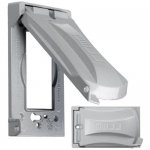
I am using similar covers to what you show, for a damp location. I'm using the type with two separate covers since I'm using old-style receps. I can do that because I'm GFCI at the breaker.

Looking for a suggestion on the wiring. Two boxes recessed into a solid brick wall with a hole going out the other side. Both of those holes come out in the stairwell to an unfinished basement and I could probably technically get away with NM-b there but I don't want that. I was thinking of conduit between them and then NM-b from there to the box where it isn't exposed. What's a good way to do that?

I was thinking of conduit out the back of the box, through the wall and then a pull elbow and a Tee connecting the two stubs. From the Tee I could use an EMT-to-NM-b clamp. I want to keep the conduit snug to the wall, though, and the fittings I see stand off a bit. I guess I could enlarge the holes and push the assembled conduit in, then locknut them to the boxes. Easier to just use MC with a JB at the second hole but a bit ugly.
 
OP
A

AntonLargiader

Well-known member
Joined
Nov 20, 2016
Messages
1,372
Location
Charlottesville, VA
OK, finally ready to put these in after some stupid difficulties with not having a large enough hole through the brick. At this point I have a kind of mix of wiring methods but I think it works:

  • Metal masonry boxes in the exterior holes.
  • Metal LB and Tee boxes on inner wall
  • Rigid pipe connecting the boxes to the LB and T (no room for EMT fittings behind the various parts) threaded into the LB and held with a nut inside the back of the box. This basically holds the two together through the wall (times two).
  • EMT connecting the LB and Tee on the inside (exposed in stairwell).
  • NM-B from the panel to the Tee and into the first box
  • THHN from the first box back to the Tee, to the LB and to the second box

I believe I can use bare ground wire in the THHN section, right?

Also, how far from a box can you strip the sheathing off the NM-B? For instance, I just removed a surface mounted switch box that had PVC conduit going through the ceiling. The end of the conduit had an NM clamp on it and the wires were loose from there down into the box. Made perfect sense to me but technically I suppose it was loose NM-B wires in conduit.
 
To avoid these ads, REGISTER NOW!
Top Bottom