To avoid these ads, REGISTER NOW!

Covering up a ground rod

NUTTSGT

Super Moderator
Staff member
Joined
Sep 14, 2009
Messages
50,904
Location
Northern Central Ohio
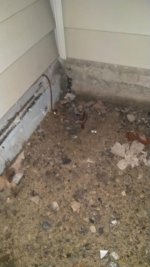
I've seen many ground rods driven down under ground level to be mown over or covered with mulch. Still access to them with a little digging.

However, the ground rod I just installed in going to be in the apron area outside the front overhead door. Where I have it driven to, is probably going to be under the surface of the concrete.

Am I going to have to pull it up so the clamp clears the surface of the concrete ?

I won't be pouring the slab until Spring as it has gotten too cold here and i need to work on the inside.


attachment.php
 

Attachments

  • KIMG0687.jpg
    KIMG0687.jpg
    50.9 KB · Views: 513
To avoid these ads, REGISTER NOW!

captaindiode

Well-known member
Joined
Jul 8, 2013
Messages
370
Location
NC
Don't most installations require 2 ground rods now? Unless you can prove 25 ohms or less to ground.
 
OP
N

NUTTSGT

Super Moderator
Staff member
Joined
Sep 14, 2009
Messages
50,904
Location
Northern Central Ohio
No thats not a question but that is code here anyhow

Sent from my SM-N981U using Tapatalk

Yes, I get that. If burying it is okay, then I'll drive another rod, which I believe, has to be 6' away.

If it's not ok, I'll drill through the concrete floor for one when I pour the apron. The other will get attached to the rebar grid in the apron.
 

casmurbax

Well-known member
Joined
Sep 25, 2012
Messages
2,757
Location
Wilton, NY
I have a dumb observation question.

Is this grounding rod in the sub panel that you just installed? if it is, isn't that considered to be an attached structure? If that is the case, does it even need a grounding rod?
 

wyliesdiesels

Well-known member
Joined
Aug 14, 2012
Messages
19,998
Location
Modesto, CA
I've seen many ground rods driven down under ground level to be mown over or covered with mulch. Still access to them with a little digging.

However, the ground rod I just installed in going to be in the apron area outside the front overhead door. Where I have it driven to, is probably going to be under the surface of the concrete.

Am I going to have to pull it up so the clamp clears the surface of the concrete ?

I won't be pouring the slab until Spring as it has gotten too cold here and i need to work on the inside.

attachment.php

you can bury it in concrete. not an issue.

Don't most installations require 2 ground rods now? Unless you can prove 25 ohms or less to ground.

yes per 250.53(2)

As long he has GEC inside going to his water pipe with in 5 ft coming in the house, he is ok. That rod is for lightning strikes . At least that is how it is done here

Sent from my SM-G960U using The Garage Journal mobile app

thats not quite right

in order for a water pipe to be permitted to be an electrode under the NEC for such things as lightning strikes, it must be in contact with the earth for a minimum of 10' per 250.52(A)(1)

nowadays, what with plastic water service lines, this isn't possible.

Furthermore, telling someone they can use the water line as an electrode is not a good idea unless you and they know it meets the requirements of the above code.

The bonding within 5' of it entering the house, that you mentioned, has nothing to do with the requirements for it to be considered an electrode. That has to do with bonding and is required regardless if the water line is to be used as an electrode or not.

That's not really the question at hand. Im working on something and need to make sure this is going to be okay.

well if you want to make sure it ok, you will need to have 2 rods.

I have a dumb observation question.

Is this grounding rod in the sub panel that you just installed? if it is, isn't that considered to be an attached structure? If that is the case, does it even need a grounding rod?

you question doesnt quite make sense but its a good observation

I think what youre asking: is this electrode for a subpanel that is in the same structure as the main service panel or another subpanel that already has electrodes?

If the answer is yes, then rods are not even needed on this subpanel.
 
OP
N

NUTTSGT

Super Moderator
Staff member
Joined
Sep 14, 2009
Messages
50,904
Location
Northern Central Ohio
you can bury it in concrete. not an issue.

you question doesnt quite make sense but its a good observation

I think what youre asking: is this electrode for a subpanel that is in the same structure as the main service panel or another subpanel that already has electrodes?

If the answer is yes, then rods are not even needed on this subpanel.

Ok, so I'm good with it buried in concrete.

Yes, this a sub panel in the new addition, which is attached. Reading Wylie's Sticky, I must have misunderstood. I thought all panels were required to have 2 rods, not just detached.

This panel will keep it's rod. Its in, I'm not taking it out. The main panel only has one rod right now. I had to remove the 2nd one when I put the foundation in. These panels are literally 6' apart and the wires are probably 8-9' long, breaker to breaker.
 
OP
N

NUTTSGT

Super Moderator
Staff member
Joined
Sep 14, 2009
Messages
50,904
Location
Northern Central Ohio
I went back and looked at your sticky. I see you recently edited it. I had printed out one of the pictures and had it in the garage. I wonder if I printed off the detached mistakenly instead of the attached diagram. I'll have to look at it tomorrow when I go out to the garage.
 

Terry D

Well-known member
Joined
Mar 25, 2015
Messages
2,202
Location
St. Louis, MO.
you can bury it in concrete. not an issue.


yes per 250.53(2)


thats not quite right

in order for a water pipe to be permitted to be an electrode under the NEC for such things as lightning strikes, it must be in contact with the earth for a minimum of 10' per 250.52(A)(1)

nowadays, what with plastic water service lines, this isn't possible.

Furthermore, telling someone they can use the water line as an electrode is not a good idea unless you and they know it meets the requirements of the above code.

The bonding within 5' of it entering the house, that you mentioned, has nothing to do with the requirements for it to be considered an electrode. That has to do with bonding and is required regardless if the water line is to be used as an electrode or not.


well if you want to make sure it ok, you will need to have 2 rods.


you question doesnt quite make sense but its a good observation

I think what youre asking: is this electrode for a subpanel that is in the same structure as the main service panel or another subpanel that already has electrodes?

If the answer is yes, then rods are not even needed on this subpanel.
I assumed this was for a main service. I merely stated how we do it here . We use the water pipe for the grounding electrode. And size the GEC per the size of the service. We add a ground rod off the meter socket connecting it with a #6 copper . The 5 ft rule inside is for alot of interior plumbing supply lines now are plastic. In the old days, the would just bond it to the nearest cold water pipe. Plus water services to houses are done in copper here

Sent from my SM-G960U using The Garage Journal mobile app
 
Last edited:

wyliesdiesels

Well-known member
Joined
Aug 14, 2012
Messages
19,998
Location
Modesto, CA
I went back and looked at your sticky. I see you recently edited it. I had printed out one of the pictures and had it in the garage. I wonder if I printed off the detached mistakenly instead of the attached diagram. I'll have to look at it tomorrow when I go out to the garage.

yeah i recently edited minor things on it, such as bolding a few important things. but the edits did not change the core parts of the information...
 
To avoid these ads, REGISTER NOW!
OP
N

NUTTSGT

Super Moderator
Staff member
Joined
Sep 14, 2009
Messages
50,904
Location
Northern Central Ohio
I had the old (now gone) 2nd ground for the main pig tailed to the first ground rod.

Was that ok or does it have to come from the ground also ?
 

finn

Well-known member
Joined
Mar 27, 2005
Messages
16,219
Location
The UP, God's country
From what I remember when I added a new sub panel, not only is a separate ground not required for a sub panel, it’s not allowed.

Something about ground loops...

The neutral and ground have to be separated in this subpanel, neutral on one bar, tied back to the main panel, and ground on the other bar, also tied back to the main panel, and thus the two existing ground rods.
 
OP
N

NUTTSGT

Super Moderator
Staff member
Joined
Sep 14, 2009
Messages
50,904
Location
Northern Central Ohio
From what I remember when I added a new sub panel, not only is a separate ground not required for a sub panel, it’s not allowed.

Something about ground loops...

The neutral and ground have to be separated in this subpanel, neutral on one bar, tied back to the main panel, and ground on the other bar, also tied back to the main panel, and thus the two existing ground rods.

The neutral and ground bars are separated in this sub panel. No bonding screw either.
 

Attachments

  • KIMG0685.jpg
    KIMG0685.jpg
    70.1 KB · Views: 56

ezzzzzzz

Well-known member
Joined
Jan 25, 2012
Messages
359
In Va you're required to have 2 ground rods 6' apart. I personally like access so I'd consider putting a piece of pvc around that rod prior to concrete. If you have any doubts contact your service provider. They can clear it up for you.
 

wyliesdiesels

Well-known member
Joined
Aug 14, 2012
Messages
19,998
Location
Modesto, CA
In Va you're required to have 2 ground rods 6' apart. I personally like access so I'd consider putting a piece of pvc around that rod prior to concrete. If you have any doubts contact your service provider. They can clear it up for you.

Code requires the rods to be in contact with soil for a minimum of 8' so leaving them exposed like that can be a violation

also the electric service provider is not the AHJ in most locales and therefore would not be the agency to get code advice from...
 

Jmellc

Well-known member
Joined
Apr 28, 2019
Messages
276
Location
Durham, NC
As long he has GEC inside going to his water pipe with in 5 ft coming in the house, he is ok. That rod is for lightning strikes . At least that is how it is done here

Sent from my SM-G960U using The Garage Journal mobile app

Most I know of do require 2 rods, at least here in NC. Years past, we used to leave about 6 inches above ground, stay visible against mower hits. Recent years it has been standard to bury a few inches down. If you intend to pour concrete over the clamp, be sure it is rated for concrete encasement. Many are but be sure.
 

tarmy

Well-known member
Joined
May 28, 2014
Messages
4,670
Location
Nor Cal
OP...if you are worried about future access...put a little round 6” irrigation valve box over it, flush with the new pour.
 
OP
N

NUTTSGT

Super Moderator
Staff member
Joined
Sep 14, 2009
Messages
50,904
Location
Northern Central Ohio
Guys, I'm not worried about future access. It's going to get covered by concrete, that's what I wanted to verify.

It'll be getting a 2nd rod. That was never in question. I had a second one for my main but as I mentioned already, I had to take the second one out when I dug the foundation for the addition as it ran along the east wall.
 

wyliesdiesels

Well-known member
Joined
Aug 14, 2012
Messages
19,998
Location
Modesto, CA
Guys, I'm not worried about future access. It's going to get covered by concrete, that's what I wanted to verify.

It'll be getting a 2nd rod. That was never in question. I had a second one for my main but as I mentioned already, I had to take the second one out when I dug the foundation for the addition as it ran along the east wall.

the second rod should go on the main panel as it was, and also because you dont want lightning strikes to divert through your house to the subpanel rods.

and this panel doesnt need any rods...
 
OP
N

NUTTSGT

Super Moderator
Staff member
Joined
Sep 14, 2009
Messages
50,904
Location
Northern Central Ohio
the second rod should go on the main panel as it was, and also because you dont want lightning strikes to divert through your house to the subpanel rods.

and this panel doesnt need any rods...

Damn dude, you reply fast. :beer: I appreciate the help.


Main panel is in my garage, separate from the house. House and my garage have their own meters for separate service. I only put in a subpanel from the main in the garage because I have created a double wall, old garage wall and new addition wall).

The garage main and sub-panel are literally feet apart, around the corner from each other.

As soon as I get the tile in for the drain and move stone for the apron out front, I'll be getting the second rod in. It'll be getting buried under the concrete as well. I had thoughts of basically doing like a UFER and attaching it to the rebar in the slab next Spring.


I'm not keen on lightning strikes. Neighbor had one about 2 months ago, I was standing at the house garage, right inside the overhead door when it hit. I think it hit his FM antenna on his shop. I saw a white vertical flash with a red bolt in the center, maybe it was his antenna getting lit up. The hair on my arms stood up.

He lost the radio in his shop, a cordless phone in his house and 2 TVs. Funny thing is, he feeds his shop from his house. He used to have separate services because the shop was for his HVAC/plumbing business. To try to save a dime, he dropped that secondary service and now feeds the shop from his house. Being a tight *** nearly cost him dearly with that lightning strike.
 
Last edited:

wyliesdiesels

Well-known member
Joined
Aug 14, 2012
Messages
19,998
Location
Modesto, CA
Damn dude, you reply fast. :beer: I appreciate the help.

Main panel is in my garage, separate from the house. House and my garage have their own meters for separate service. I only put in a subpanel from the main in the garage because I have created a double wall, old garage wall and new addition wall).

The garage main and sub-panel are literally feet apart, around the corner from each other.

As soon as I get the tile in for the drain and move stone for the apron out front, I'll be getting the second rod in. It'll be getting buried under the concrete as well. I had thoughts of basically doing like a UFER and attaching it to the rebar in the slab next Spring.


I'm not keen on lightning strikes. Neighbor had one about 2 months ago, I was standing at the house garage, right inside the overhead door when it hit. I think it hit his FM antenna on his shop. I saw a white vertical flash with a red bolt in the center, maybe it was his antenna getting lit up. The hair on my arms stood up.

He lost the radio in his shop, a cordless phone in his house and 2 TVs. Funny thing is, he feeds his shop from his house. He used to have separate services because the shop was for his HVAC/plumbing business. To try to save a dime, he dropped that secondary service and now feeds the shop from his house. Being a tight *** nearly cost him dearly with that lightning strike.

ok so you have 2 main service panels then. both should have 2 rods each.
 
OP
N

NUTTSGT

Super Moderator
Staff member
Joined
Sep 14, 2009
Messages
50,904
Location
Northern Central Ohio
ok so you have 2 main service panels then. both should have 2 rods each.

Yep, two services at my place. Since my garage used to be a service station, it had its own service. I like it that way too.

The house has two and after some dirt work, the garage will get it's second one. I don't want to snag it with the backhoe or run over it and pierce a tire on my John Deere.
 

KenC

Well-known member
Joined
Dec 20, 2009
Messages
2,578
I'm confused. Again or still. Locally the inspector requires that Ufer ground clamps be available for inspection, after the pour. So the clamp must not be encased.

I wonder why the same wouldn't be true for any ground clamp?
 

wyliesdiesels

Well-known member
Joined
Aug 14, 2012
Messages
19,998
Location
Modesto, CA
I'm confused. Again or still. Locally the inspector requires that Ufer ground clamps be available for inspection, after the pour. So the clamp must not be encased.

I wonder why the same wouldn't be true for any ground clamp?

Does your AHJ have a WRITTEN amendment for thag? If not, then the inspector is full of it.

Furthermore, the way most UFERs are done around here is copper wire is clamped onto the rebar in the footing BURIED in concrete so there would be no way to leave it exposed for inspection.

The obly way one could leave it exposed is if they do the bent up rebar method where the clamp is inside the wall cavity.
 
To avoid these ads, REGISTER NOW!
Top Bottom