To avoid these ads, REGISTER NOW!

Cracked Chisel

augustus

Well-known member
Joined
Jul 12, 2013
Messages
164
Location
Columbus, OH
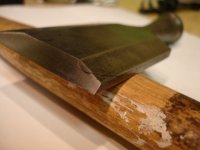
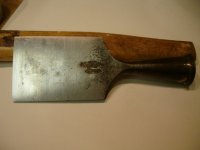
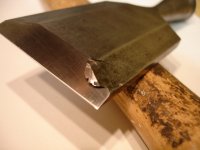
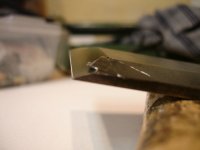
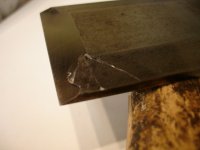
I inherited this chisel from my grandfather and decided I would try and clean it up some, perhaps even turn a new handle for it. I took the handle off, dunked it in my makeshift electroysis tank for about 20 hours, took it out, and noticed it was cracked! Does anyone know what happened here? Has anyone had this happen to them, is it the electrolysis? I just can't believe it is, but it did happened during the process.

Also, what should I do with it now, grind that out?
 

Attachments

  • DSC04472.JPG
    DSC04472.JPG
    95.3 KB · Views: 295
  • DSC04473.JPG
    DSC04473.JPG
    107 KB · Views: 236
  • DSC04475.JPG
    DSC04475.JPG
    94.2 KB · Views: 216
  • DSC04476.JPG
    DSC04476.JPG
    94.9 KB · Views: 211
To avoid these ads, REGISTER NOW!

monomach

Well-known member
Joined
Oct 8, 2013
Messages
1,489
Location
Illinois
Are you sure that crack wasn't just covered in **** that hid it before it went in the tank?
 

Steven67fr

Well-known member
Joined
Sep 7, 2010
Messages
438
Location
Gilbert
I would doubt that it happened during electrolysis. I've tanked 100's of items in all sorts of conditions. I would guess it was cracked before hand but was much less visible.

From here you can break off that piece the rest of the way and regrind a new edge? Or you can use as is knowing that that piece could fall off at any time and possibly cause injury to you or someone nearby.

I'd say finish cleaning it and retire it as a memento. :)
 
OP
A

augustus

Well-known member
Joined
Jul 12, 2013
Messages
164
Location
Columbus, OH
It may have been thinner (really really thin) and I may not have noticed it, but that part of the chisel was fairly clean, it definitely wasn't that big of a gap. Worst case, memento, but I'm wondering if maybe I should grind it and see where it stops, maybe make a smaller chisel? I mean it is 2" wide, I could make it smaller, of course I'd have to take equal from both sides I guess, right?
 
Last edited:

neophyte

Well-known member
Joined
Apr 23, 2012
Messages
9,531
Location
Pennsylvannia
It's a Swedish Berg Woodworking chisel. It was probably hand forged and developed a flaw in the forging. I've found cracks on new hand forged chisels. It will probably take and hold an excellent edge. If you're that concerned about the crack you might want to see if you can get some thin flexible adhesive into the crack just in case.
 

noid

Well-known member
Joined
Jul 15, 2010
Messages
1,341
My guess is that there was corrosion in a much smaller/less noticable crack that got removed during the process and what your left with is the real size of the crack sans the corrosion.
 

neophyte

Well-known member
Joined
Apr 23, 2012
Messages
9,531
Location
Pennsylvannia
Would thread locker safely bond the crack enough to prevent flying debris in case of major failure? I doubt you would get major failure since it's a woodworking chisel not a chisel meant for metal, but just wondering.
 

sasquatch12

Well-known member
Joined
Nov 6, 2013
Messages
403
It appears to be just a stress crack, i wouldn't try to fix it, but as posted keep it as a momento of grandad.
To regrind that nice chisel into something else is going to ruin it.
 
OP
A

augustus

Well-known member
Joined
Jul 12, 2013
Messages
164
Location
Columbus, OH
I have other chisels of his, so I'm not worried about not having something of his around, and so I'd rather (and I think he would have also) have a usable tool. He was an electrician and he definitely used this chisel hard. I have already spent considerable time trying to straighten the edge up (still needs some work, I know) which is why I am still shocked I hadn't seen it.

I'd rather not regrind it smaller if possible, could I weld it and grind it back?

I like your adhesive ideas Neophyte, but don't think thread locker would keep it together, would it?
 

2oolhound

Well-known member
Joined
Dec 18, 2010
Messages
5,918
Location
BC Canada
A 2" chisel is mighty nice. A crack is a crack and the only way to stop it from spreading further down is grind it out. If you'd like to use it then I'd grind it and keep dunking it so it doesn't get too hot. It's so short I think you could just grind one side and the off set wouldn't be too big a problem, after all, often you are just using one side of a chisel. If at some point the lopsidedness bothered you you could grind the other side to match. Otherwise it will make a beautiful keepsake just as is. You could also use it like a little slick for hand shaving just as it is. A nice little dedicated hand shaving chisel in your tool arsenal.
 
To avoid these ads, REGISTER NOW!

neophyte

Well-known member
Joined
Apr 23, 2012
Messages
9,531
Location
Pennsylvannia
I have other chisels of his, so I'm not worried about not having something of his around, and so I'd rather (and I think he would have also) have a usable tool. He was an electrician and he definitely used this chisel hard. I have already spent considerable time trying to straighten the edge up (still needs some work, I know) which is why I am still shocked I hadn't seen it.

I'd rather not regrind it smaller if possible, could I weld it and grind it back?

I like your adhesive ideas Neophyte, but don't think thread locker would keep it together, would it?

Thats the problem. I don't know whether the threadlocker would have the strength to properly bond the crack. Welding or soldering the chisel is way too likely to heat the steel up too much and destroy the temper. Berg chisels are considered some of the finest older chisels. Keeping that chisel for use as a slick would probably be a better idea. The crack looks like it runs along the top surface of the chisel. Personally I would try to clean to crack out as best as possible and then glue it, or I would just leave it be. I don't see it becoming dangerous unless you're pounding it thru wood embedded with nails, or working something ridiculously hard like ebony or purpleheart.
 

RivennHewn

Well-known member
Joined
Jun 4, 2011
Messages
10,356
Location
PNW
Looks like a good candidate for becoming a skew chisel.

Eric Anton Berg is a top shelf tool maker, and without the crack, that'd be a $70-$80 chisel
without the handle.

Even cracked, it's going to be tougher than most wood. I'd sharpen it and use it.
 

A_Pmech

Well-known member
Joined
May 8, 2007
Messages
8,002
Location
IL
Does anyone know what happened here? Has anyone had this happen to them, is it the electrolysis? I just can't believe it is, but it did happened during the process.

Since it happened during the bath, it's a good guess that your chisel cracked due to hydrogen embrittlement.

Essentially, hydrogen atoms diffuse into the steel, later building up sufficient internal pressure to cause cracks to form. I'm guessing you made the chisel the cathode in the electrolysis bath.

If you perform a dye penetrant or magnetic particle inspection you'll likely find more cracks.
 
Last edited:

MBfreak

MEMBER EMERITUS
Joined
Dec 10, 2010
Messages
2,301
Location
Linkoping , Sweden
+1 on Pmechs H2 embrittlement, if it is tempered steel. It could also be partly due to incorrect heat treatment.

If you are going to use this as a tool, I beleive it is essential to first heat treat is at a competent heat treatment shop. Some guys there are skilled enough to touch the part onto a grinding wheel and determine the steel quality( i e how to remper it) by looking at the sparks flying off of the part when grinding it.

Let them then cut the cracked part off and make, regrind the edge and heat treat it.

That takes considerarble experience and skill, and better not done by an eager amateur.

It will last several lifetimes after that.

Ola
 

uart

Well-known member
Joined
Nov 17, 2011
Messages
1,226
Location
Australia
I think it was a small hairline slag inclusion from the original forging, and the electrolysis has dissolved some of that inclusion. It's possible that there was also some internal stresses there, so that once some of the inclusion was gone it may have also opened a little bit as well.
 

thom1968

Active member
Joined
Oct 23, 2012
Messages
29
I think it was a small hairline slag inclusion from the original forging, and the electrolysis has dissolved some of that inclusion. It's possible that there was also some internal stresses there, so that once some of the inclusion was gone it may have also opened a little bit as well.

I agree. Hand forging will occasionally show up like this. Since the problem is not on the cutting edge, I would use it as a small slick/cleanup chisel. I would grind a small divot on the separated part so it won't catch chips as they climb the bevel.
 
OP
A

augustus

Well-known member
Joined
Jul 12, 2013
Messages
164
Location
Columbus, OH
Oh, that makes me angry when I type a long reply and it logs me off in the meantime and then loses my reply.

So, I really like the chisel, now you're telling me it's actually a good one at that, ugh I feel even worse! After reading all the comments, I have some more questions/concerns.

If it was the hydrogen embrittlement caused by electrolysis, is there something I should do differently in the future? I couldn't bake it in the oven, since it came out of the tank with the crack. Should I still bake it even now to get any leftover hydrogen out? I did use the chisel as the cathode (tied to the negative), which I thought was the correct method for rust removal, should I do something else?

It sounds like welding that crack would ruin the tempering. If I took my time and kept it cool like 2oolhound suggest, couldn't I grind it without ruining the temper? To me, it even looks like I might be able to just move that tapered angle on the side over a bit until the crack is ground out and I might still have my 2". How much meat is needed over on the sides? I obviously don't want another edge over there, but beyond that, couldn't I just tweak those tapers some and keep my full width?

Also, are you guys suggesting it would be a good slick chisel because those aren't struck? Likewise, why would it make a good skew chisel? Heck, for that matter, what kind of chisel is it in the first place?

Thanks to everyone who has replied, I appreciate your time and thoughts!
 
OP
A

augustus

Well-known member
Joined
Jul 12, 2013
Messages
164
Location
Columbus, OH
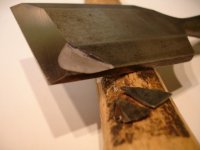
OK, well, I took it in to the machinist at work and to another co-worker who specializes in corrosion. They were both under the opinion that it was an inclusion and was congenital. The machinist couldn't stand how out of whack the edge was and offered to straighten it out for me (really saved me a lot of time). He noticed right away how hard the metal was, and alluded to the fact that we'd be sacrificing an endmill for the effort. we were going down 5 mils at a time to re-establish 25 degrees and to square up the edge when the crack caught and snapped off, and ended up doing it again on a later pass, thus effectively ending the debate on what to do about the crack! Our intent was not to do anything about the crack, but oh well, I like what has happened since I now know the extent of that crack. You can see from the photos with the chips that its angle was pretty far off. So, I'm moving on to cleaning it up some more, putting and edge on it, then I'll work on the handle.

Suggestions on handles are welcome, I'm going to look at some wood tonight.
 

Attachments

  • DSC04478.JPG
    DSC04478.JPG
    98.5 KB · Views: 18
  • DSC04479.JPG
    DSC04479.JPG
    74.9 KB · Views: 18
  • DSC04480.JPG
    DSC04480.JPG
    85.4 KB · Views: 17
  • DSC04481.JPG
    DSC04481.JPG
    93.6 KB · Views: 22
Last edited:

jakemac

Well-known member
Joined
May 21, 2013
Messages
9,035
Location
New England
Suggestions on handles are welcome, I'm going to look at some wood tonight.


Did your grandfather have a firewood pile ? or a tree in his yard ?

If you can make the handle out of some wood on his property or from his shop, you'll have more than one memory of him whenever you use the chisel.
 
OP
A

augustus

Well-known member
Joined
Jul 12, 2013
Messages
164
Location
Columbus, OH
jakemac, I wish, those are really good ideas. I picked up a maple dowel, and may use that, or possibly some cherry from a friend....but I don't have a lathe, thinking of using the drill press to turn it, not sure how well that will work though.
 
To avoid these ads, REGISTER NOW!
Top Bottom