To avoid these ads, REGISTER NOW!

Cracked Concrete under 2 Post Lift

MG44

Banned
Joined
Jan 14, 2013
Messages
928
Hello,

I have a 2 post lift in my shop that the concrete has cracked under. The floor is only 3.25-3.50 inches think under the lift.

I called the supplier I bought my lift from and they said to dig 3ftx3ftx3ft holes under each lift and fill with 3000psi concrete. I asked about rebar and connecting it to the thin slab, and they could not offer my any information.

I know the 3x3x3ft footer is what they recommended, but it just seems "tippy" to me.

When they car is lifted up to the highest point of the lift, what is to stop it from tipping foward, rearwards, or side to side? Surely not a yard of concrete on the bottom, or is it?

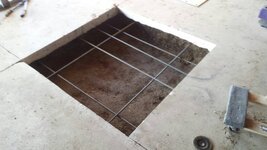
Does anybody have any photographs they can post of a concrete floor being repaired correctly to install a 2 post lift on?

With me being uncomfortable with just a 3x3x3 section of concrete under each post, I was debating on replacing the floor with a 14x18ft section of 6" concrete. The only thing holding me back is I can't finish that myself, and I have had a hard time finding somebody who would come in just to finish concrete that is poured without doing the digging and removal themselves (which I want to do to save on money).
 
To avoid these ads, REGISTER NOW!

Firebrick43

Well-known member
Joined
May 12, 2015
Messages
14,062
Location
West central Indiana
It's actually 2 yards of concrete on under both post which weighs 8000lbs total. But solid on the side and underneath is really what keeps it from tipping. It never hurts to add rebar and t it into the current slab. Also excavating under the slab a few inches will key the new concrete into it as long as you consolidate it with a vibrating pencil. Otherwise you may get a void there.
 
Last edited:
OP
M

MG44

Banned
Joined
Jan 14, 2013
Messages
928
You're worried about a 3x3x3 column of concrete under it and you weren't worried about a 3" slab??:headscrat

Do what they say to do!;)

Hey don't cheat me 1/4 to 1/2" of concrete :)

When I installed the lift, they drilled the holes and said 3.5" was the requirement, that I was a little bit low and it may be ok, or it may not. It held for 4 years with everyday use until the cracks developed. Now I don't use it, but need to use it.

The rebar, do you drill holes in the current slab or place it under the slab? With it only being 3.25-3.5" thick, I have concerns that drilling a hole in the concretes side may compromise what little strength it has because of how thin it is.

3x3x3 is one yard of concrete, how do you figure it is 2? So its 4,000lbs under each post, 8,000lbs total.

Does anybody have any photos of a successful repair being done?
 

ishiboo

Well-known member
Joined
Oct 27, 2010
Messages
9,481
Location
Oshkosh, WI
It takes a lot to leverage a 4,000 lb concrete block that's encased in packed soil... and the lift company has done the engineering to say what is and isn't safe. So I think that's a good bet for you.

If you don't feel it's enough, then you can use about the same amount of concrete and build two concrete "beams" which are longer but not as deep, with a lot of bar in them.

I would probably look at replacing the slab. I think you are always going to have issues with the two things moving up/down at different rates due to the differences in soil/compaction/etc. under them, and doweling the lift area into the slab could cause the slab to crack around the dowels more easily as you think.
 
OP
M

MG44

Banned
Joined
Jan 14, 2013
Messages
928
Why not replace the area under where a vehicle would be and wide enough for the lift? You could rebar reinforce it and beef up the areas under the lift at that time. That way everything with weight on it would be one pour.


That was my second option I was thinking of. I mentioned cutting out a 14 ft x 18ft section the garage slab and repouring it 6 inches deep. My only hold up going that route is its a lot more concrete, almost 5 yards, and I would have to find help in finishing that area, Concrete is over $100 a yard right now, and while I still have a shop, I recently got a new job in my dream field and have taken a large, painful pay cut. 5 yards of concrete costs me more then I make in a week now. The cost is not the ending factor, just something I have to take into consideration these days.


I guess if I had seen photos of somebody pouring 3x3x3 footers under the lift I would feel more comfortable with it. I did not know at first that they weighed 4,000lbs a piece, that is comforting my mind a little bit now that I do know that.
 

James-W

Well-known member
Joined
Feb 3, 2013
Messages
12,432
Location
Southeastern Wisconsin
If it were me, I would rip out the concrete under the lift and use rebar to tie the new concrete into the old concrete. I would pour the new concrete 8 - 10 inches thick. But that's just me and I tend to do an "overkill" on stuff like this. When you are lifting a vehicle that costs many thousands of dollars you don't want anything bad to happen to it, not to mention the safety aspect if the vehicle should fall.
 
OP
M

MG44

Banned
Joined
Jan 14, 2013
Messages
928
I understand about the cost factor. Any indication as to what caused the cracks?

My shop is very old, from the 1920's I do not know how old the concrete is, but probably over 50 years old. When they installed it I started to notice a hairline crack a few months later.

I retorqued the nuts a few times, and I had to keep retorquing them every 6 months or so. I am not sure when the hairline crack turned into a crack, but I noticed the post to start wobbling when cars were going up and down, and I checked the nuts after that and they were only finger tight. After that I stopped using the lift due to the wobbling off the post.
 

432bullet

Well-known member
Joined
Dec 2, 2012
Messages
70
You need to figure out what your life is worth and then build , I think you will come up with the right answer then.
 
To avoid these ads, REGISTER NOW!
OP
M

MG44

Banned
Joined
Jan 14, 2013
Messages
928
You need to figure out what your life is worth and then build , I think you will come up with the right answer then.

This type of answer, the talking in circles, is not going to lead to a result. Trust me, I know what my life is worth, hence why I was cautious about the lift suppliers 3x3x3 suggestion at first.

-----------------------------------------------------------------------------------------------------------------------------

Spoke to Mohawk on the phone today about their recommendations. Their labeling of Width and Length I believe are backwards to me, so I called to confirm.

Their recommendation on their 9,000lbs lift is a 12ft wide, by 4 foot long (well in their woods 12 foot long by 4 foot wide, which sounds off, which is why I called) rectangle footing that is a minimum of 12 inches deep. The rectangle footing has rebar in it, and is keyed under the existing slab.

It is roughly 1.8 yards of concrete, the lighest of all the suggestions right now, but probably the easiest to dig up.
 

Z2V

Well-known member
Joined
Jul 19, 2016
Messages
418
Location
Cedar Park (Austin) Texas
Where the twelve foot would be post to post and four foot would be front to back? What do your post measure overall outside to outside? I like the four foot front to back and if I were doing it I would add four feet to the overall post to post just to be sure.
 

Falcon67

Well-known member
Joined
Jun 11, 2009
Messages
18,371
Location
Merkel, TX
For budgeting, I'd call your local concrete suppliers and ask what the minimum delivery quantity is. Could well be cheaper the buy 4 yards delivered than 2. You'd then cut a hole appropriately. Just for reference, that 3x3x3 is 27 cu/ft. So that's be 45 80lb bags of Quik-rete 1101, about $180. So $360ish for both bases. But a lot of azz busting work.
 

wssix99

Well-known member
Joined
Mar 2, 2011
Messages
5,161
Location
Chicago, IL
Just follow the Mohawk recommendations:

http://www.mohawklifts.com/library/manuals/Slab_Require_Recommend_11_07.pdf

That will more than cover you.

This is excellent advice.


I called the supplier I bought my lift from and they said to dig 3ftx3ftx3ft holes under each lift and fill with 3000psi concrete. I asked about rebar and connecting it to the thin slab, and they could not offer my any information.

This is really bad advice. Who is the supplier? Are they the same as the manufacturer? It sounds like you caught someone who doesn't know what they are talking about or interrupted their enjoyment of a cherished Marlboro...


Spoke to Mohawk on the phone today about their recommendations. Their labeling of Width and Length I believe are backwards to me, so I called to confirm.

Is your concern the 4' dimension and the tipping? If so, the extra depth of the repair slab, coupled with the keyed feature takes care of that for you. It effectively makes the repair slab one with the rest of your slab. At the point you get out to the edges of that repair slab, the thinner slab is not critical for you, engineering-wise.


There are some threads on the site where people have done some great do-it-yourself jobs for this. With some good instruction, I wouldn't shy away from taking this on. Concrete delivery will be expensive, but you can rent a portable mixer and bag it.
 

Road_runner

Well-known member
Joined
Jun 28, 2015
Messages
74
Location
Somewhere around here (in the UK)
Its been a long time since I designed any slab structures, but I suspect your cracking is due to the shear stress caused by the vertical (shear) force from the lift base plates. basically the concrete is failing in shear.

This could be as a result of the moments applied by the lift structure with the car on top. On the basis that the biggest moments will be applied around a horizontal axis through each post (that goes fore-aft relative to the car). This means that the concrete between the two posts will act as a beam. Therefore, you ideally want on relatively deep piece of concrete below and continuous between your posts.

I wouldn't be particularly happy with two "separate" lumps of concrete that could fail independently. Depending on the applied load, you would most likely first see cracks where the deep concrete meets the more shallow concrete, where there will be a sudden and significant reduction in the ability of the material to carry shear. Z2V has hit the nail on the head, for the reasons stated. (And WSSIX99 when I was typing!)
 

wssix99

Well-known member
Joined
Mar 2, 2011
Messages
5,161
Location
Chicago, IL
Although its the accepted method, I never really liked the idea of tightening something that expanded with force in a drilled hole in concrete.

There are very good engineering, mathematical, and physical reasons for doing this.


When I configured my shop floor, I made receiver brackets that allowed bolts to secure the lift to the floor. These brackets have threaded sleeves buried in 18 inches of concrete under each lift post. If the lift is ever to be moved or taken down, just unbolt it from the floor. The lift is a Mohawk system 1.

You should have a structural engineer review your work and confirm your configuration isn't creating higher punch-out forces on the concrete than the recommended anchors would. Depending on the configuration, it might be OK. (Possibly considering the depth of concrete you are talking about.)

http://www.garagejournal.com/forum/showpost.php?p=5920060&postcount=17

Others on this site have come up with similar methods that are very weak and could fail with little or no warning.
 

wssix99

Well-known member
Joined
Mar 2, 2011
Messages
5,161
Location
Chicago, IL
Um.....I don't need an engineer to tell me how to anchor my lift.

I know. You are a special circumstance, which is why I said that you should.

Lots of people posting on this site do actually need the help of an engineer, particularly when they ignore the instructions and try to invent things that are beyond their education and understanding.
 

ebfabman

Well-known member
Joined
Aug 15, 2009
Messages
85
There are very good engineering, mathematical, and physical reasons for doing this.


You should have a structural engineer review your work and confirm your configuration isn't creating higher punch-out forces on the concrete than the recommended anchors would. Depending on the configuration, it might be OK. (Possibly considering the depth of concrete you are talking about.)

http://www.garagejournal.com/forum/showpost.php?p=5920060&postcount=17

Others on this site have come up with similar methods that are very weak and could fail with little or no warning.

I know. You are a special circumstance, which is why I said that you should.

Lots of people posting on this site do actually need the help of an engineer, particularly when they ignore the instructions and try to invent things that are beyond their education and understanding.


I didn't ask for your opinion. I don't care what you think. This isn't your thread. I'm not "Lots of people". You don't know my education level or my ability to understand.
 

JohnnyK8

Well-known member
Joined
Jan 25, 2016
Messages
664
Location
Illinois
I was in the same spot with thin floors.

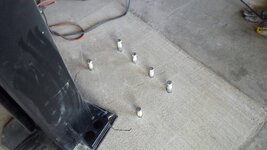
Did 4x4 cuts and keyed under 5-6 more inches around the edges (5x5 slab essentially) and rebarred under the existing slab. I did 10-12 " deep. Greg Smith Equipment instructions plus more depth,rebar and keying,)

Make sure the soil is compacted so no settling occurs leading to failure.

It was easy and didn't cost much ($150 for 60 bags of 60 lbs 4000 psi Crete)

Then I used EPOXY wejit PS58 for a flawless install.

071bb1de50e9bd77ce411bbf4f980a73.jpg
413d75a622422a06f8cdf946e712b790.jpg
b8a2486bfa51065b66295c0895c6c866.jpg
2da9467f04373c891ff6910a64fb458a.jpg

Sent from my Nexus 7 using Tapatalk
 
Last edited:

DAVE VAN

Well-known member
Joined
Oct 2, 2012
Messages
80
Location
Gastonia, NC
When I installed my 2 post lift I cut out a 4ft X 4ft X 12in hole under each leg. Dug out about 6in around the edges under the old slab and put in rebar in a pattern to miss the anchor bolts. Poured with 5000LB concrete and then waited 30 days before installing lift.

My life is on the line when working under the car so I didn't want to take any chances.
 

73fxe

Well-known member
Joined
Jun 11, 2016
Messages
308
Location
SW. Michigan
We use to install one piston lifts using a 55 gallon barrel with the piston inside it. 4 " of concrete slab , good to go. All per engineers spec.
 

Orionrising

Well-known member
Joined
Nov 16, 2012
Messages
960
Location
Western Maine
with depth you get resistance to tipping...well compacted soil has a resistance to lateral compression just like vertical... often measure in thousands of PSF... so 3x3 block has a lateral resistance of one hell of alot so does a 55 gallon drum....

and with a lift most of the load is vertical as long as the car is place right.
 
To avoid these ads, REGISTER NOW!
Top Bottom