To avoid these ads, REGISTER NOW!

Craftsman 113.19063 motor

tmh10033

Member
Joined
Feb 2, 2025
Messages
14
Location
Philadelphia, PA
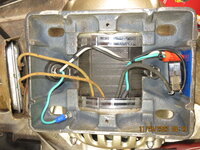
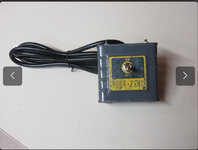
Want to add ground wiring to Craftsman motor 113.19063. Looking to see where the grounding wire would go inside the plate. Two will go to the toggle, but where can I attach the ground? Using a replacement power cord 12AWG. Pictures below are of existing plate.
 

Attachments

  • IMG_0908.jpeg
    IMG_0908.jpeg
    775.2 KB · Views: 35
  • IMG_0907.jpeg
    IMG_0907.jpeg
    629.3 KB · Views: 34
To avoid these ads, REGISTER NOW!
OP
T

tmh10033

Member
Joined
Feb 2, 2025
Messages
14
Location
Philadelphia, PA
Frank, thanks. Do you mean to pre drill a hole that size, put in the screw, and tie the ground wire from the new power cord around the new screw?
 

FrankLee

Well-known member
Joined
Sep 13, 2010
Messages
3,578
Location
seMI, 48317
No.

Drill and tap for an 8-32 screw. Crimp a ring terminal onto the ground wire. I frequently also use a toothed washer with the screw.

I never use the base bolts for grounding.

Different motor, same concept:
IMG_3113.JPG IMG_3115.JPG IMG_3116.JPG IMG_3177.JPG
 
OP
T

tmh10033

Member
Joined
Feb 2, 2025
Messages
14
Location
Philadelphia, PA
Frank, I appreciate your time & help with that. That’s how I’ll do it when grounding the motor.

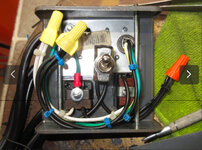
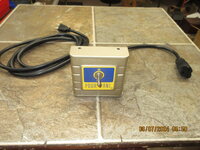
I’ll direct my next question to you actually, since I read some of your previous work on Craftsman Power Panels, specifically the one picture below because that’s the one I’m working on for my 113.27520 table saw.

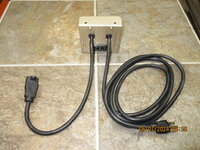
What I was thinking about doing is running the new 6FT 12AWG power cord from the motor (once I wire it for grounding) to the Power Panel and then run a new 10FT 12AWG replacement power cord from the Power Panel to the wall.

Since I’m grounding the motor at 12AWG, can I also ground the Power Panel at 12AWG? I know that the Husky replacement cords are 16/3 & 14/3.

The pictures below are yours and that’s what I’m looking to do, but wasn’t sure if I’d lose a little bit of power to the motor by using a Husky.
 

Attachments

  • IMG_0917.jpeg
    IMG_0917.jpeg
    1.1 MB · Views: 19
  • IMG_0918.jpeg
    IMG_0918.jpeg
    1 MB · Views: 14
  • IMG_0919.jpeg
    IMG_0919.jpeg
    1 MB · Views: 16

FrankLee

Well-known member
Joined
Sep 13, 2010
Messages
3,578
Location
seMI, 48317
Frank, I appreciate your time & help with that. That’s how I’ll do it when grounding the motor.

I’ll direct my next question to you actually, since I read some of your previous work on Craftsman Power Panels, specifically the one picture below because that’s the one I’m working on for my 113.27520 table saw.

What I was thinking about doing is running the new 6FT 12AWG power cord from the motor (once I wire it for grounding) to the Power Panel and then run a new 10FT 12AWG replacement power cord from the Power Panel to the wall.
I'm certainly no electrical expert, but imo, a 14 gauge cord rated at 15 amps would be adequate. I believe your 19063 motor is rated at 11.4 amps.

Also, keep in mind that most of your household wiring is 14 gauge on a 15 amp breaker. But there could be other things in use at the same time on that breaker. You also likely have a few 20 amp breakers with 12 gauge wire for you heavier-duty appliances. Maybe you thought about this already.

Since I’m grounding the motor at 12AWG, can I also ground the Power Panel at 12AWG? I know that the Husky replacement cords are 16/3 & 14/3.
Whatever gauge you use, use it through the entire path from the motor to the breaker box. 12 gauge wire on a 15 amp breaker is overkill, IMO.


If I don't know what I'm talking about, I hope someone will chime in.


The pictures below are yours and that’s what I’m looking to do, but wasn’t sure if I’d lose a little bit of power to the motor by using a Husky.
Honestly, I like this design the best. The length of each side of the cord can be customized to specific needs.
Powr-Panl #6a.JPG Powr-Panl #6b.JPG Powr-Panl #6c.JPG
 
Last edited:
To avoid these ads, REGISTER NOW!

Cruzan80

Well-known member
Joined
Jul 22, 2015
Messages
4,200
Location
Denver, CO
I would check for continuity from the plug ground to the chassis. Or check the resistance level (same thing essentially, one just is a Yes/No vs a numerical value). In normal operation, nothing should be travelling down the ground, it is for when bad things happen.
 

kylexj88

Member
Joined
Mar 9, 2025
Messages
15
if you throw the first 3 numbers of any sears/craftsman/kenmore p/n into google and ask who made this for sears? 99% of the time you will get an answer and be able to further narrow down info regarding the product. - a former sears employee
 

Snip's

Well-known member
Joined
Apr 29, 2017
Messages
1,850
Location
Ohio
Whenever I aquire a vintage machine that I'm going to refurbish, one of the first things I do is power cord replacement...
I stay away from the one piece moulded cord / plug sets... They most generally have the cords made from PVC for the lower cost that the raw material provides...

Living here in Ohio, with cold winters and having a non heated garage, I want a flexible power cord on my machines...
I generally go with 14-3 from Lowe's and buy maybe 30' at a time and make my own... This gives me the option of buying either a straight wall plug or a 90 degree plug so the plug cord hangs straight down the wall... The plugs are name brand and are made from a more durable material (probably polycarbonate)... I'll buy either SJOOW (3/8" dia. 300V, epdm rated @ -40f-190f) or SOOW (1/2" dia. 600V epdm rated @ -40f-190f)...
The EPDM material allows the cord to stay flexible at lower temperatures, making it much easier to unfurl or recoil the cord... PVC cords are the pits during the cold months... My method is more expensive but my cords don't fight me...
 

Provincial

Well-known member
Joined
Sep 21, 2011
Messages
6,865
Location
Near Salem, OR
Another factor in wiring sizing is electrical resistance in the wire itself. The actual factor limiting the number of amps in a circuit (and the breaker/fuse size) is the heat generated by the electricity flowing through the wire. Too much electricity, too much heat, with the insulation being the weak link.

Resistance is mainly determined by wire diameter and length. The larger the wire, or shorter the length, the less resistance. The more amps carried, the greater the resistance and the greater the resistance, the more the voltage drops. The more the voltage drops, the more amps the motor will draw, and on in a viscous cycle.

Running a 11.5 amp motor on a 15 amp circuit (14 gauge) that isn't too long (including both the house wiring and the cord length) will work fine, as long as there aren't more loads on that circuit. Running the same motor on a 20 amp circuit (12 gauge) will give less voltage drop and more cushion if other loads draw on that circuit.

I always try to use larger conductors. I've used 10 gauge house wire on a 20 amp circuit that has long runs, or multiple loads.

The only way most people experience voltage drop is when the motor heats up or lacks full power.
 
To avoid these ads, REGISTER NOW!
Top Bottom