You are using an out of date browser. It may not display this or other websites correctly.
You should upgrade or use an alternative browser.
You should upgrade or use an alternative browser.
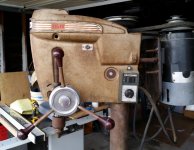
Craftsman 150 Drill press - Speed pully question
- Thread starter Cable_Hogue
- Start date
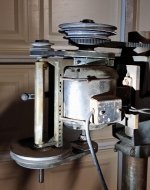
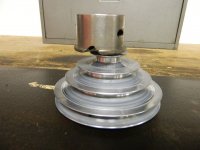
Good question. I think I'd prefer the middle pulley set up. It's neater, takes up less space and only needs two belts instead of three.
That being said, seeing as you already have the other set up working and all, if you wanted to use one and sell the other then the middle pulley system would be a lot more saleable.
BTW. Is there much difference in the available speed ranges between the two? Also, how difficult is it to change speed with the existing set up?
That being said, seeing as you already have the other set up working and all, if you wanted to use one and sell the other then the middle pulley system would be a lot more saleable.
BTW. Is there much difference in the available speed ranges between the two? Also, how difficult is it to change speed with the existing set up?
I'd throw the middle pulley on there and save the speed attachment for another drill press or similar machine. Did that drill press actually come with both?
2nd thought, I'm lazy at times and if you don't currently have another machine that can use the variable speed attachment, I'd just leave the drill press as is and save the middle pulley for down the road.
2nd thought, I'm lazy at times and if you don't currently have another machine that can use the variable speed attachment, I'd just leave the drill press as is and save the middle pulley for down the road.
Indexmill
Well-known member
The 3-belt system looks pretty crappy. If looks is important, then replace the 3-belter with the column mount pulley.
OP
Cable_Hogue
Well-known member
Appreciate the advice. I don't know the speed differences yet between the two.
These came from two different presses, both of which I still have (and parts of a third press).
I actually like the look of the McKelvey. I love odd contraptions, especially old contraptions, so it isn't just about practical.
I think I'm going to sell the middle pulley. I'd keep it, but I plan to make some new purchases, and it will appease the Mrs a bit to see that happen.
I'll see about getting a video posted on the McK sometime this weekend if I can.
I appreciate all the input.
These came from two different presses, both of which I still have (and parts of a third press).
I actually like the look of the McKelvey. I love odd contraptions, especially old contraptions, so it isn't just about practical.
I think I'm going to sell the middle pulley. I'd keep it, but I plan to make some new purchases, and it will appease the Mrs a bit to see that happen.
I'll see about getting a video posted on the McK sometime this weekend if I can.
I appreciate all the input.
schor
Well-known member
You should be able to calculate the speeds you can get with either setup.
google pulley calculator, there are lots of them.
I would guess the 3 belt design is going to get you way down in speed. I made a column pulley block for my atlas drill and can get it down to 100rpm.
google pulley calculator, there are lots of them.
I would guess the 3 belt design is going to get you way down in speed. I made a column pulley block for my atlas drill and can get it down to 100rpm.
OP
Cable_Hogue
Well-known member
OP
Cable_Hogue
Well-known member
Ha, I just realized I posted model 150. This is actually a 100 I just picked up off craigslist. It's probably going to end up on my 150 in the near future.
Mark in Indiana
Well-known member
I vote for the 3 belt set up (if it works), and save the column pulley for another day. To me it looks like they're more speed choices with the 3 belt set up. If aesthetics are a concern, paint & polish will take care of that. Which would look really cool (IMHO).
I would guess the 3 belt design is going to get you way down in speed. I made a column pulley block for my atlas drill and can get it down to 100rpm.
Yeah, not necessarily exact but just estimating from the photos it looks to me like the triple belts set up is somewhere about 6:1 to 7:1 (relative to the speed with motor pulley directly driving the final spindle pulley). So yeah if the original minimum speed was around 700 rpm then you should get somewhere near 100 with that reducer.
In comparison the middle pulley system looks like roughly 4:1 to me.
Thanks... that's cool. Does the motor have a double shaft? I'm still trying to figure out how it works.
Hi Frank. I haven't seen it so I'm guessing here, but I'm pretty certain that the motor is just turned over and mounted upside down with this adaptor.
I assume the only modification would be that you would need to change the direction of rotation of the motor.
OP
Cable_Hogue
Well-known member
Thanks... that's cool. Does the motor have a double shaft? I'm still trying to figure out how it works. Is there a patent number on the unit somewhere?
Edit:
Here's the patent, I believe:
https://www.google.com/patents/US25...a=X&ei=SU3nVI6JG8i5ggSc0YLQBw&ved=0CCsQ6AEwAg
At first I thought double shaft too, but no, the shaft is down only. The pulley above is just further speed adjustment.
I'll have to look for patent info....
Thanks for the patent link. That does look like the thing.
Last edited:
OP
Cable_Hogue
Well-known member
I posted a video link above there.
OP
Cable_Hogue
Well-known member
After reading the patent some and studying the drawing, it looks like the top pulley is free-spinning on the top motor shaft. The side shaft is being driven by the bottom motor pulley. It's an interesting design that adds one more reduction than the Craftsman Slo-Speed pulley.
I'm pretty sold on this one. Now I just need to figure out the best way to clean it up and replace any bearings. It's making a bit of noise, but I haven't isolated it to this reducer. Could be anything at this point.
OP
Cable_Hogue
Well-known member
After reading the patent some and studying the drawing, it looks like the top pulley is free-spinning on the top motor shaft. The side shaft is being driven by the bottom motor pulley. It's an interesting design that adds one more reduction than the Craftsman Slo-Speed pulley.
So Frank, what do you do, buy and sell these old presses? They are pretty cool. Everytime I see one on craigslist it is hard for me not to go get it.
OP
Cable_Hogue
Well-known member
Yeah... pretty much, but not only DPs.
The first DP I bought was amazing and full of options; it's a keeper. The second was a parts machine for the first and a part-out. The third was a restoration and a keeper. Forth, fifth, sixth, and eighth were flips. Seventh may be a keeper. Nineth was a part-out. Tenth and eleventh are sitting in my basement waiting for clean-up and flip. They are getting harder to find. LOL!
That is awesome! I've got 3 now, two 100's and the 150, and my eye on another 150 benchtop. Do you find it's worth it to fix up and flip? (ok, you obviously do, is it financially worth it?

I've stripped and got my floor 150 with new bearings and half painted, and it's a lot of work.
Last edited:
OP
Cable_Hogue
Well-known member
It depends mainly on the purchase price and whether the DP has options. For example, that Slo-Speed pulley you have is worth over $200 on ebay.
Also, the sum of the parts is worth way more than the whole. I do not generally like to part-out a drill press, but it is very lucrative. Another example... my DP #9. It was a nice running machine, but it looked like ****. I could not sell it for $50 on craigslist, but I parted it out for about $130 and I still have some parts.
As you are finding out, restoration is only worth it if you're going to keep it.
That's about what I thought. The hours involved in restoration.... But then you have a very cool press that you just can't buy anymore retail.
I really can't understand why anyone would go to lowes and buy a new made in China drill press these days. Look for these old ones! You might have to do some work, but it's so worth it.
OP
Cable_Hogue
Well-known member
So, if you have three of these DPs, two 100s, and one 150, you are starting to discover the differences between the different models.
Do both of your 100s have a 67" column? I'm trying to determine when the 62" column was introduced. I think it was with the 150s.
Which 150 do you have? The early one with the external spring tension knob, or the later one with the internal spring attachment?
Yes I am. Last night I was setting up my new 100 with the pull arms and broke one. That is when I learned that they are different from the 150 knobs. But I was able to pull the whole mechanism out of the 150 and it fit right into the 100. I don't know much more than that yet, but do have both models apart and am ready to start comparing.
I'll have to measure the posts tonight for you. I'll get you the serial #'s too. It would be cool to start a 100/150 post with all the info.
OP
Cable_Hogue
Well-known member
So, if you have three of these DPs, two 100s, and one 150, you are starting to discover the differences between the different models.
Do both of your 100s have a 67" column? I'm trying to determine when the 62" column was introduced. I think it was with the 150s.
Which 150 do you have? The early one with the external spring tension knob, or the later one with the internal spring attachment?
So the 150 and 100 I bought first have the shorter post. This last 100 I just got has the taller post. That seems odd. ?
OP
Cable_Hogue
Well-known member
Perhaps the shorter column was introduced at the same time the tilt table was dropped late in the 100 series run. All 3 of my 100 floor models had the 67" column. Interesting.
Hey Frank, where do you get your bearings, and do you have the whole set documented?
Are they different between the 100 and 150?
I ordered a pair of bearings for my quill off ebay and I ended up getting China ****.
OP
Cable_Hogue
Well-known member
Accurate Bearing, and yes, part numbers are documented in posts #32 and #84 in my drill press thread below.
I replaced bearings during my #3 drill press restore. I bought sealed bearings for both the pulley bearings and the quill bearings. In hindsight, I would have bought shielded bearings for the pulley.
I need to write-up a bearing post.
I think you are qualified to write the definitive 100/150 drill press information thread. If you start it I will add to it as I go. I seem to have the same affinity as you for these old machines.
I think it would be cool to create a table of parts and show interchangeability. That would probably be helpful to many. For instance, I like the motor mount on the 100 over the 150, and I think it's interchangeable. I'll know later today. It went into the rust removal bath last night.
OP
Cable_Hogue
Well-known member
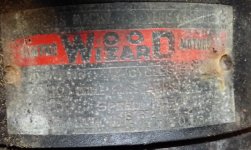
So I'm getting into this motor and speed reducer, and wanted to ask if anyone knows anything about this motor. It's a wood wizard.
It looks like a really well built motor and I want to restore it to life.
It runs, but makes just a little noise.
Wondering it's age, and anything else someone might know about it. Pics attached.
It looks like a really well built motor and I want to restore it to life.
It runs, but makes just a little noise.
Wondering it's age, and anything else someone might know about it. Pics attached.
Attachments


OP
Cable_Hogue
Well-known member
Perhaps the shorter column was introduced at the same time the tilt table was dropped late in the 100 series run. All 3 of my 100 floor models had the 67" column. Interesting.
Hey Frank, have you noticed column outside diameter differences? My 150 seems fatter than the 100's by a tad.
I was trying to put my speed adapter into the 150 and found that the inside diameter wasn't wide enough.

I looked at the 100 it came out of and that one appears to have the top reamed out to make it fit. Looks professionally done though.
So I was thinking about using that column, and sure enough they aren't quite the same OD. Good grief. Challenges!
OP
Cable_Hogue
Well-known member
I've found the column ODs to be very consistent. I've probably switched at least six and even swapped a 33" for a 62" and then a 67" with a friend.
First the obvious question... on your 150, did you check the other end of the column for the reamed ID? Maybe it was installed upside down. ....
Firstly, thanks for the more than thorough post. All good info and much appreciated Frank.
You hit it with the first swing. I put the column in upside down when I cleaned it up. Bottom is reamed and fits perfectly. Many thanks sir!
OP
Cable_Hogue
Well-known member
Awesome! That was an easy fix then.
I do have another question for you. I have 3 of these things, and can't seem to get the chuck off any of them. Any advice or tips on removal and restoration?
OP
Cable_Hogue
Well-known member
That's another topic where I have pictures somewhere and intended to post.
When removing the chuck, I prefer to have the spindle assembly removed from the head frame. I chuck-up a large allen wrench; short side in the chuck. Then, the long side clamped in a vise with the spindle vertical. I use my woodworking vise.
I have a small pin spanner that fits into a hole on the chuck collar and just crank it off. I've also use old drill bits that fit into the collar holes. I'm still pondering a better solution. My pin spanner is really too small and it frequently slips off the chuck.
Sometimes I'll use a couple flat-washers as spacers between the threaded collar and the chuck. It often takes some effort to get these off.
I even used a pipe wrench once, but don't recommend it.
I'm also currently restoring a small old Atlas #00 arbor press so I can disassemble/reassemble these chucks.
I'll give it another shot this weekend sometime. I should have my paint and reassembly done later toady.
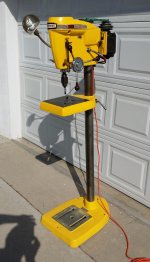
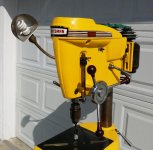
I'll post some pics when I get it. Went with a bright yellow on mine.
Oh, you were right I think about the columns being banged at the end causing the size difference. I measured in the middle and all seem pretty close to each other. Enough that the parts would fit.
I got a tilt-able table with one of the 100's. I haven't got into that much, but I don't see a handle to tilt it. How do they work?
OP
Cable_Hogue
Well-known member
Got it all together, painted, and new belts. I got the speed adjustment pully in, but it's got a wobble to it. Have to figure that out. :|
Looks like I might not have the pulleys quite lined up between the middle and front too.
Looks like I might not have the pulleys quite lined up between the middle and front too.
Last edited:
OP