Cooter Brown
Well-known member
- Joined
- Feb 6, 2017
- Messages
- 317
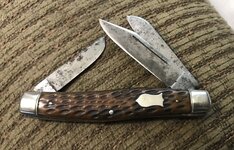
A short time ago @bmwrd0 posted a haul in the Garage Sale thread. One of the items he found was a pocket knife I thought I recognized. I described it to Aaron and it turns out I was right--a Schrade Walden split back whittler pattern. I responded with an ID and he offered to sell it to me for a great price. I told him I thought the price was low--Aaron very kindly sold it to me for that anyway. This is what we call a gentleman!
It was in much better condition that I thought it'd be from the original pictures. After a light cleanup it appears to be essentially unused, never even put on a stone. I looked at it under a magnifying lamp and sure enough, the etch was still visible! There's some discoloration and staining on the carbon steel blades and springs, but not the sort of patina I'd associate with carry and use. The bolsters and bone are perfect, no dings or nicks. The springs inside the wells are still shiny and free of pepper spots--this is often the first thing that happens on a carry knife. All blades are still shiny and reflective. I'm a user much more than a collector but this one will probably get treated pretty gently and kept as a time capsule of the sort of quality produced at one time in the US.
The split back whittler pattern, sometimes called "Carpenter's Knife" is a specific pattern, referring to the configuration of the blades and springs. There are three blades and two springs. There's a tapered divider between the springs. Each small blade has its own independent spring. The springs taper together on the other end of the knife, and the main blade uses both springs. It's a difficult pattern to get right and you seldom see it offered by major manufacturers today.
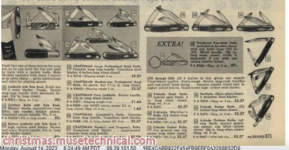
I posted pics on a knife collector's forum and got some great info, including from a man who worked for Schrade for decades. It's often hard to pin down date of mfg more specifically than a range of a decade or two--this knife was easy. Given the start of the use of the crown logo and the end of Schrade's use of bone handles, this knife was made between 1958 and 1961. One of the fellows included a page from a 1961 Sears catalog showing the knife. After '61 Schrade used Delrin handles on the knife.
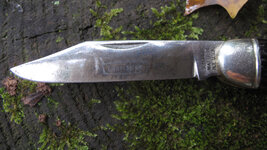
The main blade with Crown logo. You can see how shiny the blade is:
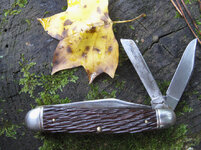
The secondary blades. They have a little staining, and even though you can't tell in this photo they still have the factory polish too, no real patina. The style of jigged bone is called "peach seed":
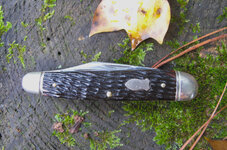
The springs, showing the tapered divider:

Note how well the blades nest and how well centered the main is:

The inside of the knife is remarkably free of corrosion and spotting. You also get a good view of how the blades and springs are set up:

Here's the knife in the 1961 Sears Spring/Summer catalog. It's number 26:
If you made it this far, thanks for indulging, and I hope some found this of interest.
And thanks again to Aaron!
It was in much better condition that I thought it'd be from the original pictures. After a light cleanup it appears to be essentially unused, never even put on a stone. I looked at it under a magnifying lamp and sure enough, the etch was still visible! There's some discoloration and staining on the carbon steel blades and springs, but not the sort of patina I'd associate with carry and use. The bolsters and bone are perfect, no dings or nicks. The springs inside the wells are still shiny and free of pepper spots--this is often the first thing that happens on a carry knife. All blades are still shiny and reflective. I'm a user much more than a collector but this one will probably get treated pretty gently and kept as a time capsule of the sort of quality produced at one time in the US.
The split back whittler pattern, sometimes called "Carpenter's Knife" is a specific pattern, referring to the configuration of the blades and springs. There are three blades and two springs. There's a tapered divider between the springs. Each small blade has its own independent spring. The springs taper together on the other end of the knife, and the main blade uses both springs. It's a difficult pattern to get right and you seldom see it offered by major manufacturers today.
I posted pics on a knife collector's forum and got some great info, including from a man who worked for Schrade for decades. It's often hard to pin down date of mfg more specifically than a range of a decade or two--this knife was easy. Given the start of the use of the crown logo and the end of Schrade's use of bone handles, this knife was made between 1958 and 1961. One of the fellows included a page from a 1961 Sears catalog showing the knife. After '61 Schrade used Delrin handles on the knife.
The main blade with Crown logo. You can see how shiny the blade is:
The secondary blades. They have a little staining, and even though you can't tell in this photo they still have the factory polish too, no real patina. The style of jigged bone is called "peach seed":
The springs, showing the tapered divider:
Note how well the blades nest and how well centered the main is:
The inside of the knife is remarkably free of corrosion and spotting. You also get a good view of how the blades and springs are set up:
Here's the knife in the 1961 Sears Spring/Summer catalog. It's number 26:
If you made it this far, thanks for indulging, and I hope some found this of interest.
And thanks again to Aaron!
Last edited: