To avoid these ads, REGISTER NOW!

Craftsman Drill Press

OP
F

FrankLee

Well-known member
Joined
Sep 13, 2010
Messages
3,548
Location
seMI, 48317
How do you guys like to remove the bearings from the quill body?
I have just removed the spindle from the quill on my newly acquired 100 DP. Fortunately the spindle slid out easily from the quill. However, both the bearings stayed inside the quill. I am thinking I will use a long thin (1/2") wood dowel through the inside race of one bearing and tap the opposite bearing out. Once the first bearing is out, the 2nd one will be easy.
The only caveat to this method is I expect this non-uniform "striking" may damage the bearing (especially if the bearing requires some considerable effort to remove. In my case, though, both spindle bearings feel very gritty and should probably be replaced anyhow.

That's exactly how I remove them. It usually doesn't take much to get them out.

Typically, if anything is damaged, it's just the shield. I usually remove one or both shields if I'm going to clean and re-use the bearings.


Last edited:
To avoid these ads, REGISTER NOW!

Bill C

Well-known member
Joined
Sep 17, 2006
Messages
144
Location
Portland, OR
That's exactly how I remove them. It usually doesn't take much to get them out.

Typically, if anything is damaged, it's just the shield. I usually remove one or both shields if I'm going to clean and re-use the bearings.

FrankLee Thanks for the confirmation and pics. That method worked perfectly. It did damage the shields, but I also was not particularly careful as I already plan to replace the bearings. I also used a 3/8" oak dowel as that is what I had on hand. I'd imagine a 1/2" dowel may have been less likely to dent up the shields on the bearings.
 
OP
F

FrankLee

Well-known member
Joined
Sep 13, 2010
Messages
3,548
Location
seMI, 48317
FrankLee Thanks for the confirmation and pics. That method worked perfectly. It did damage the shields, but I also was not particularly careful as I already plan to replace the bearings. I also used a 3/8" oak dowel as that is what I had on hand. I'd imagine a 1/2" dowel may have been less likely to dent up the shields on the bearings.

You're welcome. Using what you have on hand is usually the way to go.
 

Bill C

Well-known member
Joined
Sep 17, 2006
Messages
144
Location
Portland, OR
Progress and another question.

I am almost done tearing the drill press down. Last night I got the spindle pulley bearings removed. Based on FrankLee's posts regarding the handy spindle pulley bearing tool, I had already fabbed one up but ended up not needing it. Once I removed the first bearing and lightly sanded the pulley shaft, the second bearing slid off with the need for the "custom" puller. Oh well :headscrat

32986686038_a2eb9c9437_c.jpg


Now for the question- I had some trouble removing the taper pin from the tilt table. It didn't come out after several good whacks with a punch, so I stopped for the evening in order to confirm that I am trying to remove it from the correct direction. Based on visual inspection (and posts on this thread), it looks like I should drive the pin up and out through the top of the table (meaning strike the pin from underneath). I believe this is the correct direction of the taper. See the photo below... I should be striking from this end correct? If this is indeed the correct direction, I will hit it with more penetrating oil and add some torch heat next. I do fear the taper may have been over-driven as the opposite side (top side) is a little below flush with the surface.

32986684018_1a6059896a_c.jpg
 
OP
F

FrankLee

Well-known member
Joined
Sep 13, 2010
Messages
3,548
Location
seMI, 48317
Re: Progress and another question.

I am almost done tearing the drill press down. Last night I got the spindle pulley bearings removed. Based on FrankLee's posts regarding the handy spindle pulley bearing tool, I had already fabbed one up but ended up not needing it. Once I removed the first bearing and lightly sanded the pulley shaft, the second bearing slid off with the need for the "custom" puller. Oh well :headscrat

Well, you may need that tool for your next dp. LoL!

Now for the question- I had some trouble removing the taper pin from the tilt table. It didn't come out after several good whacks with a punch, so I stopped for the evening in order to confirm that I am trying to remove it from the correct direction. Based on visual inspection (and posts on this thread), it looks like I should drive the pin up and out through the top of the table (meaning strike the pin from underneath). I believe this is the correct direction of the taper. See the photo below... I should be striking from this end correct? If this is indeed the correct direction, I will hit it with more penetrating oil and add some torch heat next. I do fear the taper may have been over-driven as the opposite side (top side) is a little below flush with the surface.

Yes, that is correct. Strike from the bottom end.
https://www.garagejournal.com/forum/showthread.php?p=4984370&post4984370

If it was over-driven in, once out, inspect the cast iron for cracks. Also, I had a table once where after the pin was out and the tilt lock removed, I could not remove the table from the mount. I eventually tilted just a bit, but it took much effort. I suspected that the pin was driven in too far and distorted the cast iron.
https://www.garagejournal.com/forum/showthread.php?p=7239981#post7239981
 
Last edited:

bubinga

Well-known member
Joined
Jul 26, 2014
Messages
12,744
Location
Bridgeport Ohio. (Across River From Wheeling WV)
FrankLee Thanks for the confirmation and pics. That method worked perfectly. It did damage the shields, but I also was not particularly careful as I already plan to replace the bearings. I also used a 3/8" oak dowel as that is what I had on hand. I'd imagine a 1/2" dowel may have been less likely to dent up the shields on the bearings.
Now is the inner race to spindle usually a slip fit, or usually a press fit.
Bill C said his slipped right out.

I thought about changing mine, (Changed the Pulley bearings a while back)
But the Quill bearings are so smooth and quiet, I hate to "Shuffle the deck"
 
Last edited:
OP
F

FrankLee

Well-known member
Joined
Sep 13, 2010
Messages
3,548
Location
seMI, 48317
Now is the inner race to spindle usually a slip fit, or usually a press fit.
Bill C said his slipped right out.

I thought about changing mine, (Changed the Pulley bearings a while back)
But the Quill bearings are so smooth and quit, I hate to "Shuffle the deck"

Usually a press fit.

The spindle on SOME, but not all of the earlier models slide out with little effort. I never tried to identify a pattern of which years had this characteristic.

IMO, if you don't notice a problem with your spindle or run-out, there's no need to mess with it.
 
Last edited:

bubinga

Well-known member
Joined
Jul 26, 2014
Messages
12,744
Location
Bridgeport Ohio. (Across River From Wheeling WV)
The spindle on SOME, but not all of the earlier models slide out with little effort. I never tried to identify a pattern of which years had this characteristic.

IMO, if you don't notice a problem with your spindle or run-out, there's no need to mess with it.
That is the thinking I am going with. :beer: :beer:
Basically repeating myself though, LOL....... (Hate to shuffle the deck)
 

Bill C

Well-known member
Joined
Sep 17, 2006
Messages
144
Location
Portland, OR
Re: Progress and another question.

Well, you may need that tool for your next dp. LoL!

Yes, that is correct. Strike from the bottom end.
https://www.garagejournal.com/forum/showthread.php?p=4984370&post4984370

If it was over-driven in, once out, inspect the cast iron for cracks. Also, I had a table once where after the pin was out and the tilt lock removed, I could not remove the table from the mount. I eventually tilted just a bit, but it took much effort. I suspected that the pin was driven in too far and distorted the cast iron.
https://www.garagejournal.com/forum/showthread.php?p=7239981#post7239981

Phew!!! Getting that taper pin out was quite the effort. I applied penetrating oil for days, I heat cycled it a bunch with a torch.
Ultimately,I had to drill out the center of the large end to relieve some of the pressure on the pin. I also had to drill a recess into the small end to allow a non-slip seat for a punch. Even after all that, It took several real solid whacks with my 3lb drilling hammer (hand sledge). Fortunately, once the pin was out, the table freely rotated and slid right out of the mount. :bowdown: No evidence of cracks on either piece.... but damn that taper pin was stuck.
Now the DP is pretty much completely disassembled. Now I must decided if I want to keep the patina or repaint. :headscrat

31961459897_3c4a4a104b_c.jpg
 

bubinga

Well-known member
Joined
Jul 26, 2014
Messages
12,744
Location
Bridgeport Ohio. (Across River From Wheeling WV)
Re: Progress and another question.

Phew!!! Getting that taper pin out was quite the effort. I applied penetrating oil for days, I heat cycled it a bunch with a torch.
Ultimately,I had to drill out the center of the large end to relieve some of the pressure on the pin. I also had to drill a recess into the small end to allow a non-slip seat for a punch. Even after all that, It took several real solid whacks with my 3lb drilling hammer (hand sledge). Fortunately, once the pin was out, the table freely rotated and slid right out of the mount. :bowdown: No evidence of cracks on either piece.... but damn that taper pin was stuck.
Now the DP is pretty much completely disassembled. Now I must decided if I want to keep the patina or repaint. :headscrat
Whew, Good Job.
I don't mean that you did anything wrong, but I would have been worrying about cracking it myself.
I vote for new paint!
 

Smokeshow69

Well-known member
Joined
Dec 7, 2012
Messages
8,366
Location
Pacific Northwest
Re: Progress and another question.

Phew!!! Getting that taper pin out was quite the effort. I applied penetrating oil for days, I heat cycled it a bunch with a torch.
Ultimately,I had to drill out the center of the large end to relieve some of the pressure on the pin. I also had to drill a recess into the small end to allow a non-slip seat for a punch. Even after all that, It took several real solid whacks with my 3lb drilling hammer (hand sledge). Fortunately, once the pin was out, the table freely rotated and slid right out of the mount. :bowdown: No evidence of cracks on either piece.... but damn that taper pin was stuck.
Now the DP is pretty much completely disassembled. Now I must decided if I want to keep the patina or repaint. :headscrat

31961459897_3c4a4a104b_c.jpg


Bill- glad to see you are giving the old girl the love it deserves! Any other pictures of your progress ? I am curious to see how the head and column cleaned up ?


Sent from my iPhone using The Garage Journal mobile app
 

Bill C

Well-known member
Joined
Sep 17, 2006
Messages
144
Location
Portland, OR
Whew, Good Job.
I don't mean that you did anything wrong, but I would have been worrying about cracking it myself.
I vote for new paint!

It was certainly a concern of mine. Luckily, everything is A-OK.

Bill- glad to see you are giving the old girl the love it deserves! Any other pictures of your progress ? I am curious to see how the head and column cleaned up ?

Sent from my iPhone using The Garage Journal mobile app

I have not done a ton of clean up yet. I have lightly degreased/scrubbed the base and the table and quickly wire wheeled a small section of the column. The column is gonna take a bit of work... I haven't had a chance to clean the head yet. I want to remove the decorative trim first, but I don't have a tiny (1/16") pin punch. I'll need to buy one of those first.
 

Smokeshow69

Well-known member
Joined
Dec 7, 2012
Messages
8,366
Location
Pacific Northwest
It was certainly a concern of mine. Luckily, everything is A-OK.


I have not done a ton of clean up yet. I have lightly degreased/scrubbed the base and the table and quickly wire wheeled a small section of the column. The column is gonna take a bit of work... I haven't had a chance to clean the head yet. I want to remove the decorative trim first, but I don't have a tiny (1/16") pin punch. I'll need to buy one of those first.


Well it looks like you are doing great so keep up the good work!


Sent from my iPhone using The Garage Journal mobile app
 

RiseAbove

Well-known member
Joined
Dec 19, 2018
Messages
128
Location
NJ
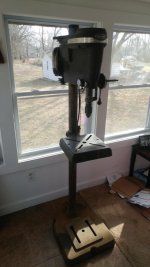
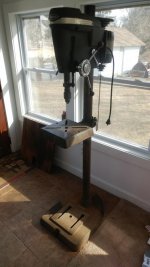
Picked this up late last night for $70.

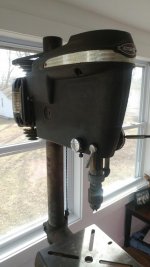
Looks to be in good shape from initial inspection. I believe it's missing a lever for the shelf adjustment, and it looks like one of the 3 lowering levers has been replaced and is missing the ball. It has the chuck key/chain.

It was originally used in a woodworking shop at a school. The motor has 2 belt pulleys (top and bottom), so i'm wondering if it's the original motor, or if the school swapped it out for another maybe? I don't recall seeing them with pulleys top and bottom, can't think why they would do that. It has a grub/set screw going up underneath the tension knob.

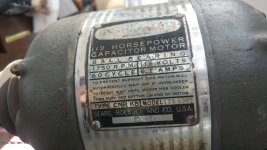
Frank, am i right in thinking this is a CM 100 15 1/2"? Any idea on what year it could be, and wether or not it is the original motor? The stamp on the bottom stand reads: 103.23140. The stamp on the motor reads: TYPE:CNB K8 MODEL: 115 6962 and E1 47 on the lower section.

Going to be following Franks hard work with the guides that he created, and refurbish it the best i can. Hopefully i'm able to keep it the original color. Should make a good partner for my '52/'53 80 bench top :beer:
 

Attachments

  • 1.jpg
    1.jpg
    68.5 KB · Views: 59
  • 2.jpg
    2.jpg
    71.7 KB · Views: 49
  • 3.jpg
    3.jpg
    67.5 KB · Views: 52
  • 4.jpg
    4.jpg
    60.7 KB · Views: 57
  • 5.jpg
    5.jpg
    148.5 KB · Views: 54
  • 7.jpg
    7.jpg
    66.5 KB · Views: 48
  • 8.jpg
    8.jpg
    150.6 KB · Views: 45
Last edited:
OP
F

FrankLee

Well-known member
Joined
Sep 13, 2010
Messages
3,548
Location
seMI, 48317
Picked this up late last night for $70.

Looks to be in good shape from initial inspection. I believe it's missing a lever for the shelf adjustment, and it looks like one of the 3 lowering levers has been replaced and is missing the ball. It has the chuck key/chain.

It was originally used in a woodworking shop at a school. The motor has 2 belt pulleys (top and bottom), so i'm wondering if it's the original motor, or if the school swapped it out for another maybe? I don't recall seeing them with pulleys top and bottom, can't think why they would do that. It has a grub/set screw going up underneath the tension knob.

Frank, am i right in thinking this is a CM 100 15 1/2"? Any idea on what year it could be, and wether or not it is the original motor? The stamp on the bottom stand reads: 103.23140. The stamp on the motor reads: TYPE:CNB K8 MODEL: 115 6962 and E1 47 on the lower section.

Going to be following Franks hard work with the guides that he created, and refurbish it the best i can. Hopefully i'm able to keep it the original color. Should make a good partner for my '52/'53 80 bench top :beer:

Good score for $70!

Yes, I would say that's original motor. E1 47 is the date code on the motor. If there are machine screws securing the head frame trim panel to the head frame, your machine is pre-1951.

You can move the lock handle from the head frame to the table. I often suggest to my buyers that they remove that style of handle from the head head frame. It really serves no purpose. BTW, it's on the wrong side of the head frame. The bolt is all that's needed there.

For being a school shop machine, that table looks to be in pretty good shape.

I have one feed handle with a black knob available. It's not chrome plated, but polished steel.

The quill is partially extended. Is the feed return spring ok?


I bought a craftsman shaper last year. It also had a second pulley on the motor. I believe the PO used it to get the motor started by hand because the capacitor was bad. Any issues starting the motor?
 
Last edited:

RiseAbove

Well-known member
Joined
Dec 19, 2018
Messages
128
Location
NJ
Good score for $70!

Yes, I would say that's original motor. E1 47 is the date code on the motor. If there are machine screws securing the head frame trim panel to the head frame, your machine is pre-1951.

You can move the lock handle from the head frame to the table. I often suggest to my buyers that they remove that style of handle from the head head frame. It really serves no purpose. BTW, it's on the wrong side of the head frame. The bolt is all that's needed there.

For being a school shop machine, that table looks to be in pretty good shape.

I have one feed handle with a black knob available. It's not chrome plated, but polished steel.

The quill is partially extended. Is the feed return spring ok?


I bought a craftsman shaper last year. It also had a second pulley on the motor. I believe the PO used it to get the motor started by hand because the capacitor was bad. Any issues starting the motor?

Yeah. I though it seemed a good deal. Especially with not really needing a whole bunch of work!

The quill feels very stiff and doesnt move freely too well or return to the top. The adjustment knob is pretty stiff also, and when i try to loosen it, it is hard to turn and turns back on itself somewhat. The grub screw underneath tightens and loosens up good. Is that the return spring that needs replacing?

Defintely interested in that feed handle and knob. The one that is on there with the missing ball is shorter than the other 2.

The motor fires up great, and is actually pretty quiet. It looks like it has the original power cord.

Here's some pictures of the trim. The machined trim piece is screwed in, but the CM logo trim is riveted in. Does that make it pre '51? I'm guessing it would be anyway if the motor is a '47, or did they hold onto motors and install them on later machinery? I noticed a hole (circled in third photo) on the head and don't know what it could be used for?


That is the earliest known motor, post wwii. I have not found a single 46 motor stamp. We know the earliest catalog is 48.

Sent from my Moto G (5) Plus using The Garage Journal mobile app

That's cool. I defintely want to keep it as original as i can now. It actually works very well too. So a '46 almost defintely doesn't exist, and the '47 is generally known to be the earliest that was listed in the '48 catolog?
 

Attachments

  • 11.jpg
    11.jpg
    34.5 KB · Views: 35
  • 10.jpg
    10.jpg
    78.9 KB · Views: 36
  • 9.jpg
    9.jpg
    28.6 KB · Views: 35
Last edited:

Outlawmws

Well-known member
Joined
Aug 9, 2011
Messages
39,110
Location
The Badlands
First get the thing going up and down smoothly THEN worry about the return spring. If its working at all it probably just needs cleaning /adjustment
 
OP
F

FrankLee

Well-known member
Joined
Sep 13, 2010
Messages
3,548
Location
seMI, 48317
My comments are interspersed.

Yeah. I though it seemed a good deal. Especially with not really needing a whole bunch of work!

The quill feels very stiff and doesnt move freely too well or return to the top.

It's highly likely that the quill lock is dirty and stuck which prevents the quill from moving freely. Remove the quill lock bolt and both lock cylinders. Then re-check the quill feed.
Review this post: https://www.garagejournal.com/forum/showthread.php?p=5443008#post5443008


The adjustment knob is pretty stiff also, and when i try to loosen it, it is hard to turn and turns back on itself somewhat. The grub screw underneath tightens and loosens up good. Is that the return spring that needs replacing?

Ditto on the spring tension knob... dirty and stubborn. Trying to turn back on itself suggests that the spring is good. Remove the thumb screw, spray the knob inside and out with any kind of penetrant or WD40. It may loosen immediately and release the spring tension. Then remove the tension knob and inspect.

I would not be making any adjustments to the spring or anything else until the entire head frame is dismantled, cleaned, inspected, lubed and reassembled.


Defintely interested in that feed handle and knob. The one that is on there with the missing ball is shorter than the other 2.

I'll set that feed handle aside for you.


The motor fires up great, and is actually pretty quiet. It looks like it has the original power cord.

You might consider replacing the cord with a grounded cord.


Here's some pictures of the trim. The machined trim piece is screwed in, but the CM logo trim is riveted in. Does that make it pre '51?

Machine screws were replaced with panel screws for the trim panel in the 1951 model year. Panel screws were used on the oval badge throughout the entire Craftsman 100 era.


I'm guessing it would be anyway if the motor is a '47, or


did they hold onto motors and install them on later machinery?

It's possible, but not likely.


I noticed a hole (circled in third photo) on the head and don't know what it could be used for?

I don't recall noticing that hole on any machines I've had. That hole appears to be in line with the quill. It's possible it could have been designed for quill lubrication.

Many times, previous owners would drill holes in the head frame to mount switches and/or lights.


That's cool. I defintely want to keep it as original as i can now. It actually works very well too. So a '46 almost defintely doesn't exist, and the '47 is generally known to be the earliest that was listed in the '48 catolog?

Original is very nice, but there were many improvements to these machines between '46 and '66. Upgrading parts when the opportunity arises will give you an awesome machine with the newer features.
 
Last edited:

RiseAbove

Well-known member
Joined
Dec 19, 2018
Messages
128
Location
NJ
First get the thing going up and down smoothly THEN worry about the return spring. If its working at all it probably just needs cleaning /adjustment

Gonna take it apart and check it all out. Hopefully nothing too serious :beer:
 
Last edited:
To avoid these ads, REGISTER NOW!

RiseAbove

Well-known member
Joined
Dec 19, 2018
Messages
128
Location
NJ
My comments are interspersed.

Thanks for the tips :beer:

Going to be going through the guides and refurbishing it asap.

What do you recomend as a general cleaner for the big cast iron parts etc? Maybe Simple Green? I don't want to damage the paint as i'd like to avoid painting it.

I found an instruction manual online that i think may explain the tiny hole on the head. I've not seen it before getting this one. My '52/'53 bench top doesn't have it. Here's a pic...
 

Attachments

  • Lubrication.JPG
    Lubrication.JPG
    87.1 KB · Views: 29
OP
F

FrankLee

Well-known member
Joined
Sep 13, 2010
Messages
3,548
Location
seMI, 48317
Thanks for the tips :beer:

Going to be going through the guides and refurbishing it asap.

What do you recomend as a general cleaner for the big cast iron parts etc? Maybe Simple Green? I don't want to damage the paint as i'd like to avoid painting it.

I found an instruction manual online that i think may explain the tiny hole on the head. I've not seen it before getting this one. My '52/'53 bench top doesn't have it. Here's a pic...

If a machine is really grimy, I first use an engine degreaser at the quarter car wash or sometimes mineral spirits and a green scotch brite pad. Then I use simple green or a liquid Zud or Barkeeper's Friend with a small plastic scrub brush.

That lubrication hole in the instructs refers to the pinion shaft on the right side.
 

RiseAbove

Well-known member
Joined
Dec 19, 2018
Messages
128
Location
NJ
If a machine is really grimy, I first use an engine degreaser at the quarter car wash or sometimes mineral spirits and a green scotch brite pad. Then I use simple green or a liquid Zud or Barkeeper's Friend with a small plastic scrub brush.

That lubrication hole in the instructs refers to the pinion shaft on the right side.

Ah ok. I've just noticed a couple more on Google images that have that hole too.

On my '52/'53 bench, it doesn't have the head trim ring, but it has the mounting holes for it. I'm guessing they all had the trim mounting holes as they would of all shared the same cast? Unless mine had the trim at some point.
 
Last edited:
OP
F

FrankLee

Well-known member
Joined
Sep 13, 2010
Messages
3,548
Location
seMI, 48317
Ah ok. I've just noticed a couple more on Google images that have that hole too.

On my '52/'53 bench, it doesn't have the trim, but it has the holes. I'm guessing they all had the trim mounting holes as they would of all shared the same cast? Unless mine had the trim at some point.

I've had so many that had holes drilled for switches and lamps, I could have easily overlooked that.

Yes, afaik, all ‘52 and ‘53 models have trim mounting holes... likely bored as opposed to cast in.

If yours had the trim panel at one time, it would likely be very obvious. The paint under the trim would have less fade, grime or patina. You should also be able to see witness marks in the holes from the drive screws.
 
Last edited:

Chucktin

Well-known member
Joined
May 24, 2015
Messages
326
Re: The Classic Craftsman 100/150 Drill Press

This is my Craftsman Be chtop Drill Press. Notice the date? 1990. Is mine radically different from the model 100 or 150s mentioned in this string?a3a4f16a1f1f5df78794d01dc6a69481.jpg
 

Attachments

  • a3a4f16a1f1f5df78794d01dc6a69481.jpg
    a3a4f16a1f1f5df78794d01dc6a69481.jpg
    81.8 KB · Views: 2

sheltonfilms

Well-known member
Joined
May 28, 2014
Messages
157
Re: The Classic Craftsman 100/150 Drill Press

This is my Craftsman Be chtop Drill Press. Notice the date? 1990. Is mine radically different from the model 100 or 150s mentioned in this string?a3a4f16a1f1f5df78794d01dc6a69481.jpg


I think the country listed on the bottom right of the manual should give you a good idea of the answer. [emoji16]


Sent from my iPhone using Tapatalk
 

Attachments

  • a3a4f16a1f1f5df78794d01dc6a69481.jpg
    a3a4f16a1f1f5df78794d01dc6a69481.jpg
    81.8 KB · Views: 3

Bill C

Well-known member
Joined
Sep 17, 2006
Messages
144
Location
Portland, OR
Just wanted to post another update on my progress.

For background, I am restoring a Model 100 (P/N 103.23131). The date code from the original motor is 4/54. So I will assume this particular DP was built in 1954. I purchased this drill press from a fellow local Garage Journal member, Smokeshow69. (Thanks again for the deal :beer:)

Here is what I started with:

46751845982_dbdf58b278_c.jpg

**NOTE that the broken vari-slo was not included in the sale, so I do not have that**

I now have the DP completely disassembled (with the exception of the motor) and have started to clean it up and polish some of the part.

First we have the head. Overall it cleaned up pretty well. I pressure washed it inside and out, sprayed it down with degreaser & mineral spirits and scrubbed it with wire brushes and green scotch-brite pads. There is some light rust in spots and the original paint is worn through in some areas (near the top). There is also some very stubborn paint splatter on one side. The wire brushing, mineral spirits, scotch-brite scrubbing etc didn't touch that white paint splatter.
I am at a crossroads here as I am still undecided if I will repaint it or keep the patina. If I don't repaint it I really need to remove the white paint splatter but don't want to further damage the finish. Maybe I will try a fresh razor blade and attempt to scrape 'em off carefully.

46939260662_89e10f933e_c.jpg


33115639298_bedb84386c_c.jpg


46266891054_caa858862a_c.jpg


The column base and tilting table also cleaned up pretty well. The biggest challenge so far was removing the taper pin from the tilt table. (see my previous post (https://www.garagejournal.com/forum/showpost.php?p=7687770&postcount=2292). The cleaning of the machined surface of the table uncovered some "arc-of-shame" holes that were not apparent when it was covered in barn dust. Fortunately, the errant drill holes are minimal and will not impact usability at all.
Also, despite the warnings on this forum, I "accidently" removed all the finish from the data plate on the column base. Interestingly, though, I used no harsh chemicals/solvents... nor did I use a brush. I wiped it with soapy water and a shop towel and the finish came right off. So I am not sure there was any way for me to have cleaned that without ruining it. OH WELL!.


46991357691_89e10f933e_c.jpg


46266892634_067603c09a_c.jpg


40032771523_c97f0417f4_c.jpg


As for the head band + badge. The headband was pretty dirty and had some of the same white paint splatter on it. I wiped it with laquer thinner and it sort-of cleaned up, but not really. I then tried some cleaner wax I had, and the finish was still very dull. Finally, I tried some very light metal polish (Blue Magic) in one area and it polished the "turning" away immediately.... even using very light pressure. OOOPS! :lol_hitti (no pictures, sorry). Not sure what I will do now. I don't care for the appearance of the "engine turned" vinyl wrap so I may just give the headband a brushed finished. The head badge, however is in good shape. I don't think I will do any additional cleaning or repair to it.

46266892214_8eb5533133_c.jpg


I also spent a little bit of time cleaning up the quill lock handle and return spring tension knob. They are pretty severely pitted and rough. I am not sure where I want to go with these. If I try to remove the "bumps" caused by the pitting with light sanding/wire wheeling, I will further damage the good chrome. So I think my two options would be strip the original chrome off completely and hand polish them back to a mirror shine (A ton of work and it will oxidize quickly) or I call it good enough and apply a coat of wax and move on.


46266894004_43fe989aa5_c.jpg


As for the motor, I have not touched it beyond plugging it in to see if it works... and it does. The bearings are noisy and will need to be cleaner or replaced. As I am already replacing the quill and spindle bearings, I will likely replace the motor bearings as well. I will tear the motor down and give it a good cleaning, service the wiring, replace the cord and the bearings. I may or not repaint it... that will all depend on what I do with the rest of the drill press finish. One thing is for sure, the decorative middle band is likely beyond repair. It is rusty and heavily pitted. I doubt it will clean up well.


33115639468_f400198479_c.jpg


32049751077_bb9dd9b1c3_c.jpg
 
OP
F

FrankLee

Well-known member
Joined
Sep 13, 2010
Messages
3,548
Location
seMI, 48317
Just wanted to post another update on my progress.

For background, I am restoring a Model 100 (P/N 103.23131). The date code from the original motor is 4/54. So I will assume this particular DP was built in 1954. I purchased this drill press from a fellow local Garage Journal member, Smokeshow69. (Thanks again for the deal :beer:)

Here is what I started with:


**NOTE that the broken vari-slo was not included in the sale, so I do not have that**

I now have the DP completely disassembled (with the exception of the motor) and have started to clean it up and polish some of the part.

First we have the head. Overall it cleaned up pretty well. I pressure washed it inside and out, sprayed it down with degreaser & mineral spirits and scrubbed it with wire brushes and green scotch-brite pads. There is some light rust in spots and the original paint is worn through in some areas (near the top). There is also some very stubborn paint splatter on one side. The wire brushing, mineral spirits, scotch-brite scrubbing etc didn't touch that white paint splatter.
I am at a crossroads here as I am still undecided if I will repaint it or keep the patina. If I don't repaint it I really need to remove the white paint splatter but don't want to further damage the finish. Maybe I will try a fresh razor blade and attempt to scrape 'em off carefully.


The column base and tilting table also cleaned up pretty well. The biggest challenge so far was removing the taper pin from the tilt table. (see my previous post (https://www.garagejournal.com/forum/showpost.php?p=7687770&postcount=2292). The cleaning of the machined surface of the table uncovered some "arc-of-shame" holes that were not apparent when it was covered in barn dust. Fortunately, the errant drill holes are minimal and will not impact usability at all.
Also, despite the warnings on this forum, I "accidently" removed all the finish from the data plate on the column base. Interestingly, though, I used no harsh chemicals/solvents... nor did I use a brush. I wiped it with soapy water and a shop towel and the finish came right off. So I am not sure there was any way for me to have cleaned that without ruining it. OH WELL!.


As for the head band + badge. The headband was pretty dirty and had some of the same white paint splatter on it. I wiped it with laquer thinner and it sort-of cleaned up, but not really. I then tried some cleaner wax I had, and the finish was still very dull. Finally, I tried some very light metal polish (Blue Magic) in one area and it polished the "turning" away immediately.... even using very light pressure. OOOPS! :lol_hitti (no pictures, sorry). Not sure what I will do now. I don't care for the appearance of the "engine turned" vinyl wrap so I may just give the headband a brushed finished. The head badge, however is in good shape. I don't think I will do any additional cleaning or repair to it.


I also spent a little bit of time cleaning up the quill lock handle and return spring tension knob. They are pretty severely pitted and rough. I am not sure where I want to go with these. If I try to remove the "bumps" caused by the pitting with light sanding/wire wheeling, I will further damage the good chrome. So I think my two options would be strip the original chrome off completely and hand polish them back to a mirror shine (A ton of work and it will oxidize quickly) or I call it good enough and apply a coat of wax and move on.


As for the motor, I have not touched it beyond plugging it in to see if it works... and it does. The bearings are noisy and will need to be cleaner or replaced. As I am already replacing the quill and spindle bearings, I will likely replace the motor bearings as well. I will tear the motor down and give it a good cleaning, service the wiring, replace the cord and the bearings. I may or not repaint it... that will all depend on what I do with the rest of the drill press finish. One thing is for sure, the decorative middle band is likely beyond repair. It is rusty and heavily pitted. I doubt it will clean up well.

Very good work Bill!

It is a very tough call when deciding whether to repaint. My opinion is that it's only original once. The condition of the chrome parts may look out of place on a newly re-painted machine.

It wasn't too long ago when I swapped out the table and re-painted base in the background with the paint splattered original table and base in the foreground. Then, I swapped a fully reconditioned motor with an original untouched motor. I never regretted it.

The bottom line, I guess, is personal preference.

 
Last edited:

RiseAbove

Well-known member
Joined
Dec 19, 2018
Messages
128
Location
NJ
Great work Bill C :beer:


I've had so many that had holes drilled for switches and lamps, I could have easily overlooked that.

Yes, afaik, all ‘52 and ‘53 models have trim mounting holes... likely bored as opposed to cast in.

If yours had the trim panel at one time, it would likely be very obvious. The paint under the trim would have less fade, grime or patina. You should also be able to see witness marks in the holes from the drive screws.

Just checked the head, and like you mentioned, it had no difference in coloration or witness marks to say the holes had been used.

I just noticed, my '52-'53 benchtop has kind of a cast ornate design on the head (where the band would usually be) that is kind of like the Kraeuter pliers art deco 'Don't Slip' handle pattern, although not as intricate. Have you noticed some of the banded models are flat underneath, or are they all the same? The one Bill C posted above looks similar, and i noticed the ones you posed in the badge cleaning section are the same too. Heres mine:
 

Attachments

  • 3.jpg
    3.jpg
    84.8 KB · Views: 27
Last edited:
OP
F

FrankLee

Well-known member
Joined
Sep 13, 2010
Messages
3,548
Location
seMI, 48317
Great work Bill C :beer:


Just checked the head, and like you mentioned, it had no difference in coloration or witness marks to say the holes had been used.

I just noticed, my '52-'53 benchtop has kind of a cast ornate design on the head (where the band would usually be) that is kind of like the Kraeuter pliers art deco 'Don't Slip' handle pattern, although not as intricate. Have you noticed some of the banded models are flat underneath, or are they all the same? The one Bill C posted above looks similar, and i noticed the ones you posed in the badge cleaning section are the same too. Heres mine:

Your bench top is a 13-1/2" model?

As far as I know,


  • the 12-1/4" models have a smooth casting in the head frame trim area (although the 12-1/4" models never had trim, except in '64)

  • the 13-1/2" models have completely recessed casting areas in the head frame trim area

  • the 15-1/2" models have the transitioned, recessed to smooth casting areas in the head frame trim area
 
Last edited:

RiseAbove

Well-known member
Joined
Dec 19, 2018
Messages
128
Location
NJ
Your bench top is a 13-1/2" model?


Yeah, the bench is a 13-1/2".

I also just pulled the trim off of the '47/'48 floor model and found what looks like a screwed on plate that says 'A23' upside down that's been painted over. Looks like you have the same thing in the last pic you posted above too?

Also, do you have any tips on removing dirt and grime from the S/N plates? Both the bench and floor model plates i have are pretty rough. I'm guessing there's no piant underneath, but not sure.
 

Attachments

  • Head.jpg
    Head.jpg
    114.1 KB · Views: 30
  • Plate '47.jpg
    Plate '47.jpg
    150.6 KB · Views: 23
  • Plate '53.jpg
    Plate '53.jpg
    125.2 KB · Views: 26
Last edited:
OP
F

FrankLee

Well-known member
Joined
Sep 13, 2010
Messages
3,548
Location
seMI, 48317
Yeah, the bench is a 13-1/2".

I also just pulled the trim off of the '47/'48 floor model and found what looks like a screwed on plate that says 'A23' upside down that's been painted over. Looks like you have the same thing in the last pic you posted above too?

Also, do you have any tips on removing dirt and grime from the S/N plates? Both the bench and floor model plates i have are pretty rough. I'm guessing there's no piant underneath, but not sure.

I have no idea what those casting numbers mean. There are a several different sets of numbers and I have one head frame with no numbers. They were imprinted into the mold during the manufacturing process.

I have no suggestions for resurrecting a painted-over badge. I do have a post about badges where describe how I clean them.
https://www.garagejournal.com/forum/showthread.php?p=6060823#post6060823

Your 23641 badge looks like it has very nice original paint under the gray paint.
 

RiseAbove

Well-known member
Joined
Dec 19, 2018
Messages
128
Location
NJ
I have no idea what those casting numbers mean. There are a several different sets of numbers and I have one head frame with no numbers. They were imprinted into the mold during the manufacturing process.

I have no suggestions for resurrecting a painted-over badge. I do have a post about badges where describe how I clean them.
https://www.garagejournal.com/forum/showthread.php?p=6060823#post6060823

Your 23641 badge looks like it has very nice original paint under the gray paint.

Thanks for the link :beer:

Yeah, the badge looks to be in good shape, just got to remove that paint. Want to try avoid chemicals. Going to remove the badge, then maybe try to loosen/soften the paint with steam...maybe put it in a steamer basket above a boiling pan on the stove or something. Lol. I'll post results if it works out.
 
Last edited:

Bill C

Well-known member
Joined
Sep 17, 2006
Messages
144
Location
Portland, OR
Re: Spring, Pinion, Hub, Feed Handle Assemblies

Frank,
Regarding your post Here: 6347465 and quoted below:

I need to mate a replacement hub assembly to the original pinion shaft on my drill press. Of course, per your statements in the quoted post, the holes do not line up. I will need to drill my original pinion shaft to match the holes in the replacement hub assembly.
So my question is: What size drill bit are you using to re-drill the pinion shaft? The pin seems to measure between 0.280 and 0.285". Size "I" or "J" perhaps?

Spring, Pinion, Hub, Feed Handle Assemblies

There is a pin in the hub that passes through pinion shaft. That pin holds the hub to the shaft and also passes through the loop on the spring. One end of that pin is knurled.

38997162025_25ee6988f0_n.jpg


Before dismantling the pinion/hub assembly, I like to scribe a small mark on the shaft and the hub. It makes assembly easier. The pin holes are never bored perfectly centered and the holes will only line up one way.

And to complicate things even more, the holes are never the same between assemblies. That means that the hub or the pinion shaft must be re-drilled when swapping or replacing these parts.
 
OP
F

FrankLee

Well-known member
Joined
Sep 13, 2010
Messages
3,548
Location
seMI, 48317
Re: Spring, Pinion, Hub, Feed Handle Assemblies

Frank,
Regarding your post Here: 6347465 and quoted below:

I need to mate a replacement hub assembly to the original pinion shaft on my drill press. Of course, per your statements in the quoted post, the holes do not line up. I will need to drill my original pinion shaft to match the holes in the replacement hub assembly.
So my question is: What size drill bit are you using to re-drill the pinion shaft? The pin seems to measure between 0.280 and 0.285". Size "I" or "J" perhaps?

I wanted to a couple times, but I've never swapped a hub.

I would choose the largest bit that fits in the existing holes in the pinion shaft.

How are you going to drill? New holes through both hub and pinion? Through just hub?
 
Last edited:

Bill C

Well-known member
Joined
Sep 17, 2006
Messages
144
Location
Portland, OR
Re: Spring, Pinion, Hub, Feed Handle Assemblies

I wanted to a couple times, but I've never swapped a hub.

I would choose the largest bit that fits in the existing holes in the pinion shaft.

How are you going to drill? New holes through both hub and pinion? Through just hub?

Not entirely sure what I am going to do yet. I have two "good" spare hubs and my original pinion shaft.
  • Hub #1 has holes that line up pretty darn close to original pinion shaft. With this hub I could probably line it up and only need to "oblong" one of the hub holes for a good fit. The downside, however, is this hub has a pretty loose fit on the pinion and also has gnarly threads for the feed handles. All three feed handle holes have threads that are half stripped. The feed handles do tighten up OK, but not sure how durable it will be long term.

    Here you can see the damaged threads:

    32152137597_31eca2ee4a_c.jpg


  • Hub #2 has pretty poor hole alignment between the pinion and the hub, but it fits very snuggly on the pinion shaft and the threads for the feed handles are in great shape. For this one, If I lined up one pinion hole with one hub hole, the opposite side hub hole would be severely oblonged if I drilled through. So for this one, I would likely need to re-drill this one completely (hub & pinion) 90deg off from the original set of holes.

    In this photo you can see that one side could be made to line-up perfect w/ a little filing to shorten the pinion shaft.

    46180243465_24bdabcabc_c.jpg


    The other side, however, ends up way off from proper alignment:

    40129108043_2da7b463fd_c.jpg

The other challenge I have is that I do not have a working drill press *yet* to enable me to accurately drill new holes in the hub & pinion. So I will have to find a friend with a nice drill press so that I can drill the holes.
 
OP
F

FrankLee

Well-known member
Joined
Sep 13, 2010
Messages
3,548
Location
seMI, 48317
Re: Spring, Pinion, Hub, Feed Handle Assemblies

Not entirely sure what I am going to do yet. I have two "good" spare hubs and my original pinion shaft.
  • Hub #1 has holes that line up pretty darn close to original pinion shaft. With this hub I could probably line it up and only need to "oblong" one of the hub holes for a good fit. The downside, however, is this hub has a pretty loose fit on the pinion and also has gnarly threads for the feed handles. All three feed handle holes have threads that are half stripped. The feed handles do tighten up OK, but not sure how durable it will be long term.

  • Hub #2 has pretty poor hole alignment between the pinion and the hub, but it fits very snuggly on the pinion shaft and the threads for the feed handles are in great shape. For this one, If I lined up one pinion hole with one hub hole, the opposite side hub hole would be severely oblonged if I drilled through. So for this one, I would likely need to re-drill this one completely (hub & pinion) 90deg off from the original set of holes.

    In this photo you can see that one side could be made to line-up perfect w/ a little filing to shorten the pinion shaft.

    The other side, however, ends up way off from proper alignment:

The other challenge I have is that I do not have a working drill press *yet* to enable me to accurately drill new holes in the hub & pinion. So I will have to find a friend with a nice drill press so that I can drill the holes.

Hub#2 would get my vote.

Perhaps an inane statement, but I assume you test fit the hub in both orientations, ie, rotated 180 degrees to the pinion shaft. The holes would line up differently.

My first thought was to line up one hub hole with the two pinion shaft holes. Then insert the drill bit through those three holes to oblong the other side of the hub. The danger in that is that the good hub hole would likely and unintentionally get ob-longed too.

There is another option that I think I would try... shorten the pin from the non-knurled end and use a retaining compound (~Loctite 609) to aid in securing the hub to the pinion shaft.

  • shorten the non-knurled end of the pin by the thickness of the hub wall... ~3/16"?
  • inspect the hub to determine which hole has the witness marks from the knurled pin and which is the "clean" hole
  • apply Loctite to the pinion and hub
  • assemble the hub, pinion and return spring by driving the pin into the clean hole so the knurls hold tightest
  • the other end of the pin will stop short of the other side of the hub

The pin is secure. The spring is secure. The hub is secure.
 
Last edited:

Bill C

Well-known member
Joined
Sep 17, 2006
Messages
144
Location
Portland, OR
Re: Spring, Pinion, Hub, Feed Handle Assemblies

Hub#2 would get my vote.

Perhaps an inane statement, but I assume you test fit the hub in both orientations, ie, rotated 180 degrees to the pinion shaft. The holes would line up differently.

My first thought was to line up one hub hole with the two pinion shaft holes. Then insert the drill bit through those three holes to oblong the other side of the hub. The danger in that is that the good hub hole would likely and unintentionally get ob-longed too.

There is another option that I think I would try... shorten the pin from the non-knurled end and use a retaining compound (~Loctite 609) to aid in securing the hub to the pinion shaft.

  • shorten the non-knurled end of the pin by the thickness of the hub wall... ~3/16"?
  • inspect the hub to determine which hole has the witness marks from the knurled pin and which is the "clean" hole
  • apply Loctite to the pinion and hub
  • assemble the hub, pinion and return spring by driving the pin into the clean hole so the knurls hold tightest
  • the other end of the pin will stop short of the other side of the hub

The pin is secure. The spring is secure. The hub is secure.

Jim,
That was exactly my fear with trying to oblong the mismatched hub hole. It wouldn't take much extra material removal from the "good" hole to make it too loose of a fit.
I think I am going to opt for the dowel pin shortening technique + Loctite 609. The fit between the pinion and hub is already nice and tight so I suspect that w/ some retaining compound, the thing would hold without a pin at all... At that point the pin is really just needed to secure the torsion return spring.
 
To avoid these ads, REGISTER NOW!
Top Bottom