To avoid these ads, REGISTER NOW!

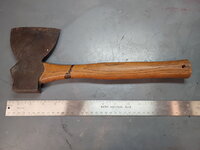
Craftsman hewing(?) hatchet

MiteyF

Well-known member
Joined
Feb 26, 2022
Messages
137
Nothing much to share, but as we all like old tools, thought someone might get a little kick.

Among some other (wonderful) woodworking tools I have been given that once belonged to my grandfather (and some my great grandfather) is this Craftsman hewing hatchet. I'm not much of a tool historian by any stretch, but it seems I can only find this particular logo on some of their old axes/hatchets.

20250618203301-cf1f3a03-me.jpg

I was a little bummed at first that it's left handed (which makes sense as my grandfather was left handed apparently), but as I don't really have any plan or need for this besides as a keepsake, I didn't think too much about it. Looking at it now, I suppose I could just rehandle it the other way around should I ever find a use.

20250618203320-5db5c2eb-me.jpg

20250618203932-f39be230-me.jpg
 
To avoid these ads, REGISTER NOW!

RTM

Well-known member
Joined
May 13, 2019
Messages
13,190
Location
SF Bay Area
not much of a tool historian by any stretch, but it seems I can only find this particular logo on some of their old axes/hatchets
Remember Craftsman didn't make anything themselves. I suspect when they contracted with Dave's House of Axes and Hatchets, they asked him to make a representative logo. That shape with a double ovals probably matches their existing logo and they just change the lettering in the middle to reflect Craftsman.

There are lots of "not quite right" logos out there as you'll see on the various craftsmen threads and I would say that forged tools are probably the most likely wearers of those logos. When making tool boxes for Craftsman it could be the Craftsman bought a million logos and gave 300,000 to each vendor to slap on the boxes they made for them.


I would think the leftmost logo here might be a tough one to stamp into certain tools..DSC09388.jpg
 

egdede

ALLIANCE MEMBER
Joined
Dec 20, 2009
Messages
2,092
What exactly makes that a left handed hatchet? Is the handle noticably thinner on the 'finger side'?
 
To avoid these ads, REGISTER NOW!

RTM

Well-known member
Joined
May 13, 2019
Messages
13,190
Location
SF Bay Area
Which side the bevel is on.
One side of the hatchet (pic2) is almost flat, the visible bevel is on the other side (pic 1). The finished surface is against the flat side. So cutting with the wrong hand means you're cutting across your body which is ergonomically uncomfortable.

I think it really depends on how you like to stand, whether you straddle the log or stand next to it when you're swinging the hatchet. Held in your right hand, you could stand with the log on your right, and not reach across.

I'm a rightie, and would straddle the log with my broad hatchets.

PXL_20220815_014350736-XL.jpg
 

Oregon Dave

Well-known member
Joined
Sep 16, 2023
Messages
298
Your carpenters' axe/hatchet is meant for a right-handed user. See the bevel on one side of the head & flush, single bevel on the other- makes more of a wood chisel-type edge.

A log could be 'roughed-out' in several ways; but when it came to finishing out the round to cant/square profile, then this tool was used, very sharp.

Standing on the left side of a log, tool in your right hand, flush side of the tool toward the work, you would chop and walk forward along the log, forming a flat vertical surface. Rotate the 'flat' side down & repeat 3 more times. At the 3rd rotation, the 1st side is up and you can begin to also use the tool more like a chisel/shaver.

We have barns built in the late 1880's that each have six foundation stringers 10" square x 100 ft. in length. When we first exposed one they appeared milled and we figured, spliced - nope, totally hand hewn by master craftsmen.

Cool to have your Grandad's tool, by the way!!!
 

Provincial

Well-known member
Joined
Sep 21, 2011
Messages
6,871
Location
Near Salem, OR
I have pieces of 12 x x12 fir beams that were made on site for a bridge. They have rotted away at the joints from the truss, but each section is in nice shape for about eight feet.

It is easy to see how they were made. There are shallow saw cuts at regular intervals across each flat, obviously guides for hewing. String lines were run down the length of the log establishing the 12 x 12 section, and then crosscut saws were used to saw down to the string at intervals. After doing this on all four sides, they roughed out the square, then made finish cuts until the "witness" saw cuts barely remained.
 
To avoid these ads, REGISTER NOW!
Top Bottom