
You are using an out of date browser. It may not display this or other websites correctly.
You should upgrade or use an alternative browser.
You should upgrade or use an alternative browser.
Craftsman power hacksaw
- Thread starter Brian Bonser
- Start date

RoninB4
Well-known member
-What you consider "straight" is a relative term. Blade condition is obviously real important but so is the material how thick it is. Longer cuts like plate compound the error, watch the cut and adjust the material as you go. When it's important I'll use layout fluid and scribe lines to easily see where the cut is going. Material can also have hard spots that deflect the cut or dull the blade, it's more common now than it used to be. Even industrial grade vertical bandsaws often cut off and require angling the material for a straight cut. Alignment of the frame arms, guides, and vise need inspection/evaluation/correction with a used saw like that one. Check operation before cash is exchanged, it appears as though there's something missing from the "lift" mechanism. The sawblade has to lift (slightly) out of the cut on the backstroke or it will rub/wear the teeth as it retracts the stroke. Hacksaws only cut in ONE direction. The lift may just need a bar made to connect the two existing points on the frame. If that's the case it's a negotiating point for the price. You'd have to see it work in person to determine this.Besides saving old american machinery, any reason to own one? I get a bandsaw will cut faster but how are these with cutting straight?
-If you have the available space for it and the cash I'd probably get it too. Even if it doesn't cut exactly perpendicular to stock axis then just compensate with a little extra material. In machining you do that anyway so you can cut a finished side. Slow? Yeah but for multiple cuts you set it, go do something else, and let the saw eat. Blades are fairly cheap (depending...) and last a long time with care. A small machine like that can be set up to accommodate longer stock easier than most horizontal bandsaws. Should be an easy rebuild. It's old, slow, noisy, and a mechanical anomaly by today's standards. It resembles me. Photos when finished please.I figure for $100 I cant go wrong if it cuts straight
FrankLee
Well-known member
These saws were made by Covel Mfg Co.
Owners manual: http://vintagemachinery.org/pubs/2115/4354.pdf
The blade lowering mechanism on these saws consists of two pawls that walk up a fine-toothed rack attached to the blade arm.
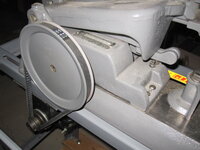
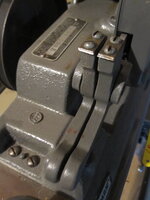

IIRC, the toothed rack is a weak link on these machines. When checking it out, verify that there are no broken teeth on that toothed rack.
EDIT:
For reference and comparison, this popped up this morning in s.e. Mi.
Facebook
 www.facebook.com
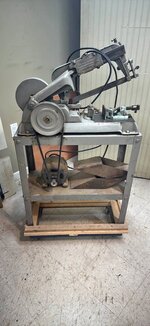
Owners manual: http://vintagemachinery.org/pubs/2115/4354.pdf
The blade lowering mechanism on these saws consists of two pawls that walk up a fine-toothed rack attached to the blade arm.
IIRC, the toothed rack is a weak link on these machines. When checking it out, verify that there are no broken teeth on that toothed rack.
EDIT:
For reference and comparison, this popped up this morning in s.e. Mi.
www.facebook.com
Last edited:
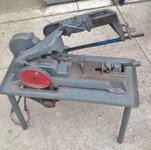
With careful fiddling, they can be made to cut accurately, slow, but fascinating to watch. Here's mine with a custom base/tray. They usually sell for $100 around here.
Attachments

Last edited:
cvairwerks
Well-known member
One of the most soothing sounds in a shop is a power hack going. The other is a shaper or metal planer.
OP
Brian Bonser
Member
Thanks for all the info-What you consider "straight" is a relative term. Blade condition is obviously real important but so is the material how thick it is. Longer cuts like plate compound the error, watch the cut and adjust the material as you go. When it's important I'll use layout fluid and scribe lines to easily see where the cut is going. Material can also have hard spots that deflect the cut or dull the blade, it's more common now than it used to be. Even industrial grade vertical bandsaws often cut off and require angling the material for a straight cut. Alignment of the frame arms, guides, and vise need inspection/evaluation/correction with a used saw like that one. Check operation before cash is exchanged, it appears as though there's something missing from the "lift" mechanism. The sawblade has to lift (slightly) out of the cut on the backstroke or it will rub/wear the teeth as it retracts the stroke. Hacksaws only cut in ONE direction. The lift may just need a bar made to connect the two existing points on the frame. If that's the case it's a negotiating point for the price. You'd have to see it work in person to determine this.
-If you have the available space for it and the cash I'd probably get it too. Even if it doesn't cut exactly perpendicular to stock axis then just compensate with a little extra material. In machining you do that anyway so you can cut a finished side. Slow? Yeah but for multiple cuts you set it, go do something else, and let the saw eat. Blades are fairly cheap (depending...) and last a long time with care. A small machine like that can be set up to accommodate longer stock easier than most horizontal bandsaws. Should be an easy rebuild. It's old, slow, noisy, and a mechanical anomaly by today's standards. It resembles me. Photos when finished please.