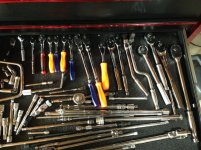
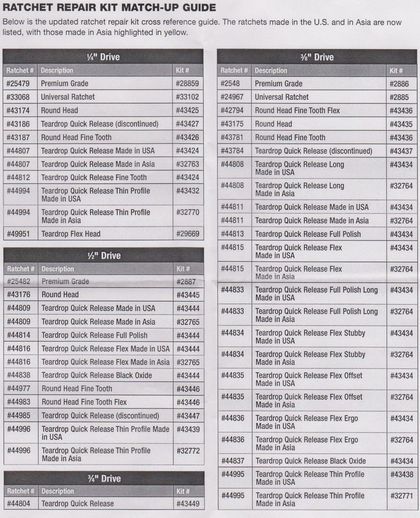
the trick to the 1/4 is cut the spring down slightly. I know you shouldn't have to but its the only solution I have come up with.
uh... sorry, i don't mean to start an argument or anything like that, but that will do exactly the opposite desired result for these types of ratchets that have a single paw that shifts from left to right.
in my experience fixing some of these ratchets, there are 2 main causes to the "reversing" or "jambing" issue...
1. too much grease or too thick grease. as you're ratcheting, the paw has to slide down and re-engage the next teeth on the gear. if there is too much grease or too thick, the paw doesn't move smoothly due to the viscosity of the grease and doesn't re-engage the next teeth but get stuck in the "middle" area.. this is where it jambs up or sometimes because it sticks to the main gear, it'll move to the opposite side and "reverse".
2. the retention pin spring isn't strong or reacting fast enough. for the paw to "push" back into the next position and re-engage the gear, the retention pin and spring are crucial. if that spring is weak, it doesn't push the paw back up against the gear on the next teeth consistently enough, and so again, the paw either gets stuck in the middle (jamb), or follows the gear to the other side (reverses).
To repair #1, just use a less viscous grease, or use an oil which is what comes from the factory. To repair #2, i actually stretch the spring out to a point where it deforms a tiny little bit so that it's resting length is longer than previously. These steps have fixed every ratchet of this type of design.
I know the older 36 teeth CMan ratchets worked "smoother" with shorter springs, but that design was completely different and you could do that without causing a disruption in function, but these ratchets absolutely need a strong retention pin spring...


 but how does this compare to the ~$12 kobalt flex head. Yes I realize one is flex and the other is a fixed, but as far as tooth count and smoothness? What really limits from buying Cman tools now is the knowledge that they have and will continue to manufacture overseas.