

You are using an out of date browser. It may not display this or other websites correctly.
You should upgrade or use an alternative browser.
You should upgrade or use an alternative browser.
CRAFTSMAN SOCKETS NUMBERING SYSTEM
- Thread starter Eddymeboy
- Start date
yatg
Well-known member
Craftsman socket and wrench numbering is mostly in sequence, but sometimes they just grab an unused number in the vicinity.
There's no set formula to convert from the socket type/size/drive to a part number.
There's no set formula to convert from the socket type/size/drive to a part number.
four.cycle
Well-known member
Hello @Eddymeboy and welcome to the site!
keep this link handy
and this one!
As noted, while other tool manufacturers endeavored to invent part numbering systems for their sockets which made sense (generally ending with the two digits that corresponded to the socket opening size in 32nds of an inch), the Craftsman socket part numbering system makes absolutely no sense at all.
While a run of sizes may have sequential part numbers (e.g., 3/16" - 1/2"), you'll find oddball, out-of-sequence part numbers on items which may have been added to the catalog at a later date (e.g., 5/32")
here is another example - of metric socket part numbers - listed from a set I currently have on ebay:
10 mm 12 pt 44232 EE
11 mm 12 pt 44229 EE
12 mm 12 pt 44233 EE
13 mm 12 pt 44234 EE
14 mm 12 pt 44235 EE
15 mm 12 pt 44236 -VV-
15 mm 12 pt 44236 EE
16 mm 12 pt 44266 EE
17 mm 12 pt 44237 EE
17 mm 12 pt 44237 -VV
19 mm 12 pt 44238 -VV-
19 mm 12 pt 44238 -VV
22 mm 12 pt 44239 -VV-
22 mm 12 pt 44239 -VV-
again, the Craftsman part numbering system on sockets makes absolutely no sense at all.
keep this link handy
and this one!
As noted, while other tool manufacturers endeavored to invent part numbering systems for their sockets which made sense (generally ending with the two digits that corresponded to the socket opening size in 32nds of an inch), the Craftsman socket part numbering system makes absolutely no sense at all.
While a run of sizes may have sequential part numbers (e.g., 3/16" - 1/2"), you'll find oddball, out-of-sequence part numbers on items which may have been added to the catalog at a later date (e.g., 5/32")
here is another example - of metric socket part numbers - listed from a set I currently have on ebay:
10 mm 12 pt 44232 EE
11 mm 12 pt 44229 EE
12 mm 12 pt 44233 EE
13 mm 12 pt 44234 EE
14 mm 12 pt 44235 EE
15 mm 12 pt 44236 -VV-
15 mm 12 pt 44236 EE
16 mm 12 pt 44266 EE
17 mm 12 pt 44237 EE
17 mm 12 pt 44237 -VV
19 mm 12 pt 44238 -VV-
19 mm 12 pt 44238 -VV
22 mm 12 pt 44239 -VV-
22 mm 12 pt 44239 -VV-
again, the Craftsman part numbering system on sockets makes absolutely no sense at all.
Thanks much. That seems to be the consensus.Hello @Eddymeboy and welcome to the site!
keep this link handy
and this one!
As noted, while other tool manufacturers endeavored to invent part numbering systems for their sockets which made sense (generally ending with the two digits that corresponded to the socket opening size in 32nds of an inch), the Craftsman socket part numbering system makes absolutely no sense at all.
While a run of sizes may have sequential part numbers (e.g., 3/16" - 1/2"), you'll find oddball, out-of-sequence part numbers on items which may have been added to the catalog at a later date (e.g., 5/32")
here is another example - of metric socket part numbers - listed from a set I currently have on ebay:
10 mm 12 pt 44232 EE
11 mm 12 pt 44229 EE
12 mm 12 pt 44233 EE
13 mm 12 pt 44234 EE
14 mm 12 pt 44235 EE
15 mm 12 pt 44236 -VV-
15 mm 12 pt 44236 EE
16 mm 12 pt 44266 EE
17 mm 12 pt 44237 EE
17 mm 12 pt 44237 -VV
19 mm 12 pt 44238 -VV-
19 mm 12 pt 44238 -VV
22 mm 12 pt 44239 -VV-
22 mm 12 pt 44239 -VV-
again, the Craftsman part numbering system on sockets makes absolutely no sense at all.
four.cycle
Well-known member
In which case you want to match the production codesTrying to keep the set as original as I can
Craftsman Hand Tool Manufacturers & Date Ranges
(e.g., -V- or =V= (which are actually the same) or G or VV or.... )
yatg
Well-known member
If you're OCD, then you need to make sure all the sockets have the right series too.That makes sense. Trying to keep the set as original as I can so I wanted to be sure before pulling the trigger
=V=, V, VV, G, G2, etc
four.cycle
Well-known member
@Eddymeboy -
Check the classifieds section. Don (d42jeep) is always unloading excess Craftsman sockets.
I have a mess of oddballs on ebay, but I don't think any of them are deep-wells.
Check the classifieds section. Don (d42jeep) is always unloading excess Craftsman sockets.
I have a mess of oddballs on ebay, but I don't think any of them are deep-wells.
Last edited:
They're -v- I'll be sure to keep that in mind.In which case you want to match the production codes
Craftsman Hand Tool Manufacturers & Date Ranges
(e.g., -V- or =V= (which are actually the same) or G or VV or.... )
scottybk
Well-known member
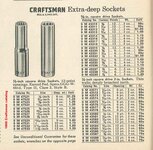
Just came across this thread, very valuable info. I was just going thru a bunch of random drawers and leftover flea market scores etc. and such and have pieced together a complete set of older -V- deep chrome six point 3/8 drive sockets, I just realized the only one I'm missing is the 7/8 number 43339.
Based on the old catalog chart above, I see there was nothing smaller than 3/8 and nothing larger than 7/8 in this particular series/era of 3/8 drive.
I think it's odd they picked 7/8 as the largest and not 3/4. There are tons and tons of sets (to the point it's extremely common, esp in wrench sets) to go from 3/8 to 3/4. Most sets that go above 3/4 run all the way up to 1 inch. Here, they include 13/16 and 7/8 and then stop. The 13/16 and 7/8 in this set/series are not "spark plug sockets" either, with the rubber boots inside etc, they are just ordinary sockets.
At any rate I'm pretty happy I pieced together a 6 point set (except for the missing 7/8) without even trying lol. I'm going to keep a close eye out at the fleas for a six point 7/8 to finish the set, even though a 3/8 drive 7/8 seems sort of useless (that size should be half inch drive).
Then again I'm a guy who has a 1/2 drive 8 mm impact that gets a lot of laughs from my buddies, since over-torquing things to strip and snap them is sort of my specialty. I'd give my eyeteeth for a 5/32 impact socket in 3/4 inch drive
Based on the old catalog chart above, I see there was nothing smaller than 3/8 and nothing larger than 7/8 in this particular series/era of 3/8 drive.
I think it's odd they picked 7/8 as the largest and not 3/4. There are tons and tons of sets (to the point it's extremely common, esp in wrench sets) to go from 3/8 to 3/4. Most sets that go above 3/4 run all the way up to 1 inch. Here, they include 13/16 and 7/8 and then stop. The 13/16 and 7/8 in this set/series are not "spark plug sockets" either, with the rubber boots inside etc, they are just ordinary sockets.
At any rate I'm pretty happy I pieced together a 6 point set (except for the missing 7/8) without even trying lol. I'm going to keep a close eye out at the fleas for a six point 7/8 to finish the set, even though a 3/8 drive 7/8 seems sort of useless (that size should be half inch drive).
Then again I'm a guy who has a 1/2 drive 8 mm impact that gets a lot of laughs from my buddies, since over-torquing things to strip and snap them is sort of my specialty. I'd give my eyeteeth for a 5/32 impact socket in 3/4 inch drive
For what it is worth, I found a complete set in a tool box I picked up recently. As far as I can tell it looks original and complete with the metal flip-top case, socket finishes look the same across the set (with a weird rough inside finish) but they are a mix of V, VV, and G.... set of older -V- deep chrome six point 3/8 drive sockets, I just realized the only one I'm missing is the 7/8 number 43339...
DAWrench
Well-known member
A lot of sockets from that era have an inside finish that is like a type of paint. Usually wears off with some use. At least those Craftsman sockets were from before the **** double detent started so that is a plusFor what it is worth, I found a complete set in a tool box I picked up recently. As far as I can tell it looks original and complete with the metal flip-top case, socket finishes look the same across the set (with a weird rough inside finish) but they are a mix of V, VV, and G.
That is exactly it. A few of them have worn paint inside. Thanks!A lot of sockets from that era have an inside finish that is like a type of paint. Usually wears off with some use. At least those Craftsman sockets were from before the **** double detent started so that is a plus
Just came across this thread, very valuable info. I was just going thru a bunch of random drawers and leftover flea market scores etc. and such and have pieced together a complete set of older -V- deep chrome six point 3/8 drive sockets, I just realized the only one I'm missing is the 7/8 number 43339.
Based on the old catalog chart above, I see there was nothing smaller than 3/8 and nothing larger than 7/8 in this particular series/era of 3/8 drive.
I think it's odd they picked 7/8 as the largest and not 3/4. There are tons and tons of sets (to the point it's extremely common, esp in wrench sets) to go from 3/8 to 3/4. Most sets that go above 3/4 run all the way up to 1 inch. Here, they include 13/16 and 7/8 and then stop. The 13/16 and 7/8 in this set/series are not "spark plug sockets" either, with the rubber boots inside etc, they are just ordinary sockets.
7/8 is the USS (often called 'heavy hex' these days) for 1/2 bolts. Lots of that still running around in the 60s. USS was largely obsolete by WWII (and the war production rationalization did it in, except for a few oddball holdouts. ), but it was used on millions of pieces of farm equipment, ford cars, and lots of other places.
Jeff Ivers
Well-known member
I have recently been working on my household inventory and sorting through both socket sets and wrench sets. I have not found a single Craftsman set where the parts numbers are in the same sequence as the sizes (either increasing or decreasing). Wish I could shed some light on why, but it may just be one of those situations where "that is the way it is". I think I found one sequence of 4 sockets where the parts numbers increased by one for each increase of socket size.
WWheeler
Well-known member
I always assumed Craftsman's socket numbers went like that as only the most basic, lowest priced set in a drive size, sets that had a lot of skipped sizes, would have all their sockets numbered sequentially, and the other sizes needed to fill out those skips either individually or in larger sets, were numbered after-the-fact, and that somehow helped make sure their most common / lowest priced sets were easiest to assemble either on rails or in those blow-molded plastic boxes, coming from the factory.
I've nothing to base that on, other than that's what I always thought made it make sense to me.
I've nothing to base that on, other than that's what I always thought made it make sense to me.