To avoid these ads, REGISTER NOW!

Craftsman =v= question...

JohnDeere1

Banned
Joined
Jun 21, 2017
Messages
710
Location
Kentucky
I just sold a giant box that took 2 people to carry of all snap on with a ton a v and other all USA craftsman I'd say 3-400 sockets with ratchets and wrenches and more it was a ton I sold it all for $75 us and paid maybe half that for it all as my pawn shop sells tools by the shoe box full for $5 I've bought alot of tool truck brand gems the same way.
Something is worth what others are willing to pay in my case I just wanted it gone and was happy with what I got because selling on eBay is a pain I the rear with all the trips to post office and waiting on your money you have to pay out of pocket first till they get the it me then you get the money. Not worth the extra trouble.
I just sold a complete -v- 1/4 and 3/8 socket set in the plastic case for $20 looked brand new never used tried to get $40 on ebay but didnt happen. I don't think the v series is any better than the other USA made stuff really maybe Bette Bette than the last usa made ratchets with plastic selectors.
I have some very rare craftsman items probably freest ratchets made with the amber handles I have all 3 sizes and other tools I paid not so much for on ebay. I do have some of those chrome punches and chisels I buy everyone I find they are very nice.
 
To avoid these ads, REGISTER NOW!

emr454

Well-known member
Joined
Oct 14, 2017
Messages
47
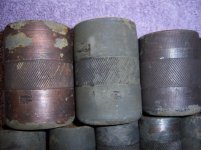
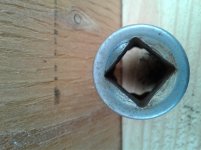
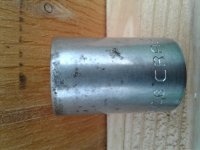
Here is my lone =v= Craftsman socket:

3KjnroaG-5gNLnhDLgLtT16fbC1M45cO1afsUBYdhOQ


KNTZ3YZd74f_qdZU90Bhr5CwoF6OSOd-ItYF5My1RB4


PxO96OBCtF2ZclXwPUJSfjYmgxNvpPDUISsZLuAoP8c
 

d42jeep

Well-known member
Joined
Oct 22, 2014
Messages
16,500
Location
Northern California
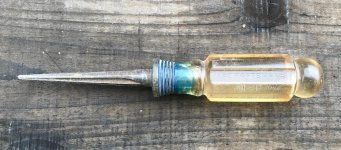
So as not to get lost in my previous post, I have forever been looking for a specific Craftsman tool from the =V= era. It is a reamer with a plastic Craftsman screwdriver handle. My neighbor had one and I always coveted it. I have a couple made by other manufacturers, but I want a Craftsman reamer. Send me a PM if you have one to sell or trade.

Brian

Brian,
I found this today. Is it what you are looking for?
-Don
 

Attachments

  • IMG_6607.jpg
    IMG_6607.jpg
    160.5 KB · Views: 46

four.cycle

Well-known member
Joined
Oct 19, 2015
Messages
28,585
Location
Tacoma, Washington
Well... this thread certainly has run a circuitous route, hasn't it?

I'm coming into this conversation late, gentlemen. Indulge me.

Private_Lugnutz:

In regard to your original inquiry regarding the selling prices of Craftsman =V= tools on Ebay:

A while back, another member had a question about the value of some older Craftsman BE socket sets. (see here: https://www.garagejournal.com/forum/showthread.php?t=320642 )
I made a concerted effort to try to get some kind of feel for the Ebay selling prices of Craftsman BE and "circle H" 1/4" drive socket sets (Both made by New Britain during the same era. I focused only on 1/4" drive so I was working within narrower parameters.)
You will note that in that thread, I noted that I had attempted to get some kind of feel for the "average" selling prices of Craftsman =V= 1/4" drive socket sets as well, but because of the sheer volume and the huge disparity in selling prices, I abandoned any attempt at trying to make sense of the =V= selling prices; there simply was no common point anywhere.

(Bear in mind that as a buyer for a mult-store retail chain for 17 years, part of what I did was keep track of selling trends, patterns, commonalities, and anomalies.)

I run searches on Ebay all the time. I search by brand name. I search by item (i.e., "socket set" or "wrench set" or "whatever".) I watch selling prices on items that catch my eye, even if I have no intention of buying them.
In the two years I've been using Ebay, I know one thing for certain:
There is no making sense of Ebay selling prices. I believe I've stated that many times here already, but to reiterate: there is no second-guessing the Ebay marketplace. It has absolutely no relationship with anything happening anywhere else, whether that's online, or in brick-and-mortar stores, or garage sales or swap meets or flea markets. None. Zip. Nada.

Expounding a bit more on Ebay, let me submit that my observations of selling prices on the Craftsman =V= led me to conclude that the market was absolutely nutty, so I picked up two or three little =V= 1/4" drive sets (and, as I recall, a smattering of 3/8" drive stuff as well) for what I considered fairly reasonable prices, and called it good. Since then, when I use the "search" function on Ebay, "Craftsman" is always entered into the "exclude from search" window; I simply haven't paid any attention to Craftsman on Ebay now for almost a year, simply because the market, for reasons which defy explanation, is insane.

Back to Craftsman =V=, there were a couple points mentioned above that I think are valid:

The "nostalgia" thing is a factor. These were the tools Grandpa owned and used.

Perception is reality in the mind of the retail buyer. This is one of those "is so" universal truths I learned after decades in sales and marketing. The Craftsman =V= is perceived to be a superior quality tool. (Refer to above anecdotal comments about flea-market sellers separating the Snap-on and Craftsman and tossing everything else together in a barrel.)

Another point mentioned is the "Sears is going out of business"/"Sears is getting rid of Craftman"/"Craftsman isn't made in the USA anymore" factor. Those of us reading the plethora of "Craftsman" threads here, are, for the most part, fully aware that there's enough Craftsman =V= out there in the second-hand market to carry us through to the next ice age, but Joe Blow out there on his lonesome, sitting in front of his desktop, could easily be deluded by the obscene asking prices and crazy selling prices he's seeing on Ebay, and believe that there's some shortage and the prices are justified.

In the larger context, the selling prices on Craftsman =V= aren't really any more outlandish than on several other "collector" brands of tools. A few weeks ago, an early Blackhaw 1/4" drive set went for $183 and change. We've watched PLOMB 1/4" drive sets go for crazy money (refer to the "Plomb" thread.) Hell, I've seen people pay crazy money for Indestro and Thorsen, and those are by no means high-dollar brands.

Speaking of which:

DadsTools said:
"...just take a walk down the schizophrenic Duro-Indestro lane..."

I have to tell you that I cracked up when I read that.

====

Regarding that copper wrench:

It should not be summarily dismissed out of hand that there could be an entirely different story behind that.
It's entirely possible that the seller was just making up a wild story for the purposes of selling the item, and "non sparking" does sound like a credible explanation for a copper-plated wrench, so it's certainly a plausible story.
But it's entirely possible that Acme Mechanical's 35-year-veteran office manager was going have a retirement party, and they went down to the hardware store and bought a big wrench and took it over to the plating shop and had them doll it up for a presentation piece.
I know that sounds silly, but that's exactly the sort of thing my mother would think up for some public "civic event".
So anything's possible.

That said, maybe it's the sole remaining survivor of a short run of copper-plated wrenches that Uncle Sam had J.P. Danielson crank out for some deep-sea Navy dive team salvage operation. I would think a copper-plated wrench would certainly be more corrosion-resistant than a plain steel wrench, but I'm not a metallurgist.

Being what appears to be a one-off piece, I'm not sure I'd make any conclusions about it without some more digging.

==

As to the "copper plating" that Private_Lugnutz mentioned:

This might provide a better explanation for the early use of copper.
Bethlehem's (The Bethlehem Spark Plug Company, of Bethlehem, Pennsylvania) "Quickway" sockets were "Oxidized copper plated to prevent rust", according to this 1927 catalog advertisement:
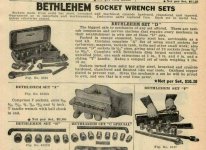
Bethlehem Quickway No. A socket set 1927 W.D. Allen Mfg. Co. catalog pp 343.jpg

I don't know what kind of condition the copper plating is on your set, Lugnutz, but my little "Set A" sockets have hardly a trace of the copper plating left on them. Most of the Bethlehem "Quickway" sets that I see on Ebay (the "Set A" being most common) have only traces of the copper.
Some, like this fabulous "Big Boy" Set F, still have some of the original copper plating intact:

https://www.ebay.com/itm/Bethlehem-...907104?hash=item1a38c9eca0:g:reEAAOSwa3BZ9gnm
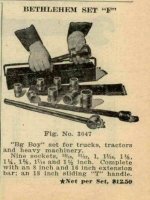
Bethlehem Quickway Set F Big Boy hex drive socket set - 1927 W.D. Allen Mfg. Co. catalog pp 343.jpg Bethlehem 'Quickway' 'Big Boy' Set F 1.2 hex drive SAE socket set (Ebay 112621907104 01).jpg Bethlehem 'Quickway' 'Big Boy' Set F 1.2 hex drive SAE socket set (Ebay 112621907104 05).jpg Bethlehem 'Quickway' 'Big Boy' Set F 1.2 hex drive SAE socket set (Ebay 112621907104 06).jpg

==

Finally, the reference to Occam's Razor is more than appropriate here.
The simplest and most logical explanation is probably the one that is correct.
 

DadsTools

Well-known member
Joined
Jul 27, 2017
Messages
1,852
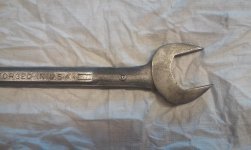
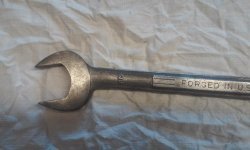
Regarding that copper wrench:

It should not be summarily dismissed out of hand that there could be an entirely different story behind that.
It's entirely possible that the seller was just making up a wild story for the purposes of selling the item, and "non sparking" does sound like a credible explanation for a copper-plated wrench, so it's certainly a plausible story.
But it's entirely possible that Acme Mechanical's 35-year-veteran office manager was going have a retirement party, and they went down to the hardware store and bought a big wrench and took it over to the plating shop and had them doll it up for a presentation piece.
I know that sounds silly, but that's exactly the sort of thing my mother would think up for some public "civic event".
So anything's possible.

My apologies, but I have to respond to this, since I'm the one who is actually holding the physical evidence, and the argument brings up an important point.

In debates (and I've been in some intense ones concerning far more esoteric issues), I have often heard the phrase "anything's possible." Sounds great, but it's almost always false. It is usually employed when:

A) The person has little idea as to what the solution to an issue might be, and feels obligated to make some sort of seemly thoughtful response, or
B) The person does not like the solution that's taking shape in a discussion and wishes to toss the issue up in the air so that any solution being offered looks to be equally credible/incredible.

In almost all cases, fundamental evidence and facts have to be ignored or dismissed to reach such a conclusion.

All things are NOT possible. We've known for some decades now that the universe is assembled according to immutable laws that pose constraints on expressions of physical reality. There is only one way a pure hydrogen atom can be configured--configure it differently, and it will be something not quite the same with different properties. Always. The photos sent back from the Mars Rovers were not taken in my garage (trust me). You're not going to put your Thanksgiving turkey in the oven and open the door 3 hours later to find a 1967 Ford Country Sedan parked in there. Never. These are things that simply are not possible. Even in the realm of probability, finding a shirt of a huge size does not justify speculation that it was custom made for Gorilla Monsoon with no evidence on which to base it.

Since none of us were there when the wrench in question was being produced, nor can we access anyone or any point directly connected with its origins, we need to look at probabilities that must be directly and reasonably justified by the physical evidence itself. If it's a trial in criminal court, the conclusion must be reached beyond a reasonable doubt based on the actual evidence, not wildly speculated or whimsically imagined. Civil court is less demanding requiring only a preponderance of evidence. With that being said:

1. The date code has been positively identified as 1944. This was wartime, when metals like copper were restricted. This is fact. To have something as frivolous as having a wrench copper plated would have actually been illegal for the plating facility to do so, even if they had access to copper. So this solution would also need to require the involved facility and someone's Mom to be intent on engaging in criminal activity. Very highly improbable and not reasonable.

2. It's highly improbably that someone would have purchased a wrench back in 1944 and then hold it for a couple of years just to copper plate it then. Far more reasonable for someone to have gone out after the war and bought a brand new wrench having that date code to have plated.

3. The plating on this wrench is heavy. It's improbable--and entirely unnecessary--to have it plated so heavily just to make it a copper color for an award.

4. The wrench was obviously used multiple times after it was plated--all physical evidence shows it was a real working tool. It is not reasonable to assume that someone having been given this wrench as an award would have done this to such a prized possession--it would require a degree of disrespect and carelessness that would probably not be characteristic of a person meriting such an award. Also, such awards are always personalized with the recipient's name, or affixed or framed in such a personalized presentation. Again, it would be improbable for someone to simply be handed an anonymous copper wrench for this purpose. It's not reasonable.

5. The wrench is clearly not plated with plain copper. Everyone knows what a pure copper surface would look like after all these years and how quickly it would have worn off. The actual physical evidence shows it to be a durable copper alloy that was likely a special alloy (i.e., not cheap or plentiful) that would have been entirely unnecessary just to make a wrench copper-colored for an award. Probability and reason dictates this was plated to endure real mechanical use.

6. The idea that the seller contrived the story just to sell the wrench is unreasonable based on the ridiculously low selling price--after all, it was not priced as a rare piece of art nor as a 1967 Country Sedan. It was six freakin' dollars for crying out loud (oy)! As in a court case, there's insufficient evidence to justify that accusation against the seller.

7. It is true that the wrench is not a 'non-sparking' wrench as the seller said. But we now know from an old catalog page previously posted here of Kop-R-Kote wrenches that such plating was intended to produce a spark-resistant wrench, and that we now know such wrenches were in reality actually produced for this very purpose. We can forgive this layperson-seller this very minor inaccuracy especially when experts in here were themselves unfamiliar with this grade of tool until the catalog page was shown (thank you). We also know that earlier tool specimens were copper coated to resist corrosion. These are facts, not speculation.

8. The provenance given by the seller is the scenario most closely fitting the facts:

A) The wrench was made this way to have something to do with resisting sparks. While one could reasonably conclude that he could have fabricated this based on common knowledge of the non-sparking qualities of copper....
B) He stated it was used on Naval ships. The thing here is, that I can tell you he had no idea there was a cryptic date code on the wrench indicating it was WWII vintage. If he did make up the story to sell it, wouldn't it be reasonable he would have added this very juicy tidbit??? Nor did he mention anything about resisting corrosion, another tidbit that would fit perfectly with Naval use. Moreover, the date code virtually assures us that this was ordered by the government for the war effort because at that time, every other means of obtaining such a wrench was illegal. Strong support for the idea that this was indeed made for US Naval service as represented.

Occam's razor at the end of the quoted post=the simplest solution is usually the correct one. There are also other similar sayings:
"If it looks like a duck, acts like a duck and quacks like a duck, it is a duck."
"Sometimes a cigar is just a cigar."

Based on the physical evidence of the wrench itself, the evidence from real catalog pages about the corrosion resistance of copper coating, the production of copper-coated safety wrenches and the date code which virtually assures government procurement, the provenance the seller gave is the one scenario that is the simplest, most probable and most reasonable:

The wrench is exactly what all the evidence indicates it appears to be; it was indeed made this way at the factory specifically to be used on Naval vessels as a spark- and corrosion-resisting wrench. Any other solution requires both improbable/fanciful speculation and the intentional ignoring of one or more points of evidence.

It is a duck.
 

Al Borland

Well-known member
Joined
Jan 20, 2016
Messages
1,598
In my travels, I've done a lot of work at a large film manufacturer.
They provided a lot of film (among other things) for the government during the war.
In their facility, non-sparking was the rule, and I've seen tons of wrenches that were copper, bronze or copper/beryllium plated for spark resistance.
Some were made that way, but they had their own plating shop as well.
As tools became worn, they were passed off to the boiler house and the pipefitters, etc.
They were a common sight there, along with lead hammers, bronze drift punches, Beryllium putty knives...
Frequently wrenches were tethered with a ground strap as well. Non-sparking is great, but static can still generate a spark.
 

four.cycle

Well-known member
Joined
Oct 19, 2015
Messages
28,585
Location
Tacoma, Washington
DadsTools - That's quite a dissertation there, and I'll concede you raise some valid points, but improbable and impossible aren't always necessarily the same.
While all the evidence so far supports the theory that it it's some sort of special unit made for the military, and (again) we consider "Occam's Razor", it is most likely a reasonable assumption to believe that is correct.
That said, it's still an assumption (even with the evidence like the date code), so without something to substantiate that, you're still back to reasonable assumption.
My suggestion above - the "award for a retirement party" story - just happened to be the most outlandish, ridiculous, and improbable scenario I could think up last night on the fly. It is highly improbable, but that doesn't necessarily mean it's impossible (like the turkey in your oven turning into a 1967 Fairlane Station Wagon.)

We're coming from two different places here.

My real-life experience, personally handling all of the warranty returns for a chain of stores handling hundreds of different product lines and hundreds of thousands of different items, has caused me over the years to realize that no matter how ridiculous or improbable you think something might be, when you actually pull something out of a box that disproves that, you get to a point where no possibility, no matter how improbable, is dismissed out of hand.
Then toss in dealing with warranties on remanufactured automotive engines for years, and one becomes inured to the bizarre and improbable to the point where it almost becomes normal.

Bottom line: I'd still keep my eye out for some other little tidbit of information that confirms your theory (which I think is most likely correct, by the way.)

I think perhaps you misconstrued my comment above as trying to disprove what you're saying, which isn't the case at all - I just tend to hold off on saying "is so" until I'm absolutely certain and have something tangible to back it up.
 
Last edited:

DadsTools

Well-known member
Joined
Jul 27, 2017
Messages
1,852
In my travels, I've done a lot of work at a large film manufacturer.
They provided a lot of film (among other things) for the government during the war.
In their facility, non-sparking was the rule, and I've seen tons of wrenches that were copper, bronze or copper/beryllium plated for spark resistance.
Some were made that way, but they had their own plating shop as well.
As tools became worn, they were passed off to the boiler house and the pipefitters, etc.
They were a common sight there, along with lead hammers, bronze drift punches, Beryllium putty knives...
Frequently wrenches were tethered with a ground strap as well. Non-sparking is great, but static can still generate a spark.
Thank you. It is well-established from multiple sources that such wrenches were actually manufactured for a specific purpose. And that purpose is consistent with the provenance on the wrench, including confirming details that the seller simply did not and could not know. We're not talking about a one-off event, but an entire class of established product, and where every shred of hard physical evidence on the wrench itself declares it to be a member of that class. When you combine the date code with the wartime metal restrictions + provenance of Naval use, the evidence is so overwhelming that it would pass in any court of law. There's not a stitch of evidence it might be anything else, other than speculation as to what it might be if the evidence was ignored. But such speculation can only justifiably enter in when there is insufficient evidence to point to a rational conclusion. Here we have a solid explanation that fits all the facts--there's really no reasonable justification to generate speculations to solve a problem that essentially appears to already have been found. Yes, you could say that it's possible someone took a vintage wrench, scanned it into a CNC, and made an exact duplicate of it. You can say it's possible that the catalog pages presented in this thread were created on a computer and are sheer fabrications. But for what purpose would you dream up such a speculation without a shred of evidence nor reasonable motive and then offer it as a possible solution to a problem that appears already solved?
 
Last edited:

four.cycle

Well-known member
Joined
Oct 19, 2015
Messages
28,585
Location
Tacoma, Washington
DadsTools said:
But for what purpose would you dream up such a speculation without a shred of evidence nor reasonable motive and then offer it as a possible solution to a problem that appears already solved?

Because without a copy of some sort of requisition order from the US Military or a catalog page or the eyewitness testimony of a former employee of that manufacturing plant, notwithstanding all of the "evidence" you've mentioned, you're still back to square one with a reasonable assumption.
And regardless of how reasonable that assumption might be, and regardless of supporting evidence that appears to be valid and credible, it's still not an "is so".
Only when you get to that point where you've got it nailed down does it become an "is so".

I'm still working on a couple puzzles, and have been for a couple years: the Indestro-made no-name-no-part-number paddle-handle 1/2" square female drive non-reversible ratchet (equivalent to Indestro's 3202), which I think was made for Montgomery Ward, and the "Frankenstein" type 1/4" square male drive no-name-no-part-number ratchet that by all indications leads me to believe it was made by G.M Mfg. Co. of Long Island City, New York. In spite of the fact that what I have seen thus far makes me pretty confident I've figured those two out, I still cannot say it's an "is so" because there's no tangible evidence - all I have to go on (in both cases) are my own observations.

No matter how you slice or dice it, 99.999% is still not 100%. ;)
 

DadsTools

Well-known member
Joined
Jul 27, 2017
Messages
1,852
DadsTools - That's quite a dissertation there, and I'll concede you raise some valid points, but improbable and impossible aren't always necessarily the same.
While all the evidence so far supports the theory that it it's some sort of special unit made for the military, and (again) we consider "Occam's Razor", it is most likely a reasonable assumption to believe that is correct.
That said, it's still an assumption (even with the evidence like the date code), so without something to substantiate that, you're still back to reasonable assumption.
My suggestion above - the "award for a retirement party" story - just happened to be the most outlandish, ridiculous, and improbable scenario I could think up last night on the fly. It is highly improbable, but that doesn't necessarily mean it's impossible (like the turkey in your oven turning into a 1967 Fairlane Station Wagon.)

We're coming from two different places here.

My real-life experience, personally handling all of the warranty returns for a chain of stores handling hundreds of different product lines and hundreds of thousands of different items, has caused me over the years to realize that no matter how ridiculous or improbable you think something might be, when you actually pull something out of a box that disproves that, you get to a point where no possibility, no matter how improbable, is dismissed out of hand.
Then toss in dealing with warranties on remanufactured automotive engines for years, and one becomes inured to the bizarre and improbable to the point where it almost becomes normal.

Bottom line: I'd still keep my eye out for some other little tidbit of information that confirms your theory (which I think is most likely correct, by the way.)

I think perhaps you misconstrued my comment above as trying to disprove what you're saying, which isn't the case at all - I just tend to hold off on saying "is so" until I'm absolutely certain and have something tangible to back it up.
Indeed, we are coming from two different places. Taking your position, it would be impossible to reach a verdict in a court of law, since you were not there and so could never reach a reasonable conclusion. Doesn't take much thought to see where that would lead us.

I'm speaking about a conclusion based on all available and sound evidence. You're speaking of speculations on what it might be in spite of the evidence. To shore up your speculation, you are now introducing the concept of assumption. Defined, it is: supposition, presumption, belief, expectation, conjecture, speculation, surmise, guess, premise, hypothesis. All of these acts of reasoning are based on the premise that there is insufficient evidence to form a reasonable conclusion. So the term assumption applied to this case is inaccurate at best and intellectually dishonest at worst. The evidence we have takes this far beyond mere assumption.

You mention all the crazy things you've seen in warranty work once you open the package and see the evidence for something you would not have deemed possible until you saw it. Then once you saw the evidence, you could form a conclusion on what was done to the product. This is a false flag when applied to this case. WE HAVE ALREADY DONE THAT. We already have viewed the evidence and formed a reasonable conclusion based on that evidence. So you're offering up a scenario that doesn't apply here because we've already passed that stage.

What is the difference between assumption/hypothesis and theory? Theories have several qualities that elevate them beyond hypothesis among which (Einstein's definition) that each elemental point of the theory has a one-to-one correlation with observable reality, and that the theory offers more answers that answers the questions posed by observation that are more convincing and consistent with themselves than any other proposed theory. This is what we already have. The speculations offered so far have only produced alternative hypotheses that either a) don't answer as many questions convincingly or create inconsistencies within themselves, or, b) have fewer correlations with actual observations.

Theories are very powerful things. Take relativity. We have used it to decode a lot of cosmological mysteries and without which we could not launch rovers to Mars or satellites to the outer reaches of the solar system.

Is relativity proven? It's still called a theory only because its cosmic scope is so huge that we are technically incapable of testing every single permutation. However, here's where another of your statements is a false flag:

"I'd still keep my eye out for some other little tidbit of information that confirms your theory..."

You've spun things around to an opposite orientation to try to bolster your position. That's not how it works. When a theory meets all the requirements to be functional and effective toward the observational puzzles it solves, it becomes the de facto standard by which we operate. It no longer needs to await confirming data--it's the very existence of the confirming data (the data we already have) that makes it a viable, functional theory (again, what we already have).

What it then actually awaits is a "little tidbit" of information that would falsify it, a hard observation taken from the evidence itself that would disprove the theory or offer another that had even more solid correlations with real observation or would answer more questions posed to it convincingly while remaining consistent with itself (not having to make an exception for one point to prove another).

Until someone produces such a piece of hard evidence that would falsify it, the current theory stands as the best possible answer, in spite of any mere speculation to the contrary.
 

four.cycle

Well-known member
Joined
Oct 19, 2015
Messages
28,585
Location
Tacoma, Washington
^ Let me expound a bit on this here:

I mentioned above "We are coming from two different places."

I don't know what your background is. You don't know what my background is.

I've been doing research on an area since 1987. Everything I could dig up about it. Sitting in the archival section of the public library until closing time, poking through hundreds of "Google" listings online. Exhausting every source I could lay my eyes on.
Just over three years ago I got a phone call. It was the head archaeologist for a local National Park.
"Brian, I'm wondering if you'd be willing to help me with a few things on a history I'm working on."
"Sure, you have my email addy?"
"Yes, I'll forward some documents to you, and then I'll have some questions for you."
We exchanged emails and phone calls for over six months on this deal. My contribution to her "swan song" - 942 pages in *.pdf format - was minuscule in comparison to the rest of the work, but I was able to nail down some tiny little details by sussing out the where/what/when/who from various documents and transcripts of interviews that had been done with early settlers of the area.

In the end, we found there were many questions that were left unanswered, because what she wanted to produce was the definitive historical narrative of one river valley; something that would be the de facto "go to" source for researchers in the future.
Because of that, all of those 99.999% deals were left out. If it wasn't 100%, it wasn't included. No speculation, no wild guesses, no "almosts". Only "is sos".

So understand that I look at the question through that prism - from working with a professional archaeologist (with a PhD and all that) - and it really had quite an effect on me and how I look at things.
 

four.cycle

Well-known member
Joined
Oct 19, 2015
Messages
28,585
Location
Tacoma, Washington
DadsTools said:
"...you could form a conclusion on what was done to the product..."

In an attempt to clarify that:
It wasn't always necessarily "what was done to the product". In more instances than I could count, it was the way the product had been produced - stuff that a reasonable person wouldn't believe could get to the end of an assembly line with even a minimum of "quality control" (i.e., combination wrenches that hadn't been broached on the box end, distributor caps with no metal contacts, etc.)

And again, just in case you missed it: I think you're probably correct about it being some sort of military "anti spark" tool. As you said - everything points that direction.
But again, it's still 99.999%.
 

emr454

Well-known member
Joined
Oct 14, 2017
Messages
47
Jesus, this has got to qualify for the "Thread Drift of the Year" award...
 

emr454

Well-known member
Joined
Oct 14, 2017
Messages
47
If I understand this correctly (unlikely), looking at the =V= socket I posted above, there is no definitive way to tell if this is was made during the Moore Drop Forge era or the Easco era because there are no other defining marks besides the =V=. My best SWAG is that my socket is not 40's vintage because it was a hand-me-down from Dad and he likely bought it new in the 70's, but I've been wrong before.

To get to the point, if one were interested in collecting wartime-era Craftsman tools, how would you discern them from later examples while perusing the wares at the flea market or garage sale?
 

ganymede

Well-known member
Joined
Nov 29, 2012
Messages
2,332
Location
New England
^^^^
Can't see the image and get an error message when I click on it but I think the Craftsman logo on Easco sockets will have flat top a's and on a Moore era socket the a's will have a pointy top.
 

jakemac

Well-known member
Joined
May 21, 2013
Messages
9,035
Location
New England
If I understand this correctly (unlikely), looking at the =V= socket I posted above, there is no definitive way to tell if this is was made during the Moore Drop Forge era or the Easco era because there are no other defining marks besides the =V=. My best SWAG is that my socket is not 40's vintage because it was a hand-me-down from Dad and he likely bought it new in the 70's, but I've been wrong before.

To get to the point, if one were interested in collecting wartime-era Craftsman tools, how would you discern them from later examples while perusing the wares at the flea market or garage sale?


I can't view the pictures either. But from your description, I would credit them to MDF, not Easco. While the double line V (=V=) may have shown up during the Easco years as an occasional anomaly, Craftsman's code changed to a single line V (-V-) around 1967 when MDF was brought under the Easco umbrella. Either way, the socket was made in the same factory no matter who's name was on the building.
 

emr454

Well-known member
Joined
Oct 14, 2017
Messages
47
^^^^
Can't see the image and get an error message when I click on it but I think the Craftsman logo on Easco sockets will have flat top a's and on a Moore era socket the a's will have a pointy top.

I can't view the pictures either. But from your description, I would credit them to MDF, not Easco. While the double line V (=V=) may have shown up during the Easco years as an occasional anomaly, Craftsman's code changed to a single line V (-V-) around 1967 when MDF was brought under the Easco umbrella. Either way, the socket was made in the same factory no matter who's name was on the building.

Hmm, must be a dropbox issue. I'll attach them to the message.

ganymeade: Interesting info. This one has the flat-top A

jakemac: Duly noted. My intent was to try and pin down an "era" since the mfg remained the same. Not that I am a collector of anything in particular, but if I were to come across wartime era tools I'd be inclined to buy them.
 

Attachments

  • 20171023_162458.jpg
    20171023_162458.jpg
    131.3 KB · Views: 8
  • 20171023_162443.jpg
    20171023_162443.jpg
    138 KB · Views: 10
  • 20171023_162433.jpg
    20171023_162433.jpg
    134.3 KB · Views: 10
To avoid these ads, REGISTER NOW!

Rileysan

Well-known member
Joined
Sep 11, 2015
Messages
4,298
Location
Milwaukie, Oregon
Hmm, must be a dropbox issue. I'll attach them to the message.

ganymeade: Interesting info. This one has the flat-top A

jakemac: Duly noted. My intent was to try and pin down an "era" since the mfg remained the same. Not that I am a collector of anything in particular, but if I were to come across wartime era tools I'd be inclined to buy them.

One thing to keep in mind is that the customer (Sears) paid for and owns the tooling. It's that way with the metal casting industry as well - the customer pays for the patterns to be made and if they decide to move on to another foundry, the patterns go with the customer.

I bring this up because of the like markings (=V=) on the tools made by both Moore Drop Forge and Easco. It is my opinion that these markings reflect revisions, not necessarily manufacturers or their sites. It is therefore likely, imo, that the tooling used by Moore Drop Forge was shipped to Easco once Sears changed manufacturers.

As such, I believe there is only one sure way to differentiate tools made by Moore Drop Forge and Easco. And that is war-time =V= tools, made without plating. These could have only been made by Moore Drop Forge. All tools made by Moore post-war are likely indecipherable from Easco made tools.


Edit: I wanted to add that I am speaking about designs that are unique to the Sears Craftsman line of tools, not pre-existing lines of tools that were labeled Craftsman like the BE series, etc.

Brian
 
Last edited:

Private Lugnutz

Well-known member
Joined
Mar 30, 2012
Messages
30,477
Location
The Authentic Jersey Shore
if one were interested in collecting wartime-era Craftsman tools, how would you discern them from later examples while perusing the wares at the flea market or garage sale?

- They will have a natural steel finish (no plating)

- They will be marked with the underline or so-called Long C Craftsman logo (not the =CRAFTSMAN= logo)

- They will have the following codes:
(Note: there is a lot of ongoing discussion/debate surrounding the identification of mfgrs aligned to these codes, EDIT: and whether or not they really are mfgrs codes in all cases, so take the mfgrs listed below with a healthy grain of salt, and understand that there are lots of anomalies out there)
> BE (New Britain) - socket drive tools all drive sizes
> (H) (New Britain) - socket drive tools all drive sizes
> (K) (S-K) - socket drive tools, most notably 3/4-inch drive
> (U) (Plomb) - socket drive tools
> (P) (Wilde) - wrenches
> CI (Moore Drop Forge) - wrenches

You can find all or most of those in the pre-war and immediate post-war years with identical characteristics, but chrome-plating.

No WWII collectors I know consider =V= code Craftsman tools to be wartime. Actually, I'm not aware of any Craftsman collectors/researchers that do, either. The earliest I have ever seen them dated is 1946, and they are more likely in my opinion to be 1948 and later based on the fact that I have never seen a =V= mark on a tool that was not also marked with the post-war =CRAFTSMAN= logo, which first shows up, as far as I know, in the 1948 catalog. If you have the time to really dive into it, visit the 'Craftsman Tool Dating' thread on Garage Gazette.
 
Last edited:

Rileysan

Well-known member
Joined
Sep 11, 2015
Messages
4,298
Location
Milwaukie, Oregon
- They will have a natural steel finish (no plating)

- They will be marked with the underline or so-called Long C Craftsman logo (not the =CRAFTSMAN= logo)

- They will have the following codes:
(Note: there is a lot of ongoing discussion/debate surrounding the identification of mfgrs aligned to these codes, EDIT: and whether or not they really are mfgrs codes in all cases, so take the mfgrs listed below with a healthy grain of salt, and understand that there are lots of anomalies out there)
> BE (New Britain) - socket drive tools all drive sizes
> (H) (New Britain) - socket drive tools all drive sizes
> (K) (S-K) - socket drive tools, most notably 3/4-inch drive
> (U) (Plomb) - socket drive tools
> (P) (Wilde) - wrenches
> CI (Moore Drop Forge) - wrenches

You can find all or most of those in the pre-war and immediate post-war years with identical characteristics, but chrome-plating.

No WWII collectors I know consider =V= code Craftsman tools to be wartime. Actually, I'm not aware of any Craftsman collectors/researchers that do, either. The earliest I have ever seen them dated is 1946, and they are more likely in my opinion to be 1948 and later based on the fact that I have never seen a =V= mark on a tool that was not also marked with the post-war =CRAFTSMAN= logo, which first shows up, as far as I know, in the 1948 catalog. If you have the time to really dive into it, visit the 'Craftsman Tool Dating' thread on Garage Gazette.

I disagree. There are =Craftsman= tools that exist without plating. These were pre =V= and often came with a random letter on one side. These are generally accepted as being war-time.

I have examples in my collection and I know Twertsy has examples as well. Also, using the 1948 catalog as the starting point for =V= tools is a bit presumptuous since there are no war-time mechanics tool catalogs to be found. Truth is no one knows what year the =V= tools were introduced.

I have a few unplated examples of =V= deep 1/2" drive sockets that are unplated, but I haven't had time to examine them closely. And even if they were proven to be issued unplated, that doesn't necessarily make them war-time. Without proof one way or another, the evidence is anecdotal.

Brian
 

Attachments

  • 1004171721.jpg
    1004171721.jpg
    130.7 KB · Views: 22
  • 1004171722.jpg
    1004171722.jpg
    129.3 KB · Views: 18
  • 1004171722a.jpg
    1004171722a.jpg
    135.5 KB · Views: 16
  • 1004171722b.jpg
    1004171722b.jpg
    133.5 KB · Views: 18

Private Lugnutz

Well-known member
Joined
Mar 30, 2012
Messages
30,477
Location
The Authentic Jersey Shore
There are =Craftsman= tools that exist without plating.
I didn't say there weren't. But a natural steel finish doesn't automatically date a tool to wartime, especially when it has characteristics inconsistent with wartime markings (e.g., no long C logo). The idea that manufacturers introduced major changes in tooling and branding during the war is not something considered likely. Billings, Fairmount, Vlchek and many other suppliers continued to provide tools to the military leading into and throughout the KW era with and without plating. They are in many 1949 and 1953 surplus re-packs, and the styles and markings are all consistent with their post-war catalogs.

Rileysan said:
These are generally accepted as being war-time.
Not in any WWII collecting community I know of, Brian, and that includes G503.com and Military Forums, where =V= and =CRAFTSMAN= are automatic post-war tells. Your experience may be different. I can only vouch for mine.

Rileysan said:
Also, using the 1949 catalog as the starting point for =V= tools is a bit presumptuous since there are no war-time mechanics tool catalogs to be found.
The 1942 catalog was printed during the war. It is an excellent source of wartime styles and markings. The next available catalog I am aware of is dated 1948, with the change in styles and markings. The general consensus is that Sears & Roebuck, in concert with their suppliers, updated their tooling and branding after the war, which is consistent with many other major manufacturers, many of who released major catalogs with new product lines in that 1947-1948 timeframe.

EDIT: But I am not going to argue with you. No problem if we don't agree.
 
Last edited:

Private Lugnutz

Well-known member
Joined
Mar 30, 2012
Messages
30,477
Location
The Authentic Jersey Shore
if one were interested in collecting wartime-era Craftsman tools, how would you discern them from later examples while perusing the wares at the flea market or garage sale?
emr454,
Addendum: I just remembered that I have a really handy Excel table-format "Sears Timeline" chart that I keep in a little pocket in my flea market notebook. It's not my work. I believe I printed it off of a thread on Garage Gazette. It has years (1930-1979) across the x axis on top, and logos and codes down the y axis on the left side. The cells are filled in with colors (making Gantt bars) showing when certain logos and codes started and ended. It's been around for awhile and could probably use updating. But other than the identification of the mfgrs associate with the codes, which, as I said, is always undergoing re-investigation, I have found very little to disagree with about the chart. (EDIT: Note: I don't pay much attention to the modern years.) You may like it. I'll try to remember where I got it and post the link. Unless someone else gets to it first. I believe Outlaw may know exactly where it is.
 
Last edited:

Rileysan

Well-known member
Joined
Sep 11, 2015
Messages
4,298
Location
Milwaukie, Oregon
I didn't say there weren't.
<snip>

Perhaps you didn't mean to say it, but that's what it sounded like.

- They will be marked with the underline or so-called Long C Craftsman logo (not the =CRAFTSMAN= logo)


But a natural steel finish doesn't automatically date a tool to wartime, especially when it has characteristics inconsistent with wartime markings (e.g., no long C logo)

I agree that having a natural finish does not necessarily mean war-time. But I don't necessarily agree that the only war-time Craftsman tools were long-C.

There were years of overlap between the long-C and Heritage logo, as well as overlap between Heritage and Crown-top. Every time everyone thinks they have it figured out, an exception comes along. Obviously I'm talking about badged tools, but who's to say there wasn't overlap between long-C, =Craftsman=, and =V=? No evidence, only speculation.

I think it reasonable to assume =V= didn't exist during war-time. And unless someone comes up with a smoking gun (like something in the original packaging and a dated receipt), it will likely always be thought of as post-war. But with the existence of non-plated =V= and =Craftsman= tools, I think it's ok to consider the possibility.

The 1942 catalog was printed during the war. The next available catalog I am aware of is dated 1948. The general consensus is that Sears & Roebuck, in concert with their suppliers, updated their tooling and branding after the war, which is consistent with many other major manufacturers, many of who released major catalogs with new product lines in that 1947-1948 timeframe.

As an aside, I've been looking for more digital catalogs. If you can point me to a source, I'm interested. The oldest Mechanics tool catalog I have is 1949. Anything earlier than that (in my collection) is a power tool catalog.

EDIT: But I am not going to argue with you. No problem if we don't agree.

Hah! You're not getting off that easy! This is too much fun!

Brian
 
Last edited:

Specs

Well-known member
Joined
Sep 30, 2013
Messages
248
Location
The other side
I can confirm the current outbreak of what I refer to as, "Barrett-Jackson" disease on Ebay. I listed a 1/4 inch drive set made between 1960 and 1973. The final price was jaw dropping.

:thumbup: :spit:

Its funny as all get out cause I use 2005-ish 44808 T2V an 2006-ish 44811 T9V ratchets and even though they’re 36 tooth, they go for way more on ebay than the kits i bought them in. Im afraid to look up my soft grey handle screwdrivers and hard black handle sets too. All because of “Made in the Usa” is on it.

Meanwhile Proto challenger kits that sold for $12 and $5 (1060,1260,1660 series), can be found for $20-$30 for entire set with original tin/plastic case. IMHO a more confy and polished set. I just gotta wait a little longer....$$$$$$$$$$
 

Private Lugnutz

Well-known member
Joined
Mar 30, 2012
Messages
30,477
Location
The Authentic Jersey Shore
Perhaps you didn't mean to say it, but that's what it sounded like.
How does enumerating the three most basic collectors' conditions for a wartime Craftsman tool - the correct logo, codes, and finish from that period, eliminate the existence of unplated tools with a post-war logo (e.g., =CRAFTSMAN=) and a post-war code (e.g., =V=)? Again, nothing about what I wrote to emr454 said or implied that there weren't examples of unplated =CRAFTSMAN= era tools out there. It did warn him that they weren't wartime, intentionally so, because they don't meet all of the conditions. There are also examples of Craftsman tools out there with the correct wartime logo, the correct codes, but a plated finish. My statement to emr454 did not eliminate the existence of those, either. On the contrary, it warned him that they are not wartime. They are either late 1930's, immediate pre-war, very early war - late 1941 (before plating restrictions kicked in), or post-war (before the transition to =CRAFTSMAN=).

Rileysn said:
But I don't necessarily agree that the only war-time Craftsman tools were long-C...[ ]...no evidence, only speculation...[ ]...I think it reasonable to assume =V= didn't exist during war-time. And unless someone comes up with a smoking gun (like something in the original packaging and a dated receipt), it will likely always be thought of as post-war. But with the existence of non-plated =V= and =Craftsman= tools, I think it's ok to consider the possibility.
Yes, I understand your position, Brian. We are obviously in disagreement.

Rileysan said:
Hah! You're not getting off that easy! This is too much fun!
Well, I hate to spoil the fun, but there's really not much to discuss and I genuinely have no desire to debate it. WWII collectors are very fastidious about substantiating criteria. We work from the safest position. The wartime markings are well-documented in the 1942 catalog. The post-war markings are well-documented in the 1948 catalog. Examples of the codes found on each abound. It's not remotely speculative or presumptuous to conclude, based on the only historical documentation available, that the major change in style, branding and accompanying codes occurred after the war, and as of right now, no sooner than 1948, it's the only safest conclusion to be made at this time. For a WWII collector, it would speculative to try to stick =CRAFTSMAN= =V= tools into a wartime kit, postulating that Craftsman may have switched styles, branding, and codes during wartime, or even sooner than 1948, until evidence is found. That's why the three conditions are so well-known in our community.

EDIT: The Tool Archives has a 1941, 1942, and 1948 catalog. Link here.
 
Last edited:

twertsy

Well-known member
Joined
Jan 5, 2014
Messages
6,726
Location
Reedville, VA
There are literally THOUSANDS of advertisements in newspapers spanning that entire timeframe. a random sampling (I wasn't looking at every single one) shows not a single Moore design in a picture up and through 1947. If somebody wants to look at every single ad, go for it, but that's my sampling of about 75 from 1944 through 1947. It was however interesting to see Craftsman Vanadium DOE wrenches in '43 and 44........simply search "Craftsman Socket" on newspapers.com if you have an account, then narrow down the years.
 

Private Lugnutz

Well-known member
Joined
Mar 30, 2012
Messages
30,477
Location
The Authentic Jersey Shore
It literally gives me a headache just thinking about the amount of time it would take to even try to get to the bottom of the CI code dilemmas! :)

As for the Vanadium references in ads, thoughts are the same as references in catalogs: reuse of old copy/typesetting. The evidence for restrictions is just irrefutable.
 

twertsy

Well-known member
Joined
Jan 5, 2014
Messages
6,726
Location
Reedville, VA
It literally gives me a headache just thinking about the amount of time it would take to even try to get to the bottom of the CI code dilemmas! :)

As for the Vanadium references in ads, thoughts are the same as references in catalogs: reuse of old copy/typesetting. The evidence for restrictions is just irrefutable.

I agree Greg, probably an old picture. You should take a gander though......I see what sure as hell looks like a paddle handle (Plomb) ratchet in 1947 ads....

Obviously Plomb was producing for Cman at the time, but I've never seen a paddle handle style Cman rat......
 

d42jeep

Well-known member
Joined
Oct 22, 2014
Messages
16,500
Location
Northern California
There are almost no WW2 toolset collectors that have any Craftsman tools in their collections. There is virtually no evidence that they were in any sets with the exception of the Signal Corps. I occasionally disagree with Lugz but certainly not on this topic!:thumbup:
-Don
 

twertsy

Well-known member
Joined
Jan 5, 2014
Messages
6,726
Location
Reedville, VA
Ok, a little more digging reveals the =CRAFTSMAN= mark, and an absolute, no question Moore ratchet picture in a March, 1945 newspaper. It's the earliest I could find.
 

bluebolt

Well-known member
Joined
Dec 28, 2008
Messages
5,435
Location
Benton LA
March, 1945 Newspaper Ad

Several things look wrong in that picture, I see the Crown logo that came out around 1958 and the quick release ratchet that came out in the late 60's IIRC. Can you recheck that newspaper date?
 

twertsy

Well-known member
Joined
Jan 5, 2014
Messages
6,726
Location
Reedville, VA
I think you guys are right. There is no date on the page, and it's the only page there. I absolutely think somebody mis-dated this page.
 

four.cycle

Well-known member
Joined
Oct 19, 2015
Messages
28,585
Location
Tacoma, Washington
Username already in use said:
That looks like a quick release mechanism on that ratchet.

^ that was the first thing I noticed.

It would not surprise me in the least that somebody posting an image of an early advertisement online might inadvertently put the wrong date on it.
 
To avoid these ads, REGISTER NOW!
Top Bottom