To avoid these ads, REGISTER NOW!

Crain Rail Anvil... whats wrong here?

just1randall

Member
Joined
Nov 8, 2013
Messages
17
Hello,
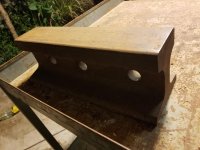
Found a beautiful rail anvil at gs.
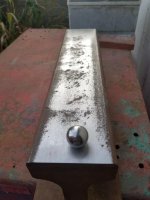
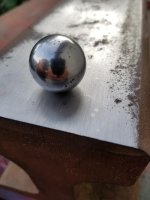
I spent time working on the top surface, only to realize its pretty soft... bearing test leaves tiny marks. Any practical way to harden, or do i move on?
 

Attachments

  • 20190330_204104.jpg
    20190330_204104.jpg
    91.9 KB · Views: 180
  • 20190330_204029.jpg
    20190330_204029.jpg
    135.6 KB · Views: 175
  • 20190401_182203.jpg
    20190401_182203.jpg
    77 KB · Views: 184
  • 20190401_182219.jpg
    20190401_182219.jpg
    67.2 KB · Views: 187
To avoid these ads, REGISTER NOW!

BFBOB

Well-known member
Joined
Sep 20, 2011
Messages
5,073
Use it like a rented mule. When the surface gets too rough, belt sand and repeat.

(or only use it for aluminum and copper)

Probably the only way to harden it would be to case-harden in a coal fire. I expect rails are already as hard as the alloy allows as manufactured; you'd have to change the metallurgy to change that. Case-hardening does just that.
 

Gmonkee

Well-known member
Joined
May 9, 2010
Messages
2,724
Top it with a hardened plate.

My rail anvil is soft too. It had to be to withstand trains passing and not break like glass.

Mine was made in 1880. Alemite steel.
 

seber

Well-known member
Joined
May 31, 2016
Messages
4,193
Location
Deep East Tx.
Rails are made with medium carbon steel. They can be hardened to some degree but not like tool steel. The problem is that you will need to get a very large chunk of steel red hot and then quench the entire thing at once. If you can manage that, tempering won't be a problem.
 
OP
J

just1randall

Member
Joined
Nov 8, 2013
Messages
17
Im trying jot to give up this being an anvol my wife can use for jewelry. She needs a surface that is really smooth. Im going to investigate the hardened plate solution, as i dont have a forge. Would a 1/2" plate do? I do have a family friend who can weld and may run it by him.
Thank you all for the feedback.
 

PCustoms

Well-known member
Joined
Jul 23, 2011
Messages
22,351
Location
VT
Im trying jot to give up this being an anvol my wife can use for jewelry. She needs a surface that is really smooth. Im going to investigate the hardened plate solution, as i dont have a forge. Would a 1/2" plate do? I do have a family friend who can weld and may run it by him.
Thank you all for the feedback.

Jewelry, as in gold, silver and copper?

It's hard enough, get it flat and smooth.
 
To avoid these ads, REGISTER NOW!

neophyte

Well-known member
Joined
Apr 23, 2012
Messages
9,557
Location
Pennsylvannia
In use rail gets work hardened.

This might be the issue.

That rail section doesn’t look like used rail, and used rail tends to have had dozens of steel rail wheels along with the tons of train cars and engines riding on those wheels, passing over the rail dozens of times or more a day for years.

After all that time, the steel rail top surface has been flexed and beaten enough that the steel gets an ultra fine molecular structure and becomes much harder.

New rail won’t have this advantage.

If you just need a block of hard steel to use as an anvil, jewelry tool suppliers usually have bench blocks that aren’t that expensive, especially fir the cheaper “import versions”
Alternately, if the piece if anvil you have gets flattened and polished, it should be fine for wacking most soct jewelry mets, as long as it doesn’t get errant hammer hits.
Back when copper and bronze were the metals used for knives etc., hard stone blocks were used as the anvil surface.
 

Gmonkee

Well-known member
Joined
May 9, 2010
Messages
2,724
Working jewelry even 1/4" plate will do. Do you anticipate any hammer bigger than 8oz on it?
 

zkling

Well-known member
Joined
Jan 23, 2007
Messages
16,939
What type of jewelry is your wife making (wire, bar, sheet)? She will most likely be much better off with a $20 horned jewelrs anvil and a $20 bench block. Add in a saw slot cutting block (don't remember the name off the top of my head) and she will likely get far more use out of those than that piece of rail.
 

timgunn1962

Well-known member
Joined
Mar 31, 2018
Messages
159
Location
Lancashire, England
Just get it smooth/flat enough for her needs and start using it.

Whilst a 1" hardened steel ball might leave a mark when dropped from a height, it's a very long way from it's intended use.

It's pretty unlikely any of the materials she uses will be harder than the rail: I think Platinum is about as hard as jewellery metals normally get and that's softer than (pure) Iron.

I made a stiddy (a wee cutlers anvil, used when assembling folding knives) out of a 4" section of 4" x 2" forklift tine. The other bits of the tine marked up like your rail when tested with a large ball bearing (I also made a post anvil) and I wasn't sure whether the stiddy would be hard enough. The knifemaker I sent it to was quite happy with it after a couple of months trial and assured me it was hard enough.
 
OP
J

just1randall

Member
Joined
Nov 8, 2013
Messages
17
She uses brass, silver and copper mostly... but she textures with a 12oz ball peen hammer. She currently uses a standard 2" rail but always complained about the narrow width. I clean it up a bit mor and have her try it. She also has a 3in bar stock cutoff that i sand on my 6x48 a few times a year... any mark on the surface will transfer to her pieces.
 

larry_g

Well-known member
Joined
Apr 28, 2007
Messages
16,871
Location
oregon
Search out someone that can 'shot peen' the surface of the rail. You could also have a piece of tool steel inserted into the surface of the rail.

lg
no neat sig line
 

MoonRise

Well-known member
Joined
Nov 5, 2010
Messages
4,028
Location
NJ
Most "rail" is made of a steel alloy that isn't all that hard until it "work hardens".

Meaning, that as the steel is bent or 'hammered' or otherwise impacted and/or deformed, it gets harder.

https://en.wikipedia.org/wiki/Work_hardening

So, one way to 'harden' the rail surface would be to impact it with a hammer repeatedly. Let the rail deform and work harden, then dress the top surface to the desired flatness. That's if the steel alloy is a work-hardening variety.

Or you can put on a top layer plate or weld-on layer(s) (of a "hardfacing" filler) of the desired properties and then dress the top surface to the desired flatness.

More than one way to get to the desired result.
 
To avoid these ads, REGISTER NOW!
Top Bottom