To avoid these ads, REGISTER NOW!

Crawl Space - School Me

ddurrett896

Well-known member
Joined
Mar 29, 2015
Messages
994
Location
VA
Currently own house on a crawl, with no moisture barrier and thin, foil insulation under subfloor. My pest guy says under is bone dry and doesn’t even recommend a vapor barrier at this point (he’s a straight shooter, not a salesperson)

My floors get cold in the winter - no brainer, and I’ve started to research Insulating. Some say insulation between joists, others say insulate the walls, add dehumidifier and seal vents.

What is the best practice? I’m never selling this house and have another 30+ years here hopefully.

**ADDED: there is no duct work under the house.
 
Last edited:
To avoid these ads, REGISTER NOW!

Jazz1

Well-known member
Joined
Jan 3, 2016
Messages
4,184
Location
Thunder Bay On.
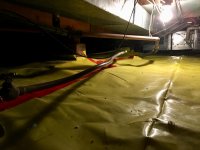
Put vapour barrier on the dirt. I did this in my crawl space which although it appears bone dry there is constant moisture evaporating into home through the dirt. My furnace is in the crawlspace. Windows would get drenched in winter with water prior to installing vapour barrier. I used STEGAWRAP. What a ugly job as crawl space is about 30 x 20 with posts and I used sealant to go around each post and to fasten to cement walls. Lowered humidity in house to 40%
This depends on your location as well. Winters are long and cold in my neck of the woods
 

Attachments

  • 23B72FE7-8555-427A-8073-F6EC1FFBA400.jpg
    23B72FE7-8555-427A-8073-F6EC1FFBA400.jpg
    116.4 KB · Views: 274
Last edited:

ddawg16

Well-known member
Joined
Jul 11, 2008
Messages
21,005
Location
S. California
If you have plenty of ventilation....I say no vapor barrier...and fill the joist cavities with insulation.

My crawl space does not have a vapor barrier. If your foundation wall goes down far enough, no reason for moisture to get into the dirt under your house.

My house is over 65 years old.....no mold down there.

I had the floor insulated 2 years ago....made a wonderful difference.
 

pattenp

Well-known member
Joined
Jun 4, 2008
Messages
10,175
Location
Virginia - USA
It really depends on a few things. Is any A/C ductwork under house? With humid summers we have A/C duct work can sweat from the humid air even with vents open. In my case I put down plastic on ground, sealed vents and use a dehumidifier under the house. It now stays dry as a bone, but previously I had mildew problems. There was fiberglass insulation batts placed between the joist with vapor barrier up when my house was built. I'm in south central Va. You can't compare South Eastern Virginia with Southern California.
 
Last edited:

BCreekDave

Well-known member
Joined
Dec 17, 2015
Messages
206
Location
Dayton, OH
I have a bit of an interesting perspective as I have done both on the same house.

Bought the house and insulated between the joists with no vapor barrier and vents. Hated it. Floors were still cold and lots of moisture. Ducts were insulated but the moisture was bad. In the humid summer it looked like it was raining down there. Puddles in the dirt.

House then caught fire and burned to the crawl.

Rebuilt house on the crawl but when it was opened up I put a vapor barrier down with gravel over top and 2-3 inches of blown insulation on the walls. Blocked up the spots where the vents were and didn't insulate the ducts so it stays ~60-65F down there. Love it now. Its really usable storage space (have a nice big pit opening in the garage) and it is dry as a bone.
 

slidehammer

Well-known member
Joined
Feb 4, 2010
Messages
169
Location
California Central Coast
Currently own house on a crawl, with no moisture barrier and thin, foil insulation under subfloor. My pest guy says under is bone dry and doesn’t even recommend a vapor barrier at this point (he’s a straight shooter, not a salesperson)

My floors get cold in the winter - no brainer, and I’ve started to research Insulating. Some say insulation between joists, others say insulate the walls, add dehumidifier and seal vents.

What is the best practice? I’m never selling this house and have another 30+ years here hopefully.
An unconditioned crawl space like yours is just outside. The floor should be detailed like an exterior wall.

If you insulate the foundation walls and seal the vents, you should treat it as a conditioned space - i.e. like another room in the house. Seal off the dirt with plastic or a rat slab, and share heated/ventilated air with the interior. Install a radon vent.

Personally I think a conditioned crawl space is the way to go.
 

My Old Tools

Well-known member
Joined
Jun 4, 2014
Messages
5,424
Location
Hamrick Lake, TX
Spray foam the subfloor and joists with closed cell. That's the insulation and the vapor barrier. Continue to ventilate the crawl space for moisture.
 

StreetGLi

Well-known member
Joined
Jun 29, 2017
Messages
138
Spray foam the subfloor and joists with closed cell. That's the insulation and the vapor barrier. Continue to ventilate the crawl space for moisture.
This is what I did. Floors are warmer and crawlspace remained the same as before. I have no ductwork or water lines down there. I close my vents in the winter still but it probably serves no purpose.

Sent from my LG-H873 using Tapatalk
 

Kevin54

MEMBER EMERITUS
Joined
Jan 12, 2005
Messages
29,341
Location
Urbana, Ohio
There is a big discrepancy between experts on whether to vent, or not to vent a "dry" crawlspace. Most say that if the crawlspace is dry, DO NOT vent it, because if you do, it will let moisture in during humid times, and also with warm against cold. Others say to open all the vents up to allow air to dry things out. 6 of one, half a dozen of the other.

But above all....insulate your floors. Spray in foam would be the best. It will make a difference during cold months.
 

timdgsr

Well-known member
Joined
Jul 13, 2015
Messages
110
Location
Birmingham, AL
I had my crawl space encapsulated, which is basically fill in the vents, put a really thick vapor varrier on the ground and up the walls & posts. Then threw a dehumidifier in there. The house has noticeably less humidity now, and seems to have lowered the power bill as well.

Plus its nice when I have to crawl around under there. Nice and clean.
 

nafterclifen

Well-known member
Joined
Nov 22, 2014
Messages
525
Location
Poconos, PA
My crawl space has a thin plastic vapor barrier between the dirt under it and about 12" of stone on top of it. All of my utilities are in the crawl space (water softener, well pressure tank, hot water heater and air handler). It has a few vents however I chose to seal them with thick foam board insulation. There are fiberglass batts in the ceiling (floor joists) but nothing on the block walls. I never had a temp problem but in the summer, it would get very humid. So I installed a standalone dehumidifier to keep the humidity under control in the summer. I've never seen any significant signs of moisture either before or after.
 

Whitworth

Well-known member
Joined
Dec 26, 2011
Messages
2,082
If you super-insulate the joists, just be aware you may get frozen pipes in the crawlspace as a by-product to warmer floors upstairs. Depending on how cold it gets in your geography, you may want some heat migrating down to the crawl space during winter months.
 

PoorOwner

Well-known member
Joined
Feb 10, 2007
Messages
5,032
Location
CA
it can be dry now, but during other parts of the year, when the ground warms and slowly let the moisture out, it can be trapped against the insulation and the subfloor, causing mold and other rot issues.

definitely recommend moisture barrier first, you can DIY if it's not too big, you don't need to cover it 100%, based on permeability. Basically 6 mil plastic drop cloth from home depot.
 

850xpeps

Well-known member
Joined
Aug 6, 2017
Messages
1,365
Moisture barrier it, insulate the walls, vapour seal the walls. And then your crawl space become a conditioned space. It’s how buildings are built up north in Canada. It also keeps the cold from being all around your house. If you insulate your floor it’s like being on stilts. And your floor will never be warm as the other way because you can’t heat it right at the subfloor. Only way to have a nice warm floor is insulate crawl space walls and condition that space.
 

mkholmes3

Active member
Joined
Dec 8, 2013
Messages
30
The new science says to treat a crawl space as a "conditioned space". When I built my house I had spray foam sprayed on the crawl space walls and the rim board. You want to put plastic down and seal it to the walls to prevent moisture. I have a heavy duty dehumidifier piped to the outside too. I don't have any duct work in the crawlspace. I debated on putting a vent off my ac and a return in the crawlspace but decided not too. So far I'm pleased.
 

StreetGLi

Well-known member
Joined
Jun 29, 2017
Messages
138
Moisture barrier it, insulate the walls, vapour seal the walls. And then your crawl space become a conditioned space. It’s how buildings are built up north in Canada. It also keeps the cold from being all around your house. If you insulate your floor it’s like being on stilts. And your floor will never be warm as the other way because you can’t heat it right at the subfloor. Only way to have a nice warm floor is insulate crawl space walls and condition that space.
I live 'up north in Canada'. My crawlspace was not a conditioned space.

Sent from my LG-H873 using Tapatalk
 

850xpeps

Well-known member
Joined
Aug 6, 2017
Messages
1,365
I live 'up north in Canada'. My crawlspace was not a conditioned space.

Sent from my LG-H873 using Tapatalk


In my 16 years of building experience I have not come across a crawl space that wasn’t conditioned in new construction. Last one I seen with vents was built in 96’. It was our crawl space. But the walls were insulated and the vents were closed in the winter.

Where do you live? Is is your crawl space empty?
 

bad_idea

Well-known member
Joined
Jun 11, 2011
Messages
4,329
Location
Pasquotank, NC
I am just down the road from you in NC outside of Elizabeth City. I grew up in VA Beach. The humidity around here is crazy high. It stays wet around here. I find it hard to believe your crawl space stays dry, most of this area is swamp land. I suggest you put a wireless outdoor thermometer in your crawl space. Put the outside sensor under the house and monitor the temp/humidity level for the next year before you do anything. This is the time of year that things are drying up. Come spring do a visual inspection after a couple of the heavy storms we will get and see if you are getting water in the crawl space or standing water along the foundation wall (those puddles will soak in and find there way under the house). If so, regrade and redirect the gutters as needed.
 
To avoid these ads, REGISTER NOW!

StreetGLi

Well-known member
Joined
Jun 29, 2017
Messages
138
In my 16 years of building experience I have not come across a crawl space that wasn’t conditioned in new construction. Last one I seen with vents was built in 96’. It was our crawl space. But the walls were insulated and the vents were closed in the winter.

Where do you live? Is is your crawl space empty?
2 hours north of Toronto. It was also built in mid 90s. There is nothing down there but concrete block and gravel. (And now sprayfroam in the joists.)

Sent from my LG-H873 using Tapatalk
 

850xpeps

Well-known member
Joined
Aug 6, 2017
Messages
1,365
2 hours north of Toronto. It was also built in mid 90s. There is nothing down there but concrete block and gravel. (And now sprayfroam in the joists.)

Sent from my LG-H873 using Tapatalk


Where is your heating system run?

My sister lives in Barrie and mom in Newmarket.
 

StreetGLi

Well-known member
Joined
Jun 29, 2017
Messages
138
Oversized garage has utility room with furnace/AC water heater and softener.

Sent from my LG-H873 using Tapatalk
 

futura

New member
Joined
Nov 23, 2010
Messages
3
Location
Weeksville, NC
I am just down the road from you in NC outside of Elizabeth City. I grew up in VA Beach. The humidity around here is crazy high. It stays wet around here. I find it hard to believe your crawl space stays dry, most of this area is swamp land. I suggest you put a wireless outdoor thermometer in your crawl space. Put the outside sensor under the house and monitor the temp/humidity level for the next year before you do anything. This is the time of year that things are drying up. Come spring do a visual inspection after a couple of the heavy storms we will get and see if you are getting water in the crawl space or standing water along the foundation wall (those puddles will soak in and find there way under the house). If so, regrade and redirect the gutters as needed.
I also live in Elizabeth City N.C. and had a humidity sensor and warning light installed to monitor the humidity in our crawl space.
 

CombatNinja

Well-known member
Joined
Aug 24, 2013
Messages
1,456
If your crawl space is dry and the floor joists have an acceptable moisture level and there is no mold present, why mess with success? If you want to increase comfort, you could insulate between the joists. If you are going to leave the crawl space unconditioned, here is the order of preference for insulating:
Best: closed cell spray foam
Better: rigid foam board with the edges sealed w/ expanding foam from a can
Acceptable: fiberglass batts with the facing toward the living space

There are pros and cons to every approach and cost varies widely. Just make 100% sure that your space does not call for encapsulation by monitoring it for the next couple of seasons. If you sink $5,000 into spray foam only to go back and encapsulate in 2 years for another $10,000, you have wasted all that money as the insulation will then be pointless.

It is generally accepted by the construction industry that ventilated crawl spaces are dumb and you don't see too many being built in the southeastern U.S. They are just too prone to issues. Some homes are still built with them because the contractors know that it will take 3 or 4 years before issues start to make themselves evident and the home warranty will have run out and the builder will have moved on to a new subdivision by then.
 
OP
D

ddurrett896

Well-known member
Joined
Mar 29, 2015
Messages
994
Location
VA
Any other suggestions for a southern VA home? The responses are great, but solutions all over the place like I’ve read online. I just want what’s best
 

jbwilkins

Well-known member
Joined
Mar 16, 2016
Messages
310
Location
Nashville Tn
Any other suggestions for a southern VA home? The responses are great, but solutions all over the place like I’ve read online. I just want what’s best


Best practice, using ‘today’s’ science is to ‘condition’ it. Install a vapor barrier on the floor and seal the entire thing up. That said, test for Radon first, Right now your crawl is vented so there is little concern, once you seal it Radon has no place to go except in the house. You may have to install a radon mitigation system if you condition the crawl space......
 

Jeepster04

Well-known member
Joined
Jun 25, 2013
Messages
3,092
Best case scenario: Good thick plastic over dirt sealed to any sleepers/walls, insulate walls, install a radon fan that pulls air from under plastic and vents it outside. You'll be able to live under your house if you want.

You can also install a dehumidifier if you think it needs it. My parents house seems to be built over a spring even though its on top of a hill... So they have moisture issues and wanted a dehumidifier...
 

lowe.joshua51

Well-known member
Joined
Jan 24, 2018
Messages
78
Location
Southeast Kansas
My crawlspace is currently vented, with regular dirt floors and cmu foundation. I'd love to seal it all off and essentially turn it into a conditioned space. My question is how critical is the vapor barrier on the ground? I only ask this because my crawl is about 18" tall and it would be a nightmare to crawl under there and put it in - to the point that I'll probably just leave it be if it's a necessity.
 

My Old Tools

Well-known member
Joined
Jun 4, 2014
Messages
5,424
Location
Hamrick Lake, TX
For moderate climates I don't understand the push to conditioned crawl spaces. 2 inches of closed cell on the subfloor and joists will effectively stop all condensation from AC in the warm months and insulate the floor for the cold months. Assuming you don't have moisture problems now, leave the vents open and you should be good to go. In places that see sub-zero regularly, I have no comment. You guys have your own set of problems.
 

CombatNinja

Well-known member
Joined
Aug 24, 2013
Messages
1,456
The problem in the Southeast is you've got air outside that is 95 degrees at 90% humidity. This air then goes into a vented crawlspace that is shaded and close to the ground and might be 80 degrees. Now some water is going to condense out. Wash rinse repeat for 9 months of the year and you have a damp, moldy crawlspace. I have seen spaces with spray foam that have literal blankets of mold growing on them from this condensation.
 
OP
D

ddurrett896

Well-known member
Joined
Mar 29, 2015
Messages
994
Location
VA
The problem in the Southeast is you've got air outside that is 95 degrees at 90% humidity. This air then goes into a vented crawlspace that is shaded and close to the ground and might be 80 degrees. Now some water is going to condense out. Wash rinse repeat for 9 months of the year and you have a damp, moldy crawlspace. I have seen spaces with spray foam that have literal blankets of mold growing on them from this condensation.

I’ve got the 90% humidity, but no mold. What would you recommend?
 

CombatNinja

Well-known member
Joined
Aug 24, 2013
Messages
1,456
Based on your original post, your concern seems to primarily be cold floors in the winter. If your crawl space is dry and you have no mold issues, don't bother with encapsulation. Not worth the $5-10K it would cost to 'solve' a non-issue. Now one thing complete encapsulation/insulation will do for your situation is make it such that your crawl space is close to the air temp in your home (provided it is done correctly with ducting to put heat and AC in there) which will have the effect of making your floors feel a bit warmer underfoot. Real good insulation under the joists can give you 90% of the same feeling at about 25% of the cost. Just remember, anyone who complains of cold floors in winter should just go put on some socks because the floor is always going to feel colder than your 98.6 degree body temp. My ceramic kitchen tile is probably the same 72 degrees on the surface as the air in my home but it feels 'cold' when you walk on it because of the 26 degree temperature delta to a person's core temp. The only way around this is in-floor radiant heat.

If you have a really accurate meat thermometer, check the surface temp of whatever floor you feel is 'cold' and cross check it to your air temp in a room that feels 'warm'. My guess is that they will not differ by more than 2 or 3 degrees and therefore no amount of messing about in your crawlspace doing anything is going to change the way your floors feel.
 
Last edited:

850xpeps

Well-known member
Joined
Aug 6, 2017
Messages
1,365
Based on your original post, your concern seems to primarily be cold floors in the winter. If your crawl space is dry and you have no mold issues, don't bother with encapsulation. Not worth the $5-10K it would cost to 'solve' a non-issue. Now one thing complete encapsulation/insulation will do for your situation is make it such that your crawl space is close to the air temp in your home (provided it is done correctly with ducting to put heat and AC in there) which will have the effect of making your floors feel a bit warmer underfoot. Real good insulation under the joists can give you 90% of the same feeling at about 25% of the cost. Just remember, anyone who complains of cold floors in winter should just go put on some socks because the floor is always going to feel colder than your 98.6 degree body temp. My ceramic kitchen tile is probably the same 72 degrees on the surface as the air in my home but it feels 'cold' when you walk on it because of the 26 degree temperature delta to a person's core temp. The only way around this is in-floor radiant heat.


There is no situation I can think of insulating a floor is gonna be cheaper than insulating a 4’ crawl space wall in material and much harder labour wise as well. Ducting does not need to feed the crawl space. If it is run to rooms through crawl space that’s adequate. Insulating floor joist will not net the same comfort as a conditioned crawl space.


A conditioned space with a poly floor will stay dry if proper drain system is in place. Which it should be regardless.
 

b-boy

Well-known member
Joined
Oct 2, 2013
Messages
2,155
Location
Buffalo NY
From personal experience, critters love fiberglass batts. When I moved into my current house, I had a whole family of squirrels living my crawl space insulation. They dug tunnels, chewed my wires, crapped everywhere, and left about 10,000 black walnut shells in there. I wouldn't go that route.

I evicted them and had a vapor barrier done and spray foam applied to the walls and under the joists and floor (I don't have a subfloor). The crawl space was sealed. It wasn't cheap. It made things a little warmer, but not that much. It did eliminate a some of the moldy smells we used to get during the winter. Overall, it made the rooms over the crawlspace more livable, but I'm not sure it was worth the money.
 

850xpeps

Well-known member
Joined
Aug 6, 2017
Messages
1,365
From personal experience, critters love fiberglass batts. When I moved into my current house, I had a whole family of squirrels living my crawl space insulation. They dug tunnels, chewed my wires, crapped everywhere, and left about 10,000 black walnut shells in there. I wouldn't go that route.

I evicted them and had a vapor barrier done and spray foam applied to the walls and under the joists and floor (I don't have a subfloor). The crawl space was sealed. It wasn't cheap. It made things a little warmer, but not that much. It did eliminate a some of the moldy smells we used to get during the winter. Overall, it made the rooms over the crawlspace more livable, but I'm not sure it was worth the money.


how did they get in? They will chew soray foam too and so will mice.

Spray foam is a waste of money on a project like that. Good in the corners where needed to get a good seal but a waste otherwise.
 

CombatNinja

Well-known member
Joined
Aug 24, 2013
Messages
1,456
It is most definitely cheaper to insulate your floor than it is to:

-put down a thick membrane that won't tear as soon as you walk on it
-secure said membrane to the walls and every pillar under the home
-cut rigid foam and anchor it to the walls, leaving a proper gap at the sill for termite inspections
-air seal the sill plate
-install ducting into the crawl space (this is how you do it right)
-install a dehumidifier (again, this is how to do it right)
-install a sump pump (vast majority of installations will call for this)

Just to give you an idea, a spray foam contractor can be done with the floor in 2 hours whereas encapsulation will take a crew of 2 or 3 guys multiple days. Often times heat pumps also need to be upgraded as the existing units don't have enough capacity to condition the additional space.

He wants to know the best course of action for his home. I get the impression he does not want to half-*** it with shadetree mechanic solutions. You are suggesting that leaky ductwork running through the space is adequate to condition the space. Think about that for a minute. You go fooling around and encapsulate a crawlspace without conditioning it properly and you could be creating 5 problems while solving none.
 

850xpeps

Well-known member
Joined
Aug 6, 2017
Messages
1,365
It is most definitely cheaper to insulate your floor than it is to:

-put down a thick membrane that won't tear as soon as you walk on it
-secure said membrane to the walls and every pillar under the home
-cut rigid foam and anchor it to the walls, leaving a proper gap at the sill for termite inspections
-air seal the sill plate
-install ducting into the crawl space (this is how you do it right)
-install a dehumidifier (again, this is how to do it right)
-install a sump pump (vast majority of installations will call for this)

Just to give you an idea, a spray foam contractor can be done with the floor in 2 hours whereas encapsulation will take a crew of 2 or 3 guys multiple days. Often times heat pumps also need to be upgraded as the existing units don't have enough capacity to condition the additional space.

He wants to know the best course of action for his home. I get the impression he does not want to half-*** it with shadetree mechanic solutions. You are suggesting that leaky ductwork running through the space is adequate to condition the space. Think about that for a minute. You go fooling around and encapsulate a crawlspace without conditioning it properly and you could be creating 5 problems while solving none.


Leaky duct work? All duct work leak unless is taped and 99% of a homes duct work is not.

Best course is to insulate the walls. Poly is cheap. Even thicker stuff. You are buying it for underside of joists or the floor makes no difference. The walls are easily sealed. This is not a multiple day job for 3 people. Yes a sump pump should be installed.

A shotty way is to insulate a joist cavity with a heating duct and expect it to be the best option. You won’t get enough insulation around it. On top of that the floor joists will always pull cold into the floor because of the lack of thermal break. Joist ends can be spray foamed and then walls insulated properly. The proper way is to condition the space and keep the humidity in check.

The crawl spaces on the houses I do now get a thin layer of sand, poly rolled out and then a 3” layer of cement. Sloped to 6’ tall in the center and flat. A clean, dust free and dry area. The duct work radiates more than enough heat underneath. Leaky or not.
 

biggziff

Well-known member
Joined
Apr 9, 2015
Messages
623
Location
Upstate NY
Spray foam the subfloor and joists with closed cell. That's the insulation and the vapor barrier. Continue to ventilate the crawl space for moisture.

This is the current best practice and will provide the best results all things being equal.
 

8mpg

Well-known member
Joined
Jul 9, 2012
Messages
350
I went through this last year. Im in DFW area of Texas so its hot humid climate. Originally I was going to encapsulate but found it cheaper to just have it spray foamed under the floor. Very happy I had it spray foamed.

We lost the "old house smell" which was a blessing. Its amazing how much air comes in from under the house you just dont know it. The floors are warmer in the winter, and we got a lot of rigidity added to the floors. We paid $4400 for spray foam. Encapsulation professionally was damn near $9000. Doing it myself (which wasnt really an option...Im not spending 40 hours under my house) was about $2000 in materials.

We followed Joe Lstiburek's advice from one of his research articles. 2" of spray foam under the whole house including the joists.
 
To avoid these ads, REGISTER NOW!
Top Bottom