To avoid these ads, REGISTER NOW!

Critique my Electrical Layout (24x32 post frame)

Joined
Jan 11, 2023
Messages
15
Location
SW Ohio
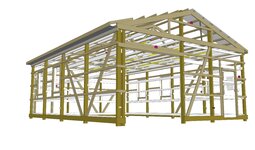
I'm in the home stretch of getting my 24x32x10 post frame dried in so I've started planning the electrical layout/wiring. I've subbed out having my meter service upgraded to 200A with 100A service/sub panel installed in the post frame but I plan to self perform the remaining electrical. I'm located in a city in SW Ohio which will require a permit and inspection (NEC 2017).

Building will primarily be used as a hobby shop (woodworking, light welding, and auto maintenance). All wiring will be ran in wall (I've have EMT in my current workshop and I hate it). Bottom 3 feet of the interior walls will be finished with metal siding so removal to access wiring should be "easier" if future changes need to be made. Top 2/3 of wall will be finished with 1/2 OSB. Please speak up if you have any suggestions on things that I'm overlooking from both a layout or code perspective.

I'm basically looking for a sanity check on my layout, understanding of code requirements, etc. Starting off with my basic understanding:
  • Grounds and neutrals will be wired on separate bars (unbonded) in sub panel
    • Electrician will wire one receptacle and one lighting circuit as part of panel install
  • All circuits with receptacles are required to have GFCI protection (210.8(A) Dwelling Units)
    • My plan is to wire the first receptacle in each circuit run with a GFCI
    • 3 circuits only provide power to receptacles that are greater than 6.5ft off the ground, and they all happened to be switched, so I plan to just install a GFCI receptacle next to the corresponding switch for easy identification
  • All receptacles will be Tamper Resistant (406.12 Tamper-Resistant Receptacles)
    • I understand that technically none of my ceiling receptacles are required to be TR, but it seems more straight forward to just do them all TR
  • All exterior receptacles will be mounted ~18" above grade using weatherproof boxes and "extra duty" weatherproof in-use covers (406.9(B)(1) 15- and 20-Ampere Receptacles in a Wet Location)
    • TayMac MM420C 1-Gang Nonmetallic Extra Duty Weatherproof In-Use Cover
  • AFCI protection is not required for any circuits as this area is not one of those defined in the NEC (210.12 Arc-Fault Circuit-Interrupter Protection)
  • 20A circuits will be 12/2 NM
  • 15A circuits will be 14/2 NM
  • QUESTION?: What are the support interval requirements for horizontal NM within a wall cavity? My posts are 8' apart, am I required to find a way to support them in runs that stretch between those posts? My understanding is that vertical runs of NM must be secured at at intervals not exceeding 4.5 ft. and within 12 in. of every cable entry into enclosures such as outlet boxes, junction boxes, cabinets, or fittings, but I can't find anything specific to horizontal runs.
I'm not a professional by any means, but I did the best I could with what I had to make diagrams that could be followed and understood.
  • Interior wall receptacles will be mounted 50" to bottom of box, +/- 8 feet between receptacles
  • I plan to install 2 circuits in each box to avoid issues with multiple high current draw power tools (IE dust collection & saw/planner/etc)
    • Wall circuits will be identified by receptacle color (A circuit Black, B circuit white, etc) because I'm weird
  • Ceiling lighting will be surface mounted 8' plug in style LED strip lights

Circuit/IdentifierDescription
A20A Interior Wall Receptacle (Black)
A*20A Interior Wall GFCI Receptacle (Black)
(A)20A Exterior Wall Receptacle (Black)
B20A Interior Wall Receptacle (White)
B*20A Interior Wall GFCI Receptacle (White)
(B)20A Exterior Wall Receptacle (White)
C20A Interior Wall Receptacle (Brown)
C*20A Interior Wall GFCI Receptacle (Brown)
(C)20A Exterior Wall Receptacle (Brown)
D20A Interior Wall Receptacle (Almond)
D*20A Interior Wall GFCI Receptacle (Almond)
(D)20A Exterior Wall Receptacle (Almond)
[$E*]15A Interior Switch & GFCI Receptacle
E15A Ceiling Outlets (switched)
[$F*]20A Interior Switch & GFCI Receptacle
F20A Ceiling Outlets (switched)
GNEMA 6-50 (Welding)
(J)15A Exterior Soffit Outlets
[$J*]15A Interior Switch & GFCI Receptacle
[$K*]15A Interior Switch & GFCI Receptacle
K15A Exterior Lights (switched)
(K)15A Exterior Motion/Camera Light
[K]15A Garage Door Outlet
{K}15A Attic Light & Receptacle
 

Attachments

  • PostFrame Electical Layout.png
    PostFrame Electical Layout.png
    30.2 KB · Views: 67
  • PostFrame Electical WIRE Layout.png
    PostFrame Electical WIRE Layout.png
    52.7 KB · Views: 67
  • post frame design.jpg
    post frame design.jpg
    397.4 KB · Views: 65
To avoid these ads, REGISTER NOW!

cybrdyke

Well-known member
Joined
Sep 9, 2014
Messages
3,442
Location
USA
I was under the impression that Ohio inspectors wanted 12/2, not 14/2, in new construction, even on 15A circuits. You might want to verify.
CD
 

AntonLargiader

Well-known member
Joined
Nov 20, 2016
Messages
1,372
Location
Charlottesville, VA
Make sure you have enough receptacles at desk and workbench areas. Phone chargers, laptop, battery chargers, stereo, USB-this, ultrasonic cleaner, whatever you're working on that needs to be plugged in, soldering iron, etc. They're easy enough to add later but just add them now. I have four above my roll cab and it should be eight. I have two where it should be four, etc. There's no downside to adding them; it's not going to change how many things you use simultaneously, just how much plug swapping you have to do. If you already know of three things that need to be plugged in, go with eight. Never two unless it's just bare wall where nothing will ever happen other than the occasional vacuum cleaner.
 

Jakemedic

Well-known member
Joined
Jul 26, 2013
Messages
721
Location
Cornfields of SE Iowa
Looks good. I did my 24x32 a couple of years ago and I included a dedicated table saw circuit, dedicated dust collection circuit, dedicated band saw circuit (still don’t own one yet) and a 20 amp usb outlet (somewhat hard to locate). Even with all that, I had to open up the walls to add a dedicated 30 amp circuit for my surface planer. I ran all my wire in the walls except on my ceiling. I ran that in conduit to connect each light.

one thing just asking about, can you use OSB on the walls? May want to check before putting it up.

Best of luck with your project!
 

cretedog

ALLIANCE MEMBER
Joined
Mar 27, 2012
Messages
232
Location
North Dakota USA
Make sure you have enough receptacles at desk and workbench areas. Phone chargers, laptop, battery chargers, stereo, USB-this, ultrasonic cleaner, whatever you're working on that needs to be plugged in, soldering iron, etc. They're easy enough to add later but just add them now. I have four above my roll cab and it should be eight. I have two where it should be four, etc. There's no downside to adding them; it's not going to change how many things you use simultaneously, just how much plug swapping you have to do. If you already know of three things that need to be plugged in, go with eight. Never two unless it's just bare wall where nothing will ever happen other than the occasional vacuum cleaner.
Good points above from AL. Also- Put a couple of receptacles in those locations with the USB cord charging feature. You'll use them for more than just phone charging- for misc work-lights, instruments, etc...
 

cretedog

ALLIANCE MEMBER
Joined
Mar 27, 2012
Messages
232
Location
North Dakota USA
I'm in the home stretch of getting my 24x32x10 post frame dried in so I've started planning the electrical layout/wiring. I've subbed out having my meter service upgraded to 200A with 100A service/sub panel installed in the post frame but I plan to self perform the remaining electrical. I'm located in a city in SW Ohio which will require a permit and inspection (NEC 2017).

Building will primarily be used as a hobby shop (woodworking, light welding, and auto maintenance). All wiring will be ran in wall (I've have EMT in my current workshop and I hate it). Bottom 3 feet of the interior walls will be finished with metal siding so removal to access wiring should be "easier" if future changes need to be made. Top 2/3 of wall will be finished with 1/2 OSB. Please speak up if you have any suggestions on things that I'm overlooking from both a layout or code perspective.

I'm basically looking for a sanity check on my layout, understanding of code requirements, etc. Starting off with my basic understanding:
  • Grounds and neutrals will be wired on separate bars (unbonded) in sub panel
    • Electrician will wire one receptacle and one lighting circuit as part of panel install
  • All circuits with receptacles are required to have GFCI protection (210.8(A) Dwelling Units)
    • My plan is to wire the first receptacle in each circuit run with a GFCI
    • 3 circuits only provide power to receptacles that are greater than 6.5ft off the ground, and they all happened to be switched, so I plan to just install a GFCI receptacle next to the corresponding switch for easy identification
  • All receptacles will be Tamper Resistant (406.12 Tamper-Resistant Receptacles)
    • I understand that technically none of my ceiling receptacles are required to be TR, but it seems more straight forward to just do them all TR
  • All exterior receptacles will be mounted ~18" above grade using weatherproof boxes and "extra duty" weatherproof in-use covers (406.9(B)(1) 15- and 20-Ampere Receptacles in a Wet Location)
    • TayMac MM420C 1-Gang Nonmetallic Extra Duty Weatherproof In-Use Cover
  • AFCI protection is not required for any circuits as this area is not one of those defined in the NEC (210.12 Arc-Fault Circuit-Interrupter Protection)
  • 20A circuits will be 12/2 NM
  • 15A circuits will be 14/2 NM
  • QUESTION?: What are the support interval requirements for horizontal NM within a wall cavity? My posts are 8' apart, am I required to find a way to support them in runs that stretch between those posts? My understanding is that vertical runs of NM must be secured at at intervals not exceeding 4.5 ft. and within 12 in. of every cable entry into enclosures such as outlet boxes, junction boxes, cabinets, or fittings, but I can't find anything specific to horizontal runs.
I'm not a professional by any means, but I did the best I could with what I had to make diagrams that could be followed and understood.
  • Interior wall receptacles will be mounted 50" to bottom of box, +/- 8 feet between receptacles
  • I plan to install 2 circuits in each box to avoid issues with multiple high current draw power tools (IE dust collection & saw/planner/etc)
    • Wall circuits will be identified by receptacle color (A circuit Black, B circuit white, etc) because I'm weird
  • Ceiling lighting will be surface mounted 8' plug in style LED strip lights

Circuit/IdentifierDescription
A20A Interior Wall Receptacle (Black)
A*20A Interior Wall GFCI Receptacle (Black)
(A)20A Exterior Wall Receptacle (Black)
B20A Interior Wall Receptacle (White)
B*20A Interior Wall GFCI Receptacle (White)
(B)20A Exterior Wall Receptacle (White)
C20A Interior Wall Receptacle (Brown)
C*20A Interior Wall GFCI Receptacle (Brown)
(C)20A Exterior Wall Receptacle (Brown)
D20A Interior Wall Receptacle (Almond)
D*20A Interior Wall GFCI Receptacle (Almond)
(D)20A Exterior Wall Receptacle (Almond)
[$E*]15A Interior Switch & GFCI Receptacle
E15A Ceiling Outlets (switched)
[$F*]20A Interior Switch & GFCI Receptacle
F20A Ceiling Outlets (switched)
GNEMA 6-50 (Welding)
(J)15A Exterior Soffit Outlets
[$J*]15A Interior Switch & GFCI Receptacle
[$K*]15A Interior Switch & GFCI Receptacle
K15A Exterior Lights (switched)
(K)15A Exterior Motion/Camera Light
[K]15A Garage Door Outlet
{K}15A Attic Light & Receptacle

Put in a panel with plenty of spaces.

Are you stubbing out spare conduits from the panel down and out to the exterior and up to ceiling for future use?

Any need for a switched exhaust fan circuit?

Switched ceiling fan circuit if you like them.?

OH door operator circuit.?

Need for exterior 240v recept for hot pressure washer, welder or compressor?

Rough in up high on the exterior for wall packs/ security lights, cameras?

Communication conduit stub outs from a small Hoffman to bring Cat 6 from house for computer, TV, cameras, alarm use, etc.?


CD
 
Last edited:
To avoid these ads, REGISTER NOW!
OP
A
Joined
Jan 11, 2023
Messages
15
Location
SW Ohio
I was under the impression that Ohio inspectors wanted 12/2, not 14/2, in new construction, even on 15A circuits. You might want to verify.
CD
Interesting, I tried searching for amendments in OH adoptions of NEC and did see anything specifically about wire size. I'll have to ask my inspector

one thing just asking about, can you use OSB on the walls? May want to check before putting it up.

Best of luck with your project!
Only reference I found regarding this is for attached garages and the wall(s) that have interior habitable space on the other side, but I will double check with the inspector.

Good points above from AL. Also- Put a couple of receptacles in those locations with the USB cord charging feature. You'll use them for more than just phone charging- for misc work-lights, instruments, etc...
I've thought about adding a few of these, thanks!

Put in a panel with plenty of spaces.

Are you stubbing out spare conduits from the panel down and out to the exterior and up to ceiling for future use?

Any need for a switched exhaust fan circuit?

Switched ceiling fan circuit if you like them.?

OH door operator circuit.?

Need for exterior 240v recept for hot pressure washer, welder or compressor?

Rough in up high on the exterior for wall packs/ security lights, cameras?

Communication conduit stub outs from a small Hoffman to bring Cat 6 from house for computer, TV, cameras, alarm use, etc.?


CD
Electrician spec'd a 20/24 panel for install. I currently only have 8 single pole, and 1 double pole, circuit planned.

Probably not a bad idea to run put some conduit in going up/down out of the panel.

I've already got a couple switched receptacle circuits planned for the ceiling, so adding fans shouldn't be an issue if I decide later

I do have a 240V receptacle planned for my welder, don't currently have plans that would require a direct wire compressor.

I've got a power planned for locations that I plan to use exterior lights/cameras

I've considered burying a conduit for low voltage to install a router due to the weak wifi signal from in the house to the shop area.
 
OP
A
Joined
Jan 11, 2023
Messages
15
Location
SW Ohio
I ran a cat 6 cable in conduit from my house to my shop. At the shop, I installed a router. One of the best things I did. Strong signal, fast internet.
Out of curiosity, do you have this set up with a unique SSID (wifi name) or is it set up as an access point that matches your home wifi?
 

pbon

Well-known member
Joined
May 14, 2017
Messages
3,498
I’d put one outlet in the center of the rear wall or perhaps offset towards your lift side.You might want to plug a vacuum in or some car related tool without running an extension cord off a side wall. I’d also put one in the center of the front if you have separate doors with a post or wall between them. If not, an outlet on either side. You might want to shop vac the cars or run a table saw in the driveway — it’s often easier to plug in inside if the doors are open than to use a weather proof exterior box.

Consider 240 for heat/ac in the future if not now with disconnect switch (there is a light switch style if the amps are not above a certain spec).
 

Jakemedic

Well-known member
Joined
Jul 26, 2013
Messages
721
Location
Cornfields of SE Iowa
Out of curiosity, do you have this set up with a unique SSID (wifi name) or is it set up as an access point that matches your home wifi?
I tried initially to do a unique SSID and found it wouldn’t work. I contacted the service provider and they guided me to making it work via an access point. It is functioning as a separate network, mostly because I didn’t want to mess with matching the two routers with the same network name. I was so happy it worked, i never bothered.

A quick phone call to your ISP should help you decide which way will work for you. I hope this helps!
 
To avoid these ads, REGISTER NOW!
Top Bottom