To avoid these ads, REGISTER NOW!

Critique my EVSE plan

ScaldedDog

Well-known member
Joined
Jan 15, 2008
Messages
1,065
Location
Sedalia, CO/NSB, FL
I need an outlet for an EVSE in our garage. It needs to pass inspection, and I'd like to future proof a bit by running 4g wire to support 48a charging in the future. (The soon-to-ours PHEV in question only supports 16a charging, but I'll be using a JuiceBox 40a charger, so both the breaker and receptacle will be 50a, for now.) I'd like your knowledgeable opinions on what I'm thinking, and also have some questions at the end of this post.

The panel below is on an inside wall of the utility room, about 4' from the internal garage wall, and about 32' from the external garage wall where the 14-50r receptacle will be (also pictured below. The disconnect is on the outside of the house, and I'll be disconnecting it when working near or in the box. I'll be using the 50a breaker toward the bottom right. It is currently wired to a "spare" circuit that just terminates in a box in the crawl space.

House Load Center.jpg

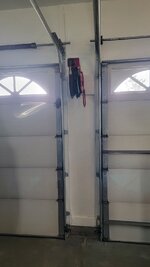
The garage wall where the 14-50 receptacle will be, and where the JuiceBox will be mounted
Garage door wall.jpg

My plan is to bring 4g Romex down from the attic through the (presumably uninsulated) interior wall and through one of the unused pop-outs in the box. The wire will run across the insulated garage attic and down into the insulated exterior garage wall shown above. I'll be taking down the hose reel and drywall, as the latter is easy to replace in that space.

My questions:

1) Can I just wire nut and label the existing spare circuit wires, and leave them in the box?
2) Are there any code restrictions for how the wire is run from the attic to the top of the box? (e.g. Must be attached to something, etc.) I don't have access to this space, and don't want to tear up that wall. Of course the wire will pass through a connector into the box, but I don't know if it needs to be somehow secured inside the wall.
3) Does the Romex have to be secured to the rafters as it passes along the attic "floor", and beneath the blown in insulation?
4) Does the fact that it will be beneath insulation in the attic, and in an insulated wall as it runs down to the outlet, in any way de-rate the wire? IOW, is 4g Romex still capable of supporting a 60a circuit in a code compliant way?
5) If I can't come down inside the garage wall, and have to use conduit along the outside (inside the garage space) of it, can 4g Romex be used in conduit? I've seen conflicting info and opinions on that. If the code-supported answer is "No", I assume I could terminate the Romex in a jbox in the attic, and run THHN down the conduit. Is that correct?
6) What should I have asked, that I have not?

Thanks!!

Mark

 
To avoid these ads, REGISTER NOW!

pattenp

Well-known member
Joined
Jun 4, 2008
Messages
10,175
Location
Virginia - USA
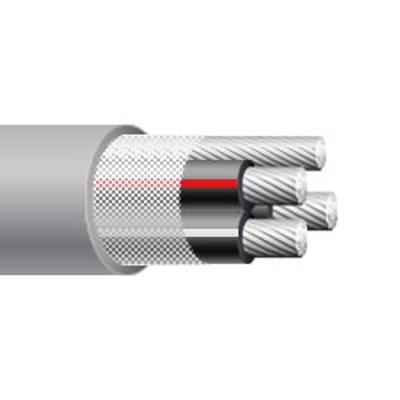
Use #4 Al SER, it's alot cheaper than #4 nm-b. The #4 Al SER is good for up to 65A. The SER is listed as 4-4-4-6.
My choice would be the ChargePoint Home Flex using the 6-50 outlet that way you can use SER 4-4-6 and not need the neutral.
 
Last edited:

Noltz

Well-known member
Joined
Mar 10, 2020
Messages
377
Location
Ontario, Canada
Sparkies will chime in with code soon, but from what I've learned during my EV plug install (and laundry room reno) is as follows. If anyone spots a mistake please point it out - I'm here to learn too. So this is just my experience as a Canadian installing their own, and then passing inspection.

1) AFAIK Yes, you can just wire nut off and mark as "unused" and leave it in the box. It's what you have now with the termination in the crawl space. I'd leave a note for courtesy.
2) My electrician required I secure romex wiring within 8" of the box with a wire staple. I had access because the drywall was down, and even though the wire was immediately going to the next stud bay through a bore hole, it had to be secured. I would verify with your own inspector ahead of time what they expect for securing in a finished wall.
3) When I contracted my bathrooms out they put the pot light wires across the rafters, secured with staples. When I did my own pot lights I drilled 3/4" holes and went through them. My work is far neater.
4) I can't answer this. I do know I went with #6 THHN because it's rated for 60A. #10 ground was called for, but I screwed up my order and got four #6 conductors. Trying to wrestle four #6 wires into a 1" conduit was tough. I don't want to be you doing this with #4 Romex inside a finished wall.
5) You can run NM-b "Romex" in a conduit.
6) If you're going to pull the drywall in the garage, drill from below into the attic
 

Model A Fan

Well-known member
Joined
Dec 1, 2011
Messages
1,223
Location
NW Washington
Wow, that is quite a full panel. I'm following this as I'd like to do something similar. Have you considered a sub-panel in the garage that is 60A? I feel like a sub-panel would make it a whole lot easier to keep your wiring job nice and tidy and you'd gain a lot of space for future electrical projects. A new box would be $90 at Lowe's and then the cost of the breakers and an extra run of wire.
 
OP
S

ScaldedDog

Well-known member
Joined
Jan 15, 2008
Messages
1,065
Location
Sedalia, CO/NSB, FL
Wow, that is quite a full panel. I'm following this as I'd like to do something similar. Have you considered a sub-panel in the garage that is 60A? I feel like a sub-panel would make it a whole lot easier to keep your wiring job nice and tidy and you'd gain a lot of space for future electrical projects. A new box would be $90 at Lowe's and then the cost of the breakers and an extra run of wire.
Good question and yes, I did, but decided against it for a few reasons:

1) There's already a 100a sub-panel right next to this one. (Serviced by the lower left breakers in the main panel) This house has everything I can imagine, already (e.g. Steam shower, warming oven, well pump, etc) and I still have one breaker spot left, though I'd have to move one of the 120v ones to get 240v out of it.
2) There's already a 240v circuit to the garage, and I currently have a 15a compressor plugged into its 6-50r. If we ever get a second electric car, I'd have it's EVSE share this outlet, since I rarely run this compressor.
3) The house garage is just where we park our dailies and bikes. I've got a separate 1200sf shop on the property with it's own 80g compressor, lift, lots of welder outlets, an external RV plug (and I don't even own an RV :D), etc.

In the end, I just don't think I'll be adding a lot of new circuits to the house. I know, I know, that's what everyone says...

Mark
 

mike93lx

ALLIANCE MEMBER
Joined
Dec 9, 2013
Messages
37,846
Location
Richmond, VA
I would go aluminum as well.

Fishing anything near that size through fi ished spaces is going to ****. I would consider opening the wall and patching it up.

If you can run conduit for it, do not use NM or SER unless it is a really short part of the run. That size will be miserable in conduit.

If you could run conduit end to end, Aluminum Xhhw would work great, as would THHN/THWN copper
 

pattenp

Well-known member
Joined
Jun 4, 2008
Messages
10,175
Location
Virginia - USA
#6 NM-b is also good for 60 amp. Just trying to save you a few bucks in wire
#6 nm-b is 55A. Yes you can use a 60A breaker on it in certain cases but my understanding is the continuous load is to be no more than 80% of the conductor rating which is 44A.
 
To avoid these ads, REGISTER NOW!
OP
S

ScaldedDog

Well-known member
Joined
Jan 15, 2008
Messages
1,065
Location
Sedalia, CO/NSB, FL
If I use 4g NM-b, how do I accomplish the two 90* bends I'll need? I guess I could just terminate the two 4' vertical runs and one 30' horizontal runs in boxes, but I'd rather not do that.

What is the outside diameter of 4g NM-b, anyway? Google hasn't helped, and the nearest Lowes that has any is 50 miles away.

Sparkies, I'd love your input on this thread. I really want to do this right, and am open to schooling.

Mark
 

mike93lx

ALLIANCE MEMBER
Joined
Dec 9, 2013
Messages
37,846
Location
Richmond, VA
4g NM bends, it's just stiff. What about your 90's are you concerned about? Hopefully you aren't thinking about pulling that cable through conduit
 

pattenp

Well-known member
Joined
Jun 4, 2008
Messages
10,175
Location
Virginia - USA
Why are you stuck on using copper NM-b? Aluminium SER will work just as well and is a third the cost. SER installs the same as NM. 4/3 NM is .825 diameter, 4-4-4-6 SER is .823 per Southwire.
 
Last edited:
OP
S

ScaldedDog

Well-known member
Joined
Jan 15, 2008
Messages
1,065
Location
Sedalia, CO/NSB, FL
4g NM bends, it's just stiff. What about your 90's are you concerned about? Hopefully you aren't thinking about pulling that cable through conduit
Now that I have the diameter from the posts below, my concern is alleviated. Even a 5" bend radius shouldn't be an issue.
Why are you stuck on using copper NM-b? Aluminium SER will work just as well and is a third the cost. SER installs the same as NM. 4/3 NM is .825 diameter, 4-4-4-6 SER is .823 per Southwire.
Good point, though the stuff seems to be made of unobtanium around here. For the price difference, though, I can look harder.

From the tables I've seen, 4g aluminum is rated for 55a off the 60*C table, while copper is rated for 70a. From what I've read it seems like I should use the 60*C table for this <100a circuit, but perhaps I'm wrong about that.

Mark
 

pattenp

Well-known member
Joined
Jun 4, 2008
Messages
10,175
Location
Virginia - USA
SER is 75deg.C, so #4 is 65A. NM is limited to 60deg.C. That <100A is misleading because there's an exception on terminal ratings greater than 60deg.C, but almost all terminals are now 75deg.C., so the <100A doesn't apply.
 
Last edited:
To avoid these ads, REGISTER NOW!
Top Bottom