To avoid these ads, REGISTER NOW!

Crocker Wheeler Electric Motor

gettyupgo

Member
Joined
Nov 19, 2013
Messages
6
Moved here from introductions.
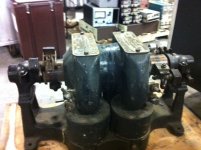
Anyone have a clue as to what this animal is?? What the application was??
Manufacture- Crocker Wheeler
Size 1, Amps. 8, Volts 115, Rpms 1450 Pat. Date 1891.
This puppy came out of the Electrical Eng. Dept. of a University of Austin. It had been sitting in a basement for many yrs. and someone sent it to the surplus sale. I am now the proud owner and its killing me trying to figure out what it was used for. Here's a few ideals- change ac to dc, used in telephone systems, used in elevator systems, used to boost 115v down the line.
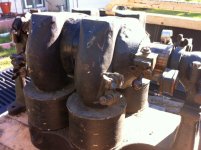
There is no way to add anything to the ends. It does have two electrical connections on each side. In one pictures you will see brass plates on top that has the specs. but each plate has a different ser. #. Off buy one number.
One other speculation was that Crocker Wheeler may have taken two 1 hp motors and put them together and offered them to schools for teaching tools.
Teaching what ? Not sure. That being the case most likely not many produced.
Ive already spent many hrs. on the net researching this item and have not found anything exactly like it. I have found a few motors that are half of this that drove a fan but not identical to what I have.
Any ideals??
Thanks in Advance,
Terry
 
To avoid these ads, REGISTER NOW!

Greatbear

Well-known member
Joined
Jan 17, 2008
Messages
1,702
Location
Columbia/Fulton, MD
A motor turning what appears to be another motor is usually a motor generator, used to convert line voltage into some entirely different voltage and frequency, something not possible with a transformer. Two identical motors spinning one another were often used for synchronizing AC power or generating extra phases.
 
OP
G

gettyupgo

Member
Joined
Nov 19, 2013
Messages
6
Sorry, Had to figure out the picture thing.
I took it back to the Electrical Eng. Dept. at the college and had a Professor look at it. His 2 cents was that CrockerWheeler must had made a few of these and most likely gave them out as teaching tools.
Still no hard answers other than this.
One more thing that indicates that it was used as a teaching tool is that each brass plate has the ser.# off by one digit. ??
 

Attachments

  • cw motor 4.jpg
    cw motor 4.jpg
    135.5 KB · Views: 104
  • CW Motor1.jpg
    CW Motor1.jpg
    127.4 KB · Views: 106
  • cw motor2.jpg
    cw motor2.jpg
    99.7 KB · Views: 91
  • cw motor3.jpg
    cw motor3.jpg
    51.6 KB · Views: 89
  • cw motor5.jpg
    cw motor5.jpg
    126 KB · Views: 84

Stuart in MN

Well-known member
Joined
Sep 8, 2005
Messages
23,139
Location
Minneapolis
It's impressive, no matter what it is.

A teaching or demonstration device seems like a reasonable explanation, what with the exposed brushes and all it would be easy to show how all the different components worked.

edit: I just noticed it was built in Ampere, New Jersey...seems like an appropriate location for a motor manufacturer.
 
Last edited:

rsanter

Well-known member
Joined
Dec 22, 2007
Messages
18,521
Location
visalia ca
Sounds like a motor-gen set used for demonstration or a hands on class in electricity.
Many schools still use them, but a slightly more modern version

Bob
 

Alan Douglas

Well-known member
Joined
Jun 4, 2011
Messages
295
Location
Cape Cod, Mass.
I presume you've already looked up the patent but if not it's 451,884 (and 451,885). Crocker-Wheeler was a well-known maker. It's hard to tell from the photos but it appears that one commutator has twice as many segments as the other? I would guess it was a voltage changer and could have been a commercial machine, not lab apparatus. Varying the field excitation on the second poles would have varied the DC output.

S.P. Thompson's Dynamo Electric Machinery seventh American ed. (1900), p.726 has an illustration of a similar motor-generator by Crocker-Wheeler but with a single field. It transformed 10A at 100V to 1A at 1000V. Wiener's Dynamo Electric Machines (1902) shows some slightly more modern Crocker-Wheeler motors (but not motor-generators). Yours probably dates before 1900 as it would have been obsolescent after that.

Crocker-Wheeler re-incorporated in 1891 and built the NJ plant. I know I've seen writeups in the electrical magazines at that time. It seems to me that Ampere didn't exist until C-W located there. C-W was still going in 1925; I don't remember who they eventually combined with.
 
Last edited:

terpfords

Active member
Joined
Feb 14, 2010
Messages
40
Not knowing the history timeline, AC wasn't available at that time ? So that would make it a DC to DC generator ? They are also 2 pole or flat head motors/generators.

I've seen more modern, 1930's, versions that ran on trollie power, but they were 4 pole.
 
To avoid these ads, REGISTER NOW!

nickleone

Well-known member
Joined
Sep 29, 2007
Messages
193
Before the human race became STUPID pre OSHA electric motors were built that way.
Commutators etc exposed.
Look at the electric fans etc from the early1900s. You could stick you whole arm into the blades past the "guard".

Nick
 

sselander

Well-known member
Joined
Nov 20, 2008
Messages
2,041
Location
CT
An interesting read on the Ampere railroad station with a tie-in to Crocker Wheeler

http://en.wikipedia.org/wiki/Ampere_(NJT_station)

Location for Ampere:
East Orange, Essex County, New Jersey

"The Crocker Wheeler plant, was bought by the Carrier Corporation to manufacture refrigerators and air conditioners."
 
OP
G

gettyupgo

Member
Joined
Nov 19, 2013
Messages
6
After countless hrs. I still havnt figured this puppy out.
A few things that I have been told was, a device to boost dc power down the line,
convert dc to ac, used in the telephone industry and maybe used in elevators.
I recently sent some pictures and information on the brass tag to the
Spark Museum. Mr. Winter(curator at the museum) said he'll take a stab at it.
I have not tried to hook it up. I have had a local retired elec. engr. say that if I brought it to the house we would try and hook up 12v auto battery to it and see if it would spinn. Everything looks complete. By the way its approx. 29"L x 13"H x 14" W, wt. just guessing 300lbs.
 
Last edited:

Alan Douglas

Well-known member
Joined
Jun 4, 2011
Messages
295
Location
Cape Cod, Mass.
Well it's DC in, DC out, since both armatures have commutators and not slip rings. My guess is it was used to get more than 115VDC for running lab experiments and tests. There was no other practical way to get higher voltage then, except storage batteries or a dynamo run from a steam engine. The separate fields would have allowed varying the generator voltage without screwing up the motor.

C-W was losing money by 1940 but I don't know how much longer they lasted. Carrier isn't listed as having a NJ plant in 1955 or 1963.
 
OP
G

gettyupgo

Member
Joined
Nov 19, 2013
Messages
6
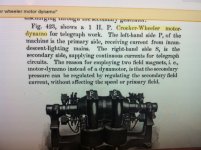
Thanks to joelr4 over on Smokstak the animal has been found.
Thanks to those of you that spent some time on looking for this puppy,
Terry
 

Attachments

  • crocker wheeler telegraph.jpg
    crocker wheeler telegraph.jpg
    133.4 KB · Views: 34

Alan Douglas

Well-known member
Joined
Jun 4, 2011
Messages
295
Location
Cape Cod, Mass.
It's all in knowing what search terms to use. And it was nice of Google to have scanned that book (which I don't have and I don't think is very common).
 

Radio Ron w4ron

Well-known member
Joined
Jan 23, 2013
Messages
867
Location
Radio Heaven (near Charlotte NC)
Well it's DC in, DC out, since both armatures have commutators and not slip rings. My guess is it was used to get more than 115VDC for running lab experiments and tests. There was no other practical way to get higher voltage then, except storage batteries or a dynamo run from a steam engine. The separate fields would have allowed varying the generator voltage without screwing up the motor.

C-W was losing money by 1940 but I don't know how much longer they lasted. Carrier isn't listed as having a NJ plant in 1955 or 1963.


Hello Alan, it's great to see you here on GJ.
This and ARF are my 2 main forums I read every day, several times
a day :)


.
 

oldgoaly

Well-known member
Joined
Apr 3, 2006
Messages
395
Location
Shiloh, Il
ARF ARF!
C-W made motors into the 1930's here is a pic of mine from a old table saw, had saw dust and moisture froze the thing up, but a few hours of cleaning, 2 new bearings has been my rotor phase converter since 1995, it's a 5hp motor.
idlermotor3ph01.jpg

excuse the mess, pic was before I make the swarf separator for the shopvac.
 
To avoid these ads, REGISTER NOW!
Top Bottom