To avoid these ads, REGISTER NOW!

Crossing square and rectangular steel tubes

theoldwizard1

Well-known member
Joined
Feb 22, 2011
Messages
43,114
Location
SE MI
Please, experienced fabricators/welder ONLY !

When building something like a 24' landscape trailer, with something like 2x6 rectangular main frame tubes and 2x2 square crossing tubes, this there a SIGNIFICANT benefit in notching the main frame tubes so that top of cross tube sits flush with the top of the main tube. Clearly it is stronger (more weld area) and clearly it cost more (time notching is money) !

In this case, the wheels will be IN SET (no outside fenders), so the cross tubes will have to extend past the main tubes to support the outside wall.

Assuming dual axle, 10,000 lb capacity, what thickness steel would you use (assume no side, front or back walls) ? 3/16? 1/4?
 
To avoid these ads, REGISTER NOW!

rwa2004

Well-known member
Joined
Oct 8, 2016
Messages
53
Location
Western PA
A couple of my opinions:
- 2x6 rectangular tubing would be minimum 1/4"
- No way would I notch out the rectangular tubing every couple of feet. That would completely destroy the integrity of the tube. Even tho you are going to fill the notch back in with the 2x2 tube, you will not bring back your beam strength and you will not likely have any semblance of straightness.
- Certainly it would be faster to "notch" the 2x2 tube by simply butting the ends to each side of rectangular tube and welding (16" weld vs 16" weld - same).
- If you are going for a flush top, maybe consider filling in between the 2x2 with short pieces of 2x2.
- Assuming wooden deck, if boards are spanning the the 2x2, the you don't gain anything with the flush top.
- Assuming metal deck, you will gain little with the flush deck.

- There is a big difference between a standard 20ft trailer and a 24ft trailer. Your 4x6 tubes are starting to become undersized at 24 ft long. The "subframe" that includes your tongue (and possibly back to your axles) becomes relevant being part of the structure.
 

jack stand

Well-known member
Joined
Feb 29, 2012
Messages
3,317
Location
Lakes Region Maine
My choice would be channel to begin with for corrosion reasons. The wall thicknesses will be partially determined by the trailer length. The longer the span between the hitch and the axles, and the same thing behind the axles to the end, the beefier cross section you'll need.
Usually pierced (or notched) X members and the associated extra work is to lower the "deck" height to remain legal in your load heights.
I don't ever recall seeing tubing let into the frame rails and wouldn't do it.
You have suspension considerations also for a "deck over" where you'll need the height although I'm not certain what you're up to using the term "walls".👍
 

tarmy

Well-known member
Joined
May 28, 2014
Messages
4,665
Location
Nor Cal
As mentioned, I would use channel or I beam for the frame rails and weld the cross members into them.IMG_4033.jpegIMG_0341.jpeg
 

Walkers

Well-known member
Joined
May 17, 2021
Messages
3,912
Location
Cave Creek Az
It sounds like you are doing a deck over tire trailer. If so, just run your crossmembers over the top of your side rails. Then adjust the size of the piece that you are welding your running gear to for the right distance above the tires.
 

kerrynzl

Well-known member
Joined
Nov 8, 2013
Messages
5,054
Location
Tauranga, New Zealand
Please, experienced fabricators/welder ONLY !

When building something like a 24' landscape trailer, with something like 2x6 rectangular main frame tubes and 2x2 square crossing tubes, this there a SIGNIFICANT benefit in notching the main frame tubes so that top of cross tube sits flush with the top of the main tube. Clearly it is stronger (more weld area) and clearly it cost more (time notching is money) !

In this case, the wheels will be IN SET (no outside fenders), so the cross tubes will have to extend past the main tubes to support the outside wall.

Assuming dual axle, 10,000 lb capacity, what thickness steel would you use (assume no side, front or back walls) ? 3/16? 1/4?

There is benefit [and issues] with cutting 2 x 2 notches into the main frame , The out-rigger part of the cross-members wont collapse the side wall of the 2 x 6 if it bends downward.
If the out-rigger part of the cross-members was 2 x 6 [3 piece cross-members] I would **** weld them.

If the top edge of the 2 x 6 frame was under tension it would be weaker, but under compression it would be stronger [this is down to axle placement and design]

Lastly the biggest issue with notching the rails is "Heat Shrinkage" bending the main rails upwards like a banana when it cools. So pre-heating and welding would be a preferred method. [or heat straightening the lower side after.

You can also "break it's back" clamping the frame over an "I" beam with a 1/8" spacer and when it cools it is straight [I do this method a lot because I don't like heating Galvanized steel]

Have fun with your tape measure 😁 [lay both rails together to get both sets of notches correct]

 
To avoid these ads, REGISTER NOW!
OP
T

theoldwizard1

Well-known member
Joined
Feb 22, 2011
Messages
43,114
Location
SE MI
If the top edge of the 2 x 6 frame was under tension it would be weaker, but under compression it would be stronger [this is down to axle placement and design]
Same is true in lumber construction, but once a wood structure is built, it is typically not subject to "load cycling" !
Lastly the biggest issue with notching the rails is "Heat Shrinkage" bending the main rails upwards like a banana when it cools. So pre-heating and welding would be a preferred method. [or heat straightening the lower side after.

You can also "break it's back" clamping the frame over an "I" beam with a 1/8" spacer and when it cools it is straight [I do this method a lot because I don't like heating Galvanized steel]
Good tip !
Have fun with your tape measure 😁 [lay both rails together to get both sets of notches correct]
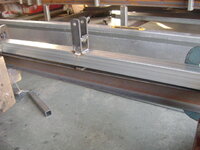
Another good tip !

Others have suggested using channel instead of tube to prevent moisture/rust on the inside. If you find yourself in a situation where you must use tubes, make small holes in the sides and spray in 3M Cavity Wax !

Capture.JPG
 

Monza Harry

Well-known member
Joined
Dec 29, 2018
Messages
1,433
Location
Windsor ON
Here is my take on the construction technique I will suggest, tube or channel for your main rails is simply a choice each has pros and cons, neither is inconsequential. I prefer tube, but rust prevention needs to be planned and executed from word go! The issues stated above for notching are pretty well covering all of them but just sticking the cross members to the side of the tube isn't a good plan either. So as @Kerry pointed out the side wall can/will "oil can" eventually breaking the weld or the main rail with different size tubes welded on to the sides of a bigger tube. So pass the cross members right trough the main rail tubes. Set them 1½" below for a lumber deck leaving the main rails flush with the top of the wooden deck. This will allow a bigger main rail without (~much of) a height penalty. Many trucks are moving to this technique for cross members so obviously there is some benefit to this over the tried and true "C" channel frame. Just insure that there is access for rust proofing of your choice. Go spend an hour watching your "guy" and ask him what he needs to get to your frame everywhere. I drilled ¾" holes at the junctions with ½" holes for the access plugs on the outside, this is to allow easier alignment for his "magic wand". Sizing is very dependent on loads, length, and load placement and concentration. You will need to give us a little more for that info. Harry
 

Firebrick43

Well-known member
Joined
May 12, 2015
Messages
14,005
Location
West central Indiana
Here is my take on the construction technique I will suggest, tube or channel for your main rails is simply a choice each has pros and cons, neither is inconsequential. I prefer tube, but rust prevention needs to be planned and executed from word go! The issues stated above for notching are pretty well covering all of them but just sticking the cross members to the side of the tube isn't a good plan either. So as @Kerry pointed out the side wall can/will "oil can" eventually breaking the weld or the main rail with different size tubes welded on to the sides of a bigger tube. So pass the cross members right trough the main rail tubes. Set them 1½" below for a lumber deck leaving the main rails flush with the top of the wooden deck. This will allow a bigger main rail without (~much of) a height penalty. Many trucks are moving to this technique for cross members so obviously there is some benefit to this over the tried and true "C" channel frame. Just insure that there is access for rust proofing of your choice. Go spend an hour watching your "guy" and ask him what he needs to get to your frame everywhere. I drilled ¾" holes at the junctions with ½" holes for the access plugs on the outside, this is to allow easier alignment for his "magic wand". Sizing is very dependent on loads, length, and load placement and concentration. You will need to give us a little more for that info. Harry
as I was reading this thread your solution is what I was formulating as a reply in my head.

Low boys and flatbed semi trailers have been doing this for a long time.

The availably of CNC laser tube cutting makes cutting precise holes with the proper radius in the corners to match the radius on the square tube corners exactly. The frame is almost self jigging at that point and you don't have to cut the top flange or plane of the channel/tubing.
If you leave the top edge of the longitudinal members slightly proud of the deck it also allows for blades and buckets to set on without tearing up the deck or to drag things up onto the deck with a winch causing less damage to the wood as it slides on the steel rails.
 

speed bump

Well-known member
Joined
May 28, 2008
Messages
6,317
Location
Butte Montana
Notching a 20 ft long tube in one side is going to give you a lot of opportunity to have it stress relieve itself. Followed by a lot of heat input to weld those rails in completely.

If I had to notch it I would find a bent c profile that hit the deflection value I wanted, plasma cut it out of sheet and bend it.

Otherwise I would run C6x8.2 main channels with a 2" pipe for torsion every 6-8ish ft and crossmember the top of it with C3x4.1 like every other trailer manufacturer decided on to build a 10k deckover.
 

Monza Harry

Well-known member
Joined
Dec 29, 2018
Messages
1,433
Location
Windsor ON
I forgot to mention above that if using tube, you will require "vent" holes for welding, and with some prior planning they can also double as "weep" holes, welded tubes for trailer type construction will almost always leak so when water gets in it needs to get out, for rust and freezing reasons. Harry
 

kerrynzl

Well-known member
Joined
Nov 8, 2013
Messages
5,054
Location
Tauranga, New Zealand
Notching a 20 ft long tube in one side is going to give you a lot of opportunity to have it stress relieve itself. Followed by a lot of heat input to weld those rails in completely.

No it doesn't , the molten filler of the welds will shrink when they cool ,and a 2" x 2" crossmember will cause a bend in a 2" x 6" tube.
You see this quite often on home built trailers that bow downwards [people assume the trailer is weak and bends]
This is often caused by heat shrinkage when welding suspension hangers on the underside.
[here is an example, from the internet]
bent trailer...png

I preload the steel over an I beam when I weld suspension hangers [breaking it's back].
Once cooled and released it is arrow straight

DSC04884.JPG

To stress relieve the main frame you need to clamp it straight and heat the area opposite to where the weld was [it will thicken when hot]
Another method is to use a blunt cold chisel and BFH and hammer the molten welds when the cool [expanding them to counteract shrinkage]
 
Last edited:

Outwest

Well-known member
Joined
Jun 26, 2018
Messages
258
Location
Northwest
I would suggest looking at Diamond C Trailers to see what they do for a visual. They utilize an arched and engineered frame, pierced beams and I beam cross members, but the idea could be applied to tubing similarly. They build trailers like semi trailers as Monza Harry referred.
 

PugetDude

ALLIANCE MEMBER
Joined
Mar 13, 2013
Messages
22,345
Location
Superstition Mountains, AZ
However you decide to cut/notch/weld the frame you should consider gussets at the stressed connections to minimize oil canning on rectangular tube and/or deflection/twisting on channel/angle.
 
To avoid these ads, REGISTER NOW!
Top Bottom