To avoid these ads, REGISTER NOW!

Crushed Stone Discussion For Construction Applications

sayn3ver

Active member
Joined
Jan 16, 2022
Messages
44
So is there anyone here who is a contractor or engineer who can explain what and when to used the various crushed stones in construction applications?
I live in the northeast. My local code specifies the frost line at 30" of depth.
I'm concerned with understanding crushed stone. Clean and minus (minus meaning a declared maximum crushed stone size plus everything else down to fines)

What I understand at the moment...

a) X" crushed clean stone (washed with no fines) will not compact. You can consolidate but not compact. Top can move with mere foot traffic after plate compaction. Essentially it is "compacted" when placed. It won't lock. Provides better drainage than crushed stone with fines. It is considered solid if restrained (like when placed between foundation walls). Often used in landscape and drainage applications for french drains and retaining walls protected by filter cloth to keep fines out.

b) X" crushed minus (crushed stones of declared size and smaller all the way to fines/dust. Obviously unwashed). You can compact this material well with a plate compactor and moisture in small lifts. Will lock together and form a tight concrete like surface. Still offers some drainage?

My project has various components and I'm trying to be educated in selecting the right materials.

1) Sub-base for interior slab: My detached garage project will be heated to 55-60f in winter to keep fluids, batteries, paint in their approved storage ranges and for working. It will have traditional strip footings placed below frost line and then CMU stemwalls poured solid. I will be using either 2-4" of 25psi foam or about 8-10" of foam glass fill below the slab for insulation. I wanted to use another 6-8" of stone fill below the insulation. I've seen arguments for clean vs minus crushed stone. I have both 3/4 minus and 3/4 washed clean crushed stone available right down the street. I believe I can get larger as I live in a dense urban/suburban area and considering the amount of road work the local municipalities and state does it should be close by. I would be moving and placing the material myself but can easily rent and operate equipment if needed. I would imagine material over 3/4" or maybe 1" would be hard to move and place without machinery.

2) Concrete/asphalt driveway: Exterior use. Due to rain and snow fall and freezing temps, I've seen recommendations for both 3/4" crushed clean and 3/4" minus for base for driveways, aprons and concrete walkways. 3/4" crushed minus will compact tight and not need to be constrained. 3/4" crushed clean seems to be recommended in freezing locations to help combat frost heave. My gut here is to use 3/4" crushed minus.

I'm not sure what a few extra inches of water drainage will accomplish if the entire ground down to the frost line is heaving. Or am I not understanding how frost heaving works? the 3/4" crushed minus will retain more moisture and could add to the heaving as that water expands when freezing. But if the ground below is doing the same, does it make a difference?

3) Paver walkways: Same deal: I've seen both the 3/4" crushed clean and 3/4" crushed minus suggested for the bulk of the base with various other finer options to top the base.

Hoping to have a decent discussion so other can reference this in the future. I encourage links to technical documents myself as source material is always useful.
 
To avoid these ads, REGISTER NOW!

C-S-H

Well-known member
Joined
Jan 18, 2024
Messages
145
Your first priority should be proper site drainage. You do not ever want to channel water under your pavements through an open graded base. I like this article from FHWA https://www.fhwa.dot.gov/pavement/concrete/pubs/hif16005.pdf .

There are potentially 4 layers: The pavement, the base, the subbase, and the subgrade (native soil). You may not need unique materials for the last 3.

Your materials of choice are the native soil, select fill, cement-stabilized native soil, dense-graded aggregate, open-graded aggregate. Your native soil may or may not be susceptible to frost heave, and the last three are relatively immune to it and strong when correctly compacted.
 

Bondo

Well-known member
Joined
Dec 22, 2007
Messages
2,549
Location
Greenfield, Maine
2) Concrete/asphalt driveway: Exterior use. Due to rain and snow fall and freezing temps, I've seen recommendations for both 3/4" crushed clean and 3/4" minus for base for driveways, aprons and concrete walkways. 3/4" crushed minus will compact tight and not need to be constrained. 3/4" crushed clean seems to be recommended in freezing locations to help combat frost heave. My gut here is to use 3/4" crushed minus.

I'm not sure what a few extra inches of water drainage will accomplish if the entire ground down to the frost line is heaving. Or am I not understanding how frost heaving works? the 3/4" crushed minus will retain more moisture and could add to the heaving as that water expands when freezing. But if the ground below is doing the same, does it make a difference?
Ayuh,...... When building a driveway, step #1 is to "box out" the area, the box-out should be self-draining to a lower area,......

Depending on the native soils, a long lived driveway would be boxed out to 8" below final grade, back-filled with 6" of 1.5" crusher-run, compacted every 2", then a couple inches of 3/4" crusher-run to tune the final grade, compacted, 'n finally the 2" of blacktop, or concrete, or pavers, or what ever you want/ need,....

The key is, the original box-out needs to be self draining to where ever the water has to go, as without water, there are No frost heaves,.....
 

Junkman

Well-known member
Joined
Dec 18, 2006
Messages
6,626
Location
Northeastern CT
If you are in New England and there are ledge outcroppings, you'd best dig deeper and disturb the soil beneath where you are planning the driveway. I went down about a foot and did it correctly; however, the boulders below the driveway have been pushing up every year, raising the driveway surface like a pimple. I have had to have the driveway cut, the boulders dug out, the hole filled, and the area repaved. It has been a never-ending headache for me. Currently, I have identified 18 that have come up in the last 10 years, and some I know will be difficult to pull out of the ground without an excavator on site.
 
OP
S

sayn3ver

Active member
Joined
Jan 16, 2022
Messages
44
If you are in New England and there are ledge outcroppings, you'd best dig deeper and disturb the soil beneath where you are planning the driveway. I went down about a foot and did it correctly; however, the boulders below the driveway have been pushing up every year, raising the driveway surface like a pimple. I have had to have the driveway cut, the boulders dug out, the hole filled, and the area repaved. It has been a never-ending headache for me. Currently, I have identified 18 that have come up in the last 10 years, and some I know will be difficult to pull out of the ground without an excavator on site.
I'm located in the mid Atlantic 2-3 states away from true New England. Known for our sandy loam and being one of the flattest states in the union.

The lot is relatively flat. The existing concrete driveway and old garage slab I demoed had no stone or sand underneath. Just subsoil. No issues with frost heave since we bought in 2014.

I had the topsoil tested years ago and was a balanced sandy loam. I haven't had any subsoil tested yet. The relatively flat lot has a total fall of about 26" from the grade next to the house down to the adjacent public sidewalk 32ft away. That grade pitch is kept constant to the backyard where the structure will be rebuilt.

The house was built I believe in the mid 1950's and the apparent age of the original garage and driveway align with that time period. The old garage had 1x sheathing on the walls and roof. Cement/asbestos siding. If these were not built during the original construction my guess is they were added close behind the house.
 

Overboost44

Well-known member
Joined
Apr 29, 2020
Messages
84
Location
MD
I am interested in the replies because I am in a similar situation. If you live in DE, why don't you say that? ;)

I spoke to two local stone suppliers on Friday. One told me CR6 under slab and footers and the other told me that I could use CR-57, or better yet RC-57 (recycled concrete) under the slab, which is much cheaper. That would include fines. Frost line here is 24".
 
To avoid these ads, REGISTER NOW!

Firebrick43

Well-known member
Joined
May 12, 2015
Messages
14,014
Location
West central Indiana
So is there anyone here who is a contractor or engineer who can explain what and when to used the various crushed stones in construction applications?
I live in the northeast. My local code specifies the frost line at 30" of depth.
I'm concerned with understanding crushed stone. Clean and minus (minus meaning a declared maximum crushed stone size plus everything else down to fines)

What I understand at the moment...

a) X" crushed clean stone (washed with no fines) will not compact. You can consolidate but not compact. Top can move with mere foot traffic after plate compaction. Essentially it is "compacted" when placed. It won't lock. Provides better drainage than crushed stone with fines. It is considered solid if restrained (like when placed between foundation walls). Often used in landscape and drainage applications for french drains and retaining walls protected by filter cloth to keep fines out.
You are mixing up terms. Clean crushed stone absolutely will compact. Consolidation is compaction. Clean crushed stone laid down in lifts and compacted via vibrtion or vibration and rolling will form a very stable tight subsurface even if the surface can be disturbed easily. Well compacted #8 (3/4 minus with no fines) stone works extremely well as a drive surface and is easy to grade. Its only detrimental if those driving on it are idiot drivers and peel out or slam on the brakes plus you don't track fines into the buildings when wet.
b) X" crushed minus (crushed stones of declared size and smaller all the way to fines/dust. Obviously unwashed). You can compact this material well with a plate compactor and moisture in small lifts. Will lock together and form a tight concrete like surface. Still offers some drainage?
It will not move as much with poor driving but it is not a concrete like surface. It still moves, potholes still form, and pot holes are much harder to permnantly fix as to do so you need to rip to the bottom of the pot hole and most don't have equipment able to do that. Clean 3/4 minus can be graded easily even with sub compact tractors and potholes are unlikely to form as water passes thru instead of holding it in the bottom of the pothole.
My project has various components and I'm trying to be educated in selecting the right materials.

1) Sub-base for interior slab: My detached garage project will be heated to 55-60f in winter to keep fluids, batteries, paint in their approved storage ranges and for working. It will have traditional strip footings placed below frost line and then CMU stemwalls poured solid. I will be using either 2-4" of 25psi foam or about 8-10" of foam glass fill below the slab for insulation. I wanted to use another 6-8" of stone fill below the insulation. I've seen arguments for clean vs minus crushed stone. I have both 3/4 minus and 3/4 washed clean crushed stone available right down the street. I believe I can get larger as I live in a dense urban/suburban area and considering the amount of road work the local municipalities and state does it should be close by. I would be moving and placing the material myself but can easily rent and operate equipment if needed. I would imagine material over 3/4" or maybe 1" would be hard to move and place without machinery.

2) Concrete/asphalt driveway: Exterior use. Due to rain and snow fall and freezing temps, I've seen recommendations for both 3/4" crushed clean and 3/4" minus for base for driveways, aprons and concrete walkways. 3/4" crushed minus will compact tight and not need to be constrained. 3/4" crushed clean seems to be recommended in freezing locations to help combat frost heave. My gut here is to use 3/4" crushed minus.
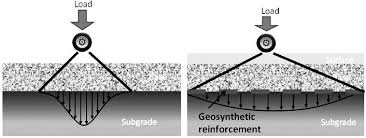
Depends what you want and who is driving on it. More important is grading and how deep you put it down. Also in clay and muck type soils a heavy geotextile barrier pays big dividends down the road with mitigating or eliminating mud pumping as the first layer. 4" of #2.5" crushed stone and 8" of 3/4 minus or 3/4 minus plus fines will usually withstand up to large pickup/medium duty truck traffic when wet.

The most important thing is however drainage. You could have stone road's 2 foot deep and if the soil is dense and the surrounding soil is higher then it will have issues. If you build a raised road bed however and its wide enough to distribute the weight and the bottom of the stone is dry and can run off when raining you can build a stable road across swamps. Across flat poorly drained ground soil is excavated to form ditches and the center raised with stable fill to raise the bottom of the road bead of surrounding surfaces. Some soils are drained well enough to just remove organic top soil and fill with 12" of aggregate and be perfectly fine. Its all about what type of soils you have and the surrounding drainage.

Remember the goal of an all weather road to to spread out the loads to the point where the underlying soils can support that load. If you allow water to stand/saturate those soils they will typically have a lower load bearing capacity.

1773171183357.png

Frost heave is an issue with paved roads. The pavement cant withstand the localized expansion and cracks, then more water penetrates that specific area and the cracked pavement is pushed back down and the wet soil can support the load causing pot holes. pot holes in crush stone roads can be caused by pockets of the same type of localized expansion upon freezing(usually a pocket of high organic material) but is usually formed by poor surface grading. The water doesn't run off the road surface with fines in the mix and when a vehicle drives through this wet depression water/slurry of fines is pumped out of the depression via displacement of the tire. Each additional tire forces more water/slurry out making the hole deeper and deeper over time holding more and more slurry, and splashing out more each time its hit. This is why just filling potholes in crushed stone roads never last. Even if you can see the water/slurry, its still there down a few inches and is pushed out in wetter periods.

Deep clean crushed stone cant hold water. If the depth is sufficient then pot holes will not form usually unless there is muck soils in places underneath. Even in that case, geotextiles will normally stop that. Of course its not a solution on county roads where morons have to accelerate/deaccelerated too quickly causing stone to be thrown and wash boarding to happen even quicker than stone with fines.
 

theoldwizard1

Well-known member
Joined
Feb 22, 2011
Messages
43,123
Location
SE MI
This may be another case of different terminology in different parts of the country, but here in the Midwest minus means with fines. Saying "clean 3/4 minus" is equivalent to a double negative.

IME, minus (with fines) compacts/locks together far better than clean, particularly when moistened and compacted in 4"-6" lifts. That is what we use for pad bases and roads here.
If you desire an area for good drainage (such as a dry well) you need "clean, crushed". Clean (as stated) contains no fines. Crushed insures that there are "sharp edges", which means that the are tiny gaps that water can go through. (Smooth/round/river rock stone should only be used for decorative purposes.)

If you desire water to pass through (French drain, dry well) you MUST line the hole/trench with landscape fabric or, over time, silt/fines will migrate into crushed rock and it will no longer allow water to flow through.
 

Firebrick43

Well-known member
Joined
May 12, 2015
Messages
14,014
Location
West central Indiana
This may be another case of different terminology in different parts of the country, but here in the Midwest minus means with fines. Saying "clean 3/4 minus" is equivalent to a double negative.
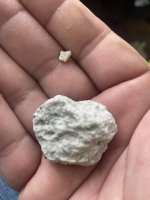
I am in the Midwest. The reason I put size “ clean 3/4 minus” is exactly because different terminology. Ohio DOT calls it #68’s. You do realize that a #8 screen is 0.097” or 2.6 mm. It’s not aglime fine that is washed away but it’s very small

Happened to be on a construction lot covered with them when I read your post. The little stones surely are not 3/4”?

IMG_1704.jpeg

And similar vernacular is even used by Ohio quarry’s

They use .375” and less plus clean. Synonyms of what I said?

IMG_1703.png
 

Firebrick43

Well-known member
Joined
May 12, 2015
Messages
14,014
Location
West central Indiana
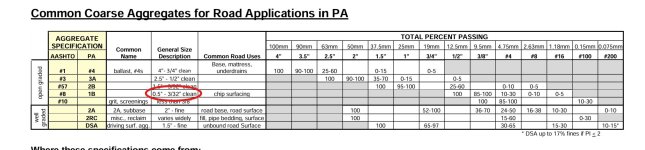
AASGTO is where most state and federal specifications come from. They dont use the term Minus, that is regional vernacular, and surprise, it differs between regions. But they do use " - " They use open graded as the term without fines, and well graded with fines and further specify that its "clean"

I am not paying for the AASTO spec book but here is a document from Pennsylvania to show that just as I displayed in the picture above, the terms are used together. Could I have used "3/32" to mean little tiny rocks in addition to "minus", sure, but its not a double negative.


Screenshot 2026-03-11 163745.jpg
 
To avoid these ads, REGISTER NOW!
Top Bottom