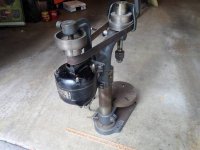
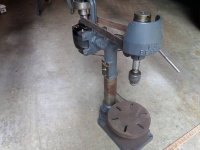
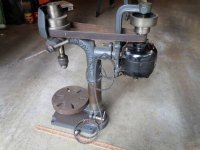
got any other old steel sitting on the "To Do" shelf that you would like to share since it is your thread?
There are a few more bits knocking about to be worked upon.

You must be a glutton for punishment regarding photo's of antique stuff.
I've worked **** ways round compared to how some would, with my collection, as in I've spent several years collecting pretty much what I wanted as and when the right thing came up, (patience is a definitely a virtue when collecting), then started working on restoring it once I classed my collection at a point where I was content with it, (I can look around my workshop now and know that I can quite happily manage with what I have. Anything I get from now on is merely a bonus), rather than getting pieces and getting them done as they came in.
This was one of the first things to be restored, due to the fact that it'll probably be needed for most of the machines at some point.
Small but useful.
This is the state it was in when I got it. Rusted solid, barring the handles.
This is the other Roundbed.
That one is the only one which is in completely original condition. It has a compound slide on it in the photo's which isn't OEM, but I have the original cross slide for it too. That one apparently belonged to a LNER engineer/designer, at some time in the past.
This is the first lathe I bought, and likely going to be the last to be restored.
It's a 1907/1908 pre-B Drummond.
There are more bits. I'll post photo's of those later. (Should probably haved named this thread "Matt's old tat thread"
).
Must admit, I do generally try to get ones which have treadles if possible, (preferably stands too), just in case. Even then though, the amount of adaptation, part appropriation and swapping etc. which has been introduced in the past can still lead to a setup which is somewhat less than original.
That's the beauty of them though, IMHO. Original is nice, but adaptation tells a story. I have a set of things I tend to look for, (the reverse gears bracket is one, where the Roundbeds are concerned), which usually rock my boat far more than condition. Even the shonkiest looking of machines can be restored. Getting hold of some of those erroneous parts can be hell though.
I like to purchase machines which have had either no restoration work done on them else/and just general tidy up work and adaptation during their life, but no more. I blatantly avoid anything which has been "lovingly restored", (seeing that sentence is usually enough to make one weep when you see the 'quality' of the work done), or anything which has been made to look like it may have just stepped out of the factory. I personally like things to look their age, and I prefer not having to chase down loads of user introduced problems by someone who thinks that emery paper, a hammer and a session with a paint brush and paint make things more desirable.
The Roundbed which started this thread is a prime example, (Frankenstein, as I've now named it, due to the amount of donor parts and bolted on bits
). That one is in no way original, has had a hard life and has been changed no end. It's all just things which have been changed during it's life to make it work and more functional though. There's no false modesty or anything else with it. That is a machine which has been used and repaired with a fair amount of time and dedication. That in itself is half it's appeal.


 )
)