To avoid these ads, REGISTER NOW!

Custom Modified Fender Washer

Wamsutta

Well-known member
Joined
Jan 8, 2014
Messages
10,870
Location
Amarillo, Texas
In the world of high-end professional string trimmers, there's a trick to adapt an Echo spool head onto a Stihl trimmer. All that's needed is a flat washer the correct thickness to go in between the Echo spool head and the Stihl thrust plate. The flat washer is needed to keep the Stihl thrust plate from rattling when mounting on an Echo spool head. The standard Stihl spool head has a recess to accept the raised area of the thrust plate, but the Echo does not.

Toro at one time by accident made the perfect washer for one of their mowers and is the perfect washer for this trick, but has since become almost impossible to find. The Toro washer is basically 3 inches O.D. x 1.0 inches I.D. with a thickness of 1.0mm. The I.D. being more critical than the O.D.

A standard fender washer is 3 inches O.D. x 5/8 inches I.D. and the thickness is way thicker than 1.0mm. So to make this customized flat washer, the I.D. would have to increased from 5/8 to 1.0 inch and the thickness would have to be shaved down to 1.0mm.

What would be the best way to increase the inside diameter and shave down the thickness? That's the question.


#19 = Toro Thrust Washer 94-8013
Toro 94-8013.gif

The flat washer would go over the top of the STIHL thrust plate shown below. You can see the 1.0 inch x 1.0mm raised section in the center.

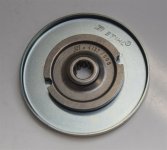
Thrust Plate 2.jpegThrust Plate 1.jpeg


THEMOWERMEDIC1 made a video about the trick:

 
Last edited:
To avoid these ads, REGISTER NOW!
OP
W

Wamsutta

Well-known member
Joined
Jan 8, 2014
Messages
10,870
Location
Amarillo, Texas
The GJ approved answer is 'buy a mill and a surface grinder', but I'd bet you could do it with a drill press and an angle grinder.
I thought about temporarily gluing the washer to a plate of steel and then taking a very large flat mill file to the washer.

I don't mean to brag but I'm damn good with a file.
 

Old tool guy

Well-known member
Joined
Apr 13, 2023
Messages
3,211
Shim stock?

I watched the video. What's the problem with the spinning washer? Does it affect transmitting power to the head?
 
Last edited:

nutjob

Well-known member
Joined
May 8, 2008
Messages
805
Location
NE, PA
3D print one.

Spacer.jpg

This part was created in the Bambu slicer, no CAD needed.

Kevin
 
Last edited:

rockbaron1

Well-known member
Joined
Nov 17, 2022
Messages
58
What about getting 0.040" (1 mm) shim stock.

Then use a piloted hole saw to cut the 3" exterior diameter. Then using the pilot hole, change the hole saw to 1" and create your interior hole.
This is pretty much what was going to say. Find a piece of metal already the right thickness and drill some holes. If the OD is less critical you could cut that out with an angle grinder and only drill the center hole.
 

OccupantRJ

Well-known member
Joined
May 15, 2009
Messages
11,005
Location
Eastern North Carolina
Easy way with less machinery is find a piece of material and center punch. Use a drawing compass to mark the 3” diameter. Drill center hole with a step bit. Then cut or grind the OD to shape by what means you have. Not sure how thick an electrical junction box lid is, but easy to acquire. One with a knockout would get you ahead a bit.
 
To avoid these ads, REGISTER NOW!

JerseyBoatBuilder

Well-known member
Joined
Mar 3, 2012
Messages
1,585
Location
Florida
Echo makes a trimmer head kit that adapts to Stihl trimmers with two different washer adapters, I accidentally bought it for my Echo trimmer.
Look up

GENUINE OEM ECHO SPEED FEED 400 UNIVERSAL TRIMMER HEAD KIT 99944200907​

Home Depot sells it
Sorry it might be the wrong type of trimmer but look up that kit maybe the adapters that are like you description can be used with that type of trimmer.

Echo adapter kit has pictures and measurements of the adapters
Also has a list on that page of what adapter fits which make and model trimmer.
 
Last edited:

seber

Well-known member
Joined
May 31, 2016
Messages
4,195
Location
Deep East Tx.
Machining .040 material with a drill or drill press is no simple task. But you can glue it down to a sacrificial base plate using double sided tape.
 

CJM8515

Well-known member
Joined
Mar 8, 2014
Messages
9,292
Location
NJ
2 mins with a bead of silicone should fix that if you dont wanna make a washer
 

Citation

Well-known member
Joined
Jan 20, 2016
Messages
3,212
Location
Indy
Get some 1mm stock, either laser cut it or photo etch the material.

Another option is to get a 1" chassis punch set and some 0.040" material. Center punch the material and scribe a 3" circle. Use a chassis punch to create the 1" hole. Hand cut/belt sand your OD to the scribed line.
 

jmarkwolf

Well-known member
Joined
Jan 15, 2013
Messages
1,812
Location
Southeast Michigan
It's been mentioned already but the slugs left over from hole-sawing make dandy fender washers. I save all mine and they come in handy.

The OP would likely have to address the ID diameter, but hole-sawing some of the appropriate material would accomplish what he needs.
 

OccupantRJ

Well-known member
Joined
May 15, 2009
Messages
11,005
Location
Eastern North Carolina
It's been mentioned already but the slugs left over from hole-sawing make dandy fender washers. I save all mine and they come in handy.

The OP would likely have to address the ID diameter, but hole-sawing some of the appropriate material would accomplish what he needs.
I save mine to reuse also, especially the thicker ones.
 

JradM

Well-known member
Joined
Sep 4, 2019
Messages
1,814
Location
Alberta
I think it was mentioned, but it would be easier to make from sheet stock that's already 1.0mm. You can buy a small stainless sheet on Amazon.

Then you could drill a hole in the center of a slightly oversized circle, put a screw through it and chuck it up in your drill press or drill, either grind or file it to final outside dimensions. Then you just enlarge the center hole to it's final dimension.
 

Citation

Well-known member
Joined
Jan 20, 2016
Messages
3,212
Location
Indy
I think it was mentioned, but it would be easier to make from sheet stock that's already 1.0mm. You can buy a small stainless sheet on Amazon.

Then you could drill a hole in the center of a slightly oversized circle, put a screw through it and chuck it up in your drill press or drill, either grind or file it to final outside dimensions. Then you just enlarge the center hole to it's final dimension.
As a variation on this idea. Get the 1mm stock, drill a hole with a step bit (Harbor Freight has them). You will probably need to screw the metal to a block of wood while drilling (don't hold the throwing star... er... metal). Then cut, grind, sand to final diameter.
 

whateg01

Well-known member
Joined
Mar 13, 2006
Messages
11,223
Location
doo dah, kansas, usa
I was thinking the same thing.

I'm curious; what tools/process do you use to center the part on the spindle axis?
Depends on the part and the degree is concentricity required. I'll mark and center punch the center and then use the live center in the ts to press the work to the mag chuck, then turn it on. Same with a superglue chuck.
 

darkzero

Well-known member
Joined
Oct 20, 2011
Messages
3,320
Location
SoCal
I'm curious; what tools/process do you use to center the part on the spindle axis?
I use a DI (dial indicator) or DTI (dial test indicator) depending on how big/small the part is along with a knocker (a copper slug in my case) to dial in the work piece. With my mag chuck, I can gradually adjust the strength of the magnetism. So I "turn on" the magnetism just enough to hold the part, dial it in, then apply full magnetism.

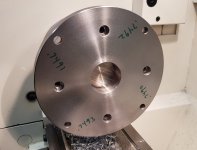
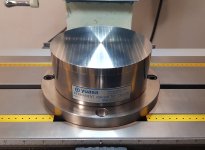
For this larger workpiece & because it had a center bore, I used a bull nose center to initially help hold it in place, then I dialed it in using an indicator. It's a chuck back plate.
20260114_163232.jpg

The reason I used the mag chuck was to remachine it so that both sides were parallel.... as much as I was capable of doing with what I have. Because parallelism is what I cared about, radial runout didn't really matter in this case but the 8" cast iron back plate had a bit of weight to it so I wanted minimize as much vibration as possible. Was also my first time holding something big on the mag chuck, I didn't know what to expect. Luckily no poo came out.

Before & After:
20260114_163412.jpg
20260114_163447.jpg

That backplate is actually a seconday backplate that I made for that round mag chuck. For use directly on my mill table or my rotary table. I have never needed to use it yet in the rare case but at least it's ready if I ever do.
20260114_163531.jpg
 
Last edited:
To avoid these ads, REGISTER NOW!
Top Bottom