To avoid these ads, REGISTER NOW!

Cutting threads on grade 5 stock

bluedog225

Well-known member
Joined
Jan 31, 2012
Messages
3,323
Location
Texas
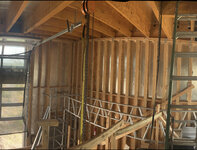
I’m building a little cabin. The walls are about 20’ high to a low-slope roof. In a moderate-risk tornado zone. 6’ overhangs on a couple of sides (for the Texas sun) so it will catch some wind.

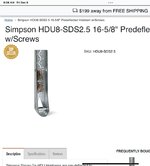
I’ve got some 7/8” simpson hdu’s in the concrete and I’d like to tie some of the 16” LVL rafters all the way down to the foundation with steel. The little hurricane ties aren’t going to cut it.

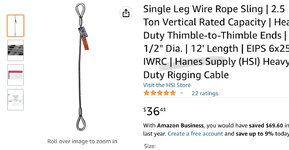
One way to skin this cat would be some steel cable with eyes on both ends, turnbuckles, eye nuts, and shackles. The components are all available and not that expensive. I’ve got one set on site to see how it works. But that’s a lot of parts.

Another way would be some grade 5, 5/8 steel rod from a simpson hdu at the top, down to the bottom. I can probably get 20’ threaded rod. But I was wondering if it was a better option to get 20’ smooth rod and tap threads into the end myself.

Before pricing the equipment and material, I wanted to check in and see if I’m being realistic. I’ve cut little stuff but nothing graded or large.

ThanksE1677C7F-6A71-4264-99FC-649351C8037A.jpeg
 
To avoid these ads, REGISTER NOW!

andyvh1959

Well-known member
Joined
Feb 15, 2020
Messages
2,598
Location
Green Bay WI
I get the idea of using cables between the slab and top plates. Cable I think is better than full threaded rod, solid rod with threaded ends would be my next best choice. Any system like this is only effective based on the weakest point in the system, like where the end connects through the top plate. The more you can spread out the stress point the better, like a flat bar or angle on the top plate between the trusses.
 
OP
B

bluedog225

Well-known member
Joined
Jan 31, 2012
Messages
3,323
Location
Texas
Thanks. I’ve got these simpson fittings at the bottom. They hold the studs/walls down. There’s enough threaded rod left over to use a coupling nut and put a similar (14”) at the top, on the rafter. That would secure the top plate.

edit-the biggest downside to the cable is that it requires a significantly larger hole in the plate.

48C62F7E-C5C5-4469-A234-04903F187F9C.jpeg
 

Zeke

Well-known member
Joined
Aug 13, 2009
Messages
17,176
Location
Long Beach CA, the sewer by the sea.
You could use the exposed threads with a coupler and a threaded eye bolt. Eye bolts tend to be very hard, so call them Grade 5 if not 8.

But it you use cables you need a way to tension them. I guess another eye bolt at the top with a long shank would do that job.

Around here you would simply run strapping on the exterior from bottom plate to top plate on the same stud that the hold downs are screwed to. I've had to connect floors with hold downs on each side of a floor with platform framing.

simpson-strong-tie-metal-straps-cs14-64_400.jpg

That building looks more like a fort than a cabin.
 
OP
B

bluedog225

Well-known member
Joined
Jan 31, 2012
Messages
3,323
Location
Texas
Man cave.

I ran some of that strapping diagonally under the ply but it didn’t occur to me to run it vertically.
 

Zeke

Well-known member
Joined
Aug 13, 2009
Messages
17,176
Location
Long Beach CA, the sewer by the sea.
In CA we have to run it vertically. Not necessarily all in one line, but a lot of it wherever there is a break in framing. Your building looks balloon framed. If so, I'd concentrate on the upper most parts where roof meets walls and the lower part where the building meets the foundation.

The plywood sheathed walls should take care of themselves. If you had a hurricane you might find your walls down the road some, but intact. Keeping it all in one piece is the goal. Here, the concern is earthquake. So we strap around corners and tie different planes of structure together along with any joints.

Straps are great and you can put a little tension on them if you start the nailing in the middle and try to place nails at the outer part of each hole as you go sort of stretching the strap.
 

mcbane

Well-known member
Joined
Jul 23, 2017
Messages
794
Location
California
The problem with cable is that it is way too stretchy vs the rest of the structure. Even if you preload the cable, it will stretch under a high load, allowing connections in the wood framing to be damaged. Stick with steel strapping or rod.
 
OP
B

bluedog225

Well-known member
Joined
Jan 31, 2012
Messages
3,323
Location
Texas
I had not thought of stretching. Darnit.

I wonder of something like this will stretch enough to matter? It would be a lot easier to work with.

edit-looks like not too much

E603FD87-203C-4257-BAB7-63930D959F05.jpeg

08AC349B-C818-4B1B-9352-10A7F8FAF85D.jpeg
 
Last edited:

PoorUB

Well-known member
Joined
Mar 29, 2021
Messages
11,729
Location
Fargo, ND
Another way would be some grade 5, 5/8 steel rod from a simpson hdu at the top, down to the bottom. I can probably get 20’ threaded rod. But I was wondering if it was a better option to get 20’ smooth rod and tap threads into the end myself.

Before pricing the equipment and material, I wanted to check in and see if I’m being realistic. I’ve cut little stuff but nothing graded or large.
You can cut threads in grade 5 with any decent HSS die, you can cut grade 8, but it is difficult. If you have a large number of rods to thread I would pay someone to do it unless you have a lathe you can rig up for power threading.

The machine shop I worked at we threaded rod once in a while. We had a die holder we built and could mount in the tools holder and slip the rod into the chuck, clamp it and run the lathe on a slower speed, lube it up and die cut the treads. Once in a we would cut long lengths and support the rod inside a piece of pipe and stands
 
Last edited:

Firebrick43

Well-known member
Joined
May 12, 2015
Messages
14,230
Location
West central Indiana
Where are you going to get this "grade 5" smooth rod??????

I don't think such a thing in any normal supply channels exist.

You would have to use something like 4140 rod which isn't to far off on tensile strength or up size mild steel rod.
 
To avoid these ads, REGISTER NOW!

cannuck

Well-known member
Joined
Nov 30, 2021
Messages
4,662
Location
Rural SK
bolts and threaded rod are not cut thread but rolled - retains more tensile strength in fastener. One thing I have done to make long tensile members is to weld Gr5 bolts into flat bar by sawing head off and cutting a groove in a end of piece of flat bar, welding the plain shank of the bolt up both sides of the grooves at ends. You can use cheap 1010-1020 hot rolled stock. Just remember to calculate flat bar strength from yield, not UTS.
 

Whitworth

Well-known member
Joined
Dec 26, 2011
Messages
2,100
I don't see why any of this is necessary. Properly installed sheathing should hold everything together.
Is this common construction practice (or a requirement) where you live, all the way to the foundation ?
Just use heavier angle iron to fasten the the rafters to the top plate, with lag screws (or if you want to go nuts, use through bolts, nuts and washers. )
 

Firebrick43

Well-known member
Joined
May 12, 2015
Messages
14,230
Location
West central Indiana
bolts and threaded rod are not cut thread but rolled - retains more tensile strength in fastener. One thing I have done to make long tensile members is to weld Gr5 bolts into flat bar by sawing head off and cutting a groove in a end of piece of flat bar, welding the plain shank of the bolt up both sides of the grooves at ends. You can use cheap 1010-1020 hot rolled stock. Just remember to calculate flat bar strength from yield, not UTS.
bolts are heat treated mid carbon steel. By welding you remove the temper they initially had, reducing their strength drastically.
 

andyvh1959

Well-known member
Joined
Feb 15, 2020
Messages
2,598
Location
Green Bay WI
It's more than just the sheathing. Yes, properly installed sheathing does much of the work, especially if its also bonded along with good fasteners. But the roof/trusses can still be torn off the top plate.
 

nadogail

Well-known member
Joined
Jan 23, 2009
Messages
32,061
Location
Coronado, CA
When I make carts I use 5/8" bolts for axles. After cutting the heads from the bolts, I weld them into the vee of the angle that I salvage from bed frames. The welds are well back from the ends of the angles. I use elastic stop nuts to keep the wheels on the axles.
 
OP
B

bluedog225

Well-known member
Joined
Jan 31, 2012
Messages
3,323
Location
Texas
I appreciate all the good ideas.

I’d like a good steel load path from the concrete to the 16’ rafters. We had an F5 in the immediate neighborhood. I don’t have real illusions about surviving a direct hit, but I’d like it to be…very….resistant to high winds. And it’s fun to do it right. The whole thing is sheathed in 3/4“ ply nailed at 4-6” centers with hot dipped ring-shank. Why stop now.
 

My Old Tools

Well-known member
Joined
Jun 4, 2014
Messages
5,450
Location
Hamrick Lake, TX
In college I worked for a company called Threaded Products. We made anchor bolts, J bolts, truss rods, etc for big buildings and such. We had 2 or 3 Landis threaders. They made short work of that type of threading, much faster and easier than a lathe or traditional dies. They were in Addison, TX back then. You should be able to find a similar operation near any major city.
 

cannuck

Well-known member
Joined
Nov 30, 2021
Messages
4,662
Location
Rural SK
bolts are heat treated mid carbon steel. By welding you remove the temper they initially had, reducing their strength drastically.
Yes that is true but grade 2 fasteners are hard to find and even fully annealed the gr5 stuff hasa value of strength that can be well more tan required
 
To avoid these ads, REGISTER NOW!
Top Bottom