To avoid these ads, REGISTER NOW!

Dating ATHA Bumping Hammer

Dirtbag

Member
Joined
Feb 4, 2024
Messages
11
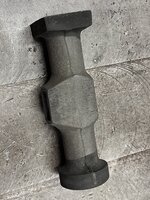
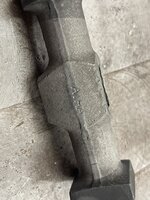
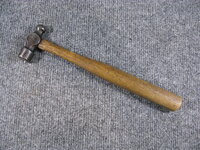
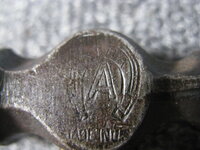
GJ Team, I’m hoping someone here might know how to identify when this hammer head was made. I bought a job lot of old and crusty vintage body hammers and discovered this beautiful specimen in the group. I’ve seen similar designs from many makers, some marked Bonney look very similar but I haven’t seen an ATHA one yet. I put it in some evaporust for a couple days. Looks like the darker ends are probably due to heat treatment and oil quenching based on the shape of the transition. Any hammer sleuths have more information about this one? Here are a few pictures.

IMG_4216.jpeg

IMG_4223.jpeg
IMG_4224.jpeg
IMG_4228.jpeg
IMG_4230.jpeg
 

Attachments

  • IMG_4225.jpeg
    IMG_4225.jpeg
    876.1 KB · Views: 2
To avoid these ads, REGISTER NOW!
OP
D

Dirtbag

Member
Joined
Feb 4, 2024
Messages
11
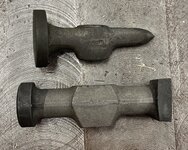
After reading up on evaporust the darker colored areas correspond to higher carbon content. The body of the ATHA head is much lighter colored. Here is the larger group in progress for comparison. The Snap On cross peen hammer is fully dark and has a date code to 1986. The ATHA appears to be old enough to have been forged out of a lower carbon steel and then case hardened and quenched. While even the old Fairmont hammers look more evenly dark like ‘86 Snap On. I suspect at one point most of the makers upgraded to a base alloy with more carbon. I tested the hammers with a harnesses file set. Feels like the ATHA might be a smidge harder than the Snap On face. Hard to tell, it’s a subjective thing scratching away and wondering. All of the hammer bodies in middle section near handle scratched easily with HRC 40 file. The ATHA subjectively felt softer compared to Snap On. The faces of all hammers felt like HRC 50 or 55 was leaving enough drag marks to call it. I suspect the interesting bent shape hammer is also quite old, no makers marks either. Looks sorta like the Fairmont shape a little, it’s forged but hard to know by who.

Also for some more trivia, that handle on left is cocobolo I think. It had a P&C 1427 cross peen mated to it. I think it is the original handle and has a well worn octagon shape, same shape as the hickory Proto 1428 below it. The heads are all going to get sanded up, polished faces, and mated to new handles. Maybe try to save the cocobolo one. I’ve seen that handle material advertised in old ATHA catalogs so it must have been less exotic around turn of the century.

IMG_4238.jpeg

IMG_4232.jpeg
IMG_4233.jpeg
IMG_4234.jpeg
 

d42jeep

Well-known member
Joined
Oct 22, 2014
Messages
16,515
Location
Northern California
I know very little about this subject. Atha was sold to Stanley in 1913. That doesn’t mean that your hammer was made before the purchase because Stanley continued the Atha name on hammers for many years although many were marked Stanley-Atha. The Atha name was discontinued after the end of WW2. IMG_9081.pngThe catalogs are few and far between.
-Don
 
Last edited:

RTM

Well-known member
Joined
May 13, 2019
Messages
13,103
Location
SF Bay Area
First Reference I can find for Atha tool is 1878 in The Commercial Agency Register for July, 1878 (unfortunately snippet view), In 1881 they show up with an address on Chapel street. Was hoping to find more, but work is getting in the way. Will edit this as I get more info.

Here is a wimpy little bit of history from elsewhere.
 
To avoid these ads, REGISTER NOW!

B Halverson

Well-known member
Joined
Sep 26, 2024
Messages
304
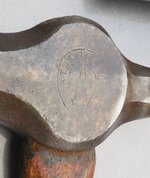
As with many steel tools made from wwii back to the civil war, they are usually marked "cast steel" or as being made of some special steel. After WWI as more modern steels came into use the "cast steel" was phased out quickly. I have a lot of ATHA marked hammers laying around here, but I think only one marked "cast steel" that I could guess was from before Stanley owned the name in 1913 and later. I would put money down that the others with the fashionable horseshoe stamp etc. were all from after WWI easily. Also before 1913 automobiles were very new and so was repairing them, and a lot of the common familiar automotive tools simply did not exist, such as all the special hammers and dollies that are laying all over used, being used in shops, and still available at any auto-parts store. My guess is that an ATHA hammer without the horseshoe stamp would be a later item, because as time wears on everything was made more cheaply to increase profits or to just stay in business at all against competition, and making stamping or forging dies to create elaborate and fancy marks on tools was an extra cost that could be dropped, and very many tool manufacturers did just that for less costly options.

ball peen women club b.jpg


atha hammer b.jpg
 
To avoid these ads, REGISTER NOW!
Top Bottom