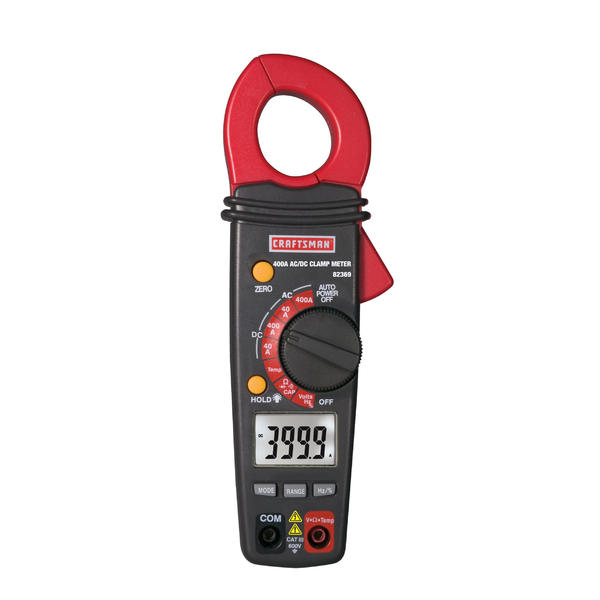
I have worked with a meter very similar looking to the Extech /Craftsman pictured above but from different brand I believe. (cant actually remember). If memory serves the DC Clamp is not useful at lower amps and in addition I found the milliamp readings in said meter to be shaky to say the least. Granted it's been thrown around a busy shop for several years. Grain of salt and all that..
Not sure what you want to measure or range. But I can share my experience with cheap amp-probes from AESwave since I have two of them.
I have the cheapest "generic brand" 40 (60?)Amp probe
http://www.aeswave.com/Current-Probe-Low-range-with-Banana-Plugs-p9501.html
You can plug this into your AVO meter and use the volt scale to measure the output from the probe and translate that to amps - very easy if you understand whats going on, but can be confusing....
I find this probe to be decent to measure great many things and it seems quite accurate if zeroed proplerly. However using it with Scope on running engines is bit difficult because it picks up plenty of noise and triggering can be troublesome. I made the mistake buying it with banana plugs instead of BNC connector. BNC would be better with scope.
I also have this 600A "generic brand" current probe:
http://www.aeswave.com/Current-Probe-High-range-Generic-brand-p8480.html
Same story you can plug this into your AVO or scope and measure the voltage output of the probe and translate it to amps. This one I actually like a lot. I have done several indirect compression tests with it with scope and I have also used it to trace down battery leakage. The big clamp can bite around big wire looms and give you an idea whats going on if you are tracing a leak. So you don't necessarily have to open the loom to figure out in what corner of the car/truck the troublemaker is hiding. It can very easily distinguish between zero current and 1-2 amps. Thats not bad for a cheap 600 amp probe!
Whatever you buy - it's always the same story when troubleshooting electric circuits - know the measuring device you are using, double check it back and forth until you are comfortable with it and confident in your measurements. I mention this because I have loaned some buddies these probes and the extra layer of complexity of not being able to read out the amps directly from the meter has puzzled few of them. Perhaps not the right tool for the job for a DIY guy stuck on the side of the road somewhere!?