To avoid these ads, REGISTER NOW!

Dc motor

Davenbuild

New member
Joined
Oct 11, 2023
Messages
2
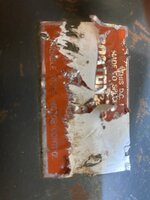
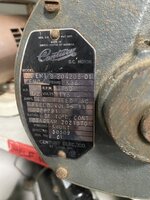
I was given this motor. I would like to use it but don't know how to power and control it. From what I can see it's a DC motor. The name plate says century DC motor model number DN D-EM I 9–204208–01. FHC. The name plate says it is shunt wound. There is another difficult to read label that says made to the specifications of Boston… Can't read the rest, at the bottom of that label it says, variable speed, motor control.

I tried powering it with a PWM controller that I have that works on a treadmill motor but got nothing.

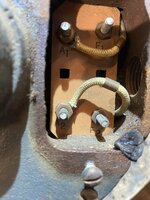
I took off the plate at the back and you can see that there are four terminals, A1, A2, F1 and F2. There are wires connected to A1 and A2.

If anyone can tell me how to wire this and control it, I would be very grateful. If I could use it as a variable speed motor then I would use it on my drill press or maybe a lathe. Even if I can't control the speed, it would be a useful motor for another project.

Any help would be appreciated. Thanks.

IMG_7560.jpeg


IMG_7560.jpegIMG_7565.jpegIMG_7564.jpeg
 
To avoid these ads, REGISTER NOW!

nadogail

Well-known member
Joined
Jan 23, 2009
Messages
31,906
Location
Coronado, CA
Minarik can provide you with all the information and supplies you need to to control the speed and direction o rotation for the motor.
 

GeoBruin

Well-known member
Joined
May 5, 2018
Messages
3,733
You have a DC shunt motor. It will make a great drill press motor. Before VFDs for AC motors we're all the rage, that would have been the bees knees.

I'm no electrical engineer so you can go read as much as you want about how DC motors work elsewhere (and be much better off!) but I can tell you that there are advantages and disadvantages to shunt wound motors vs series motors. If I remember correctly, series motor provide better starting torque, but shunt motors provide better speed regulation. Shunt motors are great for lathes for example because the motor maintains a constant speed as a load is applied, which maintains a more consistent spindle speed and yields a better surface finish.

The A and F on the motor represent the Armature and Field coils. The Field is typically the stationary winding to which current is applied. The Armature is the rotating part that responds to the electromagnet field created by the Field.

You need a DC motor controller to run the motor. KB controls offers good, affordable controllers. Depending on whether you want to run the motor on 120 or 240 power, you could look at the KBWM-120 or KBWM - 240.

Typically, I see dc motors rated at either 90 or 180 volts DC. Yours is rated at 115 volts. In that case, I would be affraid to run it on 180 volt DC output, So if you do opt for the KBWM-240, you'll want to run it in step down mode so it's still only outputting 90 volts DC.

I recommend dowoading and reading the manual for those models. You will see how to wire them and figure out what horsepower resistor to order along with the controller.

Good luck!
 
To avoid these ads, REGISTER NOW!
OP
D

Davenbuild

New member
Joined
Oct 11, 2023
Messages
2
The motor requires a field to function (f terminals). Most industrial DC motor drives have the option to provide a field voltage. Example attached.IMG_0176.jpeg
Thanks for replying- but, as I am a total idiot when it comes to anything electrical, I don't know what you mean. First of all, I need it confirmed that this is actually a DC motor, and then for someone to tell me what to buy and how to wire it in order to make it work.
 

Grant Gunderson

Well-known member
Joined
May 17, 2013
Messages
2,317
Location
Bellingham, WA
Thanks for replying- but, as I am a total idiot when it comes to anything electrical, I don't know what you mean. First of all, I need it confirmed that this is actually a DC motor, and then for someone to tell me what to buy and how to wire it in order to make it work.
It is most defiantly a DC motor. As stated above you need both Field and Armature DC current to run it. DC controllers can be quite expensive! So often getting a used 3 Phase AC motor and a VFD is a way cheaper option. However a DC motor provides way more power than a similarly rated AC motor.

Obviously you cant just connect AC power to it. Also, DC current is something to be very careful of. It's way more DEADLY than AC and always needs higher specd wiring then the same AC voltage would requite.

You will need to connect leads for the Armature to both the A1 and A2 terminals from the DC controller armature outputs.. And then connect the Field windings to the Filed outputs on the DC controller.
IMG_3538.jpeg
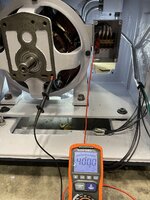
Before ordering a DC controller. I would strongly recommend testing the motor. You can often rent a Megger or buy a Klein Megger reasonably to test the Field windings.

IMG_3558.jpeg
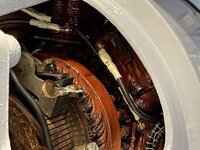
The armature windings are harder to test, as there is a commutator that transfers power to them since it rotates in the motor.
IMG_3618.jpeg
But it can be done.
IMG_3609.jpeg
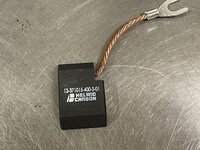
At the very least with an old DC motor, I would inspect the carbon brushes and replace them if worn.
IMG_3607.jpeg

A commutator stone can be sued to clean up the commutator and improve performance.
 

Maui

Well-known member
Joined
Sep 16, 2012
Messages
2,863
Location
Upstate NY
If you really are clueless about wiring up a DC motor then I would recommend having a professional do it for you. It is not something to screw around with because it can be very dangerous. A small mistake can cost you your life.
 
To avoid these ads, REGISTER NOW!
Top Bottom