To avoid these ads, REGISTER NOW!

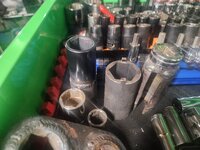
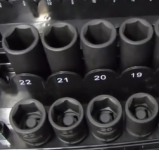
Deep Socket Broach Depth

neophyte

Well-known member
Joined
Apr 23, 2012
Messages
9,576
Location
Pennsylvannia
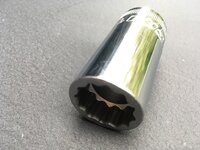
Some sockets have a mid-length broach, like this one, which was beautifully machined by the way:
54645133699_7a04e7daa9_b.jpg

That extra depth plus the twelve point worked for security lug nut removal:
54645145158_0f2bdecb6a_z.jpg

Of course it destroyed the socket, but not to worry. A little amputation and its good to go again as a semi-deep shallow broached socket.
:beer:
54645224685_1cc6fce0b5_b.jpg
Most sockets don’t gave “Machined” internals nowadays.
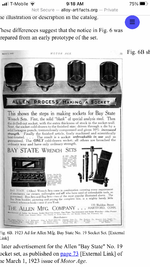
The common manufacturing method, is cold forging the socket around a die, a process that was originally Patented by Allen Manufacturing, whom originally used the process for their “safety” internal hex head screws, before it was realized the process could be used for sockets, in the 1920s.
The outside of the sockets may be machined, for instance in the case of Snap-On, and the internal square drive requires machining for the ball indent, and maybe sometimes the square drive.
There may be some exceptions to this for low production sockets, and there is the occasional manufacturer that used a cutting broach like Wiha does, or at least did on older nut drivers, and there are possibly still dome manufacturers that hot forge their sockets, but these are in the severe minority.
 
To avoid these ads, REGISTER NOW!

KnurledNut

Well-known member
Joined
Jan 28, 2011
Messages
8,104
Location
n/a
Most sockets don’t gave “Machined” internals nowadays.
The common manufacturing method, is cold forging the socket around a die, a process that was originally Patented by Allen Manufacturing, whom originally used the process for their “safety” internal hex head screws, before it was realized the process could be used for sockets, in the 1920s.
The outside of the sockets may be machined, for instance in the case of Snap-On, and the internal square drive requires machining for the ball indent, and maybe sometimes the square drive.
There may be some exceptions to this for low production sockets, and there is the occasional manufacturer that used a cutting broach like Wiha does, or at least did on older nut drivers, and there are possibly still dome manufacturers that hot forge their sockets, but these are in the severe minority.
Cold forging is a machine process.
Another simple term that has lost much of its original meaning.
 

neophyte

Well-known member
Joined
Apr 23, 2012
Messages
9,576
Location
Pennsylvannia
Cold forging is a machine process.
Another simple term that has lost much of its original meaning.
It may be a “Machine” process, but usually “Machining” is used to refer to a “cutting” process, that removes metal, where “Cold Forging” involves “Squishing” the metal into shape between dies.
As long as the dies are cleanly and smoothly made, and kept clean, the internal form of the sockets should be an almost mirror image of the die surface.
 

KnurledNut

Well-known member
Joined
Jan 28, 2011
Messages
8,104
Location
n/a
It may be a “Machine” process, but usually “Machining” is used to refer to a “cutting” process, that removes metal, where “Cold Forging” involves “Squishing” the metal into shape between dies.
As long as the dies are cleanly and smoothly made, and kept clean, the internal form of the sockets should be an almost mirror image of the die surface.
Is a derailed thread forged or machined?
Call it forging. I'll call it machining and we will both be happy.
 

AEAdam

Well-known member
Joined
May 27, 2023
Messages
2,734
Location
SE PA
May have missed a post. Does Snap On offer fully broached deep sockets? If not, why not?

Edit: I personally see VERY little use for deep sockets. I use them more as extensions than for protruding threads. Off the top of my head, battery clamps, electrical connectors on starters etc are the typical places I reach for deeps.

Honestly, I don’t typically torque either of these scenarios so a wrench suffices. Wrenches just don’t always fit the battery hold downs I’m thinking of. Currently maintaining 3 cars, a lawn mower and a bobcat and none of them have battery hold downs that require deep sockets.

Question #3: For those of you who answered one way or the other, would your answer change had we asked specifically about impacts? My comments above are regarding chrome. I use deep impacts almost exclusively. And I personally prefer fully broached impact sockets, but my mind is open. Interested to hear your thoughts.
 
Last edited:

AEAdam

Well-known member
Joined
May 27, 2023
Messages
2,734
Location
SE PA
It may be a “Machine” process, but usually “Machining” is used to refer to a “cutting” process, that removes metal, where “Cold Forging” involves “Squishing” the metal into shape between dies.
As long as the dies are cleanly and smoothly made, and kept clean, the internal form of the sockets should be an almost mirror image of the die surface.
I’m with @neophyte. Forging is forging, used both to shape as well as alter grain direction or material properties. Broaching, which looks like forging, is cutting. You forge with something like a power hammer or a press. You broach with something like a mill. Broaches cut.

In the videos of the snap on socket plant, it isn’t crystal clear to me (from memory) if the process that creates the recess is forging or broaching. But I think @neophyte is correct, it’s cold forging.

Is a derailed thread forged or machined?
Call it forging. I'll call it machining and we will both be happy.
Also agree this is off topic. But it’s information that most people reading would not have known or thought about. The manufacturing tolerances inside a socket are really too tight for conventional machining operations. And the shape is really quite complex. It sure as heck isn’t a simple hex.

For years people on GJ have discussed sockets with the attitude that they are simple objects, easily made in any metal working factory worldwide. Through numerous threads I hope all members now have come to appreciate the complexity of these seemingly simple items. We’ve seen details of exquisitely made sockets, and arrogant attempts that resulted in failed businesses. I’ve certainly learned a lot in the process.

Sorry for the digression
 

WWheeler

Well-known member
Joined
Jun 23, 2015
Messages
4,105
Location
Middleofnowhere USA
I much prefer a deep broach because it is good for backing a nut/bolt off when I don't have room for the ratchet to have to move with it, and as I pointed out in my previous post, the ratchet moving up can get your ratchet/socket stuck in a bad situation, especially on a pneumatic or battery tool where that ******* can happen in an instant with the pull of a trigger. Likewise, in that same instance where you could get the tool stuck backing off, there isn't room to start installing the fastener either with the same tool with a shallow broach. A deep broach just slides over the fastener where you don't need that extra room the shallow broach does.

I get that some like that a shallow broach can be good for starting nuts on upside down studs or ones you can't easily reach to start with your fingers, but I almost never would use a socket to start a fastener. I thread them at least a turn by hand first. In those uncommon instances where I can't reach a faster with my fingers to start it, whether I need to use a deep or shallow socket or whether the deep is full or partially broached doesn't even factor into the situation to me. I rip off a small piece of shop towel and push it into the socket with the fastener to hold it in place.

Working in tight spaces it's nice to have options, but I'm hard pressed to understand any instance where I'd actually prefer a shallow broached deep socket.
 

neophyte

Well-known member
Joined
Apr 23, 2012
Messages
9,576
Location
Pennsylvannia
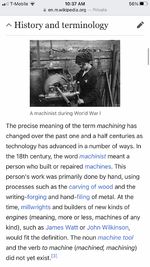
According to Wikipedia, referring to people who fabricated items, including the use of gorging techniques, as “machinists”, was a nomenclature used back in the 18th century.
Nowadays, the term “machinist” and “machining”, usually refer to subtractive manufacturing, usually using cutting tools, although “additive manufacturing” such as 3D printing, is also sometimes referred to as “machining” nowadays.

Incidentally, this is an old photo showing how a socket was “cold forged” that I copied from Alloy Artifacts.
 

Attachments

  • IMG_0272.png
    IMG_0272.png
    1 MB · Views: 23
  • IMG_0271.png
    IMG_0271.png
    1.8 MB · Views: 21
  • IMG_0269.png
    IMG_0269.png
    2.2 MB · Views: 29

Professor Gascan

Well-known member
Joined
Dec 26, 2024
Messages
178
Only a diy'er here but I can't think of a situation where it mattered how deep the broaching was on any socket, and I always start fasteners by hand to avoid cross threading. I guess having tiny carny hands is an advantage.
 

whateg01

Well-known member
Joined
Mar 13, 2006
Messages
11,214
Location
doo dah, kansas, usa
Only a diy'er here but I can't think of a situation where it mattered how deep the broaching was on any socket, and I always start fasteners by hand to avoid cross threading. I guess having tiny carny hands is an advantage.
I start fasteners by hand too, but it's still sometimes easier to get ahold of them in a socket. Just like spark plugs, I start those by hand too but my hand won't fit in the little hole in the valve cover.
 

DAWrench

Well-known member
Joined
Jan 7, 2023
Messages
160
Location
Central AR
To me starting a nut or bolt in a tight spot using an extension and socket vs fingers doesn't really increase chances of cross threading. I can tell if it is threading on right before you start tightening it with ratchet
 

T444e

Well-known member
Joined
Feb 25, 2016
Messages
448
Couldn't this be remedied with a longer extension on a shallow socket? Or are you talking about a situation where the stud doesn't have any thread at the top and takes more than the length of the shallow socket to reach the threaded portion?
I'm referring instances where I needed the socket to start the nut as i could not get my hand to the stud. The stud being too tall to tighten with a standard socket but not long enough to catch the nut when in a full broach deep socket. These have been in orientations other than vertical down installation. I'm sure I could have used a standard socket to start and then switch to a deep, but why? I'm sure a few of the instances have been on a vehicle when contorting my arm to get access and sure don't want to swap sockets to finish the install.
 
OP
M

micromind

Well-known member
Joined
Sep 24, 2023
Messages
3,019
Location
Fernley, Nevada, about 30 miles east of Reno.
I've found that I need a full broach more than a shallow one.

If I need to start a nut and cannot use a full broach to do so, I will either stuff something in the full broach socket or start the nut with a shallow socket then finish with the full broach.

In the end though, it's a mater of personal preference based on what type of wrenching you do.
 

lbhsbz

Well-known member
Joined
Jan 13, 2010
Messages
1,172
Location
Long Beach CA
I much prefer a shallow broach. Makes starting fasteners in hard to reach places much easier. I keep a couple sets of cheaper deep broach on hand for when the job requires it, but I rarely touch them.

I almost exclusively use semi-deep sockets. Since I don't have a Snap-On dealer anymore, I've been buying some ICONs....they work great so far, shallow broach, cheap, and I can read the stampings.
 
To avoid these ads, REGISTER NOW!

AEAdam

Well-known member
Joined
May 27, 2023
Messages
2,734
Location
SE PA
I've found that I need a full broach more than a shallow one.

If I need to start a nut and cannot use a full broach to do so, I will either stuff something in the full broach socket or start the nut with a shallow socket then finish with the full broach.

Boiling this thread down to personal preference feels a little sub GJ standard.

Here's my input: When you apply torque to a socket or extension, the torque you apply is the torque reacted by the fastener. The torque is conserved. But our tools are not infinitely rigid. If the torque you apply twists a spring before transferring that torque, you have to exert that energy used by the spring and really not transferred to the fastener.

Fundamentally, Snap On has focused on producing very stiff tools. Whether we learn this from anecdotal stories or side by side tests showing the HF breaker bar deflecting much more under a given load, or the hardness testing, showing Snap On near or at the top of hardness. I personally like hard tools, especially pry bars and extensions.

Snap On currently does not offer (to my knowledge) full depth deep sockets. They make them only as specials for O2 sockets etc. Even my Snap On spark plug socket isn't the same as a full depth socket. What we can know about their choice is that the shallow depth deep sockets will be stiffer and also stronger.

With all such discussions, we have to add; "Is whatever added strength necessary? Significant enough for us to pay the difference?"

My guess is, Snap On doesn't make full depth deeps because they aren't as strong as shallow depth deeps.
 
Last edited:

Pexto

Well-known member
Joined
May 5, 2018
Messages
638
Fundamentally, Snap On has focused on producing very stiff tools. Whether we learn this from anecdotal stories or side by side tests showing the HF breaker bar deflecting much more under a given load, or the hardness testing, showing Snap On near or at the top of hardness. I personally like hard tools, especially pry bars and extensions.
I seem to recall that you're an engineer. Isn't it true that hardness has essentially zero relationship with stiffness for any steel tool?
 

AEAdam

Well-known member
Joined
May 27, 2023
Messages
2,734
Location
SE PA
I seem to recall that you're an engineer. Isn't it true that hardness has essentially zero relationship with stiffness for any steel tool?
Yes, that’s right.

You can get more strength out of steels with higher hardnesses (Example, lower temper temperatures). Snap on seems to engineer the shapes of their tools to reduce stress concentrations and preserve moment of inertia, which makes their tools stiff.

Just saying, I think their choice to not make full depth recesses is about preserving wall thickness which makes the resulting shallow broached sockets both stiffer and stronger.

Sorry I bungled my earlier post
 

Typhon

Active member
Joined
Sep 23, 2021
Messages
41
Location
Taiwan
Could anyone point me toward the right Keywords to search for products with this specific design?
Also, if anyone knows of specific 6-point 3/8" or 1/2" drive model numbers that feature a deep broach,
I would greatly appreciate any recommendations.
 
Last edited:

T45

Well-known member
Joined
Nov 20, 2014
Messages
3,250
Could anyone point me toward the right Keywords to search for products with this specific design?
Also, if anyone knows of specific 6-point 3/8" or 1/2" drive model numbers that feature a deep broach,
I would greatly appreciate any recommendations.
Quinns are below (not mine, just screen grabs)
 

Attachments

  • 1770234840286.png
    1770234840286.png
    197.1 KB · Views: 15
  • 1770234018487.png
    1770234018487.png
    338.6 KB · Views: 15

Hohn

Well-known member
Joined
Aug 25, 2016
Messages
2,638
Location
Diesel Central, Indiana
Yes, that’s right.

You can get more strength out of steels with higher hardnesses (Example, lower temper temperatures). Snap on seems to engineer the shapes of their tools to reduce stress concentrations and preserve moment of inertia, which makes their tools stiff.

Just saying, I think their choice to not make full depth recesses is about preserving wall thickness which makes the resulting shallow broached sockets both stiffer and stronger.

Sorry I bungled my earlier post
I don't think there's much engineering "aha! We'll make it stiffer!" behind it at all. I think they just figured out the displacing less metal (via forging) or removing less metal (via broaching) takes less time and makes the tools easier to quickly produce with their expected quality standards.

I have no doubt that Snap-on certainly accounts for stiffness in things like breaker bar and ratchet handles and similar such tools. But in a socket? I'm quite skeptical of that. I can't see how that desire for stiffness would be squared against their proud claim of having some of the thinnest walls for maximum accessibility. If you want a stiff socket, isn't the obvious answer to just use thick walls? Which means the obvious thing is to just use an impact socket?

Because they are so short, Nano sockets are some of the stiffest you will ever find. If only we had impacts with 17mm female hex chucks.

Very few drive tools have left my complaining about a lack of stiffness. Like my XL capri 90t in 3/8. Way too thin of a handle with any real torque on it. A couple spindly Craftsman extensions also elicit that same complaint.

But it almost every case, the solution for stiffness shortcomings is using a shorter handle, shorter extension, or similar. Or, quite often, just step up from 3/8 to 1/2 drive to do the same work, as the only time you're going to really have such high torque is in a fastener large enough that it's typically covered by the next larger drive size.
 

Hohn

Well-known member
Joined
Aug 25, 2016
Messages
2,638
Location
Diesel Central, Indiana
Shallow broach hits harder with an impact gun as it’s heavier vs full broach. At least with a stout air impact gun.
The moment of inertia difference is almost nil because the extra material is too close to the axis of rotation to make much difference at all.
If you want a harder hitting socket, going shorter is the key, not going shallower broach on a deep socket.
 

Mr Ratchet

Well-known member
Joined
Mar 3, 2011
Messages
928
Location
Michigan
Would prefer all my deep sockets to be fully broached. RoninB4's pointed out how to make a fully broach act like a shallow broach. I've doubled up on O rings as well as tubing in the past. No way to go the other way if need be. I also have pass through sets. Using a short extension gives the same results as a shallow broach deep wall.
 

T45

Well-known member
Joined
Nov 20, 2014
Messages
3,250
I have no doubt that Snap-on certainly accounts for stiffness in things like breaker bar and ratchet handles and similar such tools. But in a socket? I'm quite skeptical of that.
Apex and snap on make entire lines of sockets for power tools that are not impact rated.

see, eg Apex surface drive, and Snap-on "power" market sockets (eg, surface drive, their magnetic and certain bit sockets, etc). They look like impacts with black oxide/industrial finish, but they are heat treated like hand-tools.

see, eg

fine print in the listings, eg
 

Hohn

Well-known member
Joined
Aug 25, 2016
Messages
2,638
Location
Diesel Central, Indiana
Most sockets don’t gave “Machined” internals nowadays.
The common manufacturing method, is cold forging the socket around a die, a process that was originally Patented by Allen Manufacturing, whom originally used the process for their “safety” internal hex head screws, before it was realized the process could be used for sockets, in the 1920s.
The outside of the sockets may be machined, for instance in the case of Snap-On, and the internal square drive requires machining for the ball indent, and maybe sometimes the square drive.
There may be some exceptions to this for low production sockets, and there is the occasional manufacturer that used a cutting broach like Wiha does, or at least did on older nut drivers, and there are possibly still dome manufacturers that hot forge their sockets, but these are in the severe minority.
The colder the forge, the finer the resulting microstructure and the superior the metallurgy will generally be.
If you think about how the properties of basic carbon steel change as it goes from being thick steel to thin music wire, it sort of makes sense. Music wire is nothing specially in terms of chemical composition (ASTM A228 is representative- it's over 98% iron).

But yet the high reduction ratio of the wire drawing process gives an alloy that can be up to 3x stronger than a grade 8 steel bolt in terms of yield strength. And the wire still has 5% elongation (ductility) at nearly 60 HRC.

And it does this without any exotic heat treating at all, just repeated cold drawing that refines the microstructure to have incredibly fine grain.
 

T45

Well-known member
Joined
Nov 20, 2014
Messages
3,250
If you want a harder hitting socket, going shorter is the key, not going shallower broach on a deep socket.
This would be a good "torque test channel" episode.


Attachments

  • 1770305877229.png
    1770305877229.png
    311 KB · Views: 3
  • 1770307526813.png
    1770307526813.png
    804.4 KB · Views: 2
  • 1770307601781.png
    1770307601781.png
    486.7 KB · Views: 2
  • 1770307797985.png
    1770307797985.png
    2.2 MB · Views: 3

mikey03

Well-known member
Joined
May 17, 2024
Messages
2,058
I thought I saw an old thread on here that I can’t find again but someone did a real GJ thing and made a graph of every socket brand and how much broaching it had. Honestly I’m addicted to tools and now I kinda want to see who makes the full broaching and keep an eye out for a deal on the set
 

AEAdam

Well-known member
Joined
May 27, 2023
Messages
2,734
Location
SE PA
I thought I saw an old thread on here that I can’t find again but someone did a real GJ thing and made a graph of every socket brand and how much broaching it had. Honestly I’m addicted to tools and now I kinda want to see who makes the full broaching and keep an eye out for a deal on the set
Question: why? It’s not really helpful.
Answer: Craftsman sockets. Look for the old danahers on eBay. I have them and they are not great
 

T45

Well-known member
Joined
Nov 20, 2014
Messages
3,250
I thought I saw an old thread on here that I can’t find again but someone did a real GJ thing and made a graph of every socket brand and how much broaching it had. Honestly I’m addicted to tools and now I kinda want to see who makes the full broaching and keep an eye out for a deal on the set
I have both...they are good to have. Especially with the 1/4 drive stuff, I like having both deep broach and shallow broach.

IMHO if "specific" design decision is the determining factor in usage, there are times when (suprisingly) they are a better tool than something ostensivly higher quality that has a different design.

I have 1/4 in chromes and 3/8" impact sockets are deep broached, in addition to other options with shallow broach. I don't feel the need to sell/junk the deep broached sockets, because they have a use case that justifies their shelf-space/box organization costs.
 
To avoid these ads, REGISTER NOW!
Top Bottom