Flatblackratrod
Member
- Joined
- Aug 8, 2022
- Messages
- 9
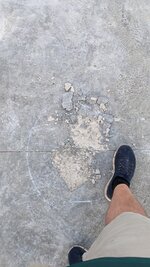
Hello folks first post and it is an unfortunate topic. I recently started my build after lurking on these forums for quite some time. You can read the long story below but the short story is my new pour immediately started to delaminate and I am looking for the best option moving forward.
-contracor immediately wanted to tearout the bad portion of the slab (approx 3/4 of it) cut it away from the footings tearoint and repour but is going back and forth with the redimix company to try to get them to cover materials for the repour. Contractor is willing to eat the labor. My biggest concern here is I feel having several different pours gives me opportunity for things to heave and move around separate from one another. This is a 5" thick slab that was poured monolithic style with 42" deep footings. The contractor says he will drill and epoxy the rebar into the footings and the portion of the slab he leaves.
-As a secondary option the contractor suggested grinding and polishing as the concrete is structurally sound under the finish. I really liked that option but he has since back pedaled and no longer feels comfortable offering that as an option.
-epoxy is pretty far out of the budget right now but it was also suggested as a fix. It is something I thought about for a future option but with the prices I have gotten it would need to be a diy option
-grinding and a self leveling topper was suggested as an option but material cost and labor would likely be entirely up to me I was quoted 2500ish in just topping materials not including grinding.
Full slightly more detailed story below:
I had my slab poured "monolithic" with footings 42" below grade to reach frost depth for my 36'x40' garage. Everything went seemingly well untill the finish. My concrete contractor poured on a Friday night and finished up late and said he would be back out first thing Saturday to cut my relief cuts. No problem... everything looked great on Friday night. Saturday rolls around and he follows through on his end of things shows up and cuts his relief lines and takes off for the day. A few hours later I went out and started blowing off the dust from the pad with my leaf blower and had literal chunks of the top layer coming off with the dust. You can imagine my feeling at that moment. There has been a lot of back and forth the last week or so between the contractor and I but no definite decisions made. It is unfortunately starting to eat into other timelines for other aspects of the build. I thought I would turn to you folks for opinions.
-contracor immediately wanted to tearout the bad portion of the slab (approx 3/4 of it) cut it away from the footings tearoint and repour but is going back and forth with the redimix company to try to get them to cover materials for the repour. Contractor is willing to eat the labor. My biggest concern here is I feel having several different pours gives me opportunity for things to heave and move around separate from one another. This is a 5" thick slab that was poured monolithic style with 42" deep footings. The contractor says he will drill and epoxy the rebar into the footings and the portion of the slab he leaves.
-As a secondary option the contractor suggested grinding and polishing as the concrete is structurally sound under the finish. I really liked that option but he has since back pedaled and no longer feels comfortable offering that as an option.
-epoxy is pretty far out of the budget right now but it was also suggested as a fix. It is something I thought about for a future option but with the prices I have gotten it would need to be a diy option
-grinding and a self leveling topper was suggested as an option but material cost and labor would likely be entirely up to me I was quoted 2500ish in just topping materials not including grinding.
Full slightly more detailed story below:
I had my slab poured "monolithic" with footings 42" below grade to reach frost depth for my 36'x40' garage. Everything went seemingly well untill the finish. My concrete contractor poured on a Friday night and finished up late and said he would be back out first thing Saturday to cut my relief cuts. No problem... everything looked great on Friday night. Saturday rolls around and he follows through on his end of things shows up and cuts his relief lines and takes off for the day. A few hours later I went out and started blowing off the dust from the pad with my leaf blower and had literal chunks of the top layer coming off with the dust. You can imagine my feeling at that moment. There has been a lot of back and forth the last week or so between the contractor and I but no definite decisions made. It is unfortunately starting to eat into other timelines for other aspects of the build. I thought I would turn to you folks for opinions.