To avoid these ads, REGISTER NOW!

Delta Rockwell 12" disc sander motor wiring help

Cleave

Well-known member
Joined
Jul 11, 2018
Messages
360
Location
Back Porch
Hi guys!
I just got this Rockwell Delta 12" disc sander for $21 at an auction.
Now, not sure what power it needs as there's no motor info plate on this one.
The start capacitor says 115V.
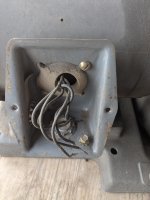
There's 6 wires sticking out into the box. There were two loose wire nuts in there.
Three wires were twisted together. These are labeled T2, T3, T5.
The wires that I guess were also twisted together are labeled T1, T4, T8.
I've skimmed through this excellent post here, https://www.garagejournal.com/forum/threads/1947-delta-12-disc-sander-restoration.556219/
But his motor had 4 wires with color coding.
Any ideas what this thing needs to power it up?

Note the sticker on top of the disc guard "Thumbslayer."
 

Attachments

  • PXL_20260812_194641510.jpg
    PXL_20260812_194641510.jpg
    816.6 KB · Views: 19
  • PXL_20260812_194651253.MP.jpg
    PXL_20260812_194651253.MP.jpg
    864 KB · Views: 18
  • PXL_20260812_194709136.jpg
    PXL_20260812_194709136.jpg
    573.3 KB · Views: 18
  • PXL_20260812_194830728.jpg
    PXL_20260812_194830728.jpg
    635.8 KB · Views: 21
To avoid these ads, REGISTER NOW!

Whitworth

Well-known member
Joined
Dec 26, 2011
Messages
2,110
Often. As I recall. T5 and T8 are interchangeable, for clockwise and counterclockwise motor operation.

As this is a single phase motor, the two bundles probably connect to the 2 lines (from the power cord).

You should also use a 3 prong cord and connect the ground wire to the case of the motor for safety.

You also need a housing or a strap for the capacitor.

Without a wiring diagram it's guesswork to an extent, proceed cautiously.
 

Cruzan80

Well-known member
Joined
Jul 22, 2015
Messages
4,439
Location
Denver, CO
Yes, it is set up for 120V. T1/2 and T3/4 are the run windings, and T5/8 is the start winding. So one set gets the hot and the other neutral. If it spins backwards, try swapping T5/T8.

For 240V, it would be T1-L1, T4-L2 and T2-3 together. IIRC, T8 gets tied with 2/3 and T5 goes on one hot (but tired now and need to confirm).

Either configuration, the start winding and capacitor only sees 120V.
 
OP
C

Cleave

Well-known member
Joined
Jul 11, 2018
Messages
360
Location
Back Porch
Ok, so hook up a cord carefully, plug into power strip and see what happens?
I see these things hooked up to complicated looking switch boxes and thermal overload protection - what's really necessary on this thing once I get it spinning at all?
The start capacitor has a cover, just wasn't visible in the picture.
 

Cruzan80

Well-known member
Joined
Jul 22, 2015
Messages
4,439
Location
Denver, CO
Minimum is a way to disconnect the motor when needed. A light switch is not motor rated, but there are switches that "look" like a light switch that are rated for more power.

There should be some way to "protect" the motor from thermal overload. This could be a red Klixon button on the motor, or a motor starter with heaters. A magnetic starter/contactor also protects against the motor starting again in the event of a power loss and resume.

Some options are also helpful for mounting the stop/start switch in a convenient place compared with the rest of the large box
 
Last edited:

Davefr

Well-known member
Joined
Jan 7, 2010
Messages
11,898
Location
OR
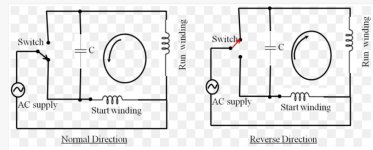
Without a wiring diagram it's guesswork to an extent, proceed cautiously.
Not really guesswork but with an ohmeter you can usually figure it out. Almost all capacitor start motors share this basic wiring diagram. Just trace where every lead goes and wire it up. (start winding ohms is > run winding ohms).
motor wiring.jpg
 
OP
C

Cleave

Well-known member
Joined
Jul 11, 2018
Messages
360
Location
Back Porch
We have signs of life at 110V!

Had continuity across T1/T2, and across T3/T4. But across T5/T8 there was only continuity one direction (swapping meter leads) - maybe this is expected.

Wired it up with T2, T3, and T8 to black and T1, T4, T5 to white.
Spun backwards and tripped the 15A breaker. (used a power strip and GFCI outlet).

Swapped T5/T8. Spun backwards and tripped the breaker again.

Got a fat extension cord and moved to a 20A breaker, unplugging the freezers first.
Also swapped which bundles the hot and neutral wires go to.
Now it spins forwards for maybe 30 seconds, but still trips the breaker. Motor never sounded super healthy, like something in there isn't quite happy and maybe doesn't come up to full rpm. Bearings are smooth and spins down slowly. No scary vibrations.

Any tips where to go from here? I've take a couple old motors apart but wasn't trying to put them back together with understanding!

Any idea what amperage or horsepower we're dealing with here?

Thanks guys!
 

Cruzan80

Well-known member
Joined
Jul 22, 2015
Messages
4,439
Location
Denver, CO
So you should have continuity between T5/T8. You said it spun backwards, both ways (swapping hots)? Did it sound like it ever got up to speed? Wondering if the capacitor is dead or the cent switch isn't set up right.

Current idea: The run winding pulled too much trying to start without help, and popped the breaker.

Disconnect the capacitor and see if T5/T8 each have continuity to one lead from there. That may help to tell if it is the cent. switch, start winding or capacitor.
 

Davefr

Well-known member
Joined
Jan 7, 2010
Messages
11,898
Location
OR
We have signs of life at 110V!

Had continuity across T1/T2, and across T3/T4. But across T5/T8 there was only continuity one direction (swapping meter leads) - maybe this is expected.

Wired it up with T2, T3, and T8 to black and T1, T4, T5 to white.
Spun backwards and tripped the 15A breaker. (used a power strip and GFCI outlet).

Swapped T5/T8. Spun backwards and tripped the breaker again.

Got a fat extension cord and moved to a 20A breaker, unplugging the freezers first.
Also swapped which bundles the hot and neutral wires go to.
Now it spins forwards for maybe 30 seconds, but still trips the breaker. Motor never sounded super healthy, like something in there isn't quite happy and maybe doesn't come up to full rpm. Bearings are smooth and spins down slowly. No scary vibrations.

Any tips where to go from here? I've take a couple old motors apart but wasn't trying to put them back together with understanding!

Any idea what amperage or horsepower we're dealing with here?

Thanks guys!
It kind of sounds like your start windings aren't being shut off by the centrifical switch. If the start winding stays in circuit the motor will draw excessive current and not sound right. Make sure your tests are brief or the start windings could burn up. Misalignment during assembly can cause that.
 

Cruzan80

Well-known member
Joined
Jul 22, 2015
Messages
4,439
Location
Denver, CO
@Davefr Wouldn't the symptoms of "start winding staying energized" have the motor swapping directions when he swapped both T5/T8 and then when he changed which bundle got the hot leg?

Worst case would be that the start windings are already toast, hence why someone auctioned it.
 

Davefr

Well-known member
Joined
Jan 7, 2010
Messages
11,898
Location
OR
@Davefr Wouldn't the symptoms of "start winding staying energized" have the motor swapping directions when he swapped both T5/T8 and then when he changed which bundle got the hot leg?

Worst case would be that the start windings are already toast, hence why someone auctioned it.
If the start windings were toast the motor wouldn't spin at all. It would just hum until the breaker went off. The OP should ohm out the start and run windings. Run should measure lower ohms then start and nothing should smell burnt.
 

Cruzan80

Well-known member
Joined
Jul 22, 2015
Messages
4,439
Location
Denver, CO
Yes, I wasn't thinking correctly about it not spinning at all if they were toast. Still think it is something with the start windings, since it doesnt want to swap directions (weak capacitor?), and draws too much at the beginning.
 
To avoid these ads, REGISTER NOW!
OP
C

Cleave

Well-known member
Joined
Jul 11, 2018
Messages
360
Location
Back Porch
Thanks for the thoughts guys, will look into it.
A couple more clues;
1. No burning smells.
2. I hear a click from the motor when it stops.
 
OP
C

Cleave

Well-known member
Joined
Jul 11, 2018
Messages
360
Location
Back Porch
So you should have continuity between T5/T8. You said it spun backwards, both ways (swapping hots)? Did it sound like it ever got up to speed? Wondering if the capacitor is dead or the cent switch isn't set up right.

Current idea: The run winding pulled too much trying to start without help, and popped the breaker.

Disconnect the capacitor and see if T5/T8 each have continuity to one lead from there. That may help to tell if it is the cent. switch, start winding or capacitor.

Just by sound I don't think it ever got up to full speed.
To get it to spin forwards I had to swap the hot and neutral on the power cord; the T5-T8 swap did nothing.

A few more measurements after removing the start capacitor;
T5 goes into and out of the start capacitor.
Measuring resistance across the removed start capacitor, I would get near 0 ohms for a few seconds then it would go to infinity. This would happen with the ohmmeter leads in either orientation (swapping red and black).
Connecting (shorting) where the start capacitor was and measuring resistance across T5-T8 was 1.8 ohms.
T1-T2 is 1 ohm
T3-T4 is 1 ohm
 

Cruzan80

Well-known member
Joined
Jul 22, 2015
Messages
4,439
Location
Denver, CO
That is weird that swapping T5/T8 bundles didn't swap rotation, but swapping hot/neutral did.

While the capacitor test of "starts at zero, climbs to infinity" indicates the capacitor isn't shorted, it may be weak and helping to contribute to the issues (or may be oversized).

Or this is larger than 1HP (the cap values seem higher to me), so it may be acting correct but pulling too much and flipping the 20A breaker. Do you have a 230V outlet available if needed?

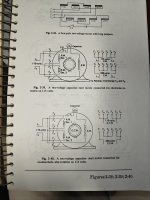
Attached pics from the Rosenberg Motor Repair book I have for both 115 and 230 CW/CCW (a version is available on Archive.org as well).
 

Attachments

  • IMG20260817195555.jpg
    IMG20260817195555.jpg
    742.6 KB · Views: 8
  • IMG20260817200809.jpg
    IMG20260817200809.jpg
    686.4 KB · Views: 7
OP
C

Cleave

Well-known member
Joined
Jul 11, 2018
Messages
360
Location
Back Porch
I don't have 230V available but could add one into the breaker box.
I just found a picture of a sander that looks identical including the motor, my motor plate just isn't there any more, says its 1 HP 13.6/6.8 Amps 115V/230V.

That image in the book is great, thanks for passing it along. I downloaded the book too.

I got a drill press once with a smashed start capacitor - needed "pull start" to get going. I found a start capacitor with similar values on ebay, and now it works fine. This thing has different symptoms.
 

Cruzan80

Well-known member
Joined
Jul 22, 2015
Messages
4,439
Location
Denver, CO
The only note I will add about the book is that navigating the digital copy can be a bit tricky. The physical copy has two sets of bindings and "unfolds", so you can see the text and the diagrams next to each other. Some digital copies have all one binding, then all the other, making you have to scroll a long way back/forth to line up the words/diagrams.

If you can find a physical copy, it is well worth it. Think mine was somewhere in the $25-40 range (got it from OWWM a while back).
 

RTM

Well-known member
Joined
May 13, 2019
Messages
13,415
Location
SF Bay Area
The only note I will add about the book is that navigating the digital copy can be a bit tricky. The physical copy has two sets of bindings and "unfolds", so you can see the text and the diagrams next to each other. Some digital copies have all one binding, then all the other, making you have to scroll a long way back/forth to line up the words/diagrams.
I think acrobat will not allow you to "open in new window" like word will.

But you can open the same file in a second PDF reader, there are several free ones available. Pin one to each side of the screen, cuts down on the flipping. I have a 600 page operating manual, that I frequently need two pages open to flip between the text.
 

Davefr

Well-known member
Joined
Jan 7, 2010
Messages
11,898
Location
OR
I think you need to trace where every wires goes and then draw up a diagram for your exact motor. If you feel it's wired correctly and still has problems diasable the centrifical start so the start winding is never in circuit. Now wrap a cord around the motors shaft and turn it on. Pull the cord like you're starting an old fashioned lawn mower. The motor should now be running properly on the run winding. If it's not your problem is the starting circuit. (maybe bad capacitor or cent. sw)

These motors can be pretty forgiving to brief periods where the start winding doesn't disengage but limit it to 10-15 seconds.
 

Cruzan80

Well-known member
Joined
Jul 22, 2015
Messages
4,439
Location
Denver, CO
Good catch. If he is putting 2/3 and 1/4 together, the two run windings may be out of phase and fighting each other. I am so used to 240 connecting 2/3 together that I didn't question it the first time.
 
OP
C

Cleave

Well-known member
Joined
Jul 11, 2018
Messages
360
Location
Back Porch
Rosenburg book illustration has 1-3-8 and 2-4-5 (or conversely 1-3-5 and 2-4-8)

Have you tried that yet ?

YES! This did the trick. First time, ran backwards. Switching 5 and 8 did the trick.
Runs very nicely. Had all the kids out there taking turns sanding scraps for maybe 20 minutes on a 15 amp breaker.
I guessed also that previously the start and run windings were fighting each other.
Thanks all for the help. Now it just needs a permanent mounting location and a good switch.
 
To avoid these ads, REGISTER NOW!
Top Bottom