To avoid these ads, REGISTER NOW!

Desiccant beads in close contact with machine tools

ckucia

Well-known member
Joined
Sep 23, 2008
Messages
370
Location
West Virginia
I inherited a bunch of reamers from my father/grandfather along with a bunch of other tools.

Moisture/rust has been a serious issue for me in my workshop and I had to triage this when I brought the tools home and discovered how quickly they were attacked. So I finally got around to addressing the reamers. I just spent about two weeks examining them, cleaning, degreasing, Evaporust and/or Purple Power as needed, then sorting, rust-preventataive oiling, IDing and labelling them.

I have a bunch of odd sizes so there's really no index that I could find that would work. I didn't want them banging around against each other in some sort of large container, so I got a bunch of 9/16 diameter plastic tubes with caps on ebay. So far so good.

Problem is, I've noticed that some of the tools I put in plastic baggies to protect last year started light rusting even inside the baggie. I attribute this to moisture in the air captured in the bag. I've starting putting little desiccant capsules in all my tool storage containers and using waterproof plastic boxes from Plano/Flambeau.

Can't really fit any desiccant capsules in these small tubes.

Was wondering if silica desiccant beads will harm tools they're in contact with? Thought about pouring a small amount into each tube before slipping the reamer in. It's a bit more work, but I also considered using a leather punch on some window screen to make a little barrier - pour in some beads, drop the disk of screening and then drop in the reamers. Just because the beads are likely to stick to the oiled reamers and become ineffective once coated.

I know I'm being a little obsessive, but I lost a lot of good tools to rust and lost a lot of time recovering what I could. I don't want to open a box a year from now and find I have to go through all this again.

I've done all the moisture mitigation I can do, and we plan on moving once I get my tool situation sorted so protection is my focus.
 
To avoid these ads, REGISTER NOW!
OP
C

ckucia

Well-known member
Joined
Sep 23, 2008
Messages
370
Location
West Virginia
Soak some WD40 on a rag and wipe them down

I can tell you for certain WD40 is not a long-term solution for rust prevention. BTDT. Not even a month of protection

In my environment, Ballistol will last six months but you'd better re-apply it before then.

I'm currently trying Sta-Bil rust stopper, which does seem to coat better and last. Time will tell.

I don't mind giving Boeshield a try as a first defense but I think the dessicant is a prudent backup.
 

carlaisle

Well-known member
Joined
May 14, 2022
Messages
373
Store them submerged in a container full of oil? Not exactly elegant, but 100% guarantee of zero rust. Could you fill the individual tubes with oil and then store them vertically?
 
OP
C

ckucia

Well-known member
Joined
Sep 23, 2008
Messages
370
Location
West Virginia
Store them submerged in a container full of oil? Not exactly elegant, but 100% guarantee of zero rust. Could you fill the individual tubes with oil and then store them vertically?
I like that idea. Only downside might be temperature swings. Maybe I should have used glass test tubes instead...
 

no704

Well-known member
Joined
Apr 27, 2016
Messages
5,215
Well according to the new Dan video you should be able to wipe them down with NaOH to prevent rusting?
 

RoninB4

Well-known member
Joined
Jul 22, 2020
Messages
3,534
Location
Under My House
For any sort of closed tool box/chest it's been my habit to throw a couple of camphor blocks in. Just make a few slits in the cellophane wrapper. The blocks used to be $1 each at Walgreen or any decent drug store, they can even be purchased on the internet. The blocks will last maybe 6 months to a year and will prevent rust forming. I kept these in my machinist chest for a few decades, never a problem with rust.

As for the individual tools you'll have to avoid keeping them in closed plastic tubes or baggies, those hold moisture in. Either keep the tools in one half of the tube or create some dividers (not from oak). A light film of oil on the appropriate surfaces is required.
 

BrandonV

Well-known member
Joined
Jun 9, 2023
Messages
4,030
Location
Arizona
Last couple minutes.

Interesting video. My natural instinct is that dilute sodium hydroxide solutions have a tendency to pull carbon dioxide out of the air which would form sodium carbonate which would probably accelerate rusting but I would defer to a guy who seems like he's had success doing this for decades.

My fear would be if you have aluminum that comes in contact with the sodium hydroxide solution thru inadvertent contact the carbonates under very humid conditions could cause some minor corrosion.
 
To avoid these ads, REGISTER NOW!

no704

Well-known member
Joined
Apr 27, 2016
Messages
5,215
Interesting video. My natural instinct is that dilute sodium hydroxide solutions have a tendency to pull carbon dioxide out of the air which would form sodium carbonate which would probably accelerate rusting but I would defer to a guy who seems like he's had success doing this for decades.

My fear would be if you have aluminum that comes in contact with the sodium hydroxide solution thru inadvertent contact the carbonates under very humid conditions could cause some minor corrosion.
Agreed, just saw that on HSM page and thought it might be relevant. Never tried it and i hate filling my H2 generator with it!
 
OP
C

ckucia

Well-known member
Joined
Sep 23, 2008
Messages
370
Location
West Virginia
Interesting video. My natural instinct is that dilute sodium hydroxide solutions have a tendency to pull carbon dioxide out of the air which would form sodium carbonate which would probably accelerate rusting but I would defer to a guy who seems like he's had success doing this for decades.

My fear would be if you have aluminum that comes in contact with the sodium hydroxide solution thru inadvertent contact the carbonates under very humid conditions could cause some minor corrosion.
His comment about electroless nickel plating led me down a rabbit hole last night. I think I'd like to give that a try. Was wondering if it's a viable coating for lathe ways.
 

scooby074

Well-known member
Joined
Oct 26, 2008
Messages
5,236
Location
Nova Scotia
Thanks, ill watch it later

Edit: Wow now there is a guy with quite a C.V. Somehow I wasn't subscribed to his channel. Rare poster though.


yhprum

Well-known member
Joined
Jul 27, 2006
Messages
1,389
Location
Brisbane Australia
I had a similar problem with my autobody dollys rusting. I have them polished up pretty well. I ended up putting them in an airtight plastic container. Lightly oiled and throw in a few camphor tablets. You could throw in some desiccant bags and oxygen absorbers and i bet rust would never be an issue. I live in a humid place by the ocean similar to Florida .
 

Shadowdog500

Well-known member
Joined
Dec 7, 2009
Messages
9,848
Location
Down the shore
Interesting video. My natural instinct is that dilute sodium hydroxide solutions have a tendency to pull carbon dioxide out of the air which would form sodium carbonate which would probably accelerate rusting but I would defer to a guy who seems like he's had success doing this for decades.

My fear would be if you have aluminum that comes in contact with the sodium hydroxide solution thru inadvertent contact the carbonates under very humid conditions could cause some minor corrosion.
You may want to mention that on a comment on his video. It looks like he does respond to questions.

I subscribe to his channel and was surprised when his video popped up in my feed. He has an 18 part video series on prototyping that is worth watching.

After he sold his business to Kodak he became an engineering professor.
I just found this video series of his MECH 520: Control Sensors and Actuators course.
Here is a link. https://youtube.com/playlist?list=PLlkx3gSXbdKAl4oUtflEJE_vSX-hYZHrn&feature=shared
 
Last edited:

BrandonV

Well-known member
Joined
Jun 9, 2023
Messages
4,030
Location
Arizona
You may want to mention that on a comment on his video. It looks like he does respond to questions.

I subscribe to his channel and was surprised when his video popped up in my feed. He has an 18 part video series on prototyping that is worth watching.

After he sold his business to Kodak he became an engineering professor.
I just found this video series of his MECH 520: Control Sensors and Actuators course.
Here is a link. https://youtube.com/playlist?list=PLlkx3gSXbdKAl4oUtflEJE_vSX-hYZHrn&feature=shared

Maybe. Would be interesting to run a control test with various types of steels and metal alloys.

Should have known he had an engineering background, surprised he didn't give a molarity or anything for the solution... seems like the opposite of what I would expect.
 

BrandonV

Well-known member
Joined
Jun 9, 2023
Messages
4,030
Location
Arizona
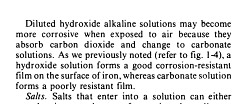
I just pulled up an old text on corrosion control, and this does seem to be a good method. I’d probably go with a solution diluted using distilled water, since tap water might leave behind unwanted salts which may negate the protection provided by the sodium hydroxide. My take on carbonates seems accurate, though I suppose it depends on the liquid film persisting on the surface for an extended period of time. If you let it dry to become a crystalline/anhydrous salt I suppose any moisture down the road will cause an extremely alkaline solution to form which would work.

I will admit the feeling of strong sodium hydroxide sloughing away of your skin is quite remarkable if you've never experienced it.

1744566797943.png

Interesting channel for sure I'm going to subscribe right now.
 

rlitman

Well-known member
Joined
Oct 18, 2010
Messages
24,596
Location
Long Island
If you use desiccants, you don’t want them in contact with anything, as they hold moisture. Place them nearby.
It's a problem with desiccants, but even worse, the color indicators in many desiccants positively will corrode metal if left in contact.
Anyway, a desiccant is only going to absorb moisture from a well sealed space. In the open air, it's like a towel trying to soak up the ocean.

The old-school way was to put a block of camphor in your toolbox. It would evaporate and leave behind a corrosion preventing film. Nowadays, VCI products do a better job with less smell.
 

no704

Well-known member
Joined
Apr 27, 2016
Messages
5,215
FOG I used to work with would keep a rag just slightly damp with kerosene in his box.
 

BurtEggley

Well-known member
Joined
Oct 8, 2024
Messages
864
put the containers into a larger container, and put the silica gel packs into the larger container. That way you get the best of both worlds. the tools are in the small containers, and those are protected by the silca gel in the larger container.
 

LopezBart

Well-known member
Joined
Oct 13, 2023
Messages
2,539
Location
Lopez Island, WA
Back 40 years ago when I was working on robots, CMMs and precision measurements, we had problems w/ rusty finger prints appearing on some of the gauges, etc, almost immediately. The lead fellow had us all place a finger print on a clean steel surface and place our initials next to it. The next day, we'd found the "rusty". One fellow's sweat always rusted the metal; the rest of us not at all.

I've had good luck wiping tools w/ way oil (Vactra #2); no rust issues and the oil sticks to the metal pretty well. This is in CA, not a lot of humidity, though. Long term in a humid environment. esp. w/ temperature swings, I'd wrap them in preservative paper.
 

Dave G in Gansevoort

Well-known member
Joined
Nov 24, 2018
Messages
71
Location
Gansevoort
An old machinist many years ago, early 70s, told me to put moth balls in my toolboxes to prevent rusting. Yes, it smells like your grandmother’s closets, but it’s worked for me for 50 plus years. And kept the bugs out of the toolboxes as well… I hate spiders!
 

cody1325

Well-known member
Joined
Apr 17, 2024
Messages
1,089
Location
Southwest Virginia
An old machinist many years ago, early 70s, told me to put moth balls in my toolboxes to prevent rusting. Yes, it smells like your grandmother’s closets, but it’s worked for me for 50 plus years. And kept the bugs out of the toolboxes as well… I hate spiders!

I used camphor (if I'm not mistaken, the active ingredient in mothballs) blocks from my local pharmacy ages ago, and it works great.

Need to get some more, as my tool selection in the decade or so since I did this has grown immensely. Plus, camphor/mothballs is cheap, decently available, and fix it and forget it, no having to re-apply spray lubricants.
 

Stuart in MN

Well-known member
Joined
Sep 8, 2005
Messages
23,090
Location
Minneapolis
The VCI protection several of us have mentioned functions in a similar manner to camphor blocks, they emit fumes inside your tool chest.
Mothballs maybe used to contain camphor, these days the active ingredient is naphthalene. The Interwebs say it can help prevent rust but it isn't as strong as camphor or VCI products.
 
To avoid these ads, REGISTER NOW!
Top Bottom