To avoid these ads, REGISTER NOW!

Detached garage code confusion

wesst

Well-known member
Joined
Feb 28, 2010
Messages
228
Location
Brighton, MI
Sorry I tried searching and the search function does not work with short phases... anyway, I ran a 100 amp panel in my detached garage from the 200 amp main in my home. I am confused on the NEC code requiring 20 amp circuits. Do all my wall outlets have to be 20 amp, or can I run a dedicated 20 amp outlet and remain in compliance while the remaining outlets are 15 amp?

I also have a 30 amp 240v outlet for my welder, just curious as to the standard outlets and the 2017 code change related to 20 amp. (All circuits are GFCI protected)

Thank you in advance for your help.
 
To avoid these ads, REGISTER NOW!

wyliesdiesels

Well-known member
Joined
Aug 14, 2012
Messages
19,994
Location
Modesto, CA
Not quite sure what youre asking but i think youre asking if you can have multiple 15a outlets on a 20a circuit and the answer is yes.

Which code are you hung up on?
 
Last edited:

bjcouche

Well-known member
Joined
Sep 11, 2010
Messages
509
Location
Ohio
I'm not 100% sure what you are asking, but I'll attempt to clarify..
Most outlets are "duplex" outlets, meaning that they have two plugs on them. You can wire a single duplex outlet to either a 15 or 20A breaker.
You can wire several duplex outlets to a 15 or a 20A breaker.
For outlets that only have ONE plug and it's the only one on that circuit:
you must wire a 15A outlet to a 15A breaker and a 20A outlet to a 20A breaker.
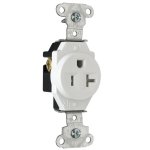
A single 20A dedicated outlet would look like the one I pictured.

Can you clarify what specifically is the difference you are concerned with in the 2017 NEC? I have the 2014 but don't have the 2017 handy at the moment... I do know that *** 15 and 20A outlets (with few exceptions) must be tamper resistant, but that was in 2014.
Brian
 

Attachments

  • single 20A.jpg
    single 20A.jpg
    135.1 KB · Views: 24

bjcouche

Well-known member
Joined
Sep 11, 2010
Messages
509
Location
Ohio
OK, I did some 2017 NEC research...
if you are asking about 2017 NEC changes, in regards to your garage....
You are now required to have a MINIMUM of 1 20A recepticle circuit in the garage.
This can be several 15A duplex outlets on a 20A circuit.
You must have 1 outlet PER GARAGE BAY. So I'm assuming if you had only 1 16' garage door, then that would be two outlets.
That required circuit can only supply outlets and not lighting, but it IS allowed to supply outlets on the outside of the garage.

As for your 240V 30A welder outlet...
If your garage is considered "Other Than Dwelling Unit", then 210.8(B) now requires your 240V receptacles 50A or less to be GFCI protected.

However, 210.8(A) for "Dwelling Units" currently does NOT require those 240V outlets to be GFCI protected, and has the language in 210.8(A)(2) "Garages and also accessory buildings".

So in laymans terms, I would interpret this as:
In residential installations (attached or detached garage) GFCI's aren't needed for 240V outlets.
In non residential installations, commercial, industrial, GFCI's are needed for outlets rated 240V <=50A.

Brian
 

bjcouche

Well-known member
Joined
Sep 11, 2010
Messages
509
Location
Ohio
There are also changes to the requirement of Tamper Resistant receptacles. Now all 120 AND 240V 15-20A NON LOCKING receptacles in dwelling units must be tamper resistant. As for a 240V 50A welding outlet, 50A range / RV outlet, 30A drier outlet, those are not yet required to be tamper resistant.

As a general rule though, it doesn't really matter what the NEC says, it matters more what your AHJ says... Often, when teh inspector tells you that you need a couple extra GFCI breakers, it's easier and cheaper to just install them than trying to fight city hall, even if you are in the right...

Brian
 
OP
W

wesst

Well-known member
Joined
Feb 28, 2010
Messages
228
Location
Brighton, MI
Sorry for the confusion. I have all my outlets wired on several 15 amp circuits with the exception of one duplex outlet on a 20 amp breaker. My concern is with the “minimum one 20 amp recepticle circuit” language. Would my single 20 amp circuit meet this requirement?

I just don’t want any surprise inspection to indicate all my wall outlets must be 20 amp.
 

sberry

Banned
Joined
Jun 18, 2005
Messages
35,747
Location
Brethren, Michigan
You don't need any 20 outlets, only a circuit if it requires it which I think is a good idea. Spec built homes had pitiful garage wiring.
 

sberry

Banned
Joined
Jun 18, 2005
Messages
35,747
Location
Brethren, Michigan
Just as a side note. Most of us not doing spec work use 20A circuits for all outlets. I just did a house, every outlet in the place is 20A. No lights or other equipment on the outlet circuits. All lights done in 14. So much easier to work overhead, wire switches and terminate fixtures.
 
Last edited:
To avoid these ads, REGISTER NOW!

Falcon67

Well-known member
Joined
Jun 11, 2009
Messages
18,371
Location
Merkel, TX
All the runs in my shop are 12-2 w/ground AWG and use the cheap 10 packs of 15A outlets. No inspection issues. Neatness in wiring counts though.
 

Sanmiam

Member
Joined
Dec 7, 2016
Messages
7
None of what is noted above is necessarily incorrect, however, it may be. Let me clarify:

What is required within the "accessory structure" will depend on what code version is being utilized in your area. For example: I just passed final on my garage that is under the 2008 NEC codes. No GFCI protection is required for 240V receptacles, however, each branch circuit for 110 outlets needed to be GFCI protected (GFCI outlet on first of the branch). No requirements for AFCI on any circuits (AFCI is the breaker types with the little ground wire on it). All outlets need to be tamper resistant.

First let us know what code your township is working under and we can provide further guidance from there. A quick call to either your building/zoning dept or electrical inspection agency will let you know. The fact that the 2017 codes are available does not mean your locality has adopted them.

Pertinent to your original question - the use of 15 vs 20amp outlets is contingent on the wire gauge used. You can throw a bunch of 15amp outlets on a 12/2 circuit with a couple of 20V outlets and you are fine. You cannot, however, put a 20amp outlet on a circuit wired with 14/2. When wiring the gold standard is to utilize 12/2 for any outlets, and a separate 14/2 for lighting circuits. You can always go up in gauge (up being numerically lower wire size) for any circuit you want.
 
OP
W

wesst

Well-known member
Joined
Feb 28, 2010
Messages
228
Location
Brighton, MI
Just a quick follow up. I called the local electrical inspector today and he was extremely helpful in explaining the 2017 change, however he indicated their agency uses the NEC 2014 as reference. He also spoke to me regarding common mistakes that could potentially result in a red tag and/or reinspection.
 

bigb56

Well-known member
Joined
Jan 27, 2018
Messages
169
Location
Tucson, Arizona
Just as a side note. Most of us not doing spec work use 20A circuits for all outlets. I just did a house, every outlet in the place is 20A. No lights or other equipment on the outlet circuits. All lights done in 14. So much easier to work overhead, wire switches and terminate fixtures.

Did the customer request that? We normally put the 20 amp circuits where required & where it is likely they will need it, like garages and outside. 15's everywhere else. I never understood why people think they need 20 amp circuits in living rooms and bedrooms.
 

kaffine

Well-known member
Joined
Dec 13, 2009
Messages
3,610
Location
Henderson, NV
Did the customer request that? We normally put the 20 amp circuits where required & where it is likely they will need it, like garages and outside. 15's everywhere else. I never understood why people think they need 20 amp circuits in living rooms and bedrooms.

Because I'm too lazy to cut the end off of my extension cord and replace it with a 15 amp instead of a 20 amp end so I want all outlets to be 20amp. That and I have been known to run table saw in my living room.
 
To avoid these ads, REGISTER NOW!
Top Bottom