To avoid these ads, REGISTER NOW!

Detached Garage Roof Venting

zcinpa

Well-known member
Joined
Nov 22, 2009
Messages
114
Location
South West PA
Hey guys,
We've got an insurance claim in process putting a new roof on our detached garage and house from storm damage. The contractors said not to worry about venting a detached non-living space.
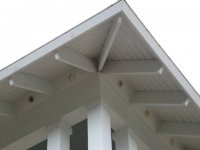
right now nothing is insulated or heated, but I'd like it to be in the next year or so. The garage has no gable vents, no sofit to vent and no ridge vent.
The garage is open space, i've built walls and insulated them, and plan to add a ceiling and insulate as well.
I suppose I can add gable vents and a ridge vent when they're done -
What do you pros think?

cheers
Zach
 
To avoid these ads, REGISTER NOW!

Stuart in MN

Well-known member
Joined
Sep 8, 2005
Messages
23,128
Location
Minneapolis
With an open space inside it's not an issue, but if you're going to put in a ceiling and insulation you will want to vent the roof.
 

cruzer75

Well-known member
Joined
Feb 7, 2009
Messages
206
We added an overhang to the outside for soffit vents and a ridge vent. I plan on sheet rocking the ceiling in the furture and did not want to have moisture problems again with the roof. The garage had insulation right up against the roof which cause moisture to accumulate and rot out the rafters and the tongue and groove roofing.

the guy is working for you, if he won't put in a ridge or gable vent then get somebody else!

Stewart
 

kbs2244

Well-known member
Joined
Nov 11, 2006
Messages
14,065
Have the contractor put in soffit vents and a ridge vent now.
It won't add much, if anything, to his cost.
(May $100 for the ridge vent.)
It will not hurt to have them there before your improvments.
And they will be there ready to work when you do need them.
 
To avoid these ads, REGISTER NOW!

bigdav160

Well-known member
Joined
Apr 14, 2007
Messages
2,027
Location
Deep in the heart of Texas
Gable and ridge vents is not a proper combination. One or the other and intake vents at the lower portion of the roof.

The roof needs to be vented or it won't last it's full life.
 
OP
Z

zcinpa

Well-known member
Joined
Nov 22, 2009
Messages
114
Location
South West PA
Since I have no soffit - what's another venting solution? would it be difficult to build a soffit with the roof on?
 

K'ledgeBldr

Well-known member
Joined
Aug 22, 2011
Messages
1,925
Location
Johns Creek, GA
Since I have no soffit - what's another venting solution? would it be difficult to build a soffit with the roof on?

Yes, you can build out a soffit, and add soffit vents along with either birdbox or queen anne returns. Or you can simply use the common round blocking vents- I'll assume that with no soffit you at least have exposed rafter tails (?). Attached diagram and pic-
These along with either gable vents or ridge vent will adequately ventilate the attic space.
The third pic is an atypical soffit detail- always built after the roof is on when the roof is stick built-
 

Attachments

  • Exposed Rafter Tail Block Venting.jpg
    Exposed Rafter Tail Block Venting.jpg
    21.4 KB · Views: 65
  • exposed-rafter-tails.jpg
    exposed-rafter-tails.jpg
    22.7 KB · Views: 64
  • Soffit Framing Detail.jpg
    Soffit Framing Detail.jpg
    71.8 KB · Views: 78
Last edited:

rsa

Well-known member
Joined
Mar 3, 2011
Messages
300
Location
Between Raleigh and Fayetteville, NC, USA
Since I have no soffit - what's another venting solution?
Hunter Panels Cool-Vent.

HunterPanels_CoolVentRigidInsu_QUR_1.png


You can also DIY with or without the foam. See comment #17 in this discussion.
In fact, an excellent way to insulate and vent a parallel-chord roof/cathedral ceiling system is to sheath the trusses with 3/8 CDX covered with #15 felt, install 2x4 flat sleepers over each truss and a thicker layer of sheathing of your choice with whatever peel-n-stick nonsense and roofing that floats your boat. Then vent the 1½" air gap bottom and top and dense-pack the trusses from below.

This creates a perfectly vented and insulated roof assembly with a complete secondary drainage plane below the roofing/sheathing - like a rainscreen siding approach. Both the secondary sheathing and the primary roof sheathing can dry to the vent cavity for long-term reliability and durability.

But, of course, this requires designing for function and letting the aesthetic follow, rather than the more usual designing for form and hoping that it will function.
Answered by Riversong
Posted Mon, 12/20/2010 - 16:57
Edited Mon, 12/20/2010 - 16:58.

A couple of good reads:
http://www.finehomebuilding.com/how-to/articles/a-crash-course-in-roof-venting.aspx
http://www.greenbuildingadvisor.com/blogs/dept/building-science/lstiburek-s-rules-venting-roofs

Roof ridges recommended by Robert Riversong: AirVent ShingleVent II or Lomanco OR-4.
 
To avoid these ads, REGISTER NOW!
Top Bottom