To avoid these ads, REGISTER NOW!

Detached Workshop Power

jhcrowman

New member
Joined
Jan 3, 2020
Messages
4
Location
Franklin, TN
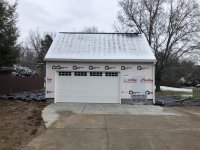
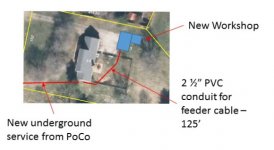
After many years of dreaming, I’ve finally started my detached workshop. Pics are attached – ended up with an L shaped garage to avoid property line setbacks and septic field lines. See pics.

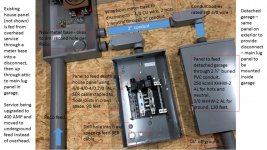
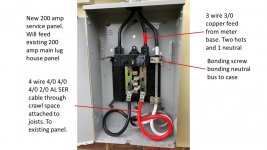
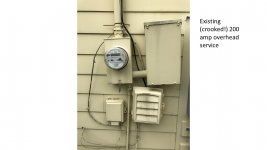
I currently have 200 AMP service to the house that is overhead and am upgrading to 400 AMP service. Since I had to rent a trencher to go from the house to the new workshop, I trenched from the pole at the street to the house so the new PoCo service could be run underground. I’ll be putting a 200 AMP panel in the new workshop. I know I don’t need near that much capability, but the decision is made so let’s move beyond that. I have a new meter base with dual lugs that will be mounted on the end of the house and will feed two 200 AMP disconnects – one that will feed the main lug panel in the garage of the house, and the other to feed the detached workshop. I plan on mounting the disconnects low (16” off the ground) so I can go through the back of the panel into the crawl space with the SER cable. The 2 ½ conduit from the second panel will carry 4 xhhw-2 conductors and will terminate at the detached workshop into the same model disconnect outside, then feed the main lug panel located in the workshop through the wall.
Questions:
1) I plan on using 2” conduit from the meter base to the disconnects. The conduit bodies are rated for three 4/0 wires, so I plan on using 4/0 copper rather than aluminum for those connections. All other wire will be aluminum as noted. Any issues with that? I was concerned about bend radius, but am assuming conduit bodies take that into account with their specs.
2) For the workshop feed, having a disconnect at the house, then another at the garage seems redundant, however I understand a disconnect means must be provided for at the detached location. Is that correct?
3) I know I need 4 wire feeds from the two disconnects at the house to the house panel and to the detached workshop. I need to research grounding rod requirements more, but am thinking I need 2 rods each for the 3 disconnects. Anybody have a similar setup?

Thanks in advance for any constructive comments!
 

Attachments

  • Overhead View.JPG
    Overhead View.JPG
    47.8 KB · Views: 110
  • Front View.jpg
    Front View.jpg
    150.1 KB · Views: 103
  • R Side View.jpg
    R Side View.jpg
    151.7 KB · Views: 102
  • Elec Panel Layout.jpg
    Elec Panel Layout.jpg
    150.4 KB · Views: 133
To avoid these ads, REGISTER NOW!

brewchief

Well-known member
Joined
Sep 20, 2008
Messages
2,370
Location
Michigan
You can use a panel with a main breaker in the new garage instead of having a separate disconnect outside.

You will need 2 rods at the house, the disconnects can both be connected to the same pair of rods. You will need another 2 at the garage since it's detached.

Sent from my SM-G965U using Tapatalk
 

sparky 1971

Well-known member
Joined
Oct 9, 2018
Messages
7,967
Location
Central Iowa
You may want to go up to 2 1/2" from the meter socket to the panels. It's going to be a pita to get 4/0's through the LL's. Maybe even put a panel on each side of the meter socket. Go straight into the side knockouts of the panels and eliminate the conduit bodies altogether? You could put the house panel to the left of the meter if you are going into the crawl space, then leave the shop panel on the right so it wont effect the trenching.

You will need a disconnect at the garage. I would just use a main breaker panel there instead of a main lug.
 
OP
J

jhcrowman

New member
Joined
Jan 3, 2020
Messages
4
Location
Franklin, TN
Re: UPDATED Detached Workshop Power

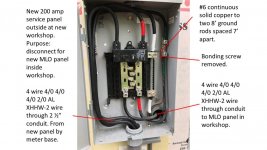
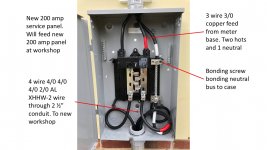
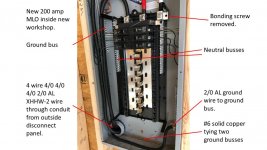
Just about finished with all the wiring and wanted to post some pictures. I'd appreciate any constructive feedback as I'm close to having the POCO schedule the service upgrade. I do have one question but will create a new post for that.

Sparky 1971 - You sure were right on the 4/0 copper in a 2" conduit. I had to step down to 3/0 copper (still good for 200 amps) and even that was really hard to run!

Brewchief - I already had the MLO panel for the workshop which is why I went with the disconnect outside. I thought that was required anyway for firefighters in the event of a fire.

Any issues spotted?
thanks much!
 

Attachments

  • Pic6 jpeg.jpg
    Pic6 jpeg.jpg
    103.9 KB · Views: 105
  • Pic5 jpeg.jpg
    Pic5 jpeg.jpg
    143.4 KB · Views: 104
  • Pic4 jpeg.jpg
    Pic4 jpeg.jpg
    89 KB · Views: 101
  • Pic3 jpeg.jpg
    Pic3 jpeg.jpg
    86.6 KB · Views: 98
  • Pic2 jpeg.jpg
    Pic2 jpeg.jpg
    93.4 KB · Views: 97
  • Pic1 jpeg.jpg
    Pic1 jpeg.jpg
    88.2 KB · Views: 92
  • Pic7 jpeg.jpg
    Pic7 jpeg.jpg
    102.3 KB · Views: 97

yeldogt

Well-known member
Joined
Jan 2, 2012
Messages
18,184
well -- if you want to start growing pot you have plenty of power
 

wyliesdiesels

Well-known member
Joined
Aug 14, 2012
Messages
19,994
Location
Modesto, CA
The 4/0 AL is no bueno for 200a as said above. Should change the breaker.

solid #6 cu and solid #4 cu GEC ground wires do not need to be in conduit

you dont need to tie the 2 ground bars together in the panel.
 

sparky 1971

Well-known member
Joined
Oct 9, 2018
Messages
7,967
Location
Central Iowa
Around here everyone lets us use 4/0 al for feeders. It's a stupid rule that it can be used on the line side of the main but not the load. He will find out when the inspection happens.
 

teamextreme

Well-known member
Joined
Aug 10, 2013
Messages
867
Location
Lakewood, CO
Hard to tell for sure, but it looks like you're missing green phase tape on the ground wire in the shop panel. Looks like top notch work.
 

sberry

Banned
Joined
Jun 18, 2005
Messages
35,747
Location
Brethren, Michigan
You may want to go up to 2 1/2" from the meter socket to the panels. It's going to be a pita to get 4/0's through the LL's. Maybe even put a panel on each side of the meter socket. Go straight into the side knockouts of the panels and eliminate the conduit bodies altogether? You could put the house panel to the left of the meter if you are going into the crawl space, then leave the shop panel on the right so it wont effect the trenching.

You will need a disconnect at the garage. I would just use a main breaker panel there instead of a main lug.

I did a job recent where the owner had mounted the panel. It looked good but wish I would have looked next door and got the geometry right. I would have removed a few screws and moved it a little and eliminated an lb. The install looks good, the owner very happy and the inspector impressed but it kills me to miss something so simple that would have saved work and removed a fitting that was difficult to deal with.
 

pattenp

Well-known member
Joined
Jun 4, 2008
Messages
10,175
Location
Virginia - USA
Around here everyone lets us use 4/0 al for feeders. It's a stupid rule that it can be used on the line side of the main but not the load. He will find out when the inspection happens.

Well that validates the engineers and fire safety people don't have a clue when that requirement was put in the NEC. If the requirement is so stupid how come it has gone through revisions and has not been removed from the NEC after all these years?
 

Norcal

Well-known member
Joined
Mar 16, 2008
Messages
13,752
Well that validates the engineers and fire safety people don't have a clue when that requirement was put in the NEC. If the requirement is so stupid how come it has gone through revisions and has not been removed from the NEC after all these years?

It was removed and from what I have read it was returned in the 2020 NEC but it is a abused rule, that should be removed for consistency.
 

pattenp

Well-known member
Joined
Jun 4, 2008
Messages
10,175
Location
Virginia - USA
It was removed and from what I have read it was returned in the 2020 NEC but it is a abused rule, that should be removed for consistency.

I know the table under 310.15(B)(7) was removed in 2014 but the allowance to size service entrance conductors different than feeder conductors after the first disconnect was not removed. I haven't looked at the 2020, are you saying the single phase dwelling service table is back?
 

sparky 1971

Well-known member
Joined
Oct 9, 2018
Messages
7,967
Location
Central Iowa
Well that validates the engineers and fire safety people don't have a clue when that requirement was put in the NEC. If the requirement is so stupid how come it has gone through revisions and has not been removed from the NEC after all these years?


It is stupid unless you can explain to me why it's ok to have a 4/0 al or a 2/0 copper on one side of a 200 amp breaker but not the other. The same goes with a #2 al or #4 copper and a 100 amp breaker.

My house originally had a 100 amp overhead service with #2 al. Last summer I went to a 200 amp underground. I live in the country so I had the POCO (REC) set a 200 amp meter main. I don't know why they supply it, but they do and I won't complain. By the rules, since the main is on a pole, I shouldn't have been able to run a 4/0 MHF to the house panel, which is a sub., but I did it anyway. The old main panel became a sub panel fed from my new sub panel and I shouldn't have run #2 SER cable to it even though I took the air conditioner, dryer, and water heater off and put them on the 200 amp panel, but I did it anyway. The garage is detached and had been fed overhead also. I ran #2 MHF to it from the meter main and hooked it up to a 100 amp breaker in the meter main. Again, I knowingly broke the "rules".


Guess what? The whole installation passed inspection with flying colors. This was a state electrical inspector, not one of those guys that shows up and looks at everything, but has no clue about anything. Maybe I shouldn't be able to sleep at night, but I have no problem whatsoever.
 

wyliesdiesels

Well-known member
Joined
Aug 14, 2012
Messages
19,994
Location
Modesto, CA
the code allowing #2 AL on 100a breaker and 4/0 on 200a breaker is ONLY allowed when the entire load of the dwelling is on that feeder. This is because residential loads are diverse.

It does NOT apply to branch feeders supplying non-residential loads such as a detached shop
 

sparky 1971

Well-known member
Joined
Oct 9, 2018
Messages
7,967
Location
Central Iowa
the code allowing #2 AL on 100a breaker and 4/0 on 200a breaker is ONLY allowed when the entire load of the dwelling is on that feeder. This is because residential loads are diverse.

It does NOT apply to branch feeders supplying non-residential loads such as a detached shop


I know that. That is why it is stupid. This thread is the perfect example. The op has a meter that feeds two panels with 4/0 al. He is using feed through lugs to feed two other panels. Why should he have to go up to 250 al or 3/0 copper because the load is now on the other side of the main. He could theoretically have 190 amps worth of load in each of the first panels, and 10 in the other panels down the line. That would put 200 amps on the 4/0 al. I just want to know why. Not what. Everyone around me knows this is stupid and that is why it isn't enforced by any inspectors that I know of. I deal with nine different actual electrical inspectors and I have no idea how many everything inspectors, and to my knowledge, not one of them would require up sizing the wire once it's on the other side of the main. It makes absolutely no sense. If it has to be 3/0 copper or 250 al on the load side, it should have to be the same on the line side.
 

wyliesdiesels

Well-known member
Joined
Aug 14, 2012
Messages
19,994
Location
Modesto, CA
I know that. That is why it is stupid. This thread is the perfect example. The op has a meter that feeds two panels with 4/0 al. He is using feed through lugs to feed two other panels. Why should he have to go up to 250 al or 3/0 copper because the load is now on the other side of the main. He could theoretically have 190 amps worth of load in each of the first panels, and 10 in the other panels down the line. That would put 200 amps on the 4/0 al. I just want to know why. Not what. Everyone around me knows this is stupid and that is why it isn't enforced by any inspectors that I know of. I deal with nine different actual electrical inspectors and I have no idea how many everything inspectors, and to my knowledge, not one of them would require up sizing the wire once it's on the other side of the main. It makes absolutely no sense. If it has to be 3/0 copper or 250 al on the load side, it should have to be the same on the line side.

maybe ask the CMP who wrote the code
 

sparky 1971

Well-known member
Joined
Oct 9, 2018
Messages
7,967
Location
Central Iowa
maybe ask the CMP who wrote the code

I don't care enough to. You are one of the most code knowledgeable people on this forum, but you can't give an answer. I know what is and isn't enforced where I work, and that is way more important than knowing the book inside out.

This story happened between 15 and 20 years ago. The first time I installed a meter main. (100 amp). The service had to be on one side of the house, but it didn't have a basement, and the garage, where the panel went, was on the other side. For some reason, they didn't want the panel in the dining room. My boss at the time said that officially, we weren't supposed to use #2 al because it was on the wrong side of the main. (he was correct). He started talking about running emt with #3 copper across the attic to the garage. I didn't want to do that, but was willing to if necessary. I called down to the inspections office and talked to the head electrical inspector for the city. I told him what was going on and asked what he wanted me to do. He told me to "Use #2 SER cable. It's f@$C!%g stupid that you can feed a 100 amp service with #2, but not a 100 amp residential sub panel". And that is pretty much a verbatim quote.

You jumped in and told the op he needed to change the breakers. He might have to, but let the AHJ tell him that. My bet is that he will be ok and not have to do a thing.
 
Last edited:

wyliesdiesels

Well-known member
Joined
Aug 14, 2012
Messages
19,994
Location
Modesto, CA
Did the make you derate the conductors for running through the hot attic? If not, then they didnt really care about code to begin with

no i couldnt give you an answer. nobody knows why the CMP wrote the code and its a hotly debated topic even on this forum.
 

Terry D

Well-known member
Joined
Mar 25, 2015
Messages
2,202
Location
St. Louis, MO.
Around here everyone lets us use 4/0 al for feeders. It's a stupid rule that it can be used on the line side of the main but not the load. He will find out when the inspection happens.

We also are allowed to use 4/0 al for 200 amps and #2 al for 100 amps as long as it is a service for a dwelling. They removed the dwelling service and feeder table in the 2017 code, the conductor cannot be rated less than 83% of the service rating. They have brought the table back in 2020 code
 
To avoid these ads, REGISTER NOW!

sparky 1971

Well-known member
Joined
Oct 9, 2018
Messages
7,967
Location
Central Iowa
Did the make you derate the conductors for running through the hot attic? If not, then they didnt really care about code to begin with

no i couldnt give you an answer. nobody knows why the CMP wrote the code and its a hotly debated topic even on this forum.

Actually, I was able to run the SER cable through a bulkhead. It didn't have to go through the attic. There would have been too many bends for conduit.
 

sparky 1971

Well-known member
Joined
Oct 9, 2018
Messages
7,967
Location
Central Iowa
We also are allowed to use 4/0 al for 200 amps and #2 al for 100 amps as long as it is a service for a dwelling. They removed the dwelling service and feeder table in the 2017 code, the conductor cannot be rated less than 83% of the service rating. They have brought the table back in 2020 code


On the load side of the main? Oh the horrors. Between the two of us, we are putting the entire Midwest at risk.:beer:
 

Terry D

Well-known member
Joined
Mar 25, 2015
Messages
2,202
Location
St. Louis, MO.
On the load side of the main? Oh the horrors. Between the two of us, we are putting the entire Midwest at risk.:beer:

And I don't want to start a argument here, but we are also allowed to size our conductors for dwelling sub panels off the same table. I have been installing #2 SER for 100 amp sub panels for 25 years, never had a problem with a inspection or has one ever burnt up. Its just how its done here, but I understand its not like that everywhere.
 

Terry D

Well-known member
Joined
Mar 25, 2015
Messages
2,202
Location
St. Louis, MO.
I know the table under 310.15(B)(7) was removed in 2014 but the allowance to size service entrance conductors different than feeder conductors after the first disconnect was not removed. I haven't looked at the 2020, are you saying the single phase dwelling service table is back?

The table was removed, but now it is back in the 2020 code. But the rule has never left, 2017 reads that you can use a conductor for dwelling services and feeders rated not less than 83% of the service rating.
 
Last edited:

sparky 1971

Well-known member
Joined
Oct 9, 2018
Messages
7,967
Location
Central Iowa
And I don't want to start a argument here, but we are also allowed to size our conductors for dwelling sub panels off the same table. I have been installing #2 SER for 100 amp sub panels for 25 years, never had a problem with a inspection or has one ever burnt up. Its just how its done here, but I understand its not like that everywhere.

Don't worry. I already started the argument with my comment about it being a stupid rule. This whole thing has gotten ridiculous. The op did a hell of a nice job. Instead of getting an atta boy, he gets beat up in posts 6 and 7. I made my comment and all of a sudden I have insulted engineers and fire safety people. Whoever they are.
 

sparky 1971

Well-known member
Joined
Oct 9, 2018
Messages
7,967
Location
Central Iowa
the code allowing #2 AL on 100a breaker and 4/0 on 200a breaker is ONLY allowed when the entire load of the dwelling is on that feeder. This is because residential loads are diverse.

It does NOT apply to branch feeders supplying non-residential loads such as a detached shop


Honest question. Not trying to be a smart ***. Is it actually enforced where you are or does everyone just follow the rules to a T because the book says so?

I just called a friend I worked with in Dallas 25 years ago. Same thing. #2 and 4/0 for subs.
 

wyliesdiesels

Well-known member
Joined
Aug 14, 2012
Messages
19,994
Location
Modesto, CA
Honest question. Not trying to be a smart ***. Is it actually enforced where you are or does everyone just follow the rules to a T because the book says so?

I just called a friend I worked with in Dallas 25 years ago. Same thing. #2 and 4/0 for subs.

Yes it is.
 

pattenp

Well-known member
Joined
Jun 4, 2008
Messages
10,175
Location
Virginia - USA
It was timely that Mike Holt had a live webcast tonight and covered the reduced size allowance in the NEC for dwelling service conductors. His opinion was the whole thing should be removed from the code.
 
Last edited:

pattenp

Well-known member
Joined
Jun 4, 2008
Messages
10,175
Location
Virginia - USA
Don't worry. I already started the argument with my comment about it being a stupid rule. This whole thing has gotten ridiculous. The op did a hell of a nice job. Instead of getting an atta boy, he gets beat up in posts 6 and 7. I made my comment and all of a sudden I have insulted engineers and fire safety people. Whoever they are.

How is making the OP aware of what the NEC calls for beating up on him? He asked for feedback.
 

sparky 1971

Well-known member
Joined
Oct 9, 2018
Messages
7,967
Location
Central Iowa
How is making the OP aware of what the NEC calls for beating up on him? He asked for feedback.

Yeah, you telling him that 3/0 cu is 200 amps and 4/0 al is 180 amps is really making him aware of what the NEC calls for

According to the video you posted, 310.12 (A) through (C), he is compliant. Technically, the detached shop getting 4/0 al is a code violation because it's not a dwelling. but that is splitting hairs. It's still a residential application. I guess a **** head inspector could say that according to (C), he fails because the feeder is smaller ampacity wise than the service conductors, but he could alleviate that by using 2/0 copper from the meter socket to the mains. I just got paid yesterday for a 400 amp pedestal service. It had 4/0 mhf to a 2400 sq ft shop fed from a 200 amp main. It passed the inspection and it isn't a dwelling. The other 200 amp breaker is for the dwelling that hasn't been built yet.

I will say this. Shame on me. I don't believe I have opened a code book since I took the masters in 2009 using a 2008 book. I still have that book buried in my service truck somewhere...I think. I remember the lines for the 100 and 200 amp services in table 310.12. I couldn't have told you it was 310.12, I would have told you there is a chart in the book somewhere. I didn't know (A) through (C) existed. I never bought a 2011 book, I did buy a 2014 super cheap when the 2017 came out but it's still wrapped in the plastic it came with. This is NOT me saying I know it all. Far from it. I don't get into a lot of different things. I do mostly commercial service work for one really large company with a little bit of residential thrown in to remind me why I hate it. I know what I know. If there is something I am not sure of, I just make a phone call and ask. I usually make the excuse I forgot my code book at home...again.
 

sparky 1971

Well-known member
Joined
Oct 9, 2018
Messages
7,967
Location
Central Iowa
It was timely that Mike Holt had a live webcast tonight and covered the reduced size allowance in the NEC for dwelling service conductors. His opinion was the whole thing should be removed from the code.

I skipped around and only watched about 10 or 15 total minutes. I doubt if I could stay awake for the whole thing. My favorite part is where he states that 310.12 isn't code. It's in the effing code book so it has to be code. He is one smart guy, but wow, talk about over analyzing things. He probably keeps a code book next to the toilet for reading pleasure.
 

wyliesdiesels

Well-known member
Joined
Aug 14, 2012
Messages
19,994
Location
Modesto, CA
Yeah, you telling him that 3/0 cu is 200 amps and 4/0 al is 180 amps is really making him aware of what the NEC calls for

According to the video you posted, 310.12 (A) through (C), he is compliant. Technically, the detached shop getting 4/0 al is a code violation because it's not a dwelling. but that is splitting hairs. It's still a residential application. I guess a **** head inspector could say that according to (C), he fails because the feeder is smaller ampacity wise than the service conductors, but he could alleviate that by using 2/0 copper from the meter socket to the mains. I just got paid yesterday for a 400 amp pedestal service. It had 4/0 mhf to a 2400 sq ft shop fed from a 200 amp main. It passed the inspection and it isn't a dwelling. The other 200 amp breaker is for the dwelling that hasn't been built yet.

I will say this. Shame on me. I don't believe I have opened a code book since I took the masters in 2009 using a 2008 book. I still have that book buried in my service truck somewhere...I think. I remember the lines for the 100 and 200 amp services in table 310.12. I couldn't have told you it was 310.12, I would have told you there is a chart in the book somewhere. I didn't know (A) through (C) existed. I never bought a 2011 book, I did buy a 2014 super cheap when the 2017 came out but it's still wrapped in the plastic it came with. This is NOT me saying I know it all. Far from it. I don't get into a lot of different things. I do mostly commercial service work for one really large company with a little bit of residential thrown in to remind me why I hate it. I know what I know. If there is something I am not sure of, I just make a phone call and ask. I usually make the excuse I forgot my code book at home...again.

yeah and inspectors NEVER miss anything.... :rolleyes:
 

sberry

Banned
Joined
Jun 18, 2005
Messages
35,747
Location
Brethren, Michigan
I havnt opened the book in a while and mine is older than that. I also know what I know and don't know anything or enough about electricity to pass the test, not sure I could even with study. I am a very good test taker, took one for something the other day, they said I scored higher than anyone so far and asked how much I studied and I didn't but I have taken it before. It's not the first time they asked if I studied.
I havnt tried to take a journeyman , should have taken it way back before they couldn't track it and knew a couple guys would have lied,,, I meant vouch for me,,, ha,,,, but 3/4 of it I don't know, couldn't figure out and I memorize instead of calculate.
 

sberry

Banned
Joined
Jun 18, 2005
Messages
35,747
Location
Brethren, Michigan
I can't remember a lot, I never learned it well enough to start with to make it instinctive. Real metalurgy, electricity, electronics, even when I do learn I don't use it enough it's like starting over or worse when I get back to it.
 

sparky 1971

Well-known member
Joined
Oct 9, 2018
Messages
7,967
Location
Central Iowa
yeah and inspectors NEVER miss anything.... :rolleyes:

They miss a lot more than one...All of them. That's the most recent. Thinking back, I can only think of one residential non dwelling. install where I used 250 for a service, but that was only from the transformer pole to the pedestal because it was a long ways. It got 4/0 from pedestal to building. That one even wound up being classified "commercial" because it was a 2nd service. I even had to calculate fault current even though it is a residential property. I guess that one could have been missed. I used urd and 4/0 and 250 look similar. Hmmm... he also missed urd inside the building there. lucky me.

Every rural residential service around around me for 30 miles is some type of meter main whether pole mount or pedestal. While I didn't do very many installs at all, I know most of the guys that did and I guarantee that every one of them installed in the last 20 years with a 200 amp feeder has 4/0 whether it goes to a house or building. Residential being the key part. Maybe they are overlooking the dwelling/non dwelling. I don't know the reasoning nor do I care. I know what is and isn't enforced where I work.

I have a good friend that is an inspector on the other side of the state. I am going to make a call later and ask about this.
 
Last edited:

sberry

Banned
Joined
Jun 18, 2005
Messages
35,747
Location
Brethren, Michigan
Fridge, hydraulic, controls, transmissions all keep me from being a real master. Heat, beat, pound, pry and I am on it. Engineers can do stuff ain't a ********* for me but when it comes to simple I am so fast I can beat up on lots of them. So.eone said the other day,, you make it so easy,, we'll yes, it's simple and I done it lots before.
 

sparky 1971

Well-known member
Joined
Oct 9, 2018
Messages
7,967
Location
Central Iowa
Here is what my inspector friend told me. Most around here don't look at it as dwelling/non dwelling. They see it as residential/commercial. Residential zoning gets treated as dwelling, commercial gets treated as non dwelling. He did say not all inspectors look at it that way though. I guess I and all my buddies have been lucky enough to have inspectors that are lenient. It's kind of like law enforcement not giving tickets for going 5 mph over the speed limit. They can, but most choose not to. The feeder rule is a code that isn't enforced by everyone but there are exceptions. An example of why it isn't enforced: 400 amp service. 1200 sq ft house gets a 200 amp feeder. 4/0 al. The other 200 amp feeder goes to a 60X40 shop. It should get a 250 al because it isn't a dwelling. When someone builds a 72X120 shop with all the toys and puts a 600 sq ft apartment in it, it's a dwelling and both feeders can be 4/0. Here is an exception. Someone decides to go into business and build a shop for auto repair in his back yard. That is a commercial installation and will have to get 250 al for the feeder if it's a 200 amp service. But... He builds the shop for himself, it gets 4/0. Six months later, he decides to open a business out of it, nothing is going to get changed.

Then a statement was made that I had never thought about. The code Nazi's are a bunch of hypocrites. Without exception, everyone who has been in a trade long enough has violated a code. In electrical, it may be something as simple as using a drywall screw in a switch box instead of getting a 6/32 or tapping it out to an 8/32. Maybe getting romex staples or conduit straps a little too far apart. Maybe a wire or two too many in a box and going over on fill. And anyone who says they have never violated a code is either a liar, or they haven't been in the trade long enough. I have done all of the above. Is it right? Nope, but I did it anyway. I have used feeders that didn't meet code intentionally also, not because I didn't know what the code was, but because I knew it wouldn't be enforced. Because, like I stated in my post that started this whole **** show, it's a stupid rule. This only goes for residential though, and like I stated earlier, I have done very few. Most resi services have been back to back with the meter socket.
 

sparky 1971

Well-known member
Joined
Oct 9, 2018
Messages
7,967
Location
Central Iowa
Fridge, hydraulic, controls, transmissions all keep me from being a real master. Heat, beat, pound, pry and I am on it. Engineers can do stuff ain't a ********* for me but when it comes to simple I am so fast I can beat up on lots of them. So.eone said the other day,, you make it so easy,, we'll yes, it's simple and I done it lots before.


I am in the same boat my friend. I know what I know and I don't pretend to be someone I'm not. I am always willing to admit my limitations. I have had a few slices of humble pie on this forum alone. I have 26 years in the trade, but have done the same 10 types of jobs over and over. Not as fast as I used to be, but I can still outrun the kids on some jobs.
 

sberry

Banned
Joined
Jun 18, 2005
Messages
35,747
Location
Brethren, Michigan
I did a job the other day, I told the guy,,, I don't know everything in the book but have done about a hundred of these. Wiring is somewhat different than really knowing about electric. My helper is on the other side, he does understand code, it all comes natural but he can read pads of schematics and put a finger on real problems that leave me eating dirt.
 
To avoid these ads, REGISTER NOW!
Top Bottom