To avoid these ads, REGISTER NOW!

Determing Quads on 1 Circuit

precisiontech

Active member
Joined
Apr 13, 2011
Messages
41
Location
SoCen Penn
I am looking at adding a few quad outlets in my weld/fabrication shop. I am no electrician by trade and was curious to know how many quad outlets you can run of a single breaker.

Typical plug in items would be 4 1/2 angle grinders, radios, fans, etc. No heavy draw items.

I didn't know I there was a standard/rule of them. Like a 10 amp breaker will give you 12 outlets, or something like that. I know it depends on what will be used, just wasn't sure if there was an easy answer.

Thanks in advance.
 
To avoid these ads, REGISTER NOW!

pattenp

Well-known member
Joined
Jun 4, 2008
Messages
10,175
Location
Virginia - USA
NEC sets no limit per circuit. The general number I've always gone by is no more than 12 duplex outlets on a 20A circuit. So that would be 6 quads on a 20A circuit. It really depends on what's plugged in and running all the time.
 

ddawg16

Well-known member
Joined
Jul 11, 2008
Messages
21,005
Location
S. California
Better yet.....stagger them.....every other quad box is on a 20a breaker....

For example....you have two 20a breakers.....and 10 quads along the wall....

Quads 1, 3, 5, 7, 9 would be on one breaker....2, 4, 6, 8 ,10 would be on the other.

Most of us tend to work in one area at a time....so if your running two things at once from the same location....your distributing the load.
 

laser3kw

Well-known member
Joined
Nov 17, 2012
Messages
7,276
Location
northen IL
(just for my future knowledge)
Could you or should you run two (or more) circuits in one 1/2" emt conduit? I am aware that there is a limit to the total numbers of wires in a conduit (3/4 fill rule?) I would'nt think 6 or 8 wires is to much.
Would you run 2 12ga "black", one 12ga "white" and 1 ground "green"? Or 2 blk, 2 wht & 1 green? Or do you really need a "green" ground at all if you are in EMT conduit?
And of course, a GFI outlet on the first box of each circuit?
 

mds5951

Well-known member
Joined
Aug 15, 2010
Messages
322
Max of 9 (12ga) wires for 1/2 emt. You need 2 hot, 2 neutral, one ground. You are only allowed to use the conduit as ground if it is rigid.
 
To avoid these ads, REGISTER NOW!

mds5951

Well-known member
Joined
Aug 15, 2010
Messages
322
Ah I stand corrected! I was taught (I'm no electrician, just a jack of all trades) by my electrician buddy while working on a doctors office remodel in which I guess it is required. I just assumed it was code and have just applied that to all of my work thereafter. My bad!
 

Speedy Petey

Well-known member
Joined
Apr 22, 2012
Messages
1,430
Location
NY State
Ah I stand corrected! I was taught (I'm no electrician, just a jack of all trades) by my electrician buddy while working on a doctors office remodel in which I guess it is required. I just assumed it was code and have just applied that to all of my work thereafter. My bad!
Even in a medical installation EMT is fine, except that most of the wiring methods there would require redundant grounding paths.
 

mdd1986

Well-known member
Joined
Jun 7, 2013
Messages
52
You can use EMT conduit as a ground without a problem.

The way you should figure out how many receptacles on a circuit is to follow what the NEC states in that each receptacle adds a 180 VA of load.

So for a 20 amp circuit you could have the following:

10 x 180 VA = 1800 VA (for 10 recp.)
1800VA/120V = 15 amps
15 amps X 125% = 18.75 amps (125% spare capacity rule)

So technically speaking 10 receptacles is under 20 amps with the 125% spare capacity considered.

Generally speaking though I wouldn't put more than 8 on a 20 amps circuit just to be on the conservative side. Obviously if you plan to overload the circuit with large loads connected to each receptacle you could limit to 6 per circuit.
 

VHF

Well-known member
Joined
Oct 27, 2008
Messages
420
Location
NW Wisconsin
I would run 5 wires of different colors:

black -- circuit 1 hot
white -- circuit 1 neutral
red -- circuit 2 hot
gray -- circuit 2 neutral
green -- ground

It is perfectly OK to run 2 black, 2 white, and 1 green in the same conduit, but you'll need to figure out a way to keep the hots and neutrals straight between the two circuits.

If you get the neutrals mixed up your GFCI recepticles will trip!
 

Charles (in GA)

Well-known member
Joined
Jan 11, 2006
Messages
12,489
Location
50 mi south of Atlanta
The relevant NEC Section is 220.14 and here are some paragraphs excerpted from it.

(I) Receptacle Outlets. Except as covered in 220.14(J)
and (K), receptacle outlets shall be calculated at not less
than 180 volt-amperes for each single or for each multiple
receptacle on one yoke. A single piece of equipment consisting
of a multiple receptacle comprised of four or more receptacles
shall be calculated at not less than 90 volt-amperes per
receptacle. This provision shall not be applicable to the receptacle
outlets specified in 210.11(C)(1) and (C)(2).

(J) Dwelling Occupancies. In one-family, two-family, and
multifamily dwellings and in guest rooms or guest suites of
hotels and motels, the outlets specified in (J)(1), (J)(2), and
(J)(3) are included in the general lighting load calculations
of 220.12. No additional load calculations shall be required
for such outlets.

(1) All general-use receptacle outlets of 20-ampere rating
or less, including receptacles connected to the circuits
in 210.11(C)(3)
(2) The receptacle outlets specified in 210.52(E) and (G)
(3) The lighting outlets specified in 210.70(A) and (B)

(K) Banks and Office Buildings. In banks or office buildings,
the receptacle loads shall be calculated to be the larger
of (1) or (2):
(1) The calculated load from 220.14(I)
(2) 11 volt-amperes/m2 or 1 volt-ampere/ft2

(L) Other Outlets. Other outlets not covered in 220.14(A)
through (K) shall be calculated based on 180 volt-amperes
per outlet.

The 180 volt/amp is per single or multiple receptacle on one yoke (or strap) but when you get to a real, genuine, quad receptacle, the number drops to 90 va per receptacle.

General purpose receptacles should be calculated at 100% and no reduction for continuous loads. If you have a known continuous load (3 hrs or more) that is to be placed on a circuit, then that becomes a separate consideration, and then and only then do you use the 125% of load for calculations.

Thus a single 120v, 20 amp branch, general purpose circuit is capable of ...................

20 amps times 120 volts equals 2400 va divided by 180 va per yoke equals 13 receptacles per circuit. This of course, would be a MAXIMINUM.

Charles

I won't even bother figuring a 15 amp circuit, as I have no idea why you would install one in a shop environment, for use as a receptacle circuit.

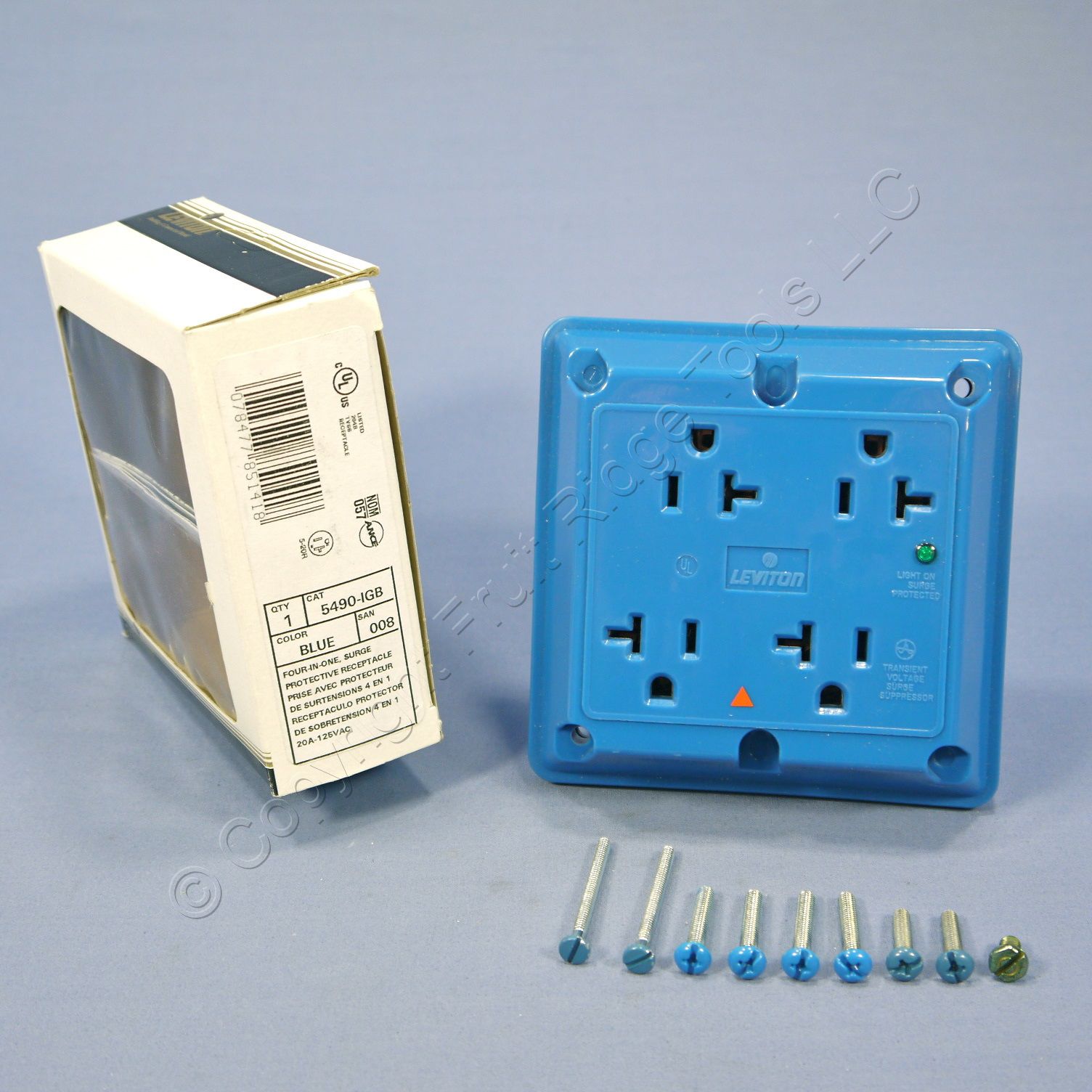
This is a quad or 4-in-1 receptacle........

L5490-IGB-EA-2.JPG


This is a 4x4 box with two duplex receptacles installed in it (and protective covers over the outlets to keep mud daubers out of the ground pin holes.)

attachment.php
 
Last edited:

mdd1986

Well-known member
Joined
Jun 7, 2013
Messages
52
The relevant NEC Section is 220.14 and here are some paragraphs excerpted from it.


The 180 volt/amp is per single or multiple receptacle on one yoke (or strap) but when you get to a real, genuine, quad receptacle, the number drops to 90 va per receptacle.

General purpose receptacles should be calculated at 100% and no reduction for continuous loads. If you have a known continuous load (3 hrs or more) that is to be placed on a circuit, then that becomes a separate consideration, and then and only then do you use the 125% of load for calculations.

Thus a single 120v, 20 amp branch, general purpose circuit is capable of ...................

20 amps times 120 volts equals 2400 va divided by 180 va per yoke equals 13 receptacles per circuit. This of course, would be a MAXIMINUM.

Charles

I won't even bother figuring a 15 amp circuit, as I have no idea why you would install one in a shop environment, for use as a receptacle circuit.

This is a quad or 4-in-1 receptacle........

L5490-IGB-EA-2.JPG


This is a 4x4 box with two duplex receptacles installed in it (and protective covers over the outlets to keep mud daubers out of the ground pin holes.)

attachment.php

You are correct about the receptacle loads being considered a non continuous load, I was speaking more along the lines of current over protection.

I generally never put more than 10 on a circuit even though technically you could put maximum of 13 on a circuit.
 
To avoid these ads, REGISTER NOW!
Top Bottom