This is interesting. They claim 25% smaller footprint, twice the lifetime and "50%" more power. But they have a lot of disclaimers. They say "Regarding 50% more power: vs. DCB203 battery, not in application". It's unclear what exactly that means. They compare it to a 2ah battery. So I would expect it to be a 3ah battery. But they were very careful to specifically avoid saying that. That would be really nice but it raises a big red flag when they obfuscate critical specifications.


You are using an out of date browser. It may not display this or other websites correctly.
You should upgrade or use an alternative browser.
You should upgrade or use an alternative browser.
DeWalt using pouch cells in new "Power stack" batteries.
- Thread starter Mallen
- Start date
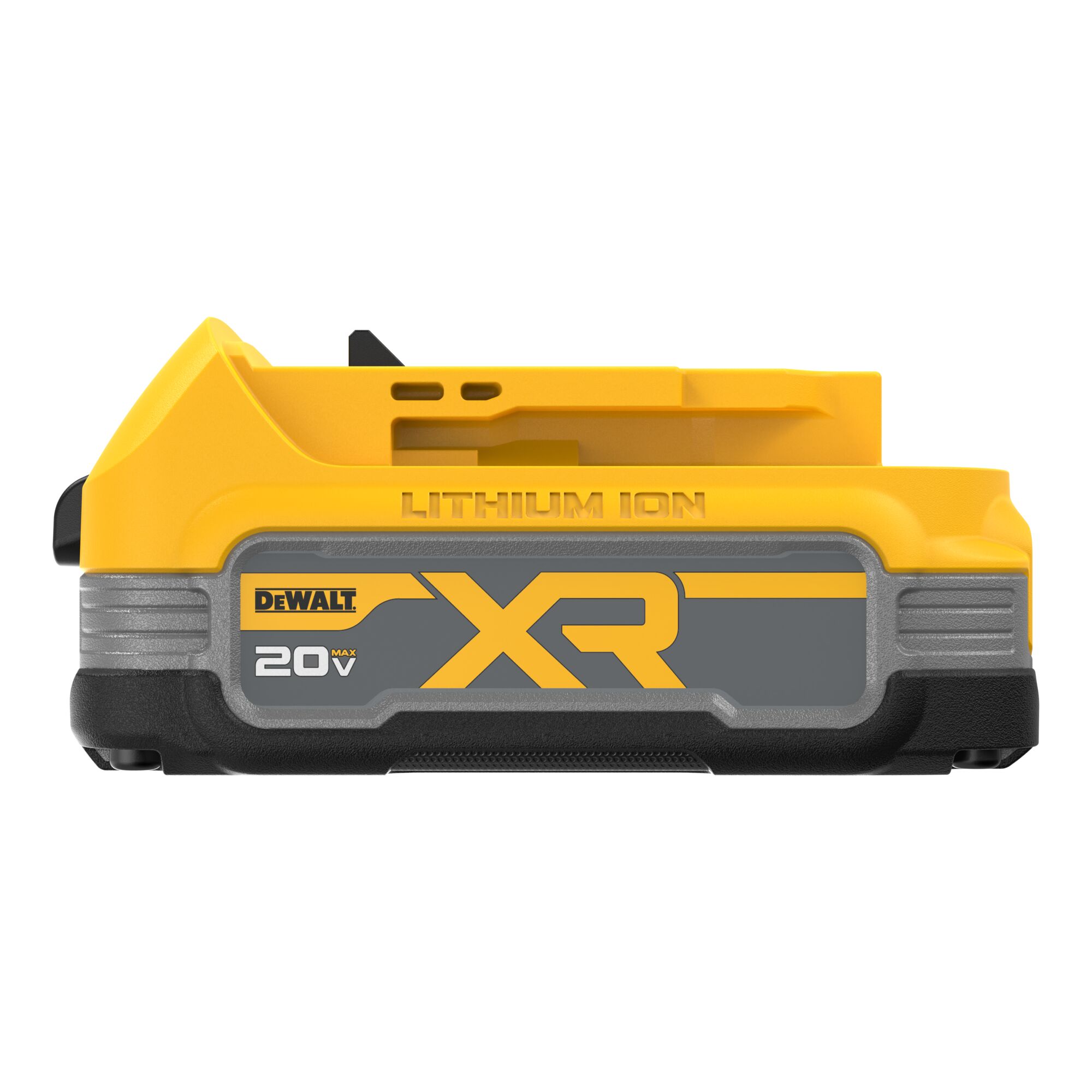
20V MAX* XR POWERSTACK™ Compact Battery
The 20V MAX* XR POWERSTACK™ Compact Battery delivers 50% more power** and a longer lifespan**. Engineered with pouch cell technology, our best performing 20V MAX* compact battery† powers through tough jobs, day in and day out. XR POWERSTACK™ batteries are a part of our best performing line of...
 www.dewalt.com
Hers a review that gives more information. It's a 1.7ah battery. How does it give "50% more power"? I bet there will be some marketing doublespeak involved.
Last edited:
Bubba Fett
Well-known member
I saw that. Like you, I'm not sure what to make of if. All the disclaimers could just be CYA in case id doesn't perform, since the battery can be used in a wide range of tools. It does make since in a way, since typical batteries have 18650 cells, or some other cylindrical cell, so there is a fair amount of empty space in the shell. This seems to be an attempt to address that.
finn
Well-known member
Looks like similar technology is being used for the newer electric cars to reduce weight and improving packaging and durability.
Also simplifies replacement of bad individual cells down the road.
Another thought or question is: does this technology allow additional discharge to extend tool run time with a given battery, effectively making a relatively small battery perform like a larger battery of older technology? That’s how I interrupt the claims, based on other things I gave read re electric vehicle range extension strategies and technology development.
Also simplifies replacement of bad individual cells down the road.
Another thought or question is: does this technology allow additional discharge to extend tool run time with a given battery, effectively making a relatively small battery perform like a larger battery of older technology? That’s how I interrupt the claims, based on other things I gave read re electric vehicle range extension strategies and technology development.
merkyworks
Well-known member
This tech has been used and abused in the RC car/Drone world for many years now. They hold up to the high charge/discharge cycles put threw them very well all things considered. Lithium ion polymer cells should give a better “C” rating than 18650/21700 cells, which translates to better tool performance.
Well, if it's true that's a 1.7ah battery, and it's 25% shorter but otherwise the same dimensions, then in it has 75% percent of the volume and 85% of the capacity compared to the the 2ah conventional battery. So the capacity per unit volume is about 13% greater.
It weighs 0.7lbs. The DCB203-2 they compare it to weighs 1lb. That's important. Their new battery weights close to 2/3 what their older one weighs. The capacity per unit weight is about 60% greater.
Most importantly, the use of pouch cells provides them the ability to make a battery pack of arbitrary size or capacity. (But obviously not both at the same time as the two are related). With cylindrical cells, your essentially limited to the two sizes of cells that are available in those high current cells that are used. There are not a lot of choices. (I bet a lot of cheap knock off packs that only last a few cycles use low current laptop type cells and that's why they die so fast. I looked inside my Metabo HPT batteries and found Samsung cells capable of putting out 30-40amps continuously and over 100 peak for brief periods of time. The lighter pack uses 18650 cells instead of the 21700, also by Samsung. Those cells were capable of 20-30 amps continuously.
I actually looked into whether there were smaller high current cells available. I could find nothing in anything smaller than a 18650 that was suitable.
Since my tools require 10 cells to get 36v, there's not much that can be done to make a smaller lighter battery. They are just large. Similarly, there's not much Dewalt can do to make a battery physically smaller and lighter than their 2ah battery using cylindrical cells. Reducing capacity further just means you can use cheaper cells but physically they are the same size. But pouch cells are available in custom sizes.
It weighs 0.7lbs. The DCB203-2 they compare it to weighs 1lb. That's important. Their new battery weights close to 2/3 what their older one weighs. The capacity per unit weight is about 60% greater.
Most importantly, the use of pouch cells provides them the ability to make a battery pack of arbitrary size or capacity. (But obviously not both at the same time as the two are related). With cylindrical cells, your essentially limited to the two sizes of cells that are available in those high current cells that are used. There are not a lot of choices. (I bet a lot of cheap knock off packs that only last a few cycles use low current laptop type cells and that's why they die so fast. I looked inside my Metabo HPT batteries and found Samsung cells capable of putting out 30-40amps continuously and over 100 peak for brief periods of time. The lighter pack uses 18650 cells instead of the 21700, also by Samsung. Those cells were capable of 20-30 amps continuously.
I actually looked into whether there were smaller high current cells available. I could find nothing in anything smaller than a 18650 that was suitable.
Since my tools require 10 cells to get 36v, there's not much that can be done to make a smaller lighter battery. They are just large. Similarly, there's not much Dewalt can do to make a battery physically smaller and lighter than their 2ah battery using cylindrical cells. Reducing capacity further just means you can use cheaper cells but physically they are the same size. But pouch cells are available in custom sizes.
That's only the case if the tools are specifically designed to take advantage of higher current batteries. Lithium ion batteries are not limited by their internal resistance. They are limited by the ability of their internal components to handle the current without being damaged. As such, batteries such as the 40A Samsung cells commonly used on high quality batteries can easily supply well beyond their rated current. It is necessary for the load , or the protection circuit in the tool, or both to limit current draw to safe levels. If the tool is designed to simply draw a safe current level, and does not have the ability to sense and adjust to the pack that's installed, every pack will work the same.This tech has been used and abused in the RC car/Drone world for many years now. They hold up to the high charge/discharge cycles put threw them very well all things considered. Lithium ion polymer cells should give a better “C” rating than 18650/21700 cells, which translates to better tool performance.
So Dewalt is indeed using LiPo cells now? Are you sure? LiPo is very sensitive and needs to be left at certain storage voltage (~3.8v per cell). And if they are discharged too low, below 3.2v, they may be permanently damaged. I haven't looked much into these new Dewalt cells, but would be surprised if they are in fact LiPo.This tech has been used and abused in the RC car/Drone world for many years now. They hold up to the high charge/discharge cycles put threw them very well all things considered. Lithium ion polymer cells should give a better “C” rating than 18650/21700 cells, which translates to better tool performance.
I think it's pretty clear that these are LiPo packs based on all the marketing and some reviewers like Pro Tool Reviews have said as much in their early reporting. We don't know exactly what chemistry Dewalt chose for these so we can only guess as to which pros and cons within the LiPo group we're dealing with.
Based on the LiPo chemistry, I think it's safe to say that the "more power" claim is meant to indicate that these will tolerate higher current draw than their Li Ion predecessors. There is no shortage of tests on the web showing that tools are able to take advantage of higher current delivery capability of larger capacity cells (and Dewalt has even taken advantage of that with their Power Detect and Flexvolt Advantage lines) so it even makes sense that the first battery released is a smaller capacity pack that may be able to provide similar performance to larger capacity cells under heavy loads.
Based on the LiPo chemistry, I think it's safe to say that the "more power" claim is meant to indicate that these will tolerate higher current draw than their Li Ion predecessors. There is no shortage of tests on the web showing that tools are able to take advantage of higher current delivery capability of larger capacity cells (and Dewalt has even taken advantage of that with their Power Detect and Flexvolt Advantage lines) so it even makes sense that the first battery released is a smaller capacity pack that may be able to provide similar performance to larger capacity cells under heavy loads.
I think it's pretty clear that these are LiPo packs based on all the marketing and some reviewers like Pro Tool Reviews have said as much in their early reporting. We don't know exactly what chemistry Dewalt chose for these so we can only guess as to which pros and cons within the LiPo group we're dealing with.
Based on the LiPo chemistry, I think it's safe to say that the "more power" claim is meant to indicate that these will tolerate higher current draw than their Li Ion predecessors. There is no shortage of tests on the web showing that tools are able to take advantage of higher current delivery capability of larger capacity cells (and Dewalt has even taken advantage of that with their Power Detect and Flexvolt Advantage lines) so it even makes sense that the first battery released is a smaller capacity pack that may be able to provide similar performance to larger capacity cells under heavy loads.
I did notice that Pro Tool Reviews says it's Lithium Ion Polymer.
I looked at the Dewalt website to see if it mentioned LiPo, but all it mentions is Lithium Ion:
Introducing THE NEXT DIMENSION IN POWER™ with the 20V MAX* DEWALT POWERSTACK™ Compact Battery 2-Pack. These batteries have 50% more power with a 25% smaller footprint** and work with the 20V MAX* tools you already have. These batteries provide twice the lifetime** and features an impact-resistant, overmolded base with non-marring material. Take advantage of our lightest and most powerful battery** as the rubber overmold base and twice the lifetime** combine to form a dependable Lithium Ion solution.
20V MAX* DEWALT POWERSTACK™ Compact Battery (2 PK)
Introducing THE NEXT DIMENSION IN POWER™ with the 20V MAX* DEWALT POWERSTACK™ Compact Battery 2-Pack. These batteries have 50% more power with a 25% smaller footprint** and work with the 20V MAX* tools you already have. These batteries provide twice the lifetime** and features an...
 www.dewalt.com
If you have it shipped to you and it was shipped correctly it should have a hazmat label on it. You can look it up by the UN number. At least when I did it we had to do it that way. But that was years ago I hated going to the class every year to get certified even though I only maybe did it once or twice a year but I still need to be certified. Just in case I was the only one there and was working weekends which was only if we had a AOG.
theamcguy
Well-known member
Think of it this way, a 1.7Ah battery giving the same power as a 2.0Ah battery in a smaller, lighter size. This is perfect for DeWalts new line of Atomic Tools. For me I am looking at the new DeWalt DCF 850 Impact Driver this thing is light and compact and with the new 1.7Ah battery it only makes the package that much lighter and compact without sacrificing power.
dnschmidt
Well-known member
What I'm thinking about is run time. All of these tool review channels test using conditions few ever encounter. How many 8" lag screws have you run into a tree stump using your impact driver. In my case none. How many deck screws have I driven in with my M18 impact driver = a shitload. Yes these new batteries should be able to deliver more current in a burst application but power tools are seldom used this way. If it has less A-hr rating it should have less run time and for most that's the most important thing. I don't want to cut up one 2X4 using a small saw I want to cut up a lot of 2X4's using a normally sized saw.
Last edited:
FrogBlastTheVentCore
Active member
- Joined
- Oct 22, 2021
- Messages
- 26
Isn’t this argument the same reason you aren’t trying to cut 2x4s with a ratchet, though?What I'm thinking about is run time. All of these tool review channels test using conditions few ever encounter. How many 8" lag screws have you run into a tree stump using your impact driver. I my case none. How many deck screws have I driven in with my M18 impact driver = a shitload. Yes these new batteries should be able to deliver more current in a burst application but power tools are seldom used this way. If it has less A-hr rating it should have less run time and for most that's the most important thing. I don't want to cut up one 2X4 using a small saw I want to cut up a lot of 2X4's using a normally sized saw.
It's a little more complicated than this though. First of all, the energy density of these cells is higher than the lithium ion, so there is more stored energy per unit volume. They just chose to shrink the footprint.What I'm thinking about is run time. All of these tool review channels test using conditions few ever encounter. How many 8" lag screws have you run into a tree stump using your impact driver. I my case none. How many deck screws have I driven in with my M18 impact driver = a shitload. Yes these new batteries should be able to deliver more current in a burst application but power tools are seldom used this way. If it has less A-hr rating it should have less run time and for most that's the most important thing. I don't want to cut up one 2X4 using a small saw I want to cut up a lot of 2X4's using a normally sized saw.
Second, being able to deliver higher current at a lower state of charge does, in a way, increase the effective runtime. With the old battery, you may not even be able to drive that 3" deck screw once your battery drops to a certain voltage. But, if the battery can deliver higher current at a lower voltage (which is a necessity to deliver the wattage necessary to drive the screw) you have the effect of more usable energy.
I'm not sure how the voltage cutoff is handled in these tools however. If the voltage is measured under load when the voltage is sagging, this could be a real effect.