To avoid these ads, REGISTER NOW!

Did I buy a big enough heater?

shaggyant

Well-known member
Joined
Oct 10, 2011
Messages
201
Location
North Idaho
I built a 36x48 shop with 14 foot walls. There is no ceiling but the underside of the roof is insulated with R25. The walls are in the process of getting R25 as well but only about half is done due to me still working on wiring. The front wall has 2 14 wide by 12 high roll up doors with a 36” man door in between them.

When I was looking for calculators online the heater BTU requirements varied wildly depending on the calculator. I was getting anywhere between 40,000 and 160,000 BTU numbers.

I lucked into an 80,000 BTU Big Maxx for super cheap but I’m not sure if it will be big enough. At 80% the heater is only putting out 64,000 BTU and I’m thinking that won’t be enough for this space.

Does anyone have any input before I spend a bunch of time and money installing this heater?
 
To avoid these ads, REGISTER NOW!

Dick in Wisconsin

Well-known member
Joined
Mar 3, 2012
Messages
3,048
Location
Shawano, Wisconsin
I suspect that in North Idaho it gets cold. What is the outside temp you used with the calculators. Heating that space to 35*F vs 10*F is a BIG difference.

What kind of insultation did you put on the underside of the roof? Spray on?

Why no ceiling? You're going to get a lot of heat loss up in to the area of the trusses. R-25 isn't much insulation for a roof or ceiling.

Depending on how much time you're going to spend in the large (I'm envious) shop, you probably would have been money ahead to put an inexpensive ceiling in and R-38 on top of it. Big reduction in heat loss and you're heating a smaller space with a smaller square footage with heat loss … calculate the square footage of the underside of the pitched roof and the gable ends of the roof vs the square footage of the ceiling.

How well is the slab insulated?

Just my 2 cents.
 

finn

Well-known member
Joined
Mar 27, 2005
Messages
16,569
Location
The UP, God's country
80k should be plenty.

The trick to being comfortable is to use /heat the building often enough to keep the slab relatively warm. The slab is a huge heat sink. An 80k heater is enough to heat the air to a comfortable working temperature while you are in the shop.

Once the slab is warm, it won’t take much to maintain that temperature.
 
OP
S

shaggyant

Well-known member
Joined
Oct 10, 2011
Messages
201
Location
North Idaho
I suspect that in North Idaho it gets cold. What is the outside temp you used with the calculators. Heating that space to 35*F vs 10*F is a BIG difference.

What kind of insultation did you put on the underside of the roof? Spray on?

Why no ceiling? You're going to get a lot of heat loss up in to the area of the trusses. R-25 isn't much insulation for a roof or ceiling.

Depending on how much time you're going to spend in the large (I'm envious) shop, you probably would have been money ahead to put an inexpensive ceiling in and R-38 on top of it. Big reduction in heat loss and you're heating a smaller space with a smaller square footage with heat loss … calculate the square footage of the underside of the pitched roof and the gable ends of the roof vs the square footage of the ceiling.

How well is the slab insulated?

Just my 2 cents.


I used 0 degrees farenheight on the calculators that asked. Others asked for my heat zone from a map.

I cannot put up a ceiling. Long story but there are only six trusses in the whole roof. They aren’t rated to be bottom loaded with a ceiling. Only option was to insulate directly to the underside of the roof. The insulation is standard fiberglass.

The slab is not insulated. Only a vapor barrier.
 

theoldwizard1

Well-known member
Joined
Feb 22, 2011
Messages
43,498
Location
SE MI
For a shop that big, you will NEVER be able to have even heat throughout even with multiple fans. Not what you want to here but you would be much better off with AT LEAST 2 heaters !

How many and what size doors does it have ? You might need 4 units for quicker recovery after a door has been opened.

FYI - You really could use MORE insulation attached to the roof. AT LEAST R36 !

"You buy insulation once. You pay for energy to heat/cool your building every time the thermostat calls for it !"
 
OP
S

shaggyant

Well-known member
Joined
Oct 10, 2011
Messages
201
Location
North Idaho
For a shop that big, you will NEVER be able to have even heat throughout even with multiple fans. Not what you want to here but you would be much better off with AT LEAST 2 heaters !

How many and what size doors does it have ? You might need 4 units for quicker recovery after a door has been opened.

FYI - You really could use MORE insulation attached to the roof. AT LEAST R36 !

"You buy insulation once. You pay for energy to heat/cool your building every time the thermostat calls for it !"

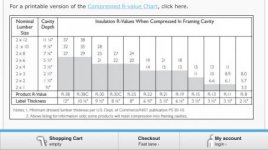
I’m not sure how I can get more insulation into the roof. The purlins between the top truss chords are 2x8’s and R25 is already 8.5” compressed to 7 1/4”. See this chart.

Edit: I have three 60” fans above the ceiling along the ridge line and they circulate pretty well even on low.
 

Attachments

  • 4035B8A6-E72B-4A72-AD06-AFCB90E86936.jpg
    4035B8A6-E72B-4A72-AD06-AFCB90E86936.jpg
    21 KB · Views: 57
Last edited:

theoldwizard1

Well-known member
Joined
Feb 22, 2011
Messages
43,498
Location
SE MI
2x8 purlins ? Are those supporting the roof or holding up the insulation ? What is the spacing of the trusses ?

It IS difficult to get a lot of insulation attached directly to a roof. A thick (4'-6") layer of foam foam board before installing the roof decking then batts on the inside is probably the best way. After the roofing is installed is a real problem.
 
OP
S

shaggyant

Well-known member
Joined
Oct 10, 2011
Messages
201
Location
North Idaho
2x8 purlins ? Are those supporting the roof or holding up the insulation ? What is the spacing of the trusses ?

It IS difficult to get a lot of insulation attached directly to a roof. A thick (4'-6") layer of foam foam board before installing the roof decking then batts on the inside is probably the best way. After the roofing is installed is a real problem.

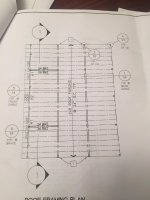
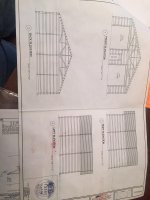
There are six 48 foot trusses in the whole shop. One at the front wall, one at the back wall and two sandwiched together on each of the two poles in between. Maybe this shot of the blueprints will help.

The steel roofing is long since installed and I don’t think pulling it off to insulate is feasible at this point. I packed the 2x8’s full of what would fit in the cavity which is R25.
 

Attachments

  • 63A31FDB-94BF-4E4A-9BEB-E9622B5F65EB.jpg
    63A31FDB-94BF-4E4A-9BEB-E9622B5F65EB.jpg
    65 KB · Views: 61
  • EEB90B3C-EFD7-4C5B-9908-0F5593D12FA7.jpg
    EEB90B3C-EFD7-4C5B-9908-0F5593D12FA7.jpg
    83.6 KB · Views: 58
Last edited:

yeldogt

Well-known member
Joined
Jan 2, 2012
Messages
18,184
One of my spaces is 32 wide and 1700 sf so it's longer than yours -- I can keep it at 70 with 1/2 your BTU's at zero outside. The ability to heat a single open space with a single point heater is all dependent on the overall insulation and leakage of the building.

An uninsulated slab is more of an issue with radiant heat .. that's not to say that a layer of foam would not have helped around the permitter when you poured.

I think you will be fine if you plan on maintaining a temp. Make sure you seal up the leaks with some foam as you put the insulation in the walls

My shop is full of equipment -- if I let the temp drop too much .... it's not just the air and walls that has to be heated ..it's everything in it. That's going to require a fair amount of BTUs if I drop it down to 50 ..and many many more if I drop it down to 40. I have no desire to work in a shop with cold equipment and hot air.

The key is to make sure the doors are tight and insulated -- leaks really take lots of BTU's and make a space less comfortable.
 
Last edited:
OP
S

shaggyant

Well-known member
Joined
Oct 10, 2011
Messages
201
Location
North Idaho
One of my spaces is 32 wide and 1700 sf so it's longer than yours -- I can keep it at 70 with 1/2 your BTU's at zero outside. The ability to heat a single open space with a single point heater is all dependent on the overall insulation and leakage of the building.

An uninsulated slab is more of an issue with radiant heat .. that's not to say that a layer of foam would not have helped around the permitter when you poured.

I think you will be fine if you plan on maintaining a temp. Make sure you seal up the leaks with some foam as you put the insulation in the walls

My shop is full of equipment -- if I let the temp drop too much .... it's not just the air and walls that has to be heated ..it's everything in it. That's going to require a fair amount of BTUs if I drop it down to 50 ..and many many more if I drop it down to 40. I have no desire to work in a shop with cold equipment and hot air.

The key is to make sure the doors are tight and insulated -- leaks really take lost of BTU's and make a space less comfortable.

What is your ceiling height? The part that makes me wonder is that mine is 22 feet at the peak and 14 at the walls.
 

Fordman7795

Well-known member
Joined
Mar 31, 2011
Messages
2,370
Location
Bay City, MI
My barn is similar in size. 30x56x14. Well insulated walls but my ceiling isn’t done yet. I have a big max 80k and it works great. Once I get the ceiling insulation finished it will only get better. I am in mid Michigan. It runs every 1-2 hours.
 
To avoid these ads, REGISTER NOW!
OP
S

shaggyant

Well-known member
Joined
Oct 10, 2011
Messages
201
Location
North Idaho
My barn is similar in size. 30x56x14. Well insulated walls but my ceiling isn’t done yet. I have a big max 80k and it works great. Once I get the ceiling insulation finished it will only get better. I am in mid Michigan. It runs every 1-2 hours.

Please confirm. Do you mean you have no ceiling? Open rafters? If so that’s what I have with insulation up top. If yours works then mine should be just fine.
 

Fordman7795

Well-known member
Joined
Mar 31, 2011
Messages
2,370
Location
Bay City, MI
Please confirm. Do you mean you have no ceiling? Open rafters? If so that’s what I have with insulation up top. If yours works then mine should be just fine.

I currently have it about 1/3 insulated with R38. The initial warm up took awhile but once it got up to where I want it, its been working great. I will add a couple ceiling fans once I get the rest of the insulation and liner installed.
 

yeldogt

Well-known member
Joined
Jan 2, 2012
Messages
18,184
What is your ceiling height? The part that makes me wonder is that mine is 22 feet at the peak and 14 at the walls.

Mine are all open -- at least that high. I have a couple of ceiling fans -- but the best is to install a length of 4" pipe from the ceiling to the floor ... run a small fantech fan .. get a used one off of e-bay ... they run forever. The fan will draw the heat off the ceiling and push it along the floor.
 

yeldogt

Well-known member
Joined
Jan 2, 2012
Messages
18,184
Old habits don't die ... even using the old 45but/ft ..at 1700 you are at 80k. I have had HVAC people tell me I need 1T of AC for 400sf? .. even with foam I have had people telling me 1T w/ 500sf. In a foamed house it's easy to get 1T for 1000sf with no problems.

Most home systems are easily double what you need.

When I was moving things around and had no gas service -- my 4000KW electric heater had the whole building above 60 .. in fact I turned it down. That's ..what ... 13k BTU's.

People think they need a bigger system if the ceilings are high -- actually, you want a smaller system running more. The key is to deliver less heat over a wider area .. with a big heater all the BTU's end up going to the ceiling ... stack effect .... you basically heat the building from the top down. Every time the heater stops -- the heat at the ceiling is wasted (w/ oversize heater)

In a radiant headed space the ceiling will often be colder -- because the heat is being delivered more efficiently. The closer you can match the need -- the more comfort ... long run time ... that's the key (AC or HEAT)
 
Last edited:

Toothaker

Well-known member
Joined
Nov 25, 2016
Messages
1,367
Location
Wichita, Kansas
Old habits don't die ... even using the old 45but/ft ..at 1700 you are at 80k. I have had HVAC people tell me I need 1T of AC for 400sf? .. even with foam I have had people telling me 1T w/ 500sf. In a foamed house it's easy to get 1T for 1000sf with no problems.

Most home systems are easily double what you need.

When I was moving things around and had no gas service -- my 4000KW electric heater had the whole building above 60 .. in fact I turned it down. That's ..what ... 13k BTU's.

People think they need a bigger system if the ceilings are high -- actually, you want a smaller system running more. The key is to deliver less heat over a wider area .. with a big heater all the BTU's end up going to the ceiling ... stack effect .... you basically hat the building from the top down. Every time the heater stops -- the heat at the ceiling is wasted.

In a radiant headed space the ceiling will often be colder -- because the heat is being delivered more efficiently. The closer you can match the need -- the more comfort ... long run time ... that's the key (AC or HEAT)

We knew what you meant, but you wrote that you have a 4MW heater. :bounce:
 

Jackfre

Well-known member
Joined
Dec 26, 2010
Messages
4,425
Location
N CA
The vast majority of heating equipment is dramatically oversized and the propensity of everyone, including the pros (who don't want to hear from Mrs MaGillicuddy on Christmas Eve that her boiler isn't heating the space at -15*) is to "make sure I have a big enough heater." I would run with the 80. TOW1 has a point about air circulation. Give some thought about positioning and how you are going to work the space.
 
OP
S

shaggyant

Well-known member
Joined
Oct 10, 2011
Messages
201
Location
North Idaho
New development on this. I heated my shop with a 135,000BTU diesel heater for the last four days as I was doing some electrical work. After the initial warm up the heater settled in at using right at 5 gallons of diesel per day.

This is with half the wall insulation removed so I would expect that when I put it back up it will help some but 5 gallons of diesel means I’m consuming 700,000 BTU per day heating. That’s 30K BTU per hour at 30 degrees outside :shocking: The heater operates about 10 minutes per hour maintaining temp.

If this doesn’t reduce significantly with the addition of the remaining insulation then that means I could definitely exceed what an 80K Big Maxx can supply when it drops below zero.

P.S. the sections of exposed metal siding where the insulation are dripping with water from running the diesel heater. They definitely do make water when operating.
 

yeldogt

Well-known member
Joined
Jan 2, 2012
Messages
18,184
New development on this. I heated my shop with a 135,000BTU diesel heater for the last four days as I was doing some electrical work. After the initial warm up the heater settled in at using right at 5 gallons of diesel per day.

This is with half the wall insulation removed so I would expect that when I put it back up it will help some but 5 gallons of diesel means I’m consuming 700,000 BTU per day heating. That’s 30K BTU per hour at 30 degrees outside :shocking: The heater operates about 10 minutes per hour maintaining temp.

If this doesn’t reduce significantly with the addition of the remaining insulation then that means I could definitely exceed what an 80K Big Maxx can supply when it drops below zero.

P.S. the sections of exposed metal siding where the insulation are dripping with water from running the diesel heater. They definitely do make water when operating.

You can't figure it that way.

Also -- whenever the heater was running since it was so large you get a stack effect. The hot air rushes up and actually creates a cycle .. the bigger the heater the greater the stack effect. Once you get it all closed up everything will change --
 

skippydoo

Well-known member
Joined
Oct 28, 2012
Messages
177
Location
Sussex NJ
I'm in north west NJ and built a 30x40x13 ft tall walls this year. I had it spray foamed (3" roof,2" walls, closed cell) I am waiting for the radiant heat boiler to be installed and didn't want to freeze so I bought a 20k btu 240 volt heater. My ceiling is wide open up to the ridge which is 19.6ft. I can keep it 50 no problem during cold nights. Lowest was 14 degrees.
 

6768rogues

Banned
Joined
Nov 28, 2007
Messages
4,524
Location
Western NY
I have a 36x48 building with 14 foot walls in western NY, and it gets plenty cold here. The ceiling is about R19 and the walls are R23, and it has two large 3" thick foam filled commercial overhead doors. I use a 100K BTU Reznor hanging heater and it heats the building effortlessly and only cycles occasionally. If I turn it up from 45 to 60 degrees, it will warm up in less than a half hour but will cycle more often until everything gets warm. I run two ceiling fans on slow speed all the time and they help considerably keeping the floor warm and the building uniformly comfortable.
 
To avoid these ads, REGISTER NOW!
Top Bottom