To avoid these ads, REGISTER NOW!

Die to clean up these oddball puller threads?

relic7680

Well-known member
Joined
Sep 5, 2011
Messages
321
Location
Northeast Florida
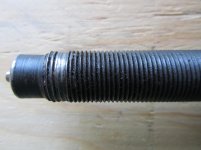
I have a military surplus Armstrong-Bray puller set, and the end of one shaft is chewed up enough not to let the arm come off it. I would have just run a die on it by now, but the threads are oddball. It seems that the pitch is not uniform...one side is sloped and the other is straight up. Can anybody tell me the name of this type of thread or where I can get a die to clean it up? The shaft is 3/4".
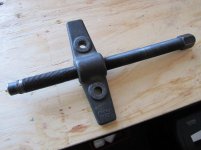
 

Attachments

  • IMG_2091.jpg
    IMG_2091.jpg
    138.7 KB · Views: 37
  • IMG_2092.jpg
    IMG_2092.jpg
    120.7 KB · Views: 48
To avoid these ads, REGISTER NOW!

mvptrukin

Well-known member
Joined
Aug 27, 2010
Messages
517
Location
Denver, CO
Most pullers with a 3/4" pressure screw are 3/4"-16 ( like Snap-on) but the only real way to tell is to use a thread gauge-the only other size it could be is 3/4"-10. Most tool companies sell rethreaders in sets but Snap-on sells individual ones for $3 or $4. I saw your other thread about this puller set--what did you pay for it? I wonder if it was made by Armstrong tools or another company for a government contract.
 

toolchaser

Well-known member
Joined
Apr 6, 2008
Messages
803
Location
Greenville, GA
It's probably a ******* thread pitch, you can use a 60 deg. thread file or just grind off the buggered threads, its not likely you will ever have the center rod in that far anyway. It was probably mangled up by pushing against a blind hole.
 

Provincial

Well-known member
Joined
Sep 21, 2011
Messages
6,874
Location
Near Salem, OR
It may be a buttress thread. Google that and compare the images to your piece.

You will probably have to take it to a machinist and have him set up the screw in a lathe. He will have to grind a tool bit to fit the thread, and recut the damaged threads. It will take a lathe big enough to clear the puller arm, since it looks like it won't unscrew past the damaged threads.
 

DocsMachine

Well-known member
Joined
Sep 16, 2006
Messages
1,873
They're called "Buttress" threads, and, unfortunately, dies to clean or cut them simply don't exist. The quick and dirty fix would be to carefully grind those threads off- they're near the end and won't take up too much usable working area, and even "cleaned up" wouldn't have the same strength as the original thread anyway.

The proper fix would be to have a machinist carefully recut them in a lathe- even though, as above, that section wouldn't be as strong. Might be better to have somebody with a lathe carefully turn that section down, get rid of the damaged threads entirely.

Doc.
 
To avoid these ads, REGISTER NOW!
OP
R

relic7680

Well-known member
Joined
Sep 5, 2011
Messages
321
Location
Northeast Florida
Thanks fellas. I'm in school for auto restoration, and we have several lathes, so I think I'll just smooth the end out that way. Several other shafts in the set just have regular 3/4-16" threads, but others have the "buttress" type like this. mvptrukin, I think I have less than $80 into the entire set. Armstrong doesn't currently make one like it (at least not offered to the public), so I suspect that it's military only.
 

mvptrukin

Well-known member
Joined
Aug 27, 2010
Messages
517
Location
Denver, CO
I didn't look at the threads in the pics that closely like the other members did--most pressure screws are interchangeable so you can use them to pull off or push on. It's my understanding that with buttress threads you can only apply a load in one direction in this case as a puller. It makes sense they didn't match up with the other pressure screws. Proto uses a rolled Acme thread on their pullers.
 

lzenglish

Well-known member
Joined
Sep 3, 2009
Messages
616
Location
California
Can anybody tell me the name of this type of thread or where I can get a die to clean it up? The shaft is 3/4".

I don't see any threads left to dress up. I would chuck it up in the lathe, and
delete the last five or so bad threads, to the smooth end diameter. If that smooth end lenght is critical, you may have to cut off and reface the end of it.

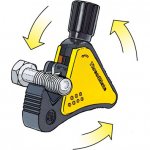
PS. I saw this tool for the first time, in a catalog, and may just get one. It is called a "threadmate", and chases up to 1/2" dia. threads.

Wayne
 

Attachments

  • 69165.jpg
    69165.jpg
    28.8 KB · Views: 6
To avoid these ads, REGISTER NOW!
Top Bottom